

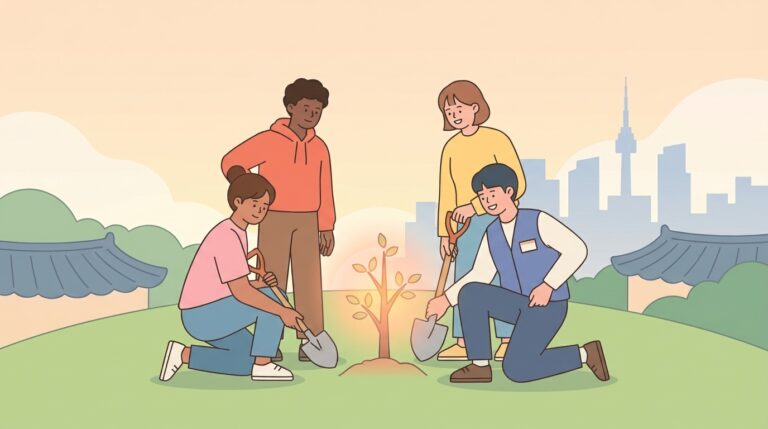
Phase 1: Empathy (Immersive Open)
Hello there! I’m your lead editor and resident Korean culture navigator at Daily Hangul.
Picture this: You’re watching a classic K-Drama. The charismatic lead, who usually wears designer suits, is suddenly wearing a simple vest, sweating under the sun, and building a school in a Southeast Asian village. Or perhaps you’ve been on X (formerly Twitter) and saw a massive trend where a K-Pop fandom planted an entire forest or donated tons of rice in their favorite idol’s name.
Volunteering (봉사활동) and giving back are huge parts of modern K-Culture. It’s often referred to as spreading “선한 영향력” (Good Influence).
If you’re at an intermediate (B2) level in Korean and applying for an overseas volunteer program—or perhaps joining a Korean NGO—you can’t just rely on textbook phrases like “I like helping people.” You need to express your motivation (지원 동기) with sincerity, humility, and a touch of Korean cultural nuance. Nailing this will make your Korean interviewers or fellow volunteers nod in deep respect.
Let’s dive into the real, heartfelt Korean expressions you need to share your passion for giving back!
Phase 2: Core Expressions Deep Dive
1. 선한 영향력을 실천하고 싶습니다.
- Pronunciation: seon-han yeong-hyang-nyeok-eul sil-cheon-ha-go sip-seum-ni-da. (Sound analogy: ‘eo’ sounds like the ‘u’ in “uh-oh”.)
- Meaning: (Literal) I want to practice good influence. / (Real Nuance) I want to make a positive impact on the world.
- K-Culture Moment: This is the ultimate buzzword in the K-Pop industry! Whenever idols donate to charity, news articles praise their “선한 영향력”. Using this in an application shows you are deeply in tune with contemporary Korean societal values.
- Editor’s Insight: It sounds incredibly mature and community-focused. It elevates your motivation from a simple “I want to help” to a broader life philosophy.
- Situation Spectrum:
- Casual with friends: 🚫 (Too serious)
- Semi-formal / Essays: ✅
- Formal Interviews: ✅✅ (Instant bonus points!)
- 🤔 Think About It: Why does Korean society emphasize “influence” (영향력) so much in charity? How does collectivism make the ripple effect of a good deed just as important as the deed itself?
2. 제 전공을 살려서 보탬이 되고 싶습니다.
- Pronunciation: je jeon-gong-eul sal-lyeo-seo bo-taem-i doe-go sip-seum-ni-da.
- Meaning: (Literal) I want to become a supplement by reviving my major. / (Real Nuance) I want to utilize my major/skills to be of help.
- K-Culture Moment: During a welcome dinner for a volunteer corps, everyone introduces themselves. When you say this, people will think, “Wow, this person is humble but highly capable.”
- Editor’s Insight: The verb “살리다” literally means “to save or revive,” but here it means “to make the most of” or “to utilize.” Meanwhile, “보탬이 되다” is a beautifully modest way to say “to help.” Koreans value humility over arrogant confidence.
- Situation Spectrum:
- Casual with friends: ⚠️ (A bit stiff)
- Semi-formal: ✅
- Formal Interviews: ✅
- 🤔 Think About It: “보탬이 되다” implies adding a small piece to a greater whole. Do you have a similarly humble way to offer your skills in your native language?
3. 현지 분들과 마음을 나누고 싶습니다.
- Pronunciation: hyeon-ji bun-deul-gwa ma-eum-eul na-nu-go sip-seum-ni-da.
- Meaning: (Literal) I want to divide hearts with the local people. / (Real Nuance) I want to connect deeply and share a bond with the local community.
- K-Culture Moment: Think of those touching documentary scenes where Korean volunteers are crying as they say goodbye to the local children at the airport. It’s all about “정” (Jeong) – emotional connection.
- Editor’s Insight: Volunteering isn’t just about providing labor; it’s an emotional exchange. “마음을 나누다” (sharing hearts) captures the essence of true empathy.
- Situation Spectrum:
- Casual with friends: ⚠️
- Semi-formal / Essays: ✅
- Formal Interviews: ✅
Phase 3: Textbook vs. Real Korean
[Situation 1: Explaining your core reason]
* 📖 Textbook Korean: 저는 다른 사람을 돕는 것을 좋아합니다. (I like helping other people.)
* 🗣️ Real Korean: 뜻깊은 일에 동참하고 싶었어요. (I wanted to join in a meaningful cause.)
* 💡 Why is it different?: “동참하다” (to join/participate together) emphasizes community and collective action, which is a core value in Korean teamwork.
[Situation 2: Showing your dedication]
* 📖 Textbook Korean: 봉사활동을 열심히 하겠습니다. (I will do the volunteer work working hard.)
* 🗣️ Real Korean: 부족하지만 발로 뛰며 배우겠습니다! (I may be lacking, but I will learn by hitting the ground running!)
* 💡 Why is it different?: Modesty (“부족하지만” – though I am lacking) paired with an action-oriented idiom (“발로 뛰다” – running with one’s feet) is the ultimate formula for a great Korean interview answer.
Bottom Note: At the B2 level, your goal is to sound less like a translation app and more like a culturally aware adult. Sprinkling in idioms like “발로 뛰다” will seriously impress native speakers.
Phase 4: Cultural Context — K-Culture Deep Dive
4-1. Non-Verbal Communication: The “Humble” Posture
When expressing your motivation in a Korean NGO interview, language is only half the battle. Your body language matters immensely. Sit up straight, keep your hands lightly clasped in your lap, and maintain a warm, gentle gaze. Don’t stare aggressively into the interviewer’s eyes—a soft gaze at their chin or tie level is traditionally seen as respectful. This is where your Nunchi (눈치) comes in: reading the room and matching the dignified tone of a charity organization.
4-2. K-Culture Connection: Fandoms & “Good Influence”
If you ever wonder why Korean youth are so active in volunteering, look no further than K-Pop fandoms. The concept of 재능기부 (Talent Donation) and charity projects is deeply woven into fan culture. Instead of buying expensive gifts for an idol’s birthday, fans will pool their money to build a library in Cambodia or donate briquettes (연탄) to elderly people in Seoul.
Critical View: While this is incredibly positive, sometimes “봉사활동” (volunteering) in Korea is treated purely as 스펙 (Spec – resume building). College students are often required to log volunteer hours to graduate or get hired by big conglomerates like Samsung. By using heartfelt phrases like “마음을 나누다” (sharing hearts), you prove that your motivation goes beyond just padding your resume.
Phase 5: Real-Life Roleplay Scenario
Setting: A Zoom interview for a well-known Korean international volunteer organization. You are applying to join a summer educational camp in Vietnam.
Characters:
– YOU: An international student in Korea, nervous but passionate.
– Manager Kim (김 팀장): 40s, experienced NGO manager. He looks stern but has a very warm heart.
Dialogue:
김 팀장: 만나서 반갑습니다. OOO 지원자님, 먼저 자기소개와 함께 해외 봉사 프로그램에 지원하신 동기를 말씀해 주시겠어요?
(man-na-seo ban-gap-seum-ni-da. OOO ji-won-ja-nim, meon-jeo ja-gi-so-gae-wa ham-kke hae-oe bong-sa peu-ro-geu-raem-e ji-won-ha-sin dong-gi-reul mal-sseum-hae ju-si-get-seo-yo?)
[Nice to meet you. Applicant OOO, could you first introduce yourself and tell us your motivation for applying to the overseas volunteer program?]
(🎭 Stage Direction: Manager Kim peers closely at the screen, pen in hand.)
YOU: 네, 안녕하십니까! 저는…
(ne, an-nyeong-ha-sim-ni-kka! jeo-neun…)
[Yes, hello! I am…]
🔀 Your Turn! How should you explain your core motivation?
– A) “제 스펙을 쌓기 위해 지원했습니다.” (I applied to build up my resume/specs.)
– B) “아이들을 가르치는 제 전공을 살려서 작은 보탬이 되고 싶어 지원했습니다.” (I applied because I want to be of a little help by utilizing my major in teaching children.)
– C) “해외여행도 하고 봉사도 하고 싶어서요!” (Because I want to travel overseas and also volunteer!)✅ Best Choice: B — Reason: It beautifully combines humility (“작은 보탬” – a little help) with practical value (“전공을 살려서” – utilizing my major).
⚠️ Choice A & C Analysis: ‘A’ is way too brutally honest and sounds selfish. ‘C’ makes it sound like you treat volunteering as a free vacation, which is a huge red flag for NGOs.
(Assuming you chose B)
김 팀장: 아, 교육학을 전공하셨군요. 하지만 현지 환경이 생각보다 많이 열악합니다. 괜찮으시겠어요?
(a, gyo-yuk-hak-eul jeon-gong-ha-syeot-gun-yo. ha-ji-man hyeon-ji hwan-gyeong-i saeng-gak-bo-da man-i yeo-rak-ham-ni-da. gwaen-chan-eu-si-get-seo-yo?)
[Ah, you majored in education. However, the local conditions are much harsher than you might think. Will you be okay?]
YOU: 네, 물론입니다. 부족하지만 팀원들과 함께 발로 뛰며 배우겠습니다!
(ne, mul-lon-im-ni-da. bu-jok-ha-ji-man tim-won-deul-gwa ham-kke bal-lo ttwi-myeo bae-u-get-seum-ni-da!)
[Yes, absolutely. I may be lacking, but I will learn by hitting the ground running alongside my teammates!]
김 팀장: (Smiling warmly) 좋습니다. 그 열정이면 충분히 선한 영향력을 나누실 수 있을 겁니다.
(jo-seum-ni-da. geu yeol-jeong-i-myeon chung-bun-hi seon-han yeong-hyang-nyeok-eul na-nu-sil su is-seul geom-ni-da.)
[Good. With that passion, you will certainly be able to share a good influence.]
Phase 6: 10-Second Shadowing Drill
Read this out loud to nail the pacing and tone for a formal setting!
😤 Confident & Sincere: 저는 / 제 전공을 살려서 / 현지 분들에게 / 작은 보탬이 되고 싶습니다!
(jeo-neun / je jeon-gong-eul sal-lyeo-seo / hyeon-ji bun-deul-e-ge / ja-geun bo-taem-i doe-go sip-seum-ni-da!)
Phase 7: K-Culture Mini Dictionary
| 한국어 | Romanization | English | Cultural Context |
|---|---|---|---|
| 선한 영향력 | seon-han yeong-hyang-nyeok | Good influence | A popular term used to describe celebrities or individuals using their platform for philanthropy. |
| 스펙 | seu-pek | Specs / Qualifications | Short for “specifications.” The certificates, GPA, and volunteer hours needed for job hunting. |
| 재능기부 | jae-neung-gi-bu | Talent donation | Volunteering by offering your professional skills (e.g., a designer making a free poster for an NGO). |
| 보탬이 되다 | bo-taem-i doe-da | To be of help | A highly respectful and humble way to say your actions will assist someone. |
Phase 8: Traveler’s Survival Kit
Even as a volunteer, you will need to navigate your way to the NGO office or the camp site! Here are survival phrases for finding your way around.
🆘 Survival Phrases for Volunteers on the Move
– 🇰🇷 “실례하지만, 봉사 센터가 이 건물 몇 층인가요?” (sil-lye-ha-ji-man, bong-sa sen-teo-ga i geon-mul myeot cheung-in-ga-yo?)
– 🗣️ English: “Excuse me, what floor is the volunteer center in this building?”
– 📍 Where to use: Office lobbies, asking security guards.
– 💡 Pro Tip: In Korea, building numbers and floors can be confusing. If you are lost, show the address on your phone to a security guard (경비 아저씨) and say “여기를 찾고 있어요” (I am looking for this place).📌 Editor’s Travel Note
– Useful Apps: KakaoMap or Naver Map are absolute must-haves. Google Maps does not provide accurate walking directions in Korea!
– Manners: If you are meeting an NGO manager, arriving 10 minutes early is standard Korean business etiquette.
Phase 9: Critical Thinking Corner — “One Step Deeper”
🧠 Think Deeper: Language & Power (The concept of “Spec”)
In Korea, the hyper-competitive job market has transformed how young people view volunteering. What should be purely a charitable act is often categorized as “스펙” (Spec – resume qualifications). When preparing for interviews, Korean students meticulously craft sentences about “learning” and “leadership” to appeal to corporate recruiters. This dual nature of volunteering—genuine heart vs. career necessity—reflects the immense pressure of modern Korean society. However, despite this pressure, the genuine emotional connection (정) formed during these trips often leaves a lasting, life-changing impact on the volunteers.💬 Your Turn: Does your culture treat volunteer work as a requirement for college or jobs, or is it purely voluntary? Share your thoughts in the comments!
Phase 10: FAQ & Avoiding Misunderstandings
Q: “Can I use slang like ‘대박’ (daebak) if the interviewer is young?”
No. Even if the interviewer is young, an NGO or volunteer interview is a formal setting. Stick to formal endings (-습니다/비다) or polite endings (-아요/어요).
Q: “In English, we say ‘I want to change the world.’ Can I say ‘세상을 바꾸고 싶어요’ in Korean?”
You can, but it might sound a bit like a movie line or overly grandiose. Koreans prefer expressions grounded in practical, collective effort, like “작은 변화를 만들고 싶습니다” (I want to make a small change).
❌ Common Mistake #1: Saying “제가 다 하겠습니다” (I will do everything).
✅ Do this instead: Koreans value teamwork. Say “팀원들과 협력해서 해내겠습니다” (I will accomplish it by cooperating with my team members).
Phase 11: Summary & Action Items
- One-Liner Summary: Express your motivation to volunteer by blending humility, practical skills, and a desire to spread “good influence” (선한 영향력)!
-
Action Mission 3 Steps:
- 🥉 Bronze (Solo): Stand in front of a mirror and practice saying “선한 영향력을 실천하고 싶습니다” three times with a confident smile.
- 🥈 Silver (Online): Write a short 2-sentence motivation letter in Korean and post it in your language learning group.
- 🥇 Gold (Real World): The next time you apply for any program or help a Korean friend, try using the phrase “작은 보탬이 되고 싶어요!”
- K-Culture Mission: Go to X (Twitter) or Google and search “[Your Favorite Idol’s Name] + 선한 영향력”. Read about the charity projects their fandom has organized!
Phase 12: Quiz — Interactive Challenge
1. Fill in the blank: “제 전공을 ( ____ ) 보탬이 되고 싶습니다.” (I want to be of help by utilizing my major.)
A) 버려서 (throwing away)
B) 살려서 (utilizing/reviving)
C) 잊어서 (forgetting)
2. True or False – K-Culture Edition: “It is perfectly fine to tell a Korean NGO interviewer that your main reason for applying to an overseas volunteer program is to enjoy free travel.”
3. Situational Judgment: You want to express that you will work hard with a humble attitude. Which phrase is best?
A) 제가 제일 잘합니다! (I am the best!)
B) 대충 하겠습니다. (I’ll do it roughly.)
C) 부족하지만 발로 뛰겠습니다! (I may lack skills, but I will learn by hitting the ground running!)
🚨 Click here for answers!
1. B (살려서) – Using your skills to the fullest.
2. False – This is a massive red flag. Always focus on the mission, the community, and “선한 영향력”!
3. C – Perfect blend of humility and passion.
Frequently Asked Questions (FAQ)
Q: What does "선한 영향력을 실천하고 싶습니다." mean in Korean and how do you pronounce it?
A: In Korean, "선한 영향력을 실천하고 싶습니다." is pronounced [seon-han yeong-hyang-nyeok-eul sil-cheon-ha-go sip-seum-ni-da. (Sound analogy: 'eo' sounds like the 'u' in "uh-oh".] and means: (Literal) I want to practice good influence. / (Real Nuance) I want to make a positive impact on the world.
Q: What does "제 전공을 살려서 보탬이 되고 싶습니다." mean in Korean and how do you pronounce it?
A: In Korean, "제 전공을 살려서 보탬이 되고 싶습니다." is pronounced [je jeon-gong-eul sal-lyeo-seo bo-taem-i doe-go sip-seum-ni-da.] and means: (Literal) I want to become a supplement by reviving my major. / (Real Nuance) I want to utilize my major/skills to be of help.
Q: What does "현지 분들과 마음을 나누고 싶습니다." mean in Korean and how do you pronounce it?
A: In Korean, "현지 분들과 마음을 나누고 싶습니다." is pronounced [hyeon-ji bun-deul-gwa ma-eum-eul na-nu-go sip-seum-ni-da.] and means: (Literal) I want to divide hearts with the local people. / (Real Nuance) I want to connect deeply and share a bond with the local community.







