

안녕하세요! (Hello!) I am your Daily Hangul Editor.
Imagine this classic K-Drama scene: The main character is running frantically to the airport to stop their true love from leaving. They pull out their phone to make that one final, desperate call… and boop. The screen goes black. The classic dead battery trope!
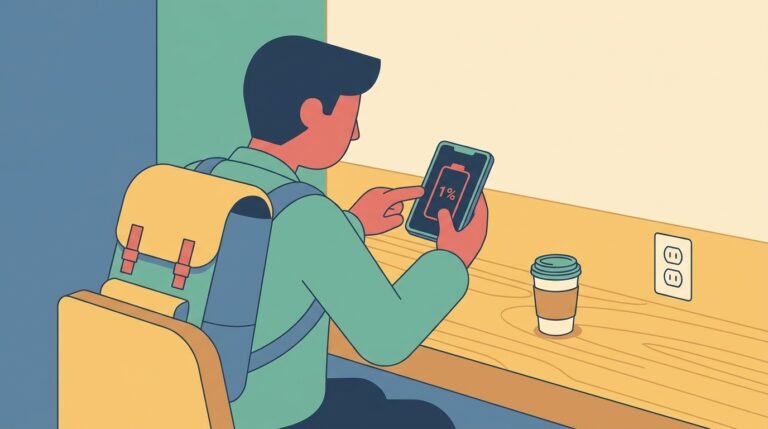
Or, let’s talk about real life. You are in the middle of bustling Hongdae, Seoul. You are following KakaoMap to find a famous K-BBQ spot, and suddenly your screen dims to 1%. Panic sets in. Without your phone, you have no map, no translation app, and no way to pay for a taxi!
In Korea, your smartphone is your lifeline. But don’t worry! Today, I will teach you the ultimate survival phrases for when your phone is running out of juice, plus some amazing insider tips about Korea’s “charging culture.” Let’s dive in!
Phase 2: Core Expressions Deep Dive
Here are the most important phrases you need when your screen turns red.
1. 배터리가 없어요. (My battery is dead.)
- Pronunciation: bae-teo-ri-ga eop-seo-yo [Sounds like: bae-tuh-ree-gah uhp-so-yo]
- Meaning: Literal = The battery does not exist. / Real nuance = My battery is dead/empty.
- K-Culture Moment: You are texting your Korean friend on KakaoTalk trying to meet up at a crowded subway station, and you only have 2% left. You quickly type this phrase before you disappear from the grid!
- Editor’s Insight: In English, we say a battery is “dead.” In Korean, we don’t “kill” the battery; we simply say it’s “not there” (없어요). It feels much less dramatic!
- Situation Spectrum:
- Casual (with friends): 배터리 없어! (baeteori eopseo!) ✅
- Semi-formal (coworkers, strangers): 배터리가 없어요. (baeteorig-a eopseoyo.) ✅
- Formal (bosses, elders): 휴대전화 배터리가 없습니다. (hyudaejeonhwa baeteorig-a eopseumnida.) ⚠️ (A bit too stiff for daily life!)
- 🤔 Think About It: Does your language say the battery “died,” “ran out,” or “emptied”? How does that reflect the way you view technology?
2. 충전기 있어요? (Do you have a charger?)
- Pronunciation: chung-jeon-gi is-seo-yo? [Sounds like: choong-jeon-ghee ees-suh-yo?]
- Meaning: Literal & Real nuance = Do you have a charger?
- K-Culture Moment: You are sitting in a beautiful Hanok cafe in Bukchon, taking hundreds of aesthetic photos. Your battery cries for help. You take your phone to the barista, put on your best puppy-dog eyes, and ask this magical question.
- Editor’s Insight: ‘충전’ (chungjeon) means charging, and ‘기’ (gi) means machine/device. You can use ‘있어요?’ (isseoyo) to ask “Do you have…?” for literally anything in Korea!
- Situation Spectrum:
- Casual: 충전기 있어? (chungjeongi isseo?) ✅
- Semi-formal: 충전기 있어요? (chungjeongi isseoyo?) ✅
- 🤔 Think About It: Why is it so common to borrow a charger in a public place in Korea? We’ll explore this in our K-Culture section!
Phase 3: Textbook vs. Real Korean
Let’s see how real Koreans speak when their battery is dying.
[Situation: Warning your friend on the phone]
* 📖 Textbook Korean: 제 휴대전화 배터리가 거의 없습니다. (je hyudaejeonhwa baeteorig-a geoui eopseumnida. – My mobile phone battery is almost empty.)
* 🗣️ Real Korean: 나 폰 꺼져! (na pon kkeojyeo! – My phone is turning off!)
* 💡 Why is it different?: Koreans love speed (빨리빨리 – ppalli-ppalli culture). Saying “mobile phone” takes too long. We just say “폰” (pon) and declare it’s turning off to create a sense of urgency!
[Situation: Asking a restaurant owner to charge your phone]
* 📖 Textbook Korean: 휴대전화를 충전해도 될까요? (hyudaejeonhwareul chungjeonhaedo doelkkayo? – May I charge my mobile phone?)
* 🗣️ Real Korean: 사장님, 이거 충전 좀 해주세요~ (sajangnim, igeo chungjeon jom haejuseyo~ – Boss, please charge this for me~)
* 💡 Why is it different?: Adding “~좀 해주세요” (please do this for me) with a slightly cute, friendly tone is the standard way to ask for a favor in Korean service situations.
Bottom Note: As an A1 beginner, sticking to “배터리가 없어요” and “충전기 있어요?” is completely safe and natural. No need to memorize complex slang just yet!
Phase 4: Cultural Context — K-Culture Deep Dive
4-1. Non-verbal Communication & Nunchi
When asking a cafe worker or restaurant owner to charge your phone, don’t just shove the phone in their face! Nunchi (눈치) tells us to approach politely. Hand over your phone with both hands while slightly bowing your head. This shows immense respect and guarantees a friendly response.
4-2. K-Travel Connection: The “Charging Utopia”
For travelers, Korea is a “Charging Utopia.”
– Cafes & Restaurants: 90% of them will charge your phone for free behind the counter if you ask politely. Some even have a designated charging station with multiple cables ready for customers!
– Wall Outlets: You will see people freely plugging their laptops and phones into wall outlets (콘센트) at cafes. It’s totally acceptable as long as you are a paying customer.
– Convenience Stores: If you are in a rush and can’t wait at a cafe, go to a convenience store (CU, GS25, 7-Eleven). You can buy a cheap portable power bank (보조배터리) to save your life!
Phase 5: Real-life Roleplay Scenario
Setting: It’s 3:00 PM. You are in a trendy, minimalist cafe in Seongsu-dong (the “Brooklyn of Seoul”). You need your phone to show your digital K-Pop concert ticket later tonight, but your battery is at 5%. You walk up to the barista counter.
Characters:
– YOU: A traveler whose entire itinerary depends on KakaoMap.
– Barista (Jimin): A friendly local college student working part-time.
Dialogue:
Barista: 안녕하세요! 주문하시겠어요? 😊
(annyeonghaseyo! jumunhasigesseoyo?)
[Hello! Would you like to order?]
YOU: 네, 아이스 아메리카노 하나 주세요.
(ne, aiseu amerikano hana juseyo.)
[Yes, one iced Americano, please.]
Barista: 네, 결제 도와드리겠습니다.
(ne, gyeolje dowadeurigetseumnida.)
[Yes, I’ll help you with the payment.]
(🎭 Stage Direction: You hand over your credit card. As you take it back, you look at your phone. It drops to 4%.)
YOU: 저기요… 핸드폰 배터리가 없어요.
(jeogiyo… haendeupon baeteorig-a eopseoyo.)
[Excuse me… My phone battery is dead.]
🔀 Your Turn! How will you ask for help?
– A) “이거 충전기!” (igeo chungjeongi! – This charger!)
– B) “혹시… 충전기 있어요?” (hoksi… chungjeongi isseoyo? – By any chance… do you have a charger?)
– C) “제발 도와주세요! 죽을 것 같아요!” (jebal dowajuseyo! jugeul geot gatayo! – Please help! I think I’m going to die!)✅ Best Choice: B — “혹시” (hoksi – by any chance) is a magic word in Korean that makes any request sound super polite and soft.
⚠️ Choice A Analysis: Too aggressive! It sounds like you are demanding a charger.
⚠️ Choice C Analysis: Too dramatic for a cafe, though the barista might laugh and definitely help you!
Barista: 아, 네! 이쪽으로 주세요. 충전해 드릴게요.
(a, ne! ijjogeuro juseyo. chungjeonhae deurilgeyo.)
[Ah, yes! Give it here. I’ll charge it for you.]
YOU: 와, 정말 감사합니다!
(wa, jeongmal gamsahamnida!)
[Wow, thank you so much!]
Phase 6: 10-Second Shadowing Drill
Read these sentences out loud to practice the natural rhythm. Pay attention to the pauses (/) and the emotion tags!
- 🥺 (Looking desperate) 저기요, / 혹시 / 충전기 있어요?
(jeogiyo, / hoksi / chungjeongi isseoyo?) - 😭 (Talking fast to a friend) 야! / 나 폰 꺼져! / 이따 봐!
(ya! / na pon kkeojyeo! / itta bwa! – Hey! My phone is turning off! See you later!) - 😊 (Polite smile) 사장님, / 이거 / 충전 좀 / 해주세요.
(sajangnim, / igeo / chungjeon jom / haejuseyo.)
Phase 7: K-Culture Mini Dictionary
| Korean | Romanization | English | Context |
|---|---|---|---|
| 보조배터리 | bojobaeteori | Power bank | ‘보조’ means auxiliary. A must-have item for K-Pop fans taking videos at concerts! |
| 콘센트 | konsenteu | Wall outlet | Konglish word derived from “concentric plug.” Look for these in cafes! |
| 폰 | pon | Phone | The most common, casual way to say smartphone in daily life. |
| 사장님 | sajangnim | Boss/Owner | The respectful way to call a restaurant or shop owner, even if it’s a small place. |
Phase 8: Traveler Survival Kit 🆘
When your phone dies, you are officially in “survival mode” in Korea. Here are your top 3 lifesaver phrases:
🆘 Survival Phrase #1: Can you charge this?
– 🇰🇷 “이거 충전해 주세요.” (igeo chungjeonhae juseyo.)
– 📍 Where to use: Cafes, Restaurants, Front desks of hotels.🆘 Survival Phrase #2: One power bank, please.
– 🇰🇷 “보조배터리 하나 주세요.” (bojobaeteori hana juseyo.)
– 📍 Where to use: Convenience stores (CU, GS25, 7-Eleven).🆘 Survival Phrase #3: Where is the outlet?
– 🇰🇷 “콘센트 어디 있어요?” (konsenteu eodi isseoyo?)
– 📍 Where to use: When you have your own charger and need to plug it into a wall at a cafe.📌 Editor’s Travel Note:
– High-Trust Society: In Korea, people often leave their laptops and phones unattended on cafe tables while they go to the restroom. While you should always be careful, theft is extremely rare. It’s perfectly normal to leave your phone charging at the counter and go back to your seat!
Phase 9: Critical Thinking — “One Step Deeper”
Korean in the Global Era & The “High-Trust” Society
Have you ever wondered why Korean cafes are so willing to take your expensive smartphone behind the counter and charge it out of your sight? It comes down to Korea being a “high-trust society” regarding personal belongings. CCTV is everywhere, but there is also a strong cultural boundary against taking someone else’s personal items. The phrase “이거 충전 좀 해주세요” (Please charge this) isn’t just about electricity; it represents a mutual trust between the customer and the business owner.
💬 Your Turn: Would you feel comfortable handing your phone to a barista to charge behind the counter in your home country? Let us know in the comments!
Phase 10: FAQ & Avoiding Misunderstandings
Q: “Can I just unplug someone else’s phone at a cafe to plug mine in?”
A: No! This is considered very rude. If all outlets are taken, it’s best to ask the staff if they can charge it for you behind the counter.
Q: “How do I say ‘My phone is dying’ like literally it’s losing battery right now?”
A: You can say “배터리가 다 돼 가요” (baeteorig-a da dwae gayo – battery is almost done), but for A1 beginners, just saying “배터리 없어요” is perfectly understood!
❌ Common Mistake: Translating “My battery died” literally into Korean as “배터리가 죽었어요” (baeteorig-a jugeosseoyo).
✅ Do this instead: In Korean, “죽다” (die) is mostly used for living things. Use “없어요” (doesn’t exist) or “꺼졌어요” (turned off) for electronics!
Phase 11: Summary & Action Items
🌟 One-Liner Summary: When your screen goes dark, don’t panic—just politely ask, “충전기 있어요?” (Do you have a charger?).
Action Mission 3 Steps:
– 🥉 Bronze (Solo): Look at your phone’s battery icon right now and say “배터리가 없어요” out loud 3 times.
– 🥈 Silver (Online): Change your phone’s language to Korean for 10 minutes and see what the battery warning looks like!
– 🥇 Gold (Real Life): Next time you go to a cafe (even in your own country), imagine handing your phone to the barista and politely asking, “이거 충전 좀 해주세요.”
🎬 K-Culture Mission: Watch any K-Drama this week. Count how many times a character’s phone rings, they look at it, and realize their battery is dead during an important moment!
Phase 12: Quiz — Interactive Challenge
1. Fill in the Blank:
You are at a cafe and your phone is at 2%. You walk to the counter and say, “혹시 _________ 있어요?” (By any chance, do you have a charger?)
* A) 아이스 아메리카노 (Iced Americano)
* B) 충전기 (Charger)
* C) 사장님 (Boss)
2. True or False – K-Culture Edition:
In Korean cafes, it is generally safe and common to leave your laptop on the table while you go order your drink. (T/F)
3. Situational Judgment:
Your Korean friend calls you, but your phone is shutting down. What is the most natural thing to yell before the call drops?
* A) “제 배터리가 죽었습니다!” (My battery died!)
* B) “야! 나 폰 꺼져!” (Hey! My phone is turning off!)
* C) “전화를 끊겠습니다!” (I will hang up the phone!)
(Answers: 1. B, 2. True, 3. B)
Frequently Asked Questions (FAQ)
Q: What does "배터리가 없어요. (My battery is dead.)" mean in Korean and how do you pronounce it?
A: In Korean, "배터리가 없어요. (My battery is dead.)" is pronounced [bae-teo-ri-ga eop-seo-yo [Sounds like: bae-tuh-ree-gah uhp-so-yo] and means: Literal = The battery does not exist. / Real nuance = My battery is dead/empty.
Q: What does "충전기 있어요? (Do you have a charger?)" mean in Korean and how do you pronounce it?
A: In Korean, "충전기 있어요? (Do you have a charger?)" is pronounced [chung-jeon-gi is-seo-yo? [Sounds like: choong-jeon-ghee ees-suh-yo?] and means: Literal & Real nuance = Do you have a charger?







