

Phase 1: Empathy (The K-Culture Cold Open)
Hello! I’m your Daily Hangul Editor.
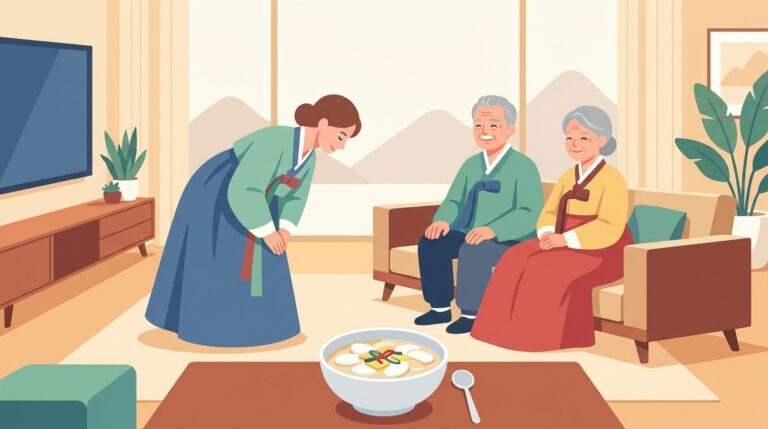
Imagine this: You are watching your favorite K-Drama family gather around a living room on Lunar New Year (Seollal). Suddenly, the younger characters drop to their knees, perform a deep, synchronized bow to their grandparents, and are immediately handed crisp white envelopes.
Wait, they get paid to bow?!
Then, everyone gathers around the dining table to eat a milky-white soup filled with oval rice cakes. Someone jokes, “If you eat two bowls, do you age two years?”
If you’ve ever been invited to a Korean friend’s home during Seollal (Lunar New Year), or even just watched a holiday-themed variety show episode, you’ve probably felt a bit lost. What is the exact angle of that bow? Why is everyone so obsessed with this specific soup? And most importantly—if an elder hands you an envelope of money, do you accept it right away, or do you have to do the Korean “polite refusal” dance?
This guide is born from the frantic text messages I’ve received from my expat students over the years, hiding in Korean bathrooms on New Year’s morning, asking, “Teacher, which hand goes on top when I bow?!”
Let’s dive into the intricate, warm, and sometimes highly lucrative world of Korean Seollal.
Phase 2: Core Expressions Deep Dive
Here are the most critical expressions you need to survive (and thrive) during the Lunar New Year.
1. 새해 복 많이 받으세요
- Pronunciation: Saehae bok mani badeuseyo / [Say-hay bohk mahn-ee bah-deu-say-yo]
- Meaning: Literal: “Receive a lot of New Year’s luck.” / Real nuance: “Happy New Year!”
- K-Culture Moment: This is the ultimate, universally accepted holiday greeting. You’ll hear it yelled by K-Pop idols in their New Year greeting videos, said warmly by your local barista, and chanted before dropping to the floor for a traditional bow (Sebae).
- Editor’s Insight: Notice that Koreans don’t say “Have a happy new year.” They say “Receive a lot of luck.” It reflects a cultural worldview where blessings and good fortune are things bestowed upon you from the universe (or ancestors), rather than something you independently create.
- Situation Spectrum:
- Casual (Friends): ✅ (Usually shortened to “새해 복 많이 받아!”)
- Semi-formal (Colleagues): ✅
- Formal (Elders/Boss): ✅
- 🤔 Think About It: Why does Korean culture emphasize “luck” (복 – bok) so much in greetings? Does your native language focus on “happiness,” “prosperity,” or “health” during the New Year?
2. 떡국 드셨어요?
- Pronunciation: Tteokguk deusyeosseoyo? / [Ddeok-gook deu-shuh-sso-yo?]
- Meaning: Literal: “Did you eat Tteokguk (rice cake soup)?” / Real nuance: “Did you celebrate the New Year?” (Or jokingly: “Did you age a year?”)
- K-Culture Moment: On variety shows like Running Man, cast members often tease each other about getting older by saying, “How many bowls of Tteokguk did you eat? You look like you ate ten bowls!”
- Editor’s Insight: In Korea, Seollal isn’t just the start of a new calendar—it’s historically the day everyone collectively turns one year older. Eating Tteokguk is the symbolic act of gaining that year. Therefore, asking if someone ate it is a cultural proxy for “Did you have a good New Year’s morning?”
- Situation Spectrum:
- Casual (Friends): ✅ (떡국 먹었어?)
- Semi-formal (Colleagues): ✅
- Formal (Elders): ⚠️ (It’s better to let elders ask you this first, as asking about their age/eating habits can sometimes be tricky unless you are close.)
- 🤔 Think About It: Food and age are deeply intertwined here. What specific holiday food in your culture holds a symbolic meaning beyond just tasting good?
3. 세뱃돈
- Pronunciation: Sebaetdon / [Say-baet-dohn]
- Meaning: Literal: “Bowing money” / Real nuance: New Year’s allowance given by elders to juniors after they perform the traditional bow.
- K-Culture Moment: The moment an idol talks about how their agency CEO gave them Sebaetdon, fans go wild. It shows a familial bond.
- Editor’s Insight: This isn’t a phrase you “say,” but a cultural keyword you must know. The giving of Sebaetdon is a beautiful gesture of elders passing down wealth and blessings to the younger generation.
- Situation Spectrum:
- Giving to elders: 🚫 (Never give Sebaetdon to elders. You give them a “gift” or “allowance” called 용돈 – Yongdon).
- Receiving as an adult: ⚠️ (Usually stops when you get a full-time job or get married, though some grandparents never stop giving it!)
- 🤔 Think About It: How does the exchange of money during holidays alter family dynamics? Is it a beautiful tradition or a source of pressure?
Phase 3: Textbook vs. Real Korean
Let’s see how real life differs from your Korean textbook.
[Situation 1: Greeting the Elders]
* 📖 Textbook Korean: 할아버지, 할머니, 새해 복 많이 받으십시오. (Grandfather, Grandmother, please receive a lot of New Year’s luck.)
* 🗣️ Real Korean: 할아버지, 새해 복 많이 받으시고 건강하세요! (Grandpa, Happy New Year and please stay healthy!)
* 💡 Why the difference?: Adding “건강하세요” (Please stay healthy) is the ultimate cheat code to win an elder’s heart. Pure textbooks often miss this emotional pairing.
[Situation 2: Receiving the Money Envelope]
* 📖 Textbook Korean: 감사합니다. 잘 쓰겠습니다. (Thank you. I will use it well.)
* 🗣️ Real Korean: (Smiling brightly) 아유~ 감사합니다! (Ayu~ Thank you!)
* 💡 Why the difference?: A little bit of mild, respectful shock (“Oh my, thank you!”) combined with a two-handed grab is the socially accepted choreography of receiving an envelope.
[Situation 3: Asking about Tteokguk]
* 📖 Textbook Korean: 오늘 떡국을 먹었습니까? (Did you eat Tteokguk today?)
* 🗣️ Real Korean: 떡국은 드셨고요? (And did you have your Tteokguk?)
* 💡 Why the difference?: The conversational “~고요?” makes it sound much softer and friendlier, showing genuine interest in their morning routine.
Bottom Note: At a B2 level, focus on matching the tone of the room. You don’t need overly archaic formal speech; natural honorifics (해요체/합쇼체) combined with warm body language work best.
Phase 4: Cultural Context — K-Culture Deep Dive
4-1. The Non-Verbal Magic: How to actually do Sebae
If you are invited to a Korean home, you might have to perform Sebae. Language isn’t enough; your body language must match.
* Hand Placement (Gongsu):
* For Men: Left hand over right hand.
* For Women: Right hand over left hand.
* (Fun Fact: The placement reverses for funerals! Do not mix this up, or you will accidentally wish bad luck upon your hosts!)
* Eye Contact & Nunchi: When bowing down to the floor, do not look up at the elder. Keep your eyes lowered respectfully.
4-2. The “Holiday Syndrome” (명절 증후군) in K-Dramas
You’ve probably seen K-Dramas where a daughter-in-law is stressed out, frantically frying massive piles of zucchini pancakes (Jeon) while the men sit in the living room watching TV. This is called 명절 증후군 (Holiday Syndrome).
While modern families are changing rapidly (ordering food online, men cooking, or skipping the gathering to travel abroad), the traditional gender dynamics of Seollal preparations remain a deeply resonant trope in Korean media. Understanding this helps you grasp the nuance when a Korean colleague sighs and says, “Ugh, Seollal is coming…”
Phase 5: Real-Life Roleplay Scenario
Setting: 10:00 AM on Lunar New Year. You are at your Korean friend Minji’s family home in Seoul. You’ve just finished eating Tteokguk. Minji’s grandfather is sitting on the sofa, wearing a modern Hanbok.
Characters:
* YOU: An expat living in Korea. You’ve practiced your bow.
* Minji (28): Your supportive Korean friend.
* Harabeoji (75): Minji’s grandfather, warm but traditional.
Dialogue:
Minji: 자, 이제 할아버지한테 세배하자!
(Ja, ije halabeojihante sebaehaja!)
[Alright, let’s do Sebae to grandpa now!]
YOU: (Nervously placing your left hand over your right) 할아버지, 새해 복 많이 받으세요!
(Halabeoji, saehae bok mani badeuseyo!)
[Grandpa, receive a lot of New Year’s luck!]
(🎭 Stage Direction: You drop to your knees and do a deep bow, staying down for a solid 2 seconds before rising.)
Harabeoji: 오냐, 외국에서 일하느라 고생이 많다. 올해는 돈도 많이 벌고 건강해라.
(Onya, oegugeseo ilhaneura gosaengi manta. Olhaeneun dondo mani beolgo geonganghaera.)
[Yes, you’re working hard in a foreign country. Earn lots of money this year and be healthy.]
(🎭 Stage Direction: Grandpa smiles broadly and holds out a white envelope toward you.)
🔀 Your Turn! How do you respond to the money?
– A) (Takes it with one hand, opens it immediately) “Wow, 50,000 won! Thank you!”
– B) (Takes it with two hands, bows head slightly) “아유, 감사합니다! 잘 쓰겠습니다!” (Oh my, thank you! I will use it well!)
– C) (Waving hands frantically) “아니에요! 저 돈 벌어요! 안 받아요!” (No! I earn money! I don’t accept!)✅ Best Choice: B — Take it with both hands, express gratitude, and do not open it until you are in private.
⚠️ Choice A Analysis: Opening money in front of the giver is considered quite rude in Korean culture.
⚠️ Choice C Analysis: While polite refusal is a thing in Korea, outright rejecting a grandfather’s Sebaetdon can make him lose face. Just accept the blessing!
[Bonus K-Culture Scenario: The Endless Food]
Korean Grandma: “떡국 한 그릇 더 줄까? 더 먹어~” (Should I give you another bowl of Tteokguk? Eat more~)
YOU: “아유, 너무 맛있는데 제 배가 터질 것 같아요! 잘 먹었습니다!” (Oh my, it’s so delicious but I think my stomach will explode! I ate well!)
(Pro Tip: Blame your stomach capacity, not the food!)
Phase 6: 10-Second Shadowing Drill
Practice this phrase so it flows naturally when you need it!
😊 할아버지! / 새해 복 / 많~~~이 / 받으세요! / 건강하세요!
(hal-a-beo-ji! / sae-hae bok / man~~~i / ba-deu-se-yo! / geon-gang-ha-se-yo!)
Intonation Guide: Raise your pitch slightly on “많~~~이” to sound affectionate and bright.
Phase 7: K-Culture Mini Dictionary
| Korean | Romanization | English | Context |
|---|---|---|---|
| 명절 | myeongjeol | Traditional Holiday | Refers mainly to Seollal (Lunar New Year) and Chuseok (Thanksgiving). |
| 세배 | sebae | New Year’s Bow | The specific deep bow on the floor meant only for the New Year. |
| 덕담 | deokdam | Words of blessing | The warm advice/blessings elders give after receiving a bow. |
| 설빔 | seolbim | New Year’s clothes | Newly prepared clothes (often Hanbok) worn on New Year’s morning. |
| 연휴 | yeonhyu | Long weekend/Holiday | Consecutive days off. Seoul becomes eerily quiet during this time! |
Phase 8: Traveler Survival Kit
If you are traveling in Korea during Seollal, you need to know that many mom-and-pop shops and restaurants close down so families can go to their hometowns.
🆘 Survival Expressions for the Holidays
– 🇰🇷 “오늘 문 여나요?” (oneul mun yeonayo?)
– 🗣️ Meaning: Are you open today?
– 📍 Where to use: Calling restaurants or asking a shop owner the day before.
- 🇰🇷 “설날 당일에도 영업하시나요?” (seollal dangile-do yeongeophasinayo?)
- 🗣️ Meaning: Are you open on the actual day of Seollal?
📌 Editor’s Travel Note
– The Ghost Town Effect: Seoul empties out during Seollal, making it a great time to avoid traffic!
– Palaces are Free: Major palaces like Gyeongbokgung are often free to enter during the holiday, and they host traditional games (like Yutnori) in the courtyards.
– Survival Food: Convenience stores are always open, but large department stores will usually close for at least two days. Plan your meals!
Phase 9: Critical Thinking Corner — “One Step Deeper”
Food & Identity: Why Do We Eat Age?
In Korean culture, the act of eating Tteokguk on New Year’s morning is deeply symbolic. The rice cakes are white, representing purity and a clean slate for the new year. Before they are sliced, the rice cakes are long cylinders (Garaetteok), symbolizing a wish for a long, healthy life. Once sliced, they look like ancient coins, representing wealth.
But more than that, eating Tteokguk is a communal equalizer. In the past, Koreans didn’t celebrate individual birthdays heavily; everyone simply turned a year older together on Seollal. Tying the concept of aging to a shared meal creates a powerful sense of collective identity. You don’t age alone—the whole community ages together over a warm bowl of soup.
💬 Your Turn: Does your culture have a food that you must eat on a specific holiday for symbolic reasons (like luck, money, or health)? Share it in the comments!
Phase 10: FAQ & Avoiding Misunderstandings
Q: Can I do Sebae to my friends?
No! Sebae is strictly for elders (grandparents, parents, aunts/uncles, or older respected mentors). Doing a deep bow to a friend is strange, and doing it to someone younger is highly inappropriate.
Q: Do I have to wear a Hanbok to eat Tteokguk?
Not at all! While some families dress up in Hanbok for the memorial service (Charye) and Sebae, many modern families just wear neat, comfortable casual clothes.
❌ Common Mistake #1: Opening the Sebaetdon envelope in front of the elder to count the cash.
✅ Do This Instead: Slide it smoothly into your pocket or bag with a grateful smile, and count it later when you are alone.❌ Common Mistake #2: Putting your left hand over your right (if you are a woman) or right over left (if you are a man) during the bow.
✅ Do This Instead: Remember: Men = Left on top. Women = Right on top. (Think: Men Left, Women Right).
Phase 11: Summary & Action Items
One-Liner Summary: A successful Korean New Year involves a perfectly angled Sebae, a bowl of Tteokguk for your new age, and gracefully accepting an envelope of cash.
Action Mission 3 Steps:
– 🥉 Bronze: Stand in front of your mirror and practice saying “새해 복 많이 받으세요!” with a bright smile.
– 🥈 Silver: Text a Korean friend (or your tutor!) “새해 복 많이 받아! 떡국은 먹었어?” on Lunar New Year.
– 🥇 Gold: If you are in Korea, go to a traditional restaurant, order Tteokguk, and mentally add one year to your “Korean age”!
K-Culture Mission: Search YouTube for “아이돌 설날 인사” (Idol Lunar New Year Greeting) and watch how they hold their hands and bow. Can you spot who gets the hand placement wrong?
Phase 12: Quiz — Interactive Challenge
1. Situational Judgment: Your Korean colleague, who is 5 years older than you, approaches you after the Lunar New Year holiday. What is the most natural thing to say?
– A) 세뱃돈 주세요. (Give me New Year’s money.)
– B) 연휴 잘 보내셨어요? 새해 복 많이 받으세요! (Did you have a good holiday? Happy New Year!)
– C) 떡국을 몇 개 먹었습니까? (How many Tteokguks did you eat?)
(Answer: B. It perfectly balances politeness and seasonal greetings.)
2. True or False — K-Culture Edition:
– T/F: It is considered polite to open your Sebaetdon envelope immediately to show how happy you are with the amount.
(Answer: False. It is considered rude. Save the excitement for later!)
3. Fill in the Blank:
Korean elders often give good advice or blessings, called ( ________ ), after receiving a New Year’s bow.
(Answer: 덕담 – Deokdam)
Frequently Asked Questions (FAQ)
Q: What does "새해 복 많이 받으세요" mean in Korean and how do you pronounce it?
A: In Korean, "새해 복 많이 받으세요" is pronounced [Saehae bok mani badeuseyo / [Say-hay bohk mahn-ee bah-deu-say-yo] and means: Literal: "Receive a lot of New Year's luck." / Real nuance: "Happy New Year!"
Q: What does "떡국 드셨어요?" mean in Korean and how do you pronounce it?
A: In Korean, "떡국 드셨어요?" is pronounced [Tteokguk deusyeosseoyo? / [Ddeok-gook deu-shuh-sso-yo?] and means: Literal: "Did you eat Tteokguk (rice cake soup)?" / Real nuance: "Did you celebrate the New Year?" (Or jokingly: "Did you age a year?")
Q: What does "세뱃돈" mean in Korean and how do you pronounce it?
A: In Korean, "세뱃돈" is pronounced [Sebaetdon / [Say-baet-dohn] and means: Literal: "Bowing money" / Real nuance: New Year's allowance given by elders to juniors after they perform the traditional bow.







