

Hello! I am the Lead Editor of Daily Hangul.
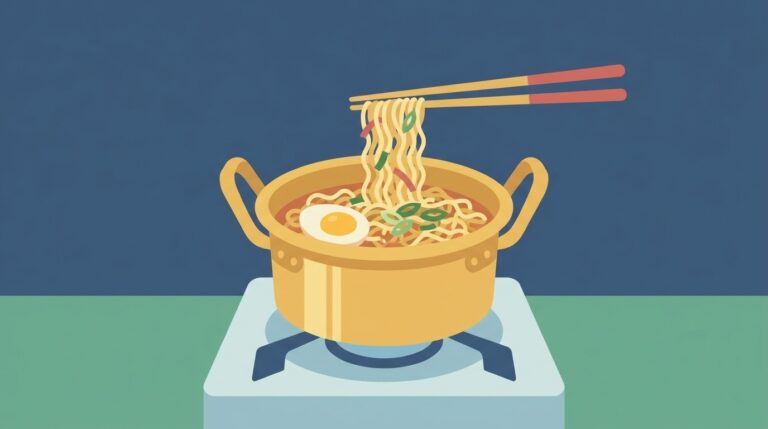
Imagine this: You are watching a K-Drama. The main characters, after a long, emotionally exhausting day, end up in a small kitchen at 2 AM. The golden pot (양은냄비) is boiling vigorously. One character asks, “스프 먼저? 면 먼저?” (Powder first or noodles first?). The other character replies with deadly seriousness.
To a beginner, cooking instant noodles seems trivial. But for you, an advanced (C2) Korean learner, you know that Ramyeon (라면) in Korea is not just fast food; it’s a religion, a science, and a profound cultural bonding experience.
If you simply say, “라면을 요리할게요” (I will cook ramyeon), it sounds painfully textbook. Today, we are going completely off-script. We will dive into the highly debated culinary nuances, advanced mimetic words (의태어), and cultural slang that Koreans use to describe their perfect pot of ramyeon. If you master this, you won’t just sound fluent—Koreans will genuinely consider you an honorary local.
Phase 2: Core Expressions Deep Dive
1. 꼬들꼬들하게 끓여주세요. (Make it chewy/al dente, please.)
- Pronunciation: [kko-deul-kko-deul-ha-ge] Sound-alike: Think of the ‘kk’ as a sharp, tight sound, like the snap of a perfectly cooked noodle against your teeth.
- Meaning: Literal: Boil it twisty/stiff. / Real Nuance: Cook the noodles al dente, leaving them slightly undercooked and pleasantly chewy.
- K-Culture Moment: At a late-night PC Bang (internet cafe) or a Bunsik-jip (snack eatery), the staff might ask for your noodle preference. Saying this immediately signals that you know your Korean food textures.
- Editor’s Insight: Koreans are obsessed with texture (식감). The opposite of kkodeul-kkodeul is 퍼진 면 (peojin myeon), which means soggy, overcooked noodles. The debate between ‘Team Chewy’ (꼬들파) and ‘Team Soggy’ (퍼진파) is as serious as politics in Korea.
- Situation Spectrum:
- Casual with friends: ✅ (야, 라면 꼬들하게 끓여라!)
- Ordering at a restaurant: ✅ (사장님, 면 좀 꼬들꼬들하게 해주세요~)
- Formal/Business: 🚫 (You wouldn’t dictate noodle texture to a CEO.)
- 🤔 Think About It: Why does Korean have so many specific mimetic words (의태어) for food textures compared to English? What does this reveal about Korean culinary values?
2. 물 조절 망했어. 완전 한강이야. (I ruined the water control. It’s totally the Han River.)
- Pronunciation: [mul jo-jeol mang-hae-sseo. wan-jeon han-gang-i-ya]
- Meaning: Literal: Water control failed. It’s the Han River. / Real Nuance: I put way too much water in the ramyeon, and now the broth is bland and overflowing.
- K-Culture Moment: You are on an MT (Membership Training) with university friends. It’s the morning after drinking, and it’s your turn to make the hangover ramyeon. You bring the pot out, and someone looks inside, sighs, and calls it “Han River Ramyeon.”
- Editor’s Insight: “한강 라면” (Han River Ramyeon) is an incredibly vivid cultural metaphor. The Han River is massive and wide. If your soup looks like a vast, watery expanse with a few lonely noodles floating in it, you’ve committed the cardinal sin of Korean ramyeon cooking.
- Situation Spectrum:
- Friends (Casual): ✅
- Close Colleagues (Semi-formal): ⚠️ (Use cautiously: “물 조절에 실패해서 한강이 됐네요.”)
- Superiors/Elders (Formal): 🚫
- 🤔 Think About It: How does geography influence slang? Do you have geographical metaphors in your native language that describe everyday mistakes?
3. 국물이 진짜 얼큰하다! (The broth is amazingly spicy and savory!)
- Pronunciation: [gung-mu-ri jin-jja eol-keun-ha-da]
- Meaning: Literal: The broth is spicy. / Real Nuance: It’s not just hot (맵다); it’s a deep, rich, refreshing spiciness that clears your throat and stomach, especially perfect for a hangover.
- K-Culture Moment: A middle-aged man eats a boiling hot, spicy bowl of Shin Ramyun, sweats profusely, lets out a loud “으아~ (Eu-ah~)”, and says, “얼큰하다!” It’s the ultimate expression of gastronomic satisfaction.
- Editor’s Insight: English speakers often translate both ‘맵다’ and ‘얼큰하다’ as ‘spicy’. But to a C2 learner, the difference is crucial. ‘맵다’ is simply the sensation of heat or pain on the tongue. ‘얼큰하다’ implies a hearty, savory heat that makes you feel physically relieved.
- Situation Spectrum:
- Friends (Casual): ✅
- Colleagues/Elders (Semi-formal/Formal): ✅ (Often used to compliment the cook: “국물이 참 얼큰하네요.”)
- 🤔 Think About It: Koreans often use the word ‘시원하다’ (cool/refreshing) for hot, spicy soups. Why do you think pain/heat is culturally associated with relief or refreshment in Korea?
Phase 3: Textbook vs. Real Korean
[Asking about Noodle Preference]
* 📖 Textbook Korean: 라면을 어떻게 요리할까요? (How shall I cook the ramyeon?)
* 🗣️ Real Korean: 라면 물 올릴까? 너 꼬들파? 퍼진파? (Should I put the water on for ramyeon? Are you Team Chewy or Team Soggy?)
* 💡 Why the difference?: Koreans rarely use the formal verb ‘요리하다’ (to cook) for instant noodles. Instead, they say ‘라면을 끓이다’ (to boil) or ‘물(을) 올리다’ (to put water on the stove). The suffix ‘-파’ (faction/team) is ubiquitous in modern Korean internet culture to describe personal preferences.
[Adding Extra Ingredients]
* 📖 Textbook Korean: 파와 계란을 넣을까요? (Shall I add green onions and an egg?)
* 🗣️ Real Korean: 파송송 계란탁 해줄까? (Shall I do ‘chop-chop green onions and crack an egg’?)
* 💡 Why the difference?: “파송송 계란탁” originates from an old iconic commercial and even became the title of a movie. It’s a rhythmic, poetic way to describe the classic ramyeon garnish.
[Eating it all]
* 📖 Textbook Korean: 밥도 먹을래요? (Do you want to eat rice too?)
* 🗣️ Real Korean: 남은 국물에 밥 말아 먹을래? (Wanna roll/mix some rice into the leftover broth?)
* 💡 Why the difference?: You don’t just ‘eat’ rice with ramyeon. The specific verb ‘말다’ (to roll/mix rice into soup) is essential for describing the ultimate finale of a ramyeon meal.
Phase 4: Cultural Context — K-Culture Deep Dive
4-1. Non-Verbal Elements: The Art of ‘Myeonchigi’ (면치기)
In many Western cultures, slurping noodles is considered bad manners. In Korea, especially on TV shows and among friends, doing a loud, continuous slurp—called 면치기 (Myeonchigi)—is a performance. It non-verbally communicates: “This ramyeon is so delicious I can’t even stop to breathe.” However, as a C2 learner, be aware of the Nunchi (눈치): while trendy on variety shows, older generations or formal company might still find loud slurping rude. Read the room!
4-2. The Convenience Store (편의점) Ramyeon Culture
If you’ve watched K-Dramas, you’ve seen the iconic scenes of characters eating at convenience store tables outside. But the true local experience is the 한강 라면 기계 (Han River Ramyeon Machine). You buy a foil bowl, scan the barcode, and the machine perfectly dispenses the exact milliliters of water and boils it via induction. It’s the perfect intersection of Korea’s ‘Palli-Palli’ (hurry up) tech culture and a deep-rooted love for comfort food.
Critical Viewpoint: Why does ramyeon taste better outdoors in freezing weather? It’s not just the temperature; it’s the shared atmosphere (분위기). In Korea, food is inherently communal. Even a cheap $1 instant noodle becomes a memory when eaten shivering by the Han River with a friend.
Phase 5: Real-Life Roleplay Scenario
Setting: A Friday night, 1 AM. You are at an Airbnb in Gapyeong with your Korean coworkers for an overnight MT (Membership Training). Everyone has been drinking Soju for hours. People are getting hungry. You confidently step up to the kitchen counter, claiming you make the best ‘K-Ramyeon’.
Characters:
– YOU: The foreign employee who knows too much about Korean ramyeon culture.
– Min-su (32, Colleague): Friendly, a bit tipsy, highly opinionated about his ramyeon.
– Ji-yoon (28, Junior Colleague): Loves spicy food, currently observing your cooking skills.
Dialogue:
YOU: 다들 해장 필요하시죠? 제가 라면 물 올릴게요. 🍜
(dadeul haejang piryohasijyo? jaega ramyeon mul ollilgeyo.)
[Everyone needs a hangover cure, right? I’ll put the water on for ramyeon.]
(🎭 Stage Direction: You pull out 5 packs of Shin Ramyun.)
Min-su: 오~ 땡기는데? 근데 너 한강 라면 만드는 거 아니지?
(o~ ttaenggineunde? geunde neo hangang ramyeon mandeuneun geo aniji?)
[Oh~ I’m craving it. But you’re not going to make a Han River ramyeon, are you?]
YOU: 에이, 절 못 믿으시네요. 저 물 조절 기가 막히게 합니다.
(ei, jeol mot mideusineyo. jeo mul jojeol giga makhige hamnida.)
[Come on, you don’t trust me. My water control is phenomenal.]
Ji-yoon: 선배님, 라면 끓이실 때 스프 먼저 넣으세요, 면 먼저 넣으세요?
(seonbaenim, ramyeon kkeurisil ttae seupeu meonjeo neoeuseyo, myeon meonjeo neoeuseyo?)
[Senior, when you boil ramyeon, do you put the powder first or noodles first?]
YOU: 당연히 스프 먼저죠! 끓는점을 높여야 면발이 쫄깃해지거든요.
(dangyeonhi seupeu meonjeojyo! kkeulneunjeomeul nopyeoya myeonbari jjolgit-haejigeodeunyo.)
[Powder first, obviously! You have to raise the boiling point to make the noodles chewy.]
(🎭 Stage Direction: Min-su claps his hands in absolute shock.)
Min-su: 와, 이 친구 진짜 한국인이네! 배운 사람이야.
(wa, i chingu jinjja hanguginine! baeun saramiya.)
[Wow, this person is a real Korean! Highly educated.]
Ji-yoon: 저는 완전 꼬들파인데, 꼬들꼬들하게 해주실 수 있어요?
(jeoneun wanjeon kkodeul-painde, kkodeul-kkodeul-hage haejusil su isseoyo?)
[I’m totally Team Chewy, can you make it al dente?]
YOU: 걱정 마세요. 공기 마찰도 시켜줄 겁니다. 파송송 계란탁도 콜?
(geokjeong maseyo. gonggi machaldo sikyeojul geomnida. pasongsong gyerantakdo kol?)
[Don’t worry. I’ll even lift the noodles to hit the air. Chopped green onions and a cracked egg too, cool?]
Min-su: 완벽하다. 계란은 절대 풀지 마! 국물 탁해지니까.
(wanbyeokhada. gyeraneun jeoldae pulji ma! gungmul takhaejinikka.)
[Perfect. Do NOT mix the egg! It makes the broth cloudy.]
🔀 Your Turn! How do you respond to Min-su?
– A) “알겠습니다. 계란을 섞지 않을게요.” (I understand. I won’t mix the egg.)
– B) “에이, 국물은 얼큰해야죠! 계란 안 풉니다.” (Hey, the broth has to be clean/spicy! I won’t scramble the egg.)
– C) “내 마음대로 할 거야!” (I’ll do whatever I want!)✅ Best Choice: B — Reason: Showing you understand that scrambling the egg reduces the ‘얼큰함’ (spiciness/clearness) of the broth proves your C2 local mastery.
⚠️ Choice C Analysis: Even in a friendly drunk setting, randomly using flat Banmal (내 마음대로 할 거야) to a coworker can disrupt the Nunchi dynamic.
Phase 6: 10-Second Shadowing Drill
Let’s practice the cadence of a true Korean complaining about bad ramyeon. Master the intonation!
😤 야, 라면은 / 물 조절이 생명인데, / 이거 / 완~전 한강이잖아!
(ya, ramyeoneun / mul jojeori saengmyeonginde, / igeo / wan~jeon hangangijana!)
“Hey, water control is the lifeblood of ramyeon, this is to~tally the Han River!”
Tip: Drag out the “완~전” (totally) with a tone of utter disappointment for maximum native-like flavor.
Phase 7: K-Culture Mini Dictionary
| 한국어 | Romanization | English | Cultural Context |
|---|---|---|---|
| 양은냄비 | yangeun naembi | Golden aluminum pot | The traditional thin yellow pot used for ramyeon. It heats up fast and cools down fast, making the noodles chewier. |
| 면치기 | myeonchigi | Noodle slurping | The act of loudly and continuously slurping noodles without biting them off. A sign of eating deliciously. |
| 맵찔이 | maepjjiri | Spice wimp | A slang term for someone who has a very low tolerance for spicy food (맵다 + 찌질이). |
| 해장 | haejang | Hangover cure | Eating spicy/hot soup (like ramyeon or Haejang-guk) to soothe the stomach after a night of heavy drinking. |
| 뽀글이 | ppogeuri | Bag ramyeon | A military/camping hack where you pour hot water directly into the ramyeon bag without a pot. |
Phase 8: Traveler’s Survival Kit
If you visit the Han River Parks (Yeouido, Banpo, Ttukseom), cooking ramyeon via the machine is a must-do activity. Here is your C2 survival kit for the convenience store.
🆘 Survival Expressions for Han River Ramyeon
– 🇰🇷 “사장님, 한강 라면 전용 용기는 어디 있어요?” (sajangnim, hangang ramyeon jeonyong yonggineun eodi isseoyo?)
– Where are the special foil bowls for the Han River ramyeon?
– 🇰🇷 “기계 조리가 안 되는데, 바코드 다시 찍어야 하나요?” (gigye joriga an doeneunde, bakodeu dasi jjigeoya hanayo?)
– The machine isn’t cooking it, do I need to scan the barcode again?
– 🇰🇷 “젓가락 두 개만 챙겨가도 될까요?” (jeotgarak du gaeman chaenggyeogado doelkkayo?)
– May I grab two pairs of chopsticks?📌 Editor’s Travel Note
– The Ultimate Mix (꿀조합): Advanced locals don’t just eat one type. Try mixing Chapaghetti and Neoguri to make Chapaguri (짜파구리), famously seen in the movie Parasite.
– Trash Etiquette: At the Han River, do not throw leftover broth in the regular trash. There are specific funnels/buckets at the recycling stations marked “남은 국물 버리는 곳” (Place to dump leftover broth).
Phase 9: Critical Thinking Corner — “One Step Deeper”
🧠 Think Deeper: Food & Identity (음식과 정체성)
Why is an instant, highly-processed food like Ramyeon considered a “soul food” in South Korea? Linguistically and culturally, ramyeon embodies the Korean “빨리빨리” (hurry-up) mindset—it takes exactly 3 minutes. Yet, paradoxically, the act of eating it is deeply communal. Friends will eat straight out of the same pot (양은냄비), crossing chopsticks, sharing the broth. In a highly competitive, fast-paced society, sharing a cheap $1 pot of ramyeon at midnight is one of the most intimate, barrier-lowering acts of “정” (Jeong – affection/attachment) people can share.
💬 Your Turn: Does your culture have a “cheap fast food” that holds deep emotional or communal significance? Share it in the comments!
Phase 10: FAQ & Avoiding Misunderstandings
Q: “라면 먹고 갈래?” (Do you want to come over for ramyeon?) — Can I use this with my friends casually?
NO. Absolutely not. 🚫 While we are talking about cooking today, remember that this specific phrase is the Korean equivalent of “Netflix and chill.” If you say this to a friend or coworker, it is a highly flirtatious romantic/sexual invitation. If you just want to eat food, say: “우리 집에서 라면 끓여 먹을래?” (Want to boil and eat some ramyeon at my place?).
Q: Is it rude to drink the broth directly from the bowl instead of using a spoon?
Not at all! In casual settings, lifting the bowl with both hands and drinking the broth directly (사발째 마시다) shows that you are deeply enjoying the meal.
❌ Common Mistake #1: Calling it “Ramen” (라멘).
✅ Do this instead: In Korea, “Ramen” refers strictly to Japanese-style fresh noodles (Tonkotsu, etc.). The Korean spicy instant noodle is ALWAYS pronounced “Ramyeon” (라면). If you ask for ‘Ramen’ at a Korean convenience store, they might point you to a Japanese restaurant!
Phase 11: Summary & Action Items
One-Liner Summary: To speak C2 Korean in the kitchen, drop “요리하다” and embrace the art of water control (물 조절), texture debates (꼬들파 vs 퍼진파), and savory spice (얼큰하다).
Action Mission 3 Steps:
– 🥉 Bronze (Solo): Stand in your kitchen and say, “아, 물 조절 망했다. 완전 한강이야!” with deep regret.
– 🥈 Silver (Online): Go to a Korean YouTube video about a Ramyeon recipe and leave a comment: “와, 국물이 진짜 얼큰해 보이네요! 저는 무조건 꼬들파입니다.”
– 🥇 Gold (Real Life): Go to a Korean market, buy a golden pot (양은냄비), and cook it for a friend, explaining the “Powder first vs. Noodle first” science in Korean.
🍜 K-Culture Special Mission:
Next time you cook ramyeon, try eating it using the pot lid (냄비 뚜껑) as a plate, just like they do in K-Dramas. It cools the noodles down perfectly!
Did you enjoy today’s deep dive? Are you Team Chewy (꼬들파) or Team Soggy (퍼진파)? Let us know in the comments! 👇
Phase 12: Quiz — Interactive Challenge
1. Fill in the Blank:
You are cooking ramyeon for your Korean friend, but you added 800ml of water instead of 500ml. Your friend looks at it and says:
“야… 이거 완전 ( _________ )이잖아!”
Hint: The river that runs through Seoul.
2. Situational Judgment:
You want to compliment the deep, refreshing, spicy taste of a hot ramyeon broth. Which word is the MOST natural for a C2 speaker?
A) 매우 뜨겁다
B) 너무 아프다
C) 진짜 얼큰하다
D) 차갑고 시원하다
3. True or False – K-Culture Edition:
“In Korea, if you are eating ramyeon with close friends, it is considered extremely rude to eat directly from the same pot without using an individual bowl.” (T/F)
🎯 Click here for Answers!
1. 한강 (Han River) – It means you messed up the water control (물 조절 실패).
2. C (진짜 얼큰하다) – While A is grammatically fine, C captures the exact cultural nuance of a savory, satisfyingly spicy broth.
3. False. In intimate/casual settings, sharing food straight from the boiling pot is very common and a sign of closeness (정)!
Frequently Asked Questions (FAQ)
Q: What does "꼬들꼬들하게 끓여주세요. (Make it chewy/al dente, please.)" mean in Korean and how do you pronounce it?
A: In Korean, "꼬들꼬들하게 끓여주세요. (Make it chewy/al dente, please.)" is pronounced [kko-deul-kko-deul-ha-ge] and means: Literal: Boil it twisty/stiff. / Real Nuance: Cook the noodles al dente, leaving them slightly undercooked and pleasantly chewy.
Q: What does "물 조절 망했어. 완전 한강이야. (I ruined the water control. It's totally the Han River.)" mean in Korean and how do you pronounce it?
A: In Korean, "물 조절 망했어. 완전 한강이야. (I ruined the water control. It's totally the Han River.)" is pronounced [mul jo-jeol mang-hae-sseo. wan-jeon han-gang-i-ya] and means: Literal: Water control failed. It's the Han River. / Real Nuance: I put way too much water in the ramyeon, and now the broth is bland and overflowing.
Q: What does "국물이 진짜 얼큰하다! (The broth is amazingly spicy and savory!)" mean in Korean and how do you pronounce it?
A: In Korean, "국물이 진짜 얼큰하다! (The broth is amazingly spicy and savory!)" is pronounced [gung-mu-ri jin-jja eol-keun-ha-da] and means: Literal: The broth is spicy. / Real Nuance: It's not just hot (맵다); it's a deep, rich, refreshing spiciness that clears your throat and stomach, especially perfect for a hangover.







