

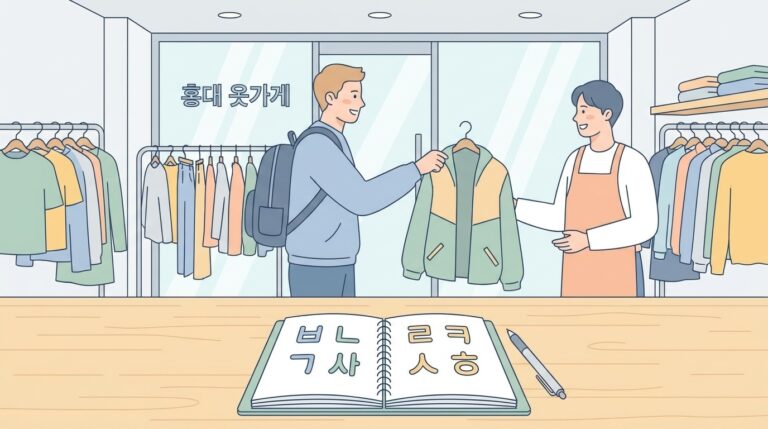
“Help, it doesn’t fit!” How to Ask for Clothes Sizes in Korea Like a Pro
Phase 1: Empathy (Welcome to the Fitting Room!)
Hello! I’m the Lead Editor of Daily Hangul.
Picture this: You are walking down the vibrant streets of Hongdae or exploring a trendy underground mall in Gangnam. You spot the perfect jacket—the exact same style your favorite K-Pop idol wore at the airport last week. Your heart races. You take it to the fitting room, slip it on, and… oh no. It’s too tight. You peek out of the curtain, make eye contact with the friendly shop staff, and your mind goes blank.
How do I say ‘Do you have a bigger size?’ without sounding awkward?
If you’ve ever felt that mild panic while shopping in Korea, you are not alone! Many of my beginner students know how to say “Hello” and “Thank you,” but completely freeze when shopping. Knowing how to ask for different sizes won’t just save you from buying clothes that don’t fit; it will make your K-fashion shopping spree 100 times more enjoyable.
This guide is built from the real, slightly embarrassing, and ultimately triumphant shopping stories of learners just like you. Let’s dive in!
Phase 2: Core Expressions Deep Dive
Let’s look at the absolute must-know phrases for finding your perfect fit. Since you are at the A1 (Beginner) level, we will focus on simple, magical ‘chunks’ of words.
1. 더 큰 거 있어요? (Do you have a bigger one?)
- Pronunciation: deo keun geo isseoyo? [Duh koon guh eess-uh-yo?]
- Sound-alike guide: ‘더(Deo)’ sounds like the ‘du’ in ‘dust’. ‘큰(keun)’ sounds like ‘koon’, but make your lips wide like you’re forcing a smile.
- Meaning: Literal = “More big thing exist?” / Real nuance = “Do you have this in a larger size?”
- K-Culture Moment: Imagine shopping in Dongdaemun Night Market at 2 AM. You point at a vintage denim jacket. The vendor hands you a size Medium, but you need a Large. You hand it back with a polite smile and say, “더 큰 거 있어요?”
- Editor’s Insight: ‘거(geo)’ means ‘thing’ and ‘있어요?(isseoyo)’ means ‘Do you have…?’. You can put almost any adjective before ‘거 있어요?’ to ask for something! It’s the ultimate shopping survival phrase.
- Situation Spectrum:
- Close friends (Casual): ✅ (Say: 더 큰 거 있어? – drop the ‘yo’)
- Shop staff (Semi-formal): ✅ (Perfect!)
- Fancy department store (Formal): ⚠️ (Acceptable, but they might use more formal words)
- 🤔 Think About It: Why do Koreans say “bigger thing” instead of directly saying “bigger size“? Korean everyday language relies heavily on context. If you are holding a shirt, it’s obvious the “thing” is the shirt!
2. 더 작은 거 있어요? (Do you have a smaller one?)
- Pronunciation: deo jageun geo isseoyo? [Duh jah-goon guh eess-uh-yo?]
- Meaning: Literal = “More small thing exist?” / Real nuance = “Do you have this in a smaller size?”
- K-Culture Moment: You’re at a K-Pop pop-up store buying concert merch. They hand you an oversized XL hoodie, but you want it to fit snugly. This is your go-to phrase.
- Editor’s Insight: Just like the previous phrase, we simply swapped ‘big’ (큰) for ‘small’ (작은). It’s soft, polite, and completely natural.
- Situation Spectrum:
- Close friends (Casual): ✅
- Shop staff (Semi-formal): ✅
- Formal: ⚠️
- 🤔 Think About It: Do you notice how ending a sentence with “요(yo)” instantly makes it polite? How does your native language show respect to strangers like shop assistants?
3. 입어봐도 돼요? (Can I try this on?)
- Pronunciation: ibeobwado dwaeyo? [Ee-buh-bwa-doh dway-yo?]
- Meaning: Literal = “Try wearing it, is it okay?” / Real nuance = “Can I try this on in the fitting room?”
- K-Culture Moment: You are in a boutique in Seongsu-dong. Before walking into the fitting room (피팅룸), you hold up the clothes and ask the staff this question. It’s a crucial etiquette step in Korea!
- Editor’s Insight: Never just walk into a fitting room without asking. Many Korean stores have strict rules about trying on certain clothes (which we will talk about soon!).
- Situation Spectrum:
- Close friends (Casual): 🚫 (Doesn’t make sense)
- Shop staff (Semi-formal): ✅
- Formal: ✅
- 🤔 Think About It: “돼요? (dwaeyo?)” means “Is it okay/allowed?” It’s a culture of asking for permission, reflecting the Korean value of respecting shared spaces.
Phase 3: Textbook vs. Real Korean
Let’s see how the textbooks differ from the lively streets of Seoul.
[Asking for a bigger size]
* 📖 Textbook Korean: 이것보다 더 큰 치수가 있습니까? (Is there a size larger than this?)
* 🗣️ Real Korean: 더 큰 거 있어요? (Got a bigger one?) or 사이즈 업 돼요? (Size up possible?)
* 💡 Why the difference?: Textbooks use formal business Korean (습니까), but everyday shopping is casual-polite. Younger Koreans also use “Konglish” (Korean-English) like ‘사이즈 (Size)’.
[Asking to try clothes on]
* 📖 Textbook Korean: 제가 이것을 입어 보아도 괜찮겠습니까? (Would it be alright if I tried wearing this?)
* 🗣️ Real Korean: 입어봐도 돼요? (Can I try it on?)
* 💡 Why the difference?: Efficiency! Koreans love getting straight to the point while maintaining the polite “요(yo)” ending.
Bottom Note: For A1 beginners, stick to the Real Korean phrases. They are easier to memorize and will make you sound much more natural!
Phase 4: Cultural Context — K-Culture Deep Dive
4-1. Non-verbal Nuances (The “Nunchi” of Shopping)
When you ask “더 큰 거 있어요?”, try holding the piece of clothing up slightly with both hands, or at least point to it gently with an open hand (not one finger!). If the shop is crowded, making eye contact and giving a slight head bow will get the staff’s attention politely.
4-2. The “Free Size” Phenomenon (K-Fashion Reality)
If you shop in underground malls (like Goto Mall) or street boutiques, you might ask for a bigger size and hear the staff say: “이거 프리사이즈예요” (This is Free Size).
Wait, free size? Does that mean it’s free?
No! “Free Size” (프리사이즈) is Konglish for “One Size Fits All.” In K-Dramas, actors look flawless in these clothes, but in reality, “Free Size” usually fits a standard Korean S or M. If you hear this, it means they don’t have larger or smaller options for that specific item. Don’t be discouraged! It’s a huge part of Korean fast-fashion culture due to mass manufacturing. If it doesn’t fit, just smile and say “아, 네~ (Ah, okay~)” and keep browsing.
Phase 5: Real-world Roleplay Scenario
Setting: It’s Saturday afternoon. You are in a bustling clothing stall in Dongdaemun’s Doota Mall. K-Pop is blasting from the speakers. You are looking for a cool street-style hoodie.
Characters:
– YOU: A foreign traveler wanting to buy a comfy hoodie.
– Auntie (이모님 – Imo-nim): The 50-something shop owner. Very friendly, moves very fast.
Dialogue:
YOU: 저기요, 이거 입어봐도 돼요? 👚
(jeogiyo, igeo ibeobwado dwaeyo?)
[Excuse me, can I try this on?]
이모님: 네~ 거기 거울 앞에서 입어보세요.
(ne~ geogi geoul apeseo ibeoboseyo.)
[Yes~ try it on in front of the mirror over there.]
(🎭 Stage Direction: You slip the hoodie on. It fits, but you want that oversized K-Pop dancer look.)
YOU: 이모님, 이거 더 큰 거 있어요?
(imonim, igeo deo keun geo isseoyo?)
[Auntie, do you have a bigger one?]
이모님: 아이고, 언니/오빠! 그거 프리사이즈예요.
(aigo, eonni/oppa! geugeo peurisaijeuyeyo.)
[Oh my, sister/brother! That is Free Size.]
🔀 Your Turn! How should you respond?
– A) “Why is it only one size?!” (In English)
– B) “아, 네… 감사합니다.” (Ah, okay… thank you.)
– C) “더 큰 거 줘!” (Give me a bigger one!)✅ Best Choice: B — In Korea, gracefully accepting that it’s Free Size and moving on is the best etiquette.
⚠️ Choice C Analysis: This is extremely rude because it drops the polite “요” and uses a commanding tone. Never use this with a shop owner!
Phase 6: 10-Second Shadowing Drill
Let’s practice the flow of the sentence. Korean rhythm is all about smooth connections.
- 😊 이모님, / 이거 / 더 큰 거 / 있어요?
- (imonim, / igeo / deo keun geo / isseoyo?)
- (Politely and cheerfully: Auntie, this one, do you have a bigger one?)
-
🥺 저기요… / 이거 / 더 작은 거 / 있어요?
- (jeogiyo… / igeo / deo jageun geo / isseoyo?)
- (A bit shyly: Excuse me… this one, do you have a smaller one?)
Phase 7: K-Culture Mini Dictionary
| Korean | Romanization | English | Cultural Context |
|---|---|---|---|
| 프리사이즈 | peuri saijeu | Free Size | “One size fits all.” Very common in Korean street fashion. |
| 핏 | pit | Fit | Konglish. Used to describe how clothes look on the body. (e.g., “핏이 예뻐요” – The fit is pretty). |
| 피팅룸 | piting-rum | Fitting Room | Where you try on clothes. Remember to take your shoes off if there’s a step up! |
| 페이스 커버 | peiseu keobeo | Face Cover | A white fabric hood provided in fitting rooms to prevent makeup from staining clothes. |
| 품절 | pumjeol | Sold Out | The heartbreaking word you see when your size is gone. |
Phase 8: Traveler’s Survival Kit
Shopping in Korea? Keep these phrases in your back pocket!
🆘 Survival Expression #1: Asking the Price
– 🇰🇷 “이거 얼마예요?” (igeo eolmayeyo?)
– 🗣️ Pronunciation: [Ee-guh uhl-mah-yay-yo?]
– 📍 Where to use: Markets, underground malls, anywhere without price tags.
– 💡 Pro Tip: If you don’t understand the numbers they say, just politely hand them your phone with the calculator app open. They will type the price for you!🆘 Survival Expression #2: Buying It
– 🇰🇷 “이걸로 주세요.” (igeollo juseyo.)
– 🗣️ Pronunciation: [Ee-guhl-lo joo-say-yo.]
– 📍 Where to use: At the cashier.📌 Editor’s Travel Note
– Cards vs. Cash: Korea is a cashless society! Credit cards are accepted 99% of the time. However, in traditional markets or underground clothing stalls (like Express Bus Terminal), paying in cash might sometimes get you a small discount!
– Trying on White Clothes: Many boutiques will NOT allow you to try on white shirts or tight knitwear. This is because Korean beauty standards emphasize foundation makeup, and they want to avoid stains. Don’t be offended if they say no!
Phase 9: Critical Thinking Corner — “A Step Deeper”
Media vs Reality: The “Free Size” Illusion
When you watch K-Dramas, everyone seems to have perfectly tailored clothes. K-Pop idols promote a very specific, slender body standard. This media representation directly impacts Korean shopping culture, leading to the dominance of “Free Size” (프리사이즈) in fast fashion. While Free Size is convenient and affordable for the majority, it can be frustrating for foreigners (and many locals!) who don’t fit that specific mold. The Korean fashion industry is slowly changing and becoming more size-inclusive, but navigating it as a foreigner is an interesting window into Korea’s collective beauty standards.
💬 Your Turn: Does your country have “One Size Fits All” clothing, or are detailed sizing charts more common? How do media body standards affect shopping in your culture? Share in the comments!
Phase 10: FAQ & Avoiding Misunderstandings
Q: Can I use “더 큰 거 있어요?” when ordering food? (Like a bigger coffee?)
Yes! You can use it at a cafe: “이거 더 큰 사이즈 있어요?” (Do you have a bigger size for this?). It’s a very versatile phrase.
Q: How do I ask for a specific size, like Medium or Large?
Just say the English letter! “엠(M) 사이즈 있어요?” (M size isseoyo?) or “라지(L) 있어요?” (Large isseoyo?). Koreans use S, M, L, XL!
❌ Common Mistake #1: Trying on clothes with your shoes on.
✅ Do this instead: Look at the fitting room floor. If it is raised or has a different material, take your shoes off before stepping in. This is traditional Korean indoor culture applied to modern shops!❌ Common Mistake #2: Getting mad when staff hand you a “Face Cover” (페이스 커버).
✅ Do this instead: Wear it! It’s a thin white veil you put over your head before pulling a shirt down. It protects the clothes from your makeup and hair products. It’s standard etiquette in Korea.
Phase 11: Summary & Action Items
One-Liner Summary: Use “더 큰/작은 거 있어요?” (deo keun/jageun geo isseoyo?) to find your perfect size politely and easily!
Action Mission:
– 🥉 Bronze (Solo): Look at a shirt in your closet and ask the air, “더 큰 거 있어요?” out loud 3 times.
– 🥈 Silver (Online): Go to a Korean shopping website (like Musinsa) and try to find the word ‘프리’ (Free) in the size charts!
– 🥇 Gold (Real World): Next time you visit a Korean store or market, try asking to try something on: “입어봐도 돼요?”
K-Culture Mission:
Watch a K-Drama episode today. If you see a scene where characters go shopping (like a classic makeover montage!), shout out “더 큰 거 있어요!” when they step out of the fitting room!
Did you ever buy the wrong size while traveling? Let me know your funny shopping stories in the comments! 👇
Phase 12: Quiz — Interactive Challenge
1. Situational Judgment: You are at a boutique in Hongdae. You want to try on a jacket. What is the BEST thing to say to the staff?
– A) 입어봐도 돼요? (ibeobwado dwaeyo?)
– B) 더 작은 거 있어요? (deo jageun geo isseoyo?)
– C) 이거 얼마예요? (igeo eolmayeyo?)
2. True or False – K-Culture Edition:
“In Korea, you can usually try on tight white t-shirts in any boutique without asking.”
– True / False
3. Fill in the Blank:
A: 이 바지 너무 작아요. (This pants are too small.)
B: 그럼 ____ 큰 거 드릴까요? (Then shall I give you a ____ bigger one?)
Hint: ‘More’
🚨 Click here for the Answers!
1. A (Can I try this on? – Always ask permission first!)
2. False (Many boutiques restrict trying on white/tight tops to prevent makeup stains. Always use the face cover if provided!)
3. 더 (deo)
Frequently Asked Questions (FAQ)
Q: What does "더 큰 거 있어요? (Do you have a bigger one?)" mean in Korean and how do you pronounce it?
A: In Korean, "더 큰 거 있어요? (Do you have a bigger one?)" is pronounced [deo keun geo isseoyo? [Duh koon guh eess-uh-yo?] and means: a key conversational Korean expression covered in this lesson.
Q: What does "더 작은 거 있어요? (Do you have a smaller one?)" mean in Korean and how do you pronounce it?
A: In Korean, "더 작은 거 있어요? (Do you have a smaller one?)" is pronounced [deo jageun geo isseoyo? [Duh jah-goon guh eess-uh-yo?] and means: Literal = "More small thing exist?" / Real nuance = "Do you have this in a smaller size?"
Q: What does "입어봐도 돼요? (Can I try this on?)" mean in Korean and how do you pronounce it?
A: In Korean, "입어봐도 돼요? (Can I try this on?)" is pronounced [ibeobwado dwaeyo? [Ee-buh-bwa-doh dway-yo?] and means: Literal = "Try wearing it, is it okay?" / Real nuance = "Can I try this on in the fitting room?"







