

Phase 1: Empathy
Hello! I’m your Daily Hangul Editor, your personal Korean tutor and local culture navigator.
Imagine this: You are living in a K-Drama. You finally meet the charismatic CEO, or maybe you are at a fan meeting, standing right in front of your favorite K-Pop idol. They smile and extend their hand. You confidently grab it, give it a firm, bone-crushing squeeze, and stare deeply into their eyes with a big grin.
Suddenly… the invisible background music stops. The atmosphere gets a little awkward. What did you do wrong? In Western cultures, a firm handshake and strong eye contact show confidence. But in Korea? You might have just accidentally declared war!
Korean handshakes aren’t just about saying hello. They are a physical map of respect, age, and status. If you don’t know the hidden rules of the Korean Handshake Etiquette (악수 예절), you might unintentionally come off as rude. But don’t worry! Today, I’ll show you exactly how to shake hands like a true local, so you can impress everyone from your Korean business partners to your future Korean in-laws.
Let’s dive in! This guide is based on the real ‘oops’ moments of my past students, so you won’t have to make the same mistakes.
Phase 2: Core Expressions Deep Dive
When you shake hands in Korea, your mouth needs to be working just as much as your hands! Here are the core expressions you need.
1. 처음 뵙겠습니다
- Pronunciation: [cheo-eum boep-get-seum-ni-da] + Sound-alike: “chuh-eum bep-get-sum-nee-da” (‘으/eu’ sounds like the disgusted sound you make when stepping in gum!)
- Meaning: (Literal) I am seeing you for the first time. / (Real nuance) How do you do? Nice to meet you.
- K-Culture Moment: Picture a K-Drama where the female lead is introduced to her new, strict team leader. She bows slightly, extends her hands carefully, and says this. It instantly sets a polite, professional tone.
- Editor’s Insight: This is the absolute gold standard for meeting adults, seniors, or colleagues for the very first time. It feels humble and deeply respectful.
- Situation Spectrum:
- Casual (Friends): 🚫 (Too stiff!)
- Semi-formal (Colleagues): ✅
- Formal (Boss/Elders): ✅✅✅
- 🤔 Think About It: Why do Koreans specifically mention “the first time” (처음) when greeting? In Korean culture, every relationship is built on shared time and history. Acknowledging the “first time” marks the official beginning of that shared history.
2. 반갑습니다
- Pronunciation: [ban-gap-seum-ni-da] + Sound-alike: “bahn-gap-sum-nee-da”
- Meaning: (Literal) It is glad. / (Real nuance) It’s a pleasure to meet you.
- K-Culture Moment: You are at a K-Pop fan-sign event. As you step up to the table, the idol smiles widely, gently holds your hands, and says, “아유~ 반갑습니다!” (Ah-yu~ Nice to meet you!).
- Editor’s Insight: You can use this during a first meeting, but also during the second or third time you see someone you aren’t super close with yet. It’s warm and welcoming.
- Situation Spectrum:
- Casual (Friends): ⚠️ (Use the casual version: 반가워 / ban-ga-wo)
- Semi-formal (Colleagues): ✅
- Formal (Boss/Elders): ✅
- 🤔 Think About It: “반갑습니다” is often combined with a handshake. Do people in your culture use physical touch to express happiness when meeting someone?
3. 안녕하세요
- Pronunciation: [an-nyeong-ha-se-yo] + Sound-alike: “ahn-nyung-ha-seh-yo”
- Meaning: (Literal) Are you in peace? / (Real nuance) Hello.
- K-Culture Moment: The classic greeting everywhere—from stepping into a cute local cafe in Seongsu-dong to greeting your Airbnb host.
- Editor’s Insight: When shaking hands, “안녕하세요” is usually said right before or during the handshake.
- Situation Spectrum:
- Casual (Friends): ⚠️ (Use 안녕 / an-nyeong)
- Semi-formal (Colleagues): ✅
- Formal (Boss/Elders): ✅
Phase 3: Textbook vs. Real Korean
[Scenario 1: Meeting a friend of a friend at a casual pub]
* 📖 Textbook Korean: Extending a firm hand and saying, “처음 뵙겠습니다.” (Cheoeum boepgetseumnida)
* 🗣️ Real Korean: No handshake! Just a slight head nod, a smile, and “안녕하세요~ 반가워요.” (Annyeonghaseyo~ bangawoyo)
* 💡 Why the difference?: Handshakes in Korea are generally reserved for formal, business, or adult-to-adult formal introductions. Young people in casual settings usually just bow their heads slightly. Shaking hands at a pub feels like you’re closing a business deal!
[Scenario 2: Greeting an older person or a VIP]
* 📖 Textbook Korean: Shaking hands with your right hand while keeping your left hand by your side.
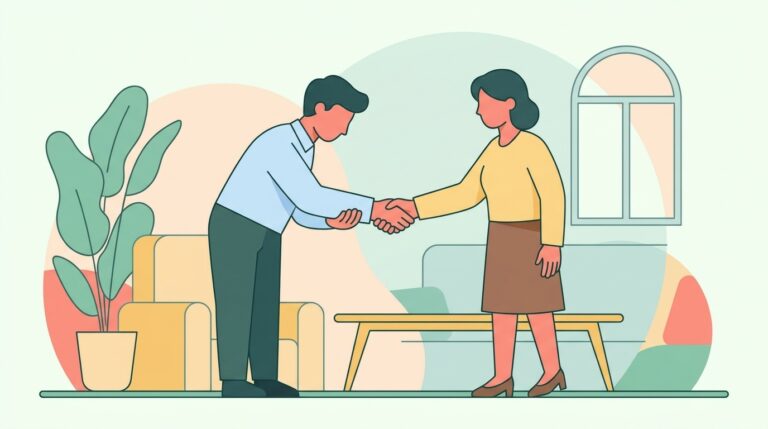
* 🗣️ Real Korean: Using two hands! Right hand shakes, while the left hand lightly supports your right wrist or elbow.
* 💡 Why the difference?: The “Manner Hand” (매너손) shows that you are offering your full attention and respect. Using only one hand with an elder can seem arrogant.
Phase 4: Cultural Context — K-Culture Deep Dive
4-1. Non-Verbal Elements: The Art of the “Manner Hand”
Words are only 20% of a Korean handshake; the body language is the other 80%. Have you noticed the Nunchi (눈치) involved here? Nunchi is the art of reading the room.
* The Two-Handed Shake: You must always use your right hand to shake. Your left hand should support your right arm (touching your wrist, elbow, or lightly resting on your stomach).
* The Bow: Never stand completely straight. Add a slight 15 to 30-degree bow while shaking hands.
* Eye Contact: Look at their face, but do not maintain an intense, unblinking stare. A soft, warm gaze, occasionally looking slightly downward, shows respect.
* The Grip: A light, gentle grip! Do not crush their fingers.
4-2. K-Drama Connection
Have you ever noticed the “Handshake Trope” in K-Dramas?
Think of a scene where two rival CEOs meet. They shake hands, but neither bows, and they squeeze tightly while glaring at each other. This is a dramatic power struggle! By refusing to bow and using only one hand, they are silently fighting for dominance.
* Critical View: In reality, if you did this to a Korean boss, you wouldn’t look like a cool K-Drama protagonist; you would just look extremely disrespectful. Don’t copy drama rivalries in real life!
Phase 5: Real-Life Roleplay Scenario
Setting: Monday morning, 9:00 AM. A bright meeting room in a tech company in Gangnam. You are introduced to the senior director, Mr. Choi, for the very first time. Your helpful Korean colleague, Min-su, is beside you.
Characters:
* YOU: An expat starting your new job in Seoul.
* Mr. Choi (55): The Senior Director. Traditional but kind.
* Min-su (32): Your friendly colleague who speaks English.
Dialogue:
Min-su: 부장님, 이쪽은 새로 온 팀원입니다.
(bujangnim, ijjogeun saero on timwonimnida.)
[Director, this is our new team member.]
(🎭 Stage Direction: Min-su bows politely to Mr. Choi)
Mr. Choi: 아, 환영합니다. 만나서 반가워요.
(Ah, hwanyeonghamnida. mannaseo bangawoyo.)
[Ah, welcome. Nice to meet you.]
(🎭 Stage Direction: Mr. Choi smiles and extends his right hand toward you)
🔀 Your Turn! How do you react?
– A) Confidently step forward, grab his hand tightly with your right hand, keep your back straight, and say “Hello!”
– B) Step forward, take his hand gently with your right hand, place your left hand on your chest/stomach, bow slightly, and say “처음 뵙겠습니다!”
– C) Give him a high-five and say “대박!” (Awesome!)✅ Best Choice: B — You waited for the senior person to extend his hand first (crucial rule!), you used the “Manner Hand” posture, added a bow, and used the perfect formal phrase.
⚠️ Choice A Analysis: The “straight back and tight grip” is too Western and aggressive for a Korean elder.
Phase 6: 10-Second Shadowing Drill
Practice reading this out loud. Pay attention to the pauses (/) and the emotion tags!
😊 Brightly & Respectfully
안녕하세요! / 처음 / 뵙겠습니다.
(an-nyeong-ha-se-yo! / cheo-eum / boep-get-seum-ni-da.)
Hello! / Nice to / meet you (first time).
😊 Warmly, with a slight bow
만나서 / 정~~~말 / 반갑습니다.
(man-na-seo / jeong~~~mal / ban-gap-seum-ni-da.)
I am / tru~~~ly / glad to meet you.
Phase 7: K-Culture Mini Dictionary
| Korean | Romanization | English | Cultural Context |
|---|---|---|---|
| 눈치 | nunchi | Social awareness | The crucial Korean skill of reading the room and knowing your place in the hierarchy. |
| 매너손 | maeneoson | Manner hand | Using the left hand to support the right arm during interactions to show respect. |
| 악수 | aksu | Handshake | Mostly used in formal, business, or adult settings in Korea. |
| 예의 | ye-ui | Etiquette/Manners | The foundation of Korean social interactions, heavily influenced by Confucianism. |
| 부장님 | bujangnim | Department Head | A common senior title in companies. Always use titles, not names, for seniors! |
Phase 8: Traveler Survival Kit
Even if you aren’t here for business, you might need to greet an Airbnb host, a tour guide, or a local friend’s parents.
🆘 Survival Phrases for Introductions
– 🇰🇷 “안녕하세요, [Your Name]입니다.” (Annyeonghaseyo, [Name]-imnida.)
– 🗣️ English: Hello, I am [Name].
– 📍 Where to use: Anytime you introduce yourself to a local.
– 💡 Pro Tip: When saying your name, point to yourself with your whole hand, not just your index finger.📌 Editor’s Travel Note: Handshake Rules for Travelers
– Who initiates?: NEVER initiate a handshake with someone significantly older than you. Wait for them to offer their hand. If they don’t, just bowing is 100% perfect.
– Male/Female dynamics: In traditional Korean settings, men rarely initiate handshakes with women unless in a strict business setting.
– Hugging?: Do not try to hug a Korean person you just met instead of shaking hands. Personal space is very important!
Phase 9: Critical Thinking — “One Step Deeper”
Language & Power (Hierarchy in Physical Space)
🧠 Think Deeper:
Why is the Korean handshake so complicated? It traces back to Confucianism, which heavily values social harmony and hierarchy based on age and status. The physical gesture of the handshake perfectly mirrors the language (존댓말 – formal language). The person with higher status (the elder/boss) has the power to initiate the physical contact. The person with lower status shows submission and respect through the bow, the gentle grip, and the “manner hand” (which historically proved you weren’t hiding a weapon in your wide Hanbok sleeves!).💬 Your Turn: Does your culture have a physical greeting that changes depending on who you are talking to? Share your thoughts in the comments!
Phase 10: FAQ & Avoiding Misunderstandings
Q: “Can I wave instead of shaking hands?”
Yes! Waving with two hands side-to-side while slightly bowing is very common and seen as cute and friendly. You often see K-Pop idols do this to fans.
Q: “What if I forget the Manner Hand?”
If you are an expat or traveler, Koreans are very forgiving! A warm smile and a slight bow cover almost any small cultural mistake.
❌ Common Mistake #1: Staring deeply into the other person’s eyes during the handshake.
✅ Do this instead: Make brief eye contact, then lower your gaze to their nose/neck level as you bow slightly.❌ Common Mistake #2: Shaking hands with your left hand in your pocket.
✅ Do this instead: This is considered highly arrogant! Always take your hands out of your pockets when greeting anyone in Korea.
Phase 11: Summary & Action Items
One-Liner Summary: A Korean handshake requires a soft grip, a “Manner Hand” supporting your arm, a slight bow, and the magic phrase: “처음 뵙겠습니다” (Nice to meet you).
Action Mission 3-Steps:
– 🥉 Bronze (Solo): Stand in front of a mirror, practice the “Manner Hand” posture, and say “처음 뵙겠습니다” out loud 3 times.
– 🥈 Silver (Online): Find a video of your favorite K-Pop idol or actor at an award show or fan meeting. Watch how they shake hands with older MCs. Did you spot the “Manner Hand”?
– 🥇 Gold (Real Life): Next time you meet a Korean speaker in a formal setting, wait for them to extend their hand, use your two-handed grip, and greet them perfectly!
K-Culture Mission: Watch any corporate K-Drama (like Queen of Tears or Business Proposal). In the first episode, spot the handshakes between the bosses and employees. Notice the angles of their bows!
Phase 12: Quiz — Interactive Challenge
1. Situational Judgment: You are meeting your Korean partner’s father for the first time. He opens the door. What do you do?
– A) Say “Hello!” and offer your hand for a firm handshake.
– B) Wait. If he offers his hand, take it with two hands and bow.
– C) Give him a big hug to show affection.
2. True or False — K-Culture Edition:
“It is polite to look directly into a Korean elder’s eyes without blinking while shaking their hand to show confidence.”
– T / F
Answers & Explanations (Click to reveal!)
- Answer: B. Never initiate a handshake with an elder. Let them set the pace! Hugging (C) is a huge culture shock for traditional Korean parents.
- Answer: False. Staring deeply into an elder’s eyes can be seen as aggressive or challenging. Soft eye contact combined with a slight downward gaze during the bow is the polite way.
Frequently Asked Questions (FAQ)
Q: What does "처음 뵙겠습니다" mean in Korean and how do you pronounce it?
A: In Korean, "처음 뵙겠습니다" is pronounced [cheo-eum boep-get-seum-ni-da] and means: (Literal) I am seeing you for the first time. / (Real nuance) How do you do? Nice to meet you.
Q: What does "반갑습니다" mean in Korean and how do you pronounce it?
A: In Korean, "반갑습니다" is pronounced [ban-gap-seum-ni-da] and means: (Literal) It is glad. / (Real nuance) It's a pleasure to meet you.
Q: What does "안녕하세요" mean in Korean and how do you pronounce it?
A: In Korean, "안녕하세요" is pronounced [an-nyeong-ha-se-yo] and means: (Literal) Are you in peace? / (Real nuance) Hello.







