

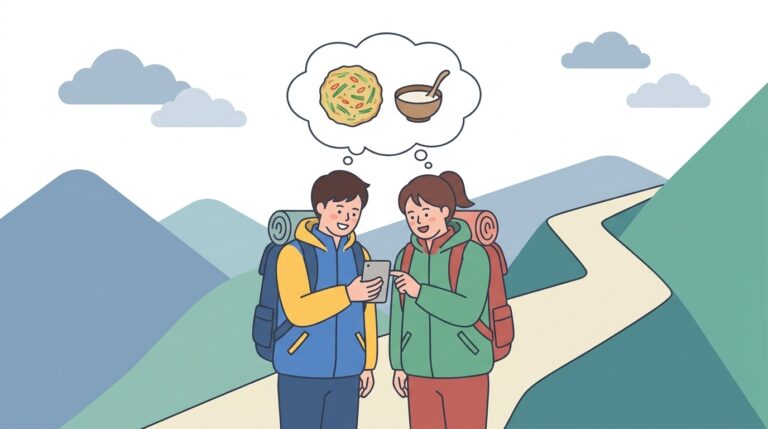
Phase 1: Empathy (Immersion Open)
Hello! Daily Hangul Editor here.
Picture this: It’s Friday afternoon in a bustling Seoul office. You and your coworkers are checking the weather app. Why? Because the weekend hiking trip (등산 – deungsan) is on the line. Someone sighs, looks at their phone, and says, “비 오면 어떡하지?” (What if it rains?).
You desperately want to reply, “If it doesn’t rain, let’s go!” but your brain suddenly freezes.
In Korea, making plans is an art form, and the weather is the ultimate boss. Knowing how to express conditions—saying “if this happens, let’s do that”—is the secret key to unlocking real friendships. It shows you have Nunchi (social awareness) and know how to pivot like a true local.
This guide is based on real tutoring sessions with expats who missed out on great weekend plans simply because they didn’t know how to set up a “Plan B” in Korean. Let’s make sure that never happens to you!
Phase 2: Core Expressions Deep Dive
1. 비가 안 오면 등산 가자
- Pronunciation: [bi-ga an o-myeon deung-san ga-ja] + [bee-ga ahn oh-myun deung-san ga-ja] (‘myun’ sounds like the ‘mun’ in ‘munch’)
- Meaning: Literal: If rain doesn’t come, let’s climb the mountain. / Real nuance: Let’s go hiking if the weather holds up.
- K-Culture Moment: You’ll hear this in almost every Friday night K-Drama scene where friends are adjusting their weekend plans. Hiking is practically a national sport in Korea!
- Editor’s Insight: The magic here is
-(으)면(if). Adding안(not) before the verb makes it negative.가자is casual, meaning “let’s go.” It’s light, friendly, and perfect for peer-to-peer chats.- Situation Spectrum:
- Casual (Friends): ✅
- Semi-formal (Co-workers): ⚠️ (Change to: 가요 instead of 가자)
- Formal (Boss/Elders): 🚫
- 🤔 Think About It: Why do Koreans always seem to have a “Plan B” based on the weather? Could it be related to Korea’s intense summer monsoon season (장마) where the weather changes by the hour?
2. 혹시 내일 비 오면 파전 먹을래요?
- Pronunciation: [hok-si nae-il bi o-myeon pa-jeon meo-geul-lae-yo?]
- Meaning: Literal: By any chance, if it rains tomorrow, do you want to eat scallion pancake? / Real nuance: If our plans get ruined by rain, let’s go get drinks and pancakes instead!
- K-Culture Moment: The ultimate rainy day K-Food combo is Makgeolli (rice wine) and Pajeon (scallion pancake). When the first drop of rain hits the pavement, Korean restaurants serving this combo are instantly fully booked.
- Editor’s Insight:
혹시(by any chance) is a fantastic word to soften your suggestion. It makes you sound considerate, not pushy.- Situation Spectrum:
- Casual (Friends): ✅ (Drop the ‘yo’ at the end)
- Semi-formal (Co-workers): ✅
- Formal (Boss/Elders): ⚠️ (Use 먹으러 갈까요? instead)
- 🤔 Think About It: Why do Koreans crave frying food when it rains? Some say the sizzling sound of the pancake batter hitting the hot oil sounds exactly like raindrops hitting the roof!
Phase 3: Textbook vs. Real Korean
[Situation 1: Making Alternative Plans]
* 📖 Textbook Korean: 만약 내일 비가 내리지 않으면, 우리는 등산을 갈 것입니다. (If it does not rain tomorrow, we will go hiking.)
* 🗣️ Real Korean: 낼 비 안 오면 등산 ㄱㄱ (If no rain tmrw, hike gogo)
* 💡 Why so different?: Texting in Korea is all about extreme efficiency. “만약” (if) is almost always dropped in daily speech because the -(으)면 ending already implies the condition. Also, “내일” becomes “낼”!
[Situation 2: Asking what to do if the condition fails]
* 📖 Textbook Korean: 비가 오면 어떻게 할까요? (What should we do if it rains?)
* 🗣️ Real Korean: 비 오면 어떡하지? / 비 오면 뭐 해? (If it rains, what do we do?)
* 💡 Why so different?: Native speakers constantly drop subject markers like “가”. Also, “어떻게 하지” naturally squishes into the much more natural-sounding “어떡하지”.
Bottom Note: For B1 learners, stick to “비가 안 오면 등산 가요” (polite) or “비 안 오면 등산 가자” (casual). You don’t need to use extreme internet slang, but dropping “만약” will instantly make you sound like a local.
Phase 4: Cultural Context — K-Culture Deep Dive
4-1. Non-verbal Elements & Nunchi
When making conditional plans, your tone is crucial. If someone’s outdoor plan gets canceled due to rain, don’t sound overly excited about the Plan B right away! Show a little Nunchi. Sigh softly, say “아쉽다…” (That’s a shame…), and then suggest the alternative.
4-2. The Weekend Hiking Ritual (K-Travel & K-Food)
Why is “비가 안 오면 등산 가자” such a classic phrase? Hiking (등산) is a deeply ingrained cultural phenomenon. If you take the Seoul subway on a Saturday morning, you’ll see a sea of middle-aged Koreans wearing neon, high-tech, Himalayan-grade outdoor gear… just to hike a local 300-meter hill.
But here is the real secret: The hike is often just an excuse for the after-party (뒷풀이). The real goal is reaching the bottom of the mountain where the Makgeolli and Pajeon restaurants are waiting. The weather condition (-(으)면) merely decides when the eating begins!
Phase 5: Real-Life Roleplay Scenario
Setting: Friday night, 7 PM. A lively Galbi restaurant near Gangnam Station. The air is thick with the smell of roasting meat, and Soju bottles line the tables. You are sitting with your Korean coworkers.
Characters:
* YOU: An expat who has been working in Seoul for a year. You want to make weekend plans.
* Min-su: 32, your friendly and humorous Korean coworker who loves the outdoors.
Dialogue:
Min-su: 이번 주말에 북한산 갈래요? 단풍이 진짜 예쁘대요!
(ibeon jumare bukhansan gallaeyo? danpungi jinjja yeppeudaeyo!)
[Wanna go to Bukhansan this weekend? They say the autumn leaves are so pretty!]
YOU: 좋아요! 근데 일요일에 비 온대요.
(joayo! geunde iryoire bi ondaeyo.)
[Sounds good! But they say it’s going to rain on Sunday.]
Min-su: 아 진짜요? 산은 비 오면 위험한데…
(a jinjja-yo? saneun bi omyeon wiheomhande…)
[Oh really? The mountain is dangerous if it rains…]
🔀 Your Turn! How do you reply?
– A) “만약 비가 내리면, 우리는 취소해야 합니다.” (Textbook, robotic)
– B) “그럼 비 안 오면 등산 가고, 비 오면 파전 먹으러 가요!” (Perfect local suggestion)
– C) “등산 싫어요. 그냥 술 마셔요.” (Too blunt, ruins the mood)✅ Best Choice: B — Why? It uses the
-(으)면grammar perfectly, offers a great Plan B, and shows you understand K-Food culture!
Min-su: 오! 완전 좋아요! 파전에 막걸리 콜?
(o! wanjeon joayo! pajeone makgeolli kol?)
[Oh! I totally love that! Pajeon and Makgeolli, deal?]
(🎭 Stage Direction: Min-su holds up his Soju glass for a toast)
YOU: 콜! 비가 와도 좋고, 안 와도 좋네요.
(kol! biga wado joko, an wado jonneyo.)
[Deal! It’s good if it rains, and good if it doesn’t.]
Min-su: 센스 대박. 그럼 일단 일요일 아침에 단톡방에서 날씨 봐서 정해요!
(senseu daebak. geureom ildan iryoil achime dantokbangeseo nalssi bwaseo jeonghaeyo!)
[Great sense. Then for now, let’s check the weather in the group chat on Sunday morning and decide!]
Bonus Scenario: Ordering Delivery
Rain is pouring outside. You are hanging out with a friend at home.
* Friend: 비 너무 많이 온다. 나가기 귀찮지?
[It’s raining so much. You feel lazy to go out, right?]
* YOU: 응. 비 오니까 짬뽕 배달 시킬까?
[Yeah. Since it’s raining, should we order Jjamppong delivery?]
* Friend: 완벽해. 비 오면 역시 국물이지!
[Perfect. When it rains, soup is the best!]
Phase 6: 10-Second Shadowing Drill
Practice these lines out loud. Pay attention to the pauses (/) and the emotion tags!
- 😊 밝게 (Brightly): 내일 / 비 안 오면 / 등산 가자!
(naeil / bi an omyeon / deungsan gaja!) - 🥺 아쉽게 (Sadly): 비 오면 / 어떡하지?
(bi omyeon / eotteokhaji?) - 😋 신나서 (Excitedly): 비 오면 / 파전에 막걸리 / 콜?
(bi omyeon / pajeone makgeolli / kol?)
Phase 7: K-Culture Mini Dictionary
| 한국어 (Korean) | Romanization | English | Cultural Context |
|---|---|---|---|
| 등산 | deungsan | Hiking | Not just a sport, but a weekend social event for Koreans. |
| 파전에 막걸리 | pajeone makgeolli | Scallion pancake & rice wine | The designated “Rainy Day” comfort food combo. |
| 콜 | kol | “Call!” / Deal! | Slang adopted from poker; used to agree to a plan enthusiastically. |
| 단톡방 | dantokbang | Group chat | The KakaoTalk group room where all Korean plans are made (and canceled). |
| 눈치 | nunchi | Social sense | Reading the room. Knowing when to pivot a plan without upsetting anyone. |
Phase 8: Traveler’s Survival Kit
If you are traveling in Korea, the weather can dictate your itinerary. Here are the survival expressions you need when things don’t go as planned.
🆘 Survival Expressions: Weather & Plans
– 🇰🇷 “비 오면 취소되나요?” (bi omyeon chwisodoenayo?)
– 🗣️ English: Is it canceled if it rains?
– 📍 Where to use: Outdoor tour guides, amusement parks, sports games.
- 🇰🇷 “우산 있어요?” (usan isseoyo?)
- 🗣️ English: Do you have an umbrella?
- 📍 Where to use: Asking a friend or a hotel concierge.
📌 Editor’s Travel Note
– Sudden Rain? Don’t panic. Just run into the nearest CU, GS25, or 7-Eleven. They sell cheap, transparent umbrellas (비닐우산) for about 4,000 KRW. It’s a lifesaver during the summer monsoon!
– Weather Apps: Don’t rely solely on global apps. Download “Naver Weather” or “KakaoMap” for hyper-local, hour-by-hour rain radar.
Phase 9: Critical Thinking Corner — “A Step Deeper”
🧠 Think Deeper: Food & Identity
Why is the connection between rain (비가 오면) and eating Pajeon so strong in Korea? It reveals how deeply intertwined Korean food culture is with the concept of community (Jeong – 정). Weather in Korea isn’t just a meteorological event; it’s a shared social mood. When it rains, the collective desire isn’t just to eat a specific food, but to share a large pancake and clink glasses of Makgeolli together, finding warmth in each other’s company while complaining about the damp weather. The weather dictates the menu, but the community dictates the experience.
💬 Your Turn: Does your culture have a specific food or activity that everyone magically agrees to do “if it rains”? Share it in the comments!
Phase 10: FAQ & Avoiding Misunderstandings
Q: Can I use “-(으)면” with my boss or elders?
Yes, the grammar itself is polite-neutral. However, you must change the ending of the sentence. Instead of saying “비 안 오면 등산 가자” (casual), say “비가 안 오면 등산 가요” or “등산 가시는 게 어떨까요?” (polite).
Q: Do I always have to use “만약” (if) at the beginning of the sentence?
No! This is a classic textbook habit. Native speakers drop “만약” 90% of the time in conversation. Just attaching -(으)면 to the verb is enough.
❌ Common Mistake #1: Trying to translate the English “if” directly as a separate word.
– Wrong context: “만약 비가 온다면…” (Too dramatic, sounds like a translated novel)
– ✅ Do this: Simply use the verb stem + “(으)면”. “비 오면…”
Phase 11: Summary & Action Items
One-Liner Summary: To make conditional plans like a local, drop the “만약”, attach -(으)면 to your verb, and always have a delicious K-Food Plan B ready!
Action Mission 3 Steps:
* 🥉 Bronze (Solo): Stand in front of a mirror and say “내일 비 안 오면 등산 가자!” three times naturally.
* 🥈 Silver (Online): Go to a Korean language exchange app (like HelloTalk) and post: “비 오면 주로 뭐 해요?” (What do you usually do if it rains?)
* 🥇 Gold (Real Life): The next time you make plans with a Korean friend, set a condition using -(으)면!
K-Culture Mission:
Open a Korean weather app or simply Google the weather in Seoul right now. Based on what you see, write one sentence in your notebook about what you would do today using -(으)면.
Did you learn something new today? Let me know your rainy day Plan B in the comments below!
Phase 12: Quiz — Interactive Challenge
1. Situational Judgment: Your friend asks what you want to do tomorrow. The forecast says it might rain. What is the most natural Korean response?
* A) 만약 내일 비가 온다면, 저는 집에 있을 것입니다.
* B) 낼 비 오면 그냥 집에서 쉴래.
* C) 비가 올 때 집입니다.
2. Fill in the Blank:
“시간이 ( ________ ), 같이 저녁 먹을래요?” (If you have time, do you want to eat dinner together?)
Hint: 시간(이) 있다 + -(으)면
3. True or False – K-Culture Edition:
In Korea, it is considered rude to cancel a hiking trip just because of a light drizzle. (T/F)
(Answers: 1. B – it sounds the most natural and casual. / 2. 있으면 (isseumyeon) / 3. False – Koreans take safety seriously on mountains; wet rocks are dangerous, so canceling or shifting to “Makgeolli mode” is highly accepted!)
Frequently Asked Questions (FAQ)
Q: What does "비가 안 오면 등산 가자" mean in Korean and how do you pronounce it?
A: In Korean, "비가 안 오면 등산 가자" is pronounced [bi-ga an o-myeon deung-san ga-ja] and means: Literal: If rain doesn't come, let's climb the mountain. / Real nuance: Let's go hiking if the weather holds up.
Q: What does "혹시 내일 비 오면 파전 먹을래요?" mean in Korean and how do you pronounce it?
A: In Korean, "혹시 내일 비 오면 파전 먹을래요?" is pronounced [hok-si nae-il bi o-myeon pa-jeon meo-geul-lae-yo?] and means: Literal: By any chance, if it rains tomorrow, do you want to eat scallion pancake? / Real nuance: If our plans get ruined by rain, let's go get drinks and pancakes instead!







