

Phase 1: Empathy & K-Culture Cold Open
Hello! I’m your Daily Hangul Editor.
You’ve definitely seen this in K-Dramas: the main characters are going on an MT (Membership Training) or having a rooftop party. They hit the local supermarket, grabbing massive packs of pork belly (Samgyeopsal) and filling their carts with mountains of fresh green leaves. It looks so fun!
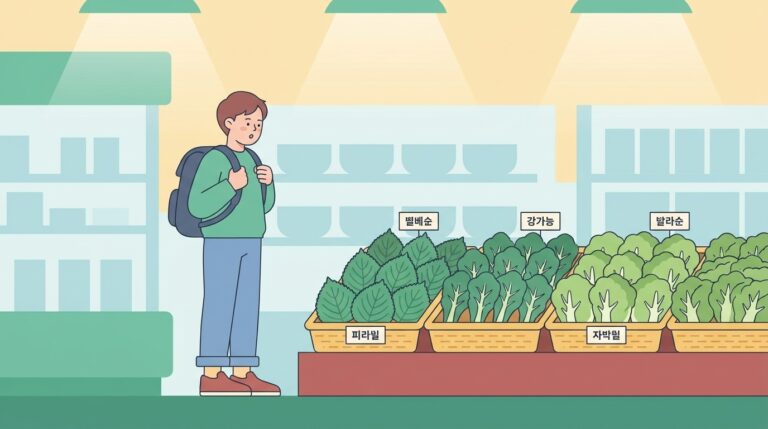
Now, cut to reality. You’re in Seoul, standing in the middle of a massive E-Mart or a bustling neighborhood grocery store. You want to buy some veggies for your own Korean BBQ night, but the signs are overwhelming, and you can’t find the lettuce anywhere. You see a busy staff member in a vest arranging apples. How do you ask for help without sounding awkward?
If you don’t know the right expressions, you might end up wandering the aisles for 30 minutes or using an unnatural translation app phrase that makes the staff freeze. But don’t worry! I’m here to give you the exact, natural phrases that will make you sound like a local resident doing their weekly grocery run. This guide is built from the real struggles of my foreign students in Seoul!
Phase 2: Deep Dive into Core Phrases
1. 채소 코너 어디에 있어요?
- Pronunciation: chaeso koneo eodie isseoyo? [Sounds like: che-so co-ner uh-dee-eh ee-sso-yo?]
- Meaning: Where is the vegetable section?
- K-Culture Moment: You’ll use this in any large Korean supermarket (마트 – Mateu). Unlike small convenience stores, Korean hypermarkets are huge. Asking this saves you a 20-minute walk!
- Editor’s Insight: ‘어디에 있어요?’ (Where is it?) is your golden ticket at the A2 level. You can put any noun in front of it. We use ‘채소’ (vegetables) or sometimes ‘야채’ (yachae), which means the same thing.
- Situation Spectrum:
- Casual with friends: ⚠️ (Say ‘채소 코너 어딨어?’ instead)
- Asking a store clerk (Semi-formal): ✅
- Formal/Elders: ✅
- 🤔 Think About It: In English, we often say ‘Where can I find…?’ but in Korean, we directly ask ‘Where does [item] exist?’ (어디에 있어요?). How does your native language structure asking for locations?
2. 상추 있어요?
- Pronunciation: sangchu isseoyo? [Sounds like: sang-choo ee-sso-yo?]
- Meaning: Do you have lettuce?
- K-Culture Moment: The moment you want to make a proper Korean ‘Ssam’ (wrap) for K-BBQ, you need ‘상추’ (lettuce). If you want to impress your Korean friends, ask for ‘깻잎’ (kkaennip – perilla leaves) too!
- Editor’s Insight: Forget complex verbs like ‘Do you sell…?’. Just say ‘[Item] 있어요?’ (Does [item] exist?). It’s the most natural, efficient way Koreans shop.
- Situation Spectrum:
- Casual with friends: ⚠️ (Say ‘상추 있어?’)
- Asking a store clerk (Semi-formal): ✅
- Formal/Elders: ✅
- 🤔 Think About It: Why do Koreans prioritize short, direct questions like ‘있어요?’ in service situations instead of long, polite requests? (Hint: ‘빨리빨리’ – hurry hurry – culture!)
3. 이거 저울 어디에 있어요?
- Pronunciation: igeo jeoul eodie isseoyo? [Sounds like: ee-geo juh-ool uh-dee-eh ee-sso-yo?]
- Meaning: Where is the scale for this?
- K-Culture Moment: In many large Korean supermarkets, you must weigh vegetables yourself and print a barcode sticker before going to the cashier. If you don’t, the cashier will send you all the way back!
- Editor’s Insight: ‘이거’ means ‘this’, and ‘저울’ is ‘scale’. Holding up the bag of veggies and asking this will make the staff realize you know how Korean supermarkets work. Instant insider status!
- Situation Spectrum:
- Casual with friends: ⚠️
- Asking a store clerk (Semi-formal): ✅
- Formal/Elders: ✅
- 🤔 Think About It: Self-service weighing systems rely on trust and efficiency. How is the grocery weighing system different in your home country?
Phase 3: Textbook vs. Real Korean
[Situation 1: Asking for a location]
* 📖 Textbook Korean: 채소를 판매하는 곳은 어디입니까? (Where is the place that sells vegetables?)
* 🗣️ Real Korean: 저기요, 채소 코너 어딨어요? (Excuse me, where’s the veg section?)
* 💡 Why the difference?: Koreans love efficiency. In daily conversations, we drop particles and use contractions (‘어딨어요’ instead of ‘어디에 있어요’) to speak faster.
[Situation 2: Asking if an item is in stock]
* 📖 Textbook Korean: 혹시 상추를 가지고 계신가요? (Do you happen to possess lettuce?)
* 🗣️ Real Korean: 상추 있어요? (Lettuce exist?)
* 💡 Why the difference?: Over-politeness in a busy supermarket actually makes communication harder. A simple, polite ‘있어요?’ (Isseoyo?) is perfectly respectful and much faster.
Bottom Note: At the A2 (Beginner) level, don’t worry about complex honorifics in the supermarket. Stick to the ‘-요’ (-yo) ending, and you will always sound polite and natural!
Phase 4: Cultural Context — K-Culture Deep Dive
4-1. Non-verbal Elements (The Supermarket ‘Nunchi’)
When asking staff for help, do not shout or wave aggressively. Walk up to them, make brief eye contact, slightly bow your head, and say “저기요” (Excuse me). Also, when pointing to an item, Koreans usually gesture with an open hand rather than pointing directly with one index finger.
4-2. K-Food Connection: The “Ssam” Culture & The Perilla Leaf Debate
Finding the vegetable section is essential because of Ssam (쌈) culture. Wrapping grilled meat in lettuce with garlic and Ssamjang (dipping sauce) is the soul of Korean dining.
But here’s a fun K-Culture fact: Next to the lettuce, you will always find Kkaennip (깻잎 – Perilla Leaves). Have you heard of the famous “Perilla Leaf Debate” (깻잎 논쟁) that K-Pop idols constantly argue about on variety shows? The leaves stick together. If your partner helps a friend peel a perilla leaf apart with their chopsticks, is it polite, or is it flirting? Knowing this makes buying vegetables so much more entertaining!
Phase 5: Real-Life Roleplay Scenario
Setting: Saturday 5 PM, Homeplus (a major Korean supermarket). You are hosting a K-BBQ dinner at your Airbnb. You need lettuce, but the store is huge and crowded. You spot a friendly staff member (이모님 – Imo-nim, commonly used for middle-aged female staff) restocking apples.
Characters:
– YOU: A foreigner who loves K-BBQ, eager but slightly lost.
– Staff (이모님): A busy but helpful supermarket employee.
Dialogue:
YOU: 저기요, 실례합니다. (jeogiyo, sillyehamnida.)
[Translation] Excuse me.
Staff: 네, 뭘 찾으세요? (ne, mwol chajeuseyo?)
[Translation] Yes, what are you looking for?
YOU: 채소 코너 어디에 있어요? (chaeso koneo eodie isseoyo?)
[Translation] Where is the vegetable section?
Staff: 채소요? 저기 우유 코너 지나서 쭉 가세요. (chaesoyo? jeogi uyu koneo jinaseo jjuk gaseyo.)
[Translation] Vegetables? Go straight past the milk section over there.
(🎭 Stage Direction: The staff points vaguely toward the back of the store.)
YOU: 아, 우유 코너요. 혹시 깻잎도 있어요? (a, uyu koneoyo. hoksi kkaennipto isseoyo?)
[Translation] Ah, the milk section. Do you happen to have perilla leaves too?
Staff: 네, 상추 옆에 다 있어요. (ne, sangchu yeope da isseoyo.)
[Translation] Yes, they are all right next to the lettuce.
YOU: 감사합니다! 아, 이거 저울 어디에 있어요? (gamsahamnida! a, igeo jeoul eodie isseoyo?)
[Translation] Thank you! Ah, where is the scale for this?
Staff: 저울은 채소 코너 가운데에 있어요. 번호 누르고 바코드 붙이세요. (jeoureun chaeso koneo gaundee isseoyo. beonho nureugo bakodeu buchiseyo.)
[Translation] The scale is in the middle of the vegetable section. Press the number and attach the barcode.
🔀 Your Turn! How do you reply?
– A) “바코드요? 무슨 말인지 모르겠어요.” (Barcode? I don’t know what you mean.)
– B) “네, 알겠습니다. 감사합니다!” (Yes, I understand. Thank you!)
– C) “저기요, 같이 가주세요!” (Excuse me, go with me!)✅ Best Choice: B — Reason: Even if you are a bit unsure, saying “I understand, thank you” and figuring it out at the scale is the polite Korean way. There’s usually a picture guide on the scale anyway!
⚠️ Choice C Analysis: Asking them to walk with you (“같이 가주세요”) might be too direct and demanding for a busy staff member in Korea. They will help, but they might feel pressured.
Phase 6: 10-Second Shadowing Drill
Let’s practice the most important phrase. Read this out loud in 10 seconds!
😊 저기요, / 채소 코너는 / 어디에 있어요?
(jeogiyo, / chaeso koneoneun / eodie isseoyo?)
Emotion: Friendly but slightly confused! Raise your pitch at the end.
Phase 7: K-Culture Mini Dictionary
| Korean | Romanization | English | Context |
|---|---|---|---|
| 눈치 | nunchi | Social sense | Reading the room. e.g., Not blocking the busy supermarket aisle. |
| 쌈 | ssam | Wrap | The act of wrapping meat and rice in leafy greens. |
| 상추 | sangchu | Lettuce | The absolute basic requirement for Korean BBQ. |
| 깻잎 | kkaennip | Perilla leaf | The sesame-flavored leaf. You either love it or hate it! |
| 마트 | mateu | Supermarket | Used for big grocery stores (E-Mart, Lotte Mart). |
| 장보기 | jangbogi | Grocery shopping | The action of buying groceries. |
Phase 8: Traveler’s Survival Kit
Are you traveling in Korea? Here are the top 3 phrases you MUST know when buying anything at a mart or convenience store.
🆘 Survival Phrases
– 🇰🇷 1. 이거 얼마예요? (igeo eolmayeyo?) – How much is this?
– 🇰🇷 2. 이거 행사 상품이에요? (igeo haengsa sangpumieyo?) – Is this a promotional item? (Great for 1+1 or 2+1 deals!)
– 🇰🇷 3. 봉투 하나 주세요. (bongtu hana juseyo.) – Please give me a bag.📌 Editor’s Travel Note
– Shopping Bags: In Korea, large supermarkets do not give out regular plastic bags to protect the environment. Instead, they sell paper bags or 종량제 봉투 (jongnyangje bongtu – official city garbage bags). Don’t be surprised! Buying a garbage bag at the checkout is a local hack because you can use it to carry groceries home, and then use it for trash later!
– Payment: Korea is a cashless society. Always have your credit card ready!
Phase 9: Critical Thinking Corner — “One Step Deeper”
Food & Identity: Why Do Koreans Love “Ssam” (Wrapping)?
🧠 Think Deeper:
When you finally find the lettuce, you are participating in a deeply historical Korean food culture. “Ssam” (쌈) is more than just eating vegetables. It represents harmony. By taking a piece of meat, rice, garlic, and sauce, and wrapping it all into one single bundle, you are combining different elements into one perfect bite. Historically, wrapping food in leaves was considered a symbol of wrapping up “good luck” (복 – bok). It reflects the communal and inclusive nature of Korean society—everything is better when brought together!💬 Your Turn: Does your culture have a special way of combining foods into a single bite? Share it in the comments!
Phase 10: FAQ & Avoiding Common Mistakes
Q: Can I use “당신” (Dangsin – You) when talking to the supermarket staff?
NO. Never use “당신” to a stranger in Korea. It can sound aggressive or confrontational. Always use “저기요” (Excuse me) to get their attention, and just omit the word “you” entirely in your sentence.
Q: Do I really have to weigh vegetables myself?
Usually, yes! In major marts (E-Mart, Homeplus), look for a digital scale in the middle of the vegetable section. Put your veggies on it, press the picture of the vegetable on the screen, and it prints a barcode. If you forget, the cashier will be very frustrated!
❌ Common Mistake #1: Going to the cashier with unweighed, barcode-less vegetables in a plastic bag.
✅ Do This Instead: Ask “이거 저울 어디에 있어요?” (Where is the scale for this?) before leaving the vegetable section.
Phase 11: Summary & Action Items
- One-Liner Summary: Find the veggie section like a pro by simply using the magic phrase: “[Item] 어디에 있어요?”
-
Action Mission 3 Stages:
- 🥉 Bronze (Solo): Stand in your own kitchen and point to a vegetable, saying “채소 어디에 있어요?” out loud 3 times.
- 🥈 Silver (Online): Go to a K-Drama or K-Pop forum and explain the “Perilla Leaf Debate” using the word 깻잎 (Kkaennip).
- 🥇 Gold (Real Life): Visit a Korean mart or Asian grocery store in your city and ask the staff “상추 있어요?”
- K-Culture Mission: Watch a K-Drama this week, and spot a scene where characters are eating K-BBQ. Count how many times they wrap meat in a lettuce leaf!
Phase 12: Interactive Quiz
1. Situational Judgment: You are at E-Mart and want to buy perilla leaves, but you can’t find them. You see a staff member. What is the most natural thing to say?
– A) 당신, 깻잎을 판매합니까?
– B) 저기요, 깻잎 어디에 있어요?
– C) 깻잎을 저에게 주세요.
2. True or False – K-Culture Edition:
– In large Korean supermarkets, it is normal to take vegetables straight to the cashier without printing a barcode sticker yourself. (T/F)
3. Fill in the Blank:
– 👨🍳 You: “저기요, 채소 ____ 어디에 있어요?” (Excuse me, where is the vegetable section?)
👉 Click to see the answers!
- B (A uses the forbidden word ‘당신’. C sounds like a robbery!)
- False (You almost always have to use the self-weighing scale – 저울 – first!)
- 코너 (koneo) – meaning ‘corner’ or ‘section’.
Frequently Asked Questions (FAQ)
Q: What does "채소 코너 어디에 있어요?" mean in Korean and how do you pronounce it?
A: In Korean, "채소 코너 어디에 있어요?" is pronounced [chaeso koneo eodie isseoyo? [Sounds like: che-so co-ner uh-dee-eh ee-sso-yo?] and means: Where is the vegetable section?
Q: What does "상추 있어요?" mean in Korean and how do you pronounce it?
A: In Korean, "상추 있어요?" is pronounced [sangchu isseoyo? [Sounds like: sang-choo ee-sso-yo?] and means: Do you have lettuce?
Q: What does "이거 저울 어디에 있어요?" mean in Korean and how do you pronounce it?
A: In Korean, "이거 저울 어디에 있어요?" is pronounced [igeo jeoul eodie isseoyo? [Sounds like: ee-geo juh-ool uh-dee-eh ee-sso-yo?] and means: Where is the scale for this?






