

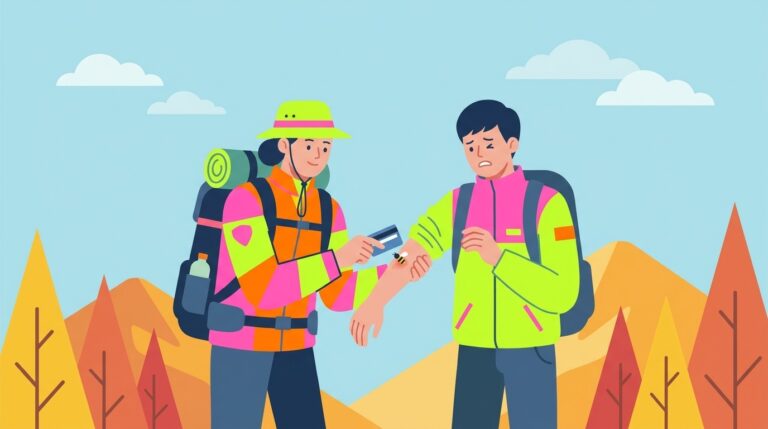
Phase 1: Empathy & The K-Culture Cold Open
Hello! I’m the lead editor at Daily Hangul, your veteran tutor and local culture navigator.
Imagine this: You are halfway up Mount Bukhansan on a crisp autumn Saturday. You’re decked out in full neon Deungsanbok (hiking gear), sharing cherry tomatoes and kimbap with your Korean hiking club (Donghohoe). Suddenly, someone screams. A massive Korean autumn hornet (malbeol) has just stung your group’s leader.
In a K-Drama, this is the exact moment the male lead would romantically toss the injured person onto his back for a dramatic piggyback ride (eobuba) down the mountain, accompanied by a sweeping ballad OST. But in reality? Running down a mountain with someone experiencing an allergic reaction is a medical disaster.
At a C2 (Advanced) level, you already know how to say “I am hurt” or “Call a doctor.” But in a life-or-death outdoor emergency in Korea, you need hyper-specific, pragmatic language. If someone goes into anaphylactic shock, knowing how to explain how you removed the stinger and monitoring their airway can literally save a life. Let’s dive into the real, unfiltered emergency Korean you hope you never need, but absolutely must know.
Phase 2: Core Expressions Deep Dive
1. 카드로 살살 밀어서 침부터 빼야 해요.
- Pronunciation: Kadeu-ro salsal mireoseo chim-buteo ppaeya haeyo.
- Meaning: We need to gently scrape the stinger out with a card first.
- K-Culture Moment: Koreans are incredibly practical. In an emergency, someone will inevitably whip out their credit card (since Korea is a cashless society, everyone has one handy) to use as a makeshift medical tool.
- Editor’s Insight: The key verb here is 밀다 (to push/scrape) rather than 뽑다 (to pull/pluck). Medical guidelines say pulling a stinger squeezes more venom into the skin. C2 learners must grasp these precise action verbs.
- Situation Spectrum:
- Casual (Friends): ✅ “야, 손대지 마! 카드로 밀어!” (Hey, don’t touch it! Scrape it with a card!)
- Semi-formal (Colleagues): ✅
- Formal (Elders/Strangers): ✅ (In emergencies, action-oriented directness supersedes extreme politeness, though you still use the polite -요 ending).
- 🤔 Think About It: Why do Koreans often append “-부터” (first) to the object here (chim-buteo)? It shows prioritizing the most critical action in a sequence. How does your native language emphasize immediate priorities?
2. 혹시 호흡 곤란이나 어지럼증 같은 알레르기 반응이 있나요?
- Pronunciation: Hokshi hoheup gollan-이나 eojireomjeung gateun allereugi baneung-i innayo?
- Meaning: Do you happen to have any allergic reactions like shortness of breath or dizziness?
- K-Culture Moment: Even when assessing a severe medical situation, Koreans often use the pragmatic softener 혹시 (by any chance). It prevents the question from sounding like an aggressive interrogation and shows empathy.
- Editor’s Insight: Notice the advanced medical vocabulary: 호흡 곤란 (dyspnea/shortness of breath) and 어지럼증 (dizziness/vertigo). Using these exact Sino-Korean terms when speaking to the 119 dispatcher will get you a much faster, more serious response than just saying “숨쉬기 힘들어요” (It’s hard to breathe).
- Situation Spectrum:
- Casual: ⚠️ (A bit too clinical for friends; use “숨쉬기 안 답답해?”)
- Semi-formal: ✅
- Formal: ✅
- 🤔 Think About It: “알레르기” comes from the German Allergie, reflecting the early influence of German medicine in Korea via Japan. Does your language adapt medical loanwords differently?
3. 독낭이 터질 수 있으니까 손으로 만지지 마세요!
- Pronunciation: Dongnang-i teojil su isseunikka soneuro manjiji maseyo!
- Meaning: The venom sac could burst, so don’t touch it with your hands!
- K-Culture Moment: You will often hear Korean elders firmly giving instructions with “~하지 마세요” (Don’t do X) out of care. This is the phenomenon of Jeong (정) manifesting as bossy, protective affection.
- Editor’s Insight: 독낭 (venom sac) and 터지다 (to burst). The grammar pattern -을 수 있으니까 (because it could…) is crucial for justifying your urgent commands, preventing misunderstandings.
- Situation Spectrum:
- Casual: ✅
- Semi-formal: ✅
- Formal: ✅
Phase 3: Textbook vs. Real Korean
[Describing a Severe Allergy]
* 📖 Textbook Korean: 저는 벌 알레르기가 있습니다. 매우 위험합니다. (I have a bee allergy. It is very dangerous.)
* 🗣️ Real Korean: 저 벌독 알레르기 심해서 아나필락시스 올 수도 있어요. (My bee venom allergy is severe, I might go into anaphylaxis.)
* 💡 Why the Difference?: At a C2 level, you should use the specific medical loanword (아나필락시스) that 119 operators listen for to categorize the priority of the ambulance dispatch.
[Telling Someone Not to Touch the Sting]
* 📖 Textbook Korean: 거기에 손을 대지 마십시오. (Do not put your hand there.)
* 🗣️ Real Korean: 앗, 긁지 마요! 독통 터져요! (Ah, don’t scratch it! The venom sac will burst!)
* 💡 Why the Difference?: In emergencies, Koreans drop formal textbook endings (-십시오) and use urgent, clipped phrases (-요) or even exclamations to convey immediate danger.
Phase 4: Cultural Context — K-Culture Deep Dive
4-1. Non-Verbal Communication: Nunchi in an Emergency
In a Korean emergency, Nunchi (눈치) dictates who takes charge. Usually, the oldest person or the group leader (대장) steps up. However, if you are the one with the medical knowledge (or the credit card ready to scrape the stinger), you must read the room rapidly. You can assert authority respectfully by acting decisively while maintaining the polite -요 form.
4-2. The “Folk Remedy” Trap (민간요법)
If you get stung in the countryside or on a mountain with older Koreans, someone might earnestly suggest rubbing Doenjang (된장 – soybean paste) or even pouring Soju over the wound.
* The Critical View: Why does this happen? Historically, before modern clinics were widespread, Koreans relied on fermented goods, believing they had drawing properties or cooling effects. While it’s a touching display of Jeong (wanting to heal you with what they have), at a C2 level, you must politely but firmly decline: “마음은 감사하지만, 2차 감염 위험이 있어서 물로만 씻을게요!” (I appreciate the thought, but there’s a risk of secondary infection, so I’ll just wash it with water!)
Phase 5: Real-Life Roleplay Scenario
Setting: Saturday morning, halfway up Mount Seoraksan. The autumn leaves are beautiful, but the yellow jackets are aggressive. You are hiking with your Korean hiking club.
Characters:
– YOU: A foreign expat who has lived in Korea for years, well-versed in mountain safety.
– Minji (32): Your friendly, slightly dramatic hiking club member.
Dialogue:
민지: (갑자기 팔을 부여잡으며) 아악! 🐝
(gapjagi pareul buyeojabeumyeo) Aak!
[Translation] (Suddenly grabbing her arm) Ahhk!
YOU: 민지 씨, 왜 그래요? 벌레 물렸어요?
Minji ssi, wae geuraeyo? beolle mullyeosseoyo?
[Translation] Minji, what’s wrong? Did you get bitten by a bug?
민지: 방금 뭐가 확 쏘고 갔어요. 말벌 같아요. 엄청 따갑고 붓고 있어요!
Banggeum mwoga hwak ssogo gasseoyo. Malbeol gatayo. Eomcheong ttagapgo butgo isseoyo!
[Translation] Something just stung me and flew off. I think it’s a hornet. It stings so much and is swelling!
YOU: 헐, 쏘인 자리에 침 박혀 있는지 볼게요. 움직이지 마세요.
Heol, ssoin jarie chim bakhyeo inneunji bolgeyo. Umjigiji maseyo.
[Translation] OMG, let me see if the stinger is stuck in the bite. Don’t move.
민지: 너무 아파요. 가방에 핀셋 있는데 그걸로 좀 뽑아주실래요?
Neomu apayo. Gabang-e pinset inneunde geugeollo jom ppobajusillaeyo?
[Translation] It hurts so much. I have tweezers in my bag, could you pull it out with that?
🔀 Your Turn! How do you respond?
– A) 네, 빨리 핀셋으로 뽑을게요! (Yes, I’ll pull it fast with tweezers!)
– B) 안 돼요! 독낭 터질 수 있으니까 제 신용카드로 살살 밀어서 뺄게요.
– C) 그냥 된장 바르면 금방 나을 거예요.✅ Best Choice: B — Reason: Medically accurate and culturally pragmatic. Using a credit card is the standard first-aid advice in Korea.
⚠️ Choice A & C Analysis: Choice A is dangerous (squeezes venom). Choice C is a joke about old folk remedies—funny in a classroom, disastrous on a mountain.
(Continuing with Choice B)
YOU: 안 돼요! 독낭 터질 수 있으니까 제 신용카드로 살살 밀어서 뺄게요.
An dwaeyo! Dongnang teojil su isseunikka je sinyongkadeuro salsal mireoseo ppaelgeyo.
[Translation] No! The venom sac could burst, so I’ll gently scrape it out with my credit card.
(🎭 Stage Direction: You carefully scrape the stinger away with your T-money card)
민지: 하아… 빠졌어요? 고마워요. 근데 저 약간 어지러운 것 같아요.
Haa… ppajyeosseoyo? Gomawoyo. Geunde jeo yakgan eojireoun geot gatayo.
[Translation] Haa… is it out? Thank you. But I feel a little dizzy.
YOU: 혹시 호흡 곤란이나 다른 알레르기 반응은 없어요?
Hokshi hoheup gollan-이나 dareun allereugi baneung-eun eopseoyo?
[Translation] Do you happen to have shortness of breath or any other allergic reactions?
민지: 숨쉬는 것도 좀 답답해지는 것 같아요. 저 사실 벌독 알레르기 있거든요…
Sumswineun geotdo jom dapdaphaejineun geot gatayo. Jeo sasil beoldok allereugi itgeodeunyo…
[Translation] Breathing is getting a bit difficult too. I actually have a bee venom allergy…
YOU: 아나필락시스 올 수 있으니까 당장 119 산악구조대에 신고할게요. 그늘에 앉아 계세요!
Anapillaksiseu ol su isseunikka dangjang il-il-gu sanakgujo-dae-e singohalgeyo. Geuneure anja gyeseyo!
[Translation] You could go into anaphylaxis, so I’ll call 119 Mountain Rescue immediately. Stay seated in the shade!
Phase 6: 10-Second Shadowing Drill
Speak out loud, matching the urgency and pacing!
😤 안 돼요! / 독낭 터질 수 있으니까 / 제 신용카드로 / 살살 밀어서 뺄게요!
(an dwaeyo! / dongnang teojil su isseunikka / je sinyongkadeuro / salsal mireoseo ppaelgeyo!)
Phase 7: K-Culture Mini Dictionary
| 한국어 | Romanization | English | Cultural Context |
|---|---|---|---|
| 말벌 | malbeol | Hornet | Korea’s giant hornets are notoriously aggressive, especially in autumn leading up to Chuseok when people clear ancestral graves (벌초). |
| 119 | il-il-gu | Emergency Number | Korea’s equivalent of 911 for fire and medical emergencies. (112 is for police). |
| 산악구조대 | sanak-gujodae | Mountain Rescue | Highly trained rescue teams that often deploy helicopters to extract injured hikers from Korea’s rocky peaks. |
| 국가지점번호 | gukga-jijeom-beonho | National Point Number | Yellow signs on Korean mountain trails. Read this alphanumeric code to 119 so they know your exact GPS location. |
| 민간요법 | mingan-yobeop | Folk Remedy | Traditional home treatments (like applying soybean paste to a sting) that are culturally ingrained but medically advised against. |
Phase 8: Traveler Survival Kit (Hiking Edition)
🆘 Survival Phrase #1: Giving your location to 119
– 🇰🇷 “여기 북한산 00번 표지판 앞인데요, 구급차 좀 보내주세요!”
– 🗣️ (Yeogi Bukhansan [Number]-beon pyojipan apindeyo, gugeupcha jom bonaejuseyo!)
– 📍 Context: Calling 119 on a mountain.
– 💡 Pro Tip: If you can’t find a trail marker, open KakaoMap or Naver Map, drop a pin, and you can read the exact Korean address or coordinates to the dispatcher.📌 Editor’s Travel Note: Korea’s Medical Speed
If you ever have to go to an ER (응급실) in Korea due to an allergy, you will be amazed by the speed and affordability, thanks to National Health Insurance. However, remember to bring your ARC (Alien Registration Card) or Passport. Also, ambulances (119) are free in Korea for genuine emergencies, so never hesitate to call if anaphylaxis is suspected!
Phase 9: Critical Thinking Corner — “A Step Deeper”
🧠 Think Deeper: Media vs. Reality in Korean Emergencies
If you’ve watched enough K-Dramas, you might think the standard response to a mountain injury is the romantic eobuba (piggyback ride). The male lead heroically carries the heroine all the way to a hospital. However, at an advanced linguistic and cultural level, we must recognize this as pure cinematic fiction. In cases of venomous stings or anaphylactic shock, moving the patient rapidly increases their heart rate, spreading the venom through the bloodstream faster. The true Korean cultural protocol is utilizing the highly efficient infrastructure: looking for the yellow 국가지점번호 (National Point Number) signs on the trail and letting the helicopter rescue teams do their job. Language reflects this reality—notice how our vocabulary focused on immobilization (앉아 계세요) and reporting (신고하다) rather than physical heroics.
💬 Your Turn: Have you ever seen a medical situation in a K-Drama that made you scream at the screen because it was medically inaccurate? How does your culture handle outdoor emergencies? Let’s discuss in the comments!
Phase 10: FAQ & Mistake Prevention
- Q: Can I use 반말 (informal language) to a 119 dispatcher if it’s an extreme emergency?
- A: NO. Even if you are bleeding or panicking, always use the
-요form (e.g., “도와주세요!” not “도와줘!”). Dropping honorifics completely to an emergency operator can cause confusion or be perceived as intoxication/disrespect. Keep it short, but keep the-요.
- A: NO. Even if you are bleeding or panicking, always use the
- Q: Is it okay to say “119에 전화할게요”?
- A: Yes, but “119에 신고할게요” is better.
전화하다is just dialing a phone.신고하다means to officially report an incident to authorities.
- A: Yes, but “119에 신고할게요” is better.
❌ Common Mistake #1: Calling 112 for an ambulance.
✅ Do this instead: Memorize the split: 119 is for Fire/Medical (구급차). 112 is for Police (경찰).
Phase 11: Summary & Action Items
- One-Liner Summary: In a bee sting emergency, don’t rely on folk remedies or K-Drama piggybacks; use a credit card to scrape the stinger (밀어서 빼다) and monitor for anaphylaxis (아나필락시스).
-
Action Mission 3 Steps:
- 🥉 Bronze (Solo): Stand in front of a mirror and practice saying the 10-second shadowing drill with absolute urgency.
- 🥈 Silver (Online): Go to a Korean language forum or comment below: Explain in C2 Korean why you shouldn’t use tweezers to remove a bee stinger.
- 🥇 Gold (Real World): Open Naver Map or KakaoMap right now, zoom into a Korean national park (like Seoraksan), and try to spot where the nearest emergency trail markers or shelters (대피소) are located!
- K-Culture Mission: Next time you watch a K-Drama with a hospital or outdoor rescue scene, listen closely. Can you hear them use the word “신고하다” or “응급실”?
Phase 12: Quiz — Interactive Challenge
1. Situational Judgment: Your friend gets stung by a wasp on a hike and their lips are swelling rapidly. What is the MOST appropriate and culturally accurate C2-level response?
– A) “빨리 제 등에 업히세요! 뛰어서 내려갈게요!” (Hurry, get on my back! I’ll run down!)
– B) “된장을 바르면 해독이 될 거예요.”
– C) “아나필락시스 반응 같아요. 움직이지 마시고 제가 119에 신고할게요.”
2. Fill in the Blank:
독낭이 터질 수 있으니까 손으로 뽑지 말고, 신용카드로 살살 ( _______ ) 빼야 해요.
(Hint: Scrape/push it)
3. True or False – K-Culture Edition:
In Korea, calling a 119 ambulance for a genuine medical emergency like anaphylactic shock costs about $500 USD. (T/F)
👀 Click here for Answers!
- C is correct. A is the K-drama trope (dangerous). B is the outdated folk remedy (also dangerous).
- 밀어서 (mireoseo).
- False! 119 ambulance services are provided free of charge by the government for genuine medical emergencies in Korea. (Private ambulances, however, do charge a fee).
Frequently Asked Questions (FAQ)
Q: What does "카드로 살살 밀어서 침부터 빼야 해요." mean in Korean and how do you pronounce it?
A: In Korean, "카드로 살살 밀어서 침부터 빼야 해요." is pronounced [Kadeu-ro salsal mireoseo chim-buteo ppaeya haeyo.] and means: We need to gently scrape the stinger out with a card first.
Q: What does "혹시 호흡 곤란이나 어지럼증 같은 알레르기 반응이 있나요?" mean in Korean and how do you pronounce it?
A: In Korean, "혹시 호흡 곤란이나 어지럼증 같은 알레르기 반응이 있나요?" is pronounced [Hokshi hoheup gollan-이나 eojireomjeung gateun allereugi baneung-i innayo?] and means: Do you happen to have any allergic reactions like shortness of breath or dizziness?
Q: What does "독낭이 터질 수 있으니까 손으로 만지지 마세요!" mean in Korean and how do you pronounce it?
A: In Korean, "독낭이 터질 수 있으니까 손으로 만지지 마세요!" is pronounced [Dongnang-i teojil su isseunikka soneuro manjiji maseyo!] and means: The venom sac could burst, so don't touch it with your hands!







