

Phase 1: Empathy & Immersion (Welcome to Korea!)
Hello! I’m your Daily Hangul Editor.
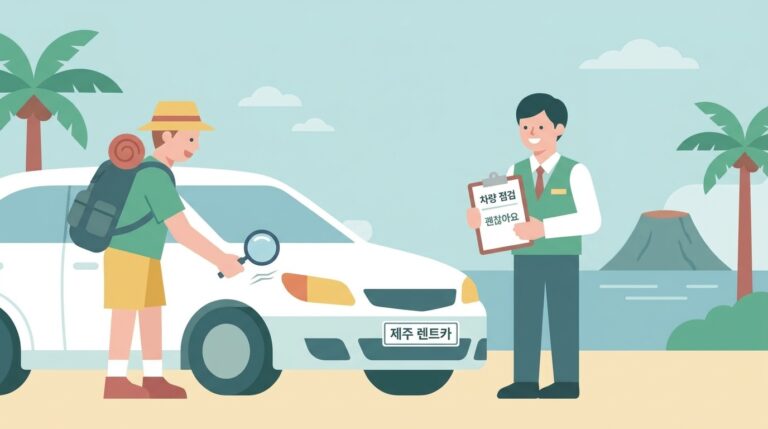
Picture this: You’ve just landed in Jeju Island. The palm trees are swaying, the ocean breeze is fresh, and you’re ready to recreate that iconic coastal drive scene from your favorite K-Drama, Welcome to Samdal-ri. You head to the massive rental car center, sign the papers, and finally walk up to your ride.
But wait… as you inspect the car, you spot a giant scratch on the front bumper. The Korean rental staff is bustling around at the speed of light (ppalli-ppalli culture at its finest). You need to tell them about the scratch before you drive off, otherwise, they might think you did it! But how do you say that politely yet firmly in Korean?
If you simply say “I’m sorry, but broken,” it might sound like the engine exploded! Don’t worry. This guide is based on real questions from travelers who panicked in rental car parking lots. Let’s learn the exact A2-level phrases you need to protect your wallet and enjoy your Korean road trip like a true insider!
Phase 2: Core Expressions Deep Dive
1. 여기에 흠집이 있어요. (There is a scratch here.)
- Pronunciation: [yeo-gi-e heum-jib-i i-sseo-yo]
(Tip: ‘heum-jib’ sounds a bit like saying “Hmm, a zip”)- Meaning: Literal: “Here, a scratch exists.” / Real nuance: “Hey, I found a scratch right here.”
- K-Culture Moment: Imagine a tense scene in a K-Drama where a chaebol heir inspects his luxury sports car. He points at the door and coldly says, “여기에 흠집이 있네.” For us regular folks, adding “~요” makes it polite and perfect for speaking to staff.
- Editor’s Insight: This is the most direct, factual, and safe way to point out damage. It’s not accusatory; you’re simply stating a fact.
- Situation Spectrum:
- Casual (Friends): ✅ (여기에 흠집 있어)
- Semi-formal (Staff/Clerks): ✅ (여기에 흠집이 있어요)
- Formal (Boss/Elders): ⚠️ (여기에 흠집이 있습니다)
- 🤔 Think About It: In Korean, we often use the subject particle ‘이/가’ with ‘있어요/없어요’ to express existence. Why do you think Korean focuses on “The scratch exists” rather than “The car has a scratch”? It removes the blame from any specific person!
2. 이거 원래 있던 건가요? (Was this here originally?)
- Pronunciation: [i-geo won-lae it-deon geon-ga-yo?]
- Meaning: Literal: “Is this something that was originally here?” / Real nuance: “Did you guys already know about this damage?”
- K-Culture Moment: You’ll hear the word “원래 (won-lae / originally)” ALL the time in Korea. In a K-Pop idol V-Live, a member might say, “원래 제 머리색은 까만색이에요” (My hair color was originally black). Here, you’re using it to double-check facts.
- Editor’s Insight: This is a fantastic ‘Nunchi (tactful)’ phrase. Instead of saying “You gave me a broken car!” you are softly asking if the scratch was already documented. It avoids making the staff defensive.
- Situation Spectrum:
- Casual (Friends): ✅ (이거 원래 있던 거야?)
- Semi-formal (Staff/Clerks): ✅ (이거 원래 있던 건가요?)
- Formal (Boss/Elders): 🚫 (Use a more honorific form)
- 🤔 Think About It: Korean culture values harmony (기분 – gibun). How does framing a complaint as a question (“Was this here?”) help maintain social harmony compared to a direct accusation?
3. 미리 사진 찍어둘게요. (I’ll take a picture in advance.)
- Pronunciation: [mi-ri sa-jin jji-geo-dul-ge-yo]
- Meaning: Literal: “I will take a picture in advance.” / Real nuance: “Just for the record, I’m taking a photo of this now.”
- K-Culture Moment: Koreans document everything with their smartphones. Go to any trendy cafe in Hongdae, and no one touches their cake until photos are taken. This habit extends to rental cars!
- Editor’s Insight: The grammar
~아/어 두다means doing something in advance for future use. Saying this shows the staff that you are a smart traveler who knows how the system works.- Situation Spectrum:
- Casual (Friends): ✅ (미리 사진 찍어둘게)
- Semi-formal (Staff/Clerks): ✅ (미리 사진 찍어둘게요)
- Formal (Boss/Elders): ✅ (미리 사진 찍어두겠습니다)
Phase 3: Textbook vs Real Korean
[Pointing out a scratch]
* 📖 Textbook Korean: 차량에 손상이 있습니다. (There is damage to the vehicle.) – Too robotic!
* 🗣️ Real Korean: 여기 기스 났어요. (There’s a scratch here.)
* 💡 Why the difference?: You will hear Koreans say “기스 (gi-seu)” instead of “흠집 (heum-jib)” very often. “Giseu” comes from the Japanese word for scratch (kizu). While standard Korean education pushes for “heum-jib,” everyday mechanics and drivers still use “giseu” as a habit.
[Confirming it’s okay]
* 📖 Textbook Korean: 이 상태로 운전해도 괜찮습니까? (Is it acceptable to drive in this condition?)
* 🗣️ Real Korean: 그냥 타도 돼요? (Can I just ride/drive it like this?)
* 💡 Why the difference?: Koreans love efficiency. “그냥 (just)” + “타도 돼요? (can I ride?)” cuts straight to the chase and sounds incredibly natural.
Bottom Note: At the
A2 (Beginner)level, sticking to “여기에 흠집이 있어요” is perfectly safe and polite. But if the staff says “아, 그 기스요?” (Ah, that scratch?), now you’ll know exactly what they mean!
Phase 4: Cultural Context — K-Culture Deep Dive
4-1. Non-verbal Elements: The “Walk-Around Ritual”
In Korea, there is an unspoken ritual when renting a car. Before you open the door, you must take out your phone, switch to video mode, and slowly walk 360 degrees around the car. The staff actually expect you to do this! Also, when pointing out a scratch, use your whole hand (palm facing up) to gesture toward the car, rather than pointing aggressively with one index finger.
4-2. K-Travel Connection: The Black Box (Dashcam) Rule
If you rent a car in Jeju Island, you will notice a little camera on your windshield. In K-Dramas, whenever there’s a mystery or a car accident, the police always say, “블랙박스 확인해!” (Check the black box!). In Korea, dashcams are called “Black Boxes” (블랙박스), and 99.9% of cars have them. When you rent a car, you don’t usually need to worry about arguing over who caused a dent while driving, because the Black Box catches everything. However, pre-existing scratches must be checked manually!
Phase 5: Real-World Roleplay Scenario
Setting: Jeju International Airport Rent-a-Car House. It’s windy. You’re standing next to a shiny white Kia K5. The rental staff, Mr. Kim (45, busy but friendly), hands you the clipboard.
Characters:
– YOU: A foreign traveler so excited to eat Jeju black pork, but trying to be responsible.
– Mr. Kim: The rental staff who is managing 10 cars at once.
Dialogue:
Mr. Kim: 고객님, 차량 여기 있습니다. 사인해 주세요. 📝
(go-gaeng-nim, cha-ryang yeo-gi it-seum-ni-da. sa-in-hae ju-se-yo.)
[Customer, the vehicle is here. Please sign.]
YOU: 아, 잠시만요. 차 한 번 볼게요. 👀
(a, jam-si-man-yo. cha han beon bol-ge-yo.)
[Ah, just a moment. I’ll take a look at the car.]
(🎭 Stage Direction: You walk around the car and spot a mark on the door)
YOU: 저기요, 여기에 흠집이 있어요. 🚗
(jeo-gi-yo, yeo-gi-e heum-jib-i i-sseo-yo.)
[Excuse me, there is a scratch here.]
Mr. Kim: 아, 문 쪽이요? 확인해 보겠습니다.
(a, mun jjog-i-yo? hwa-gin-hae bo-get-seum-ni-da.)
[Ah, by the door? Let me check.]
🔀 Your Turn! How should you respond while he checks?
– A) “빨리 해주세요!” (Do it quickly!)
– B) “이거 원래 있던 건가요?” (Was this here originally?)
– C) “경찰 부를까요?” (Should I call the police?)✅ Best Choice: B — It’s polite, non-confrontational, and gets the job done.
⚠️ Choice A & C Analysis: A sounds extremely rude and demanding. C is a massive overreaction for a tiny scratch and will definitely ruin the mood!
Mr. Kim: 네, 이건 기존 흠집이네요. 전산에 등록되어 있습니다.
(ne, i-geon gi-jon heum-jib-i-ne-yo. jeon-san-e deung-nok-doe-eo it-seum-ni-da.)
[Yes, this is an existing scratch. It’s registered in the system.]
YOU: 다행이네요. 그래도 미리 사진 찍어둘게요. 📸
(da-haeng-i-ne-yo. geu-rae-do mi-ri sa-jin jji-geo-dul-ge-yo.)
[That’s a relief. Still, I’ll take a picture just in case.]
Mr. Kim: 네, 그렇게 하세요! 즐거운 여행 되세요!
(ne, geu-reo-ke ha-se-yo! jeul-geo-un yeo-haeng doe-se-yo!)
[Yes, please do! Have a great trip!]
Phase 6: 10-Second Shadowing Drill
Let’s practice reading with the right feeling and rhythm! (The / means a short pause).
- 🙋♂️ To get attention:
😊 저기요, / 여기에 / 흠집이 있어요! (jeo-gi-yo, / yeo-gi-e / heum-jib-i i-sseo-yo!) -
📸 To state your action:
😤 확실히 하려고 / 미리 / 사진 찍어둘게요. (hwak-sil-hi ha-ryeo-go / mi-ri / sa-jin jji-geo-dul-ge-yo.)
Phase 7: K-Culture Mini Dictionary
| Korean | Romanization | English | Contextual Meaning |
|---|---|---|---|
| 렌터카 | ren-teo-ka | Rental Car | Commonly used over the pure Korean word. |
| 블랙박스 | beul-laek-bak-seu | Dashcam | Essential car accessory in Korea. Don’t say “dashcam”! |
| 완전자차 | wan-jeon-ja-cha | Full Coverage Insurance | The magic word when renting. Covers almost all damage. |
| 기스 | gi-seu | Scratch | Slang/Loanword from Japanese, highly used in auto shops. |
| 네비 | ne-bi | Navigation | Short for Navigation (GPS). Built into almost all rentals. |
Phase 8: Traveler’s Survival Kit
Renting a car? Here are the top 3 survival phrases you’ll need on the road.
🆘 Survival Phrases
– 🇰🇷 “네비게이션 영어로 되나요?” (ne-bi-ge-i-syeon yeong-eo-ro doe-na-yo?)
– 🗣️ Meaning: Does the navigation support English?
– 📍 Where to use: Before leaving the rental lot.
- 🇰🇷 “주유소는 어디에 있어요?” (ju-yu-so-neun eo-di-e i-sseo-yo?)
- 🗣️ Meaning: Where is the gas station?
- 📍 Where to use: When you need to return the car with a full tank.
🇰🇷 “만땅 채워주세요.” (man-ttang chae-wo-ju-se-yo)
- 🗣️ Meaning: Please fill it up (full tank).
- 📍 Where to use: Gas stations (Many in Korea are full-service where attendants pump for you).
📌 Editor’s Travel Note
– Useful Apps: Google Maps DOES NOT work well for driving in Korea due to security laws. You MUST download Kakao T, Kakao Map, or Naver Map.
– Phone Number Trick: Korean GPS systems let you search for destinations by entering the phone number of the restaurant or hotel! It’s much easier than typing long Korean addresses.
Phase 9: Critical Thinking Corner — “One Step Deeper”
Global Era Korean: Konglish on the Road
Notice how many English words Koreans use when driving? Rent-a-car, Black box, Navi, Handle (for steering wheel), Back-mirror (for rearview mirror). As Western car culture was introduced to Korea rapidly, English words were adopted but evolved into unique “Konglish.”
🧠 Think Deeper:
While some purists argue we should use pure Korean words, Konglish makes the language practical and reflects modern history. In your native language, do you use “loanwords” for modern technology, or do you invent new words in your own language?💬 Your Turn: Have you ever been confused by a Konglish word that meant something totally different in English? Share it in the comments!
Phase 10: FAQ & Avoiding Common Mistakes
Q: Do I really need to point out every tiny scratch?
Yes! If you didn’t buy the “완전자차” (Full Coverage Insurance), Korean rental companies can be strict about scratches. It’s always better to be safe and take a video.
Q: Can I just speak English to the rental staff?
In major hubs like Jeju Airport, staff might know basic English. However, knowing these Korean phrases will earn you massive respect and ensure no misunderstandings happen.
❌ Common Mistake: Saying “대시캠 (Dashcam)” when asking if the car records video.
✅ Do This Instead: Always use “블랙박스 (Black Box)”. If you say dashcam, they might think you’re talking about a running shoe brand!
Phase 11: Summary & Action Items
- One-Liner Summary: Protect yourself when renting a car by politely saying “여기에 흠집이 있어요” (There is a scratch here) and taking photos in advance.
Action Mission:
– 🥉 Bronze: Stand in front of a mirror (or your own car) and say “미리 사진 찍어둘게요” 3 times.
– 🥈 Silver: Leave a comment below using “원래 있던 건가요?” in a creative situation!
– 🥇 Gold: On your next trip to Korea, rent a car in Jeju or Busan and use these exact phrases during the inspection.
K-Culture Mission: Next time you watch a modern K-Drama, look closely at the windshield of the cars. Try to spot the blinking blue light of the “Black Box” (Dashcam)!
Phase 12: Quiz — Interactive Challenge
1. Situational Judgment: You find a dent on the rental car door. What is the most natural and polite way to ask if it was already there?
– A) 이거 왜 부서졌어요? (Why is this broken?)
– B) 이거 원래 있던 건가요? (Was this here originally?)
– C) 차가 나빠요. (The car is bad.)
2. Fill in the Blank:
Staff: 확인했습니다. (I’ve checked it.)
You: 확실히 하려고 미리 사진 ______ (I’ll take a picture in advance to be sure.)
– A) 지울게요 (I’ll delete)
– B) 찍어둘게요 (I’ll take and keep)
– C) 그릴게요 (I’ll draw)
3. True or False – K-Culture Edition:
In Korea, you should use Google Maps for driving directions because it’s the most accurate. (T / F)
(Answers: 1. B / 2. B / 3. False – Naver Map or Kakao Map are strictly required for driving in Korea due to map data laws!)
Frequently Asked Questions (FAQ)
Q: What does "여기에 흠집이 있어요. (There is a scratch here.)" mean in Korean and how do you pronounce it?
A: In Korean, "여기에 흠집이 있어요. (There is a scratch here.)" is pronounced [yeo-gi-e heum-jib-i i-sseo-yo] and means: Literal: "Here, a scratch exists." / Real nuance: "Hey, I found a scratch right here."
Q: What does "이거 원래 있던 건가요? (Was this here originally?)" mean in Korean and how do you pronounce it?
A: In Korean, "이거 원래 있던 건가요? (Was this here originally?)" is pronounced [i-geo won-lae it-deon geon-ga-yo?] and means: Literal: "Is this something that was originally here?" / Real nuance: "Did you guys already know about this damage?"
Q: What does "미리 사진 찍어둘게요. (I'll take a picture in advance.)" mean in Korean and how do you pronounce it?
A: In Korean, "미리 사진 찍어둘게요. (I'll take a picture in advance.)" is pronounced [mi-ri sa-jin jji-geo-dul-ge-yo] and means: Literal: "I will take a picture in advance." / Real nuance: "Just for the record, I'm taking a photo of this now."







