

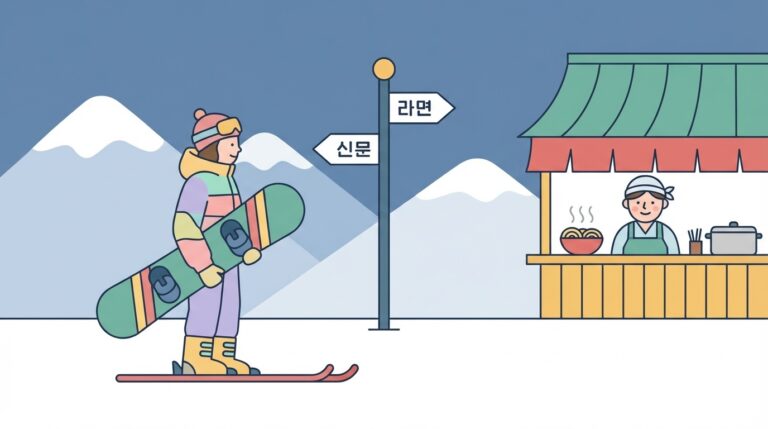
Phase 1: Welcome to the Winter Wonderland of Korea! ❄️
Hello there! I’m your Senior Editor at Daily Hangul.
Have you ever watched a K-Drama where the main characters go on a romantic winter getaway to a ski resort? They effortlessly glide down the slopes, catch each other when they fall in the snow, and share a warm cup of cocoa. It looks absolutely magical, right?
But let’s fast forward to reality. You’re standing at a sprawling Korean ski resort like Vivaldi Park or Yongpyong. The signs are everywhere, hundreds of people are walking around in neon snowsuits, and you need to figure out how to rent a snowboard without accidentally agreeing to jump off the highest peak.
Don’t worry! This guide is built from the real tears and triumphs of our students who braved the Korean winter. By the end of this post, you won’t just survive the ski resort—you’ll navigate it like a true local!
Phase 2: Core Expressions for the Ski Resort ⛷️
Let’s master the top 3 expressions you absolutely need when hitting the slopes.
1. 장비 빌리려고요. (jangbi billiryeogoyo)
- Pronunciation: [jang-bi / bil-li-ryeo-go-yo]
(Tip: ‘jang’ sounds like ‘John’ with an ‘ng’, and ‘bil’ rhymes with ‘pill’.)- Meaning: Literal: I intend to rent equipment. / Real nuance: “I’d like to rent gear.”
- K-Culture Moment: You walk into one of those bright, bustling rental shops just outside the resort. The staff is rushing around. You confidently walk up to the counter and say this, instantly letting them know what you need.
- Editor’s Insight: The ending
-(으)려고요(euryeogoyo) is a super natural way to state your intention in Korean. It sounds much softer and more native than saying “I want to…” (-고 싶어요).- Situation Spectrum:
- Casual with friends: ✅ (Drop the ‘요’ -> 장비 빌리려고)
- Shop Staff (Semi-formal): ✅ (Perfect!)
- Formal/Elders: ⚠️ (Better to say “장비 대여하러 왔습니다”)
- 🤔 Think About It: Why do Koreans prefer saying “I intend to do [X]” rather than “I want [X]”? It’s about being indirect. Stating your intention is considered softer and more polite than expressing a direct, demanding desire.
2. 리프트권 주세요. (ripeuteugwon juseyo)
- Pronunciation: [ri-peu-teu-gwon / ju-se-yo]
(Tip: The ‘eu’ sound in ‘peu-teu’ is like the disgusted sound you make when stepping in gum—just relax your lips!)- Meaning: Literal: Give me a lift ticket. / Real nuance: “I’d like a lift pass, please.”
- K-Culture Moment: In Korea, lift passes are often sold in blocks of time (Morning, Afternoon, Night). You’ll often see K-Drama friends debating whether to buy a ‘Day Pass’ or just a ‘Night Pass’ for a romantic evening ski session.
- Editor’s Insight:
권(gwon) means ‘ticket’ or ‘pass’. Just add주세요(please give me) to anything you need to buy!- Situation Spectrum:
- Ticket Counter (Semi-formal): ✅
- 🤔 Think About It: You’ll hear
주세요everywhere in Korea, from cafes to ski resorts. While it translates to “give me,” it doesn’t carry the rude tone it might in English. It’s the standard, polite way to request items.3. 초보자 코스가 어디예요? (choboja koseuga eodiyeyo?)
- Pronunciation: [cho-bo-ja / ko-seu-ga / eo-di-ye-yo?]
- Meaning: Literal: Where is the beginner course? / Real nuance: “Where’s the bunny slope?”
- K-Culture Moment: K-Pop idols often film reality shows where they learn to ski or snowboard. The members who can’t ski will desperately ask the instructor this exact question while clinging to the fence!
- Editor’s Insight:
초보자(choboja) means ‘beginner’. It’s a great word to use anytime you are new to something in Korea. People will immediately become kinder and more helpful when you admit you are a “choboja”!- Situation Spectrum:
- Friendly strangers/Staff: ✅
Phase 3: Textbook vs. Real Korean 📖🗣️
[Renting Your Gear]
* 📖 Textbook: 스키 장비를 대여하고 싶습니다. (I would like to rent ski equipment.)
* 🗣️ Real Korean: 스키(보드) 빌리려고요. (Looking to rent skis/a board.)
* 💡 Why the difference?: 대여하다 (to rent) is a formal, written word (Sino-Korean). In daily life, Koreans prefer the native verb 빌리다 (to borrow/rent).
[Choosing Your Slope Level]
* 📖 Textbook: 저는 스키를 잘 못 탑니다. (I do not ride skis well.)
* 🗣️ Real Korean: 저 완전 쌩초보예요! (I’m a total newbie!)
* 💡 Why the difference?: Adding 완전 (completely) and 쌩 (raw/pure) before 초보 (beginner) is a cute, slightly self-deprecating slang that instantly breaks the ice with friends or instructors.
Phase 4: Cultural Context — K-Culture Deep Dive 🍜
4-1. Non-Verbal Cues on the Slopes
When carrying your skis or board, always look around! Korean ski resorts can get very crowded, especially on weekends. If you bump into someone, a quick bow of the head and a sincere “죄송합니다! (I’m sorry!)” is essential. Also, you’ll notice Koreans are very quick to help if someone falls on the slope. Offering a hand and asking “괜찮으세요? (Are you okay?)” is a great way to show good Nunchi (social awareness).
4-2. The “K-Food” Resort Tradition
If you go to a Korean ski resort, skiing is only 50% of the experience. The other 50% is eating hot food in the freezing cold.
After a few runs down the slope, it is practically a rule to stop at the cafeteria or the snack bar at the top of the mountain. You MUST order a bowl of hot Ramyeon (라면) or Fish Cake Skewers (어묵 – eomuk) with hot broth. The combination of freezing cheeks and piping hot, spicy soup is the ultimate Korean winter vibe.
Critical View: Why do Koreans obsess over eating hot soup after outdoor activities? It’s deeply rooted in the belief of “이열치열” (fighting fire with fire) or warming the body’s core to restore energy and bond with friends.
Phase 5: Real-Life Roleplay Scenario 🎬
Setting: Saturday morning, 9:30 AM at the Vivaldi Park rental shop. It’s crowded, noisy, and colorful snowsuits are everywhere. You are with your Korean friend, Min-su, who is an advanced snowboarder.
Characters:
– YOU: An A2 level Korean learner, excited but slightly nervous because you are a beginner.
– Min-su (30): Your energetic Korean friend who really wants you to learn snowboarding today.
Dialogue:
Min-su: 사람 진짜 많다! 빨리 장비 빌리자.
(Saram jinjja manta! Ppalli jangbi billija.)
[English] There are so many people! Let’s rent gear quickly.
YOU: 응, 나 보드 빌리려고.
(Eung, na bodeu billiryeogo.)
[English] Yeah, I’m going to rent a snowboard.
(🎭 Stage Direction: You walk up to the busy counter with Min-su)
Staff: 어떻게 오셨어요?
(Eotteoke osyeosseoyo?)
[English] How can I help you? (Lit: How did you come?)
YOU: 보드 장비 빌리려고요.
(Bodeu jangbi billiryeogoyo.)
[English] I’d like to rent snowboard gear.
Staff: 네, 사이즈가 어떻게 되세요?
(Ne, saijeuga eotteoke doeseyo?)
[English] Okay, what is your size?
YOU: 신발 260(이백육십) 주세요.
(Sinbal ibaengnyuksip juseyo.)
[English] Shoe size 260, please.
Min-su: 야, 옷 갈아입고 빨리 나가자! 우리 상급자 코스 먼저 갈까?
(Ya, ot garaipgo ppalli nagaja! Uri sanggeupja koseu meonjeo galkka?)
[English] Hey, let’s change clothes and head out! Should we go to the advanced course first?
🔀 Your Turn! How do you reply to Min-su?
– A) 네, 좋아요! (Yes, sounds good! – Wait, do you want to die? 😱)
– B) 안 돼! 나 완전 쌩초보야. 초보자 코스 어디야?
– C) 싫어. 집에 갈래. (I hate it. I want to go home.)✅ Best Choice: B — “No way! I’m a total newbie. Where is the beginner course?” (An dae! Na wanjeon ssaengchoboya. Choboja koseu eodiya?)
This is natural, honest, and sets boundaries with your overly enthusiastic friend!
Min-su: 아, 맞다. 알았어! 초보자 코스 저쪽이야. 가자!
(A, matda. Arasseo! Choboja koseu jeojjogiya. Gaja!)
[English] Ah, right. Got it! The beginner course is over there. Let’s go!
Phase 6: 10-Second Shadowing Drill ⏱️
Practice this sentence out loud. Pay attention to the pauses (/) and the emotion!
🥺 저기요! / 저 완전 / 초보자인데, / 초보자 코스가 / 어디예요?
(jeogiyo! / jeo wanjeon / chobojainde, / choboja koseuga / eodiyeyo?)
“Excuse me! I’m a total beginner, where is the beginner course?”
Phase 7: K-Culture Mini Dictionary 📖
| Korean | Romanization | English | Context |
|---|---|---|---|
| 리프트권 | ripeuteugwon | Lift pass | Usually bought for 3, 4, or 6-hour blocks! |
| 핫팩 | hatpaek | Hot pack | A lifesaver in Korean winters. Shake it and put it in your pockets! |
| 쌩초보 | ssaengchobo | Total beginner | Slang used playfully to admit you have zero experience. |
| 장비 렌탈 | jangbi rental | Gear rental | Often cheaper at private shops outside the resort than inside. |
| 슬로프 | seulropeu | Slope | Koreans use the English word ‘slope’ for the ski runs. |
Phase 8: Traveler Survival Kit 🎒
If you are traveling to a Korean ski resort, take a screenshot of this card!
🆘 Survival Phrases for the Resort
– 🇰🇷 “의무실이 어디예요?” (uimusiri eodiyeyo?)
– 🗣️ Meaning: Where is the medical room/infirmary?
– 📍 Use it: If you or a friend gets hurt on the slopes.
– 🇰🇷 “따뜻한 물 주세요.” (ttatteuthan mul juseyo.)
– 🗣️ Meaning: Please give me warm water.
– 📍 Use it: At the cafeteria when you need to thaw your freezing body!
– 🇰🇷 “반일권으로 주세요.” (banilgwon-euro juseyo.)
– 🗣️ Meaning: A half-day pass, please.📌 Editor’s Travel Note
– Free Shuttles: Major resorts like Vivaldi Park offer FREE shuttle buses from Seoul for foreigners! You just need to book in advance on their website.
– Goggles & Gloves: Most rental shops do not rent out gloves or goggles for hygiene reasons. You must bring your own or buy them there!
– Ski Pants: Yes, you MUST rent water-resistant ski clothes (스키복). Please don’t ski in jeans; you will freeze and get very wet!
Phase 9: Critical Thinking — “One Step Deeper” 🧠
Food & Identity: The Magic of Ski Resort Ramyeon
In Korea, eating cup noodles (Ramyeon) at a convenience store is just a quick meal. But eating that same cup of Ramyeon at a freezing ski resort, or at an outdoor campsite, is considered a cultural event. Koreans call this “분위기 맛” (the taste of the atmosphere). Food in Korea isn’t just about calories; it’s about the shared context. Eating hot food together in the cold builds solidarity and creates a shared memory. It’s why K-Drama characters always seem to fall in love while sharing a warm snack in the winter!
💬 Your Turn: Does your culture have a specific food that tastes 100x better in a specific location or season? Share it in the comments!
Phase 10: FAQ & Avoiding Common Mistakes 🚫
Q: “Can I use 반말 (informal language) to the rental shop staff if they look younger than me?”
No! Always use -요 (polite form) with service staff, regardless of age. It’s a sign of mutual respect in modern Korean society.
Q: “How do I ask for my shoe size?”
Koreans measure shoe sizes in millimeters. So a US Mens 8 is about 260. Always memorize your shoe size in hundreds! (e.g., 이백육십 – 260).
❌ Common Mistake #1: Saying “보드” (Board) to mean a whiteboard or skateboard.
✅ Do this instead: In winter, “보드” strictly means Snowboard! If you say “보드 타러 가자” (Let’s go ride a board), everyone will assume you’re going to the ski resort.
Phase 11: Summary & Action Items 🎯
One-Liner Summary: To survive a Korean ski resort, know your shoe size in millimeters, admit when you are a “초보자”, and never skip the slope-side Ramyeon!
Action Mission:
– 🥉 Bronze (Solo): Say “장비 빌리려고요” out loud 3 times while pretending to hold a snowboard.
– 🥈 Silver (Online): Look up your shoe size in MM and write it in Korean in the comments! (e.g., 저는 270입니다!)
– 🥇 Gold (Real Life): Next time you watch a K-Drama winter scene, spot the characters holding ‘Hot Packs’ (핫팩) and listen for the word “초보”!
Phase 12: Quiz — Interactive Challenge! 📝
1. Situational Judgment: You are at the ticket counter. You only want to ski for the morning. What do you say?
– A) 리프트권 다 주세요. (Give me all the lift passes.)
– B) 반일권 주세요. (Half-day pass, please.)
– C) 스키복 빌리려고요. (I’d like to rent ski clothes.)
(Answer: B!)
2. True or False – K-Culture Edition:
“You can usually rent waterproof gloves at Korean ski resorts.”
(Answer: False! Bring your own or buy them there due to hygiene rules.)
3. Fill in the Blank:
You fell on the snow and your friend rushes over to check on you.
Friend: “어떡해! _____________?” (Oh no! Are you okay?)
(Answer: 괜찮아요? / 괜찮아?)
Ready to hit the slopes? Leave a comment below with your Korean shoe size, and let me know if you are a skier or a snowboarder! 🏂⛷️
Frequently Asked Questions (FAQ)
Q: What does "장비 빌리려고요. (jangbi billiryeogoyo)" mean in Korean and how do you pronounce it?
A: In Korean, "장비 빌리려고요. (jangbi billiryeogoyo)" is pronounced [jang-bi / bil-li-ryeo-go-yo] and means: Literal: I intend to rent equipment. / Real nuance: "I'd like to rent gear."
Q: What does "리프트권 주세요. (ripeuteugwon juseyo)" mean in Korean and how do you pronounce it?
A: In Korean, "리프트권 주세요. (ripeuteugwon juseyo)" is pronounced [ri-peu-teu-gwon / ju-se-yo] and means: Literal: Give me a lift ticket. / Real nuance: "I'd like a lift pass, please."
Q: What does "초보자 코스가 어디예요? (choboja koseuga eodiyeyo?)" mean in Korean and how do you pronounce it?
A: In Korean, "초보자 코스가 어디예요? (choboja koseuga eodiyeyo?)" is pronounced [cho-bo-ja / ko-seu-ga / eo-di-ye-yo?] and means: Literal: Where is the beginner course? / Real nuance: "Where's the bunny slope?"







