

Phase 1: Empathy (Immersive Open)
Hello! I’m your Daily Hangul Editor, your best Korean friend and personal cultural navigator.
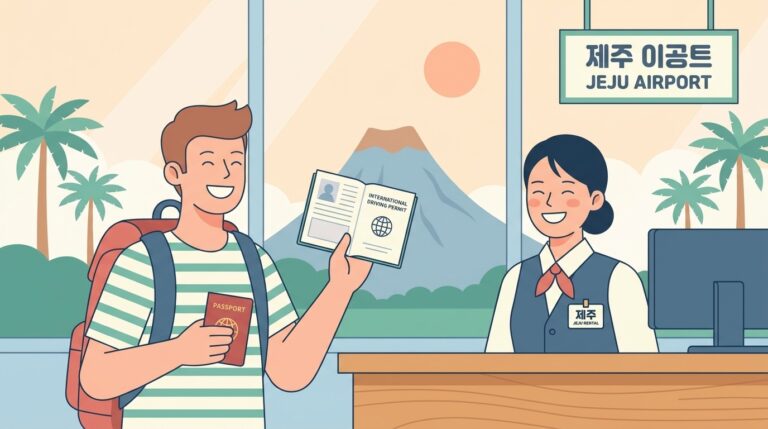
Imagine this: You’ve just landed at Jeju International Airport. The salty ocean breeze is blowing, palm trees are waving, and you’re ready to live out your ultimate K-Drama road trip fantasy—just like in Welcome to Samdal-ri or Our Blues. The perfect playlist is ready, the ocean road awaits. But first… you have to get past the rental car counter.
The staff member smiles and says something rapidly in Korean. You know they need your documents, but suddenly your mind goes blank. If you just shove your papers across the counter silently, it might feel a bit awkward. But what if you could confidently hand over your International Driving Permit with a polite, natural Korean phrase?
Don’t worry! This guide is built from the real experiences of my students who survived the Jeju rental car counters. Let’s learn how to present your documents smoothly and get you on that coastal road!
Phase 2: Core Expressions Deep Dive
1. 여기 국제 면허증이요. (Here is my international driver’s license.)
- Pronunciation: [yeo-gi guk-jje myeon-heo-jjeung-i-yo] (The ‘guk-jje’ sounds sharp, like you’re stressing the ‘j’.)
- Meaning: Literal: Here international license is. / Real nuance: Here is my international driving permit.
- K-Culture Moment: In K-Dramas, whenever a character confidently hands over an ID, a credit card to pay for a team dinner, or an important document, they always say “여기요 (Here it is).” It’s the ultimate polite-but-efficient phrase in Korea!
- Editor’s Insight: The word ‘여기 (here)’ plus the polite ending ‘-요’ makes this a magical, universally polite way to hand something to someone. You don’t need a complex verb!
- Situation Spectrum:
- Casual with friends: ⚠️ (Drop the ‘-요’)
- Service staff/Clerks: ✅ (Perfect!)
- Formal/Elders: ✅ (Very natural)
- 🤔 Think About It: Why do Koreans prefer saying “Here it is” instead of “I am giving this to you”? In Korean culture, minimizing the focus on the “I” (the doer) and focusing on the object being shared makes the interaction feel more modest and polite.
2. 여권도 같이 드릴까요? (Should I give you my passport as well?)
- Pronunciation: [yeo-gwon-do ga-chi deu-ril-kka-yo?] (The ‘eu’ in deu-ril sounds like the disgusted sound you make when stepping in gum—keep your teeth together!)
- Meaning: Literal: Passport too together shall I give? / Real nuance: Would you like my passport as well?
- K-Culture Moment: You’ll hear “같이 (together)” everywhere in Korea! From “같이 가요 (Let’s go together)” at a K-Pop concert to asking if side dishes come “같이 (together)” with the main meal.
- Editor’s Insight: Rental counters almost always need your passport along with your IDP. Asking this proactively makes you look like an experienced traveler who totally reads the room!
- Situation Spectrum:
- Casual with friends: 🚫 (Too formal)
- Service staff/Clerks: ✅ (Excellent)
- Formal/Elders: ✅ (Very respectful)
- 🤔 Think About It: The verb “주다 (to give)” changes to “드리다 (to offer humbly)” when handing things to staff or elders. Does your native language have special verbs just for showing respect?
3. 제 나라 면허증도 필요해요? (Do you need my home country license too?)
- Pronunciation: [je na-ra myeon-heo-jjeung-do pi-ryo-hae-yo?]
- Meaning: Literal: My country license too need? / Real nuance: Do you also need my original driver’s license from home?
- K-Culture Moment: When foreigners visit Korean businesses, staff are often relieved when the customer asks what is needed first. It saves time, and Koreans love “빨리빨리 (Ppal-li ppal-li / Hurry, hurry)” culture!
- Editor’s Insight: Crucial tip! Many tourists don’t realize that Korean rental companies strictly require your original local license alongside your IDP and passport. Asking this shows you came prepared.
- Situation Spectrum:
- Casual with friends: 🚫
- Service staff/Clerks: ✅ (Very practical)
- Formal/Elders: ✅
- 🤔 Think About It: “필요해요 (need)” is used as an adjective in Korean, not a verb like in English. It reflects a state of being rather than an action.
Phase 3: Textbook vs. Real Korean
[Handing over your documents]
* 📖 Textbook Korean: 저의 국제 운전 면허증을 제시합니다. (I present my international driver’s license.)
* 🗣️ Real Korean: 여기 국제 면허증이요! (Here is the international license!)
* 💡 Why so different?: Textbook Korean uses formal declarative sentences, which sound like a robot or a news anchor. Real Korean relies on short, situational phrases ending in the polite ‘-요’.
[Asking about your passport]
* 📖 Textbook Korean: 여권을 원하십니까? (Do you want the passport?)
* 🗣️ Real Korean: 여권도 드릴까요? (Shall I give the passport too?)
* 💡 Why so different?: Asking someone if they “want” (원하다) something directly can sound aggressive in Korean. Offering to “humbly give” (드리다) is much softer and socially acceptable.
Phase 4: Cultural Context — K-Culture Deep Dive
4-1. The “Two Hands” Rule (Non-Verbal Nunchi)
When you hand your International Driving Permit and passport to the rental car agent, do not use just one hand, especially if your other hand is in your pocket or holding your phone!
In Korea, passing items with one hand (especially the left hand) to someone older or a service worker can be seen as slightly rude.
Pro Tip: Use both hands to present the documents, or hold the document with your right hand and lightly support your right elbow/forearm with your left hand. It’s a subtle K-Drama move that will instantly earn you respect!
4-2. The Jeju Island Road Trip Fantasy
If you are renting a car, there’s a 90% chance you are in Jeju Island. In K-Dramas, driving in Jeju represents freedom, healing, and romance. However, the reality of Korean driving requires a bit of Nunchi (눈치). Korean GPS systems (like Naver Map) will constantly talk to you: “Speed bump ahead! Speed camera in 300 meters!” The strict enforcement of speed limits often surprises foreigners. So, when you hand over your license, you are unlocking not just a car, but a highly structured, tech-savvy driving experience!
Phase 5: Practical Roleplay Scenario
Setting: Friday morning, 9:00 AM. Jeju Airport Rental Car House. The counter is busy, and the sound of barcode scanners fills the air.
Characters:
– YOU: Excited traveler ready for a coastal drive.
– 직원 (Staff): A friendly but busy rental car agent in a crisp uniform.
직원: 안녕하세요! 예약하셨나요?
(an-nyeong-ha-se-yo! ye-yak-ha-syeon-na-yo?)
[Hello! Did you make a reservation?]
YOU: 네, 제 이름으로 예약했어요.
(ne, je i-reum-eu-ro ye-yak-hae-sseo-yo.)
[Yes, I reserved it under my name.]
직원: 네, 고객님. 운전면허증 부탁드립니다.
(ne, go-gaeng-nim. un-jeon-myeon-heo-jjeung bu-tak-deu-rim-ni-da.)
[Yes, customer. Your driver’s license, please.]
🔀 Your Turn! How do you hand over your documents?
– A) Slide the IDP across the counter with one hand while looking at your phone.
– B) Hand over the IDP with both hands and say, “여기 국제 면허증이요!”
– C) Toss the IDP and say, “면허증!”✅ Best Choice: B — Using both hands and the polite ‘-요’ ending is the golden standard of Korean etiquette.
⚠️ Choice A & C Analysis: Choice A lacks nunchi and basic respect. Choice C (dropping the polite ending) is considered very rude to a staff member you just met.
(Continuing with Choice B)
YOU: 여기 국제 면허증이요! 여권도 같이 드릴까요?
(yeo-gi guk-jje myeon-heo-jjeung-i-yo! yeo-gwon-do ga-chi deu-ril-kka-yo?)
[Here is my international license! Should I give you my passport too?]
(🎭 Stage Direction: You hand them over gracefully with both hands.)
직원: 아, 네! 여권이랑 고객님 나라 면허증도 같이 주세요.
(a, ne! yeo-gwon-i-rang go-gaeng-nim na-ra myeon-heo-jjeung-do ga-chi ju-se-yo.)
[Ah, yes! Please give me your passport and your home country license together.]
YOU: 네, 여기 있어요.
(ne, yeo-gi i-sseo-yo.)
[Yes, here they are.]
Phase 6: 10-Second Shadowing Drill
Practice these lines out loud! Pay attention to the pauses (/) and the emotions.
- 😊 밝게 (Brightly):
여기 / 국제 면허증이요!
(yeo-gi / guk-jje myeon-heo-jjeung-i-yo!) - 🥺 친절하게 (Kindly):
여권도 / 같이 드릴까요?
(yeo-gwon-do / ga-chi deu-ril-kka-yo?) - 😤 자신감 있게 (Confidently):
제 나라 면허증도 / 여기 있어요.
(je na-ra myeon-heo-jjeung-do / yeo-gi i-sseo-yo.)
Phase 7: K-Culture Mini Dictionary
| Korean | Romanization | English | Context |
|---|---|---|---|
| 국제 면허증 | guk-jje myeon-heo-jjeung | International Driving Permit | Must be the official booklet, not just a translation card! |
| 렌터카 | ren-teo-ka | Rental Car | Koreans use the English loanword, pronounced with a Korean accent. |
| 완전 자차 | wan-jeon ja-cha | Full Coverage Insurance | The magic word for peace of mind. Covers everything! |
| 서명 | seo-myeong | Signature | They will ask you to sign on an electronic pad (서명해 주세요). |
| 과속 방지턱 | gwa-sok bang-ji-teok | Speed Bump | You will encounter thousands of these while driving in Korea! |
Phase 8: Traveler Survival Kit
Since you are renting a car, you are officially embarking on a Korean road trip! Here is what you MUST know.
🆘 Survival Phrases for the Road
– 🇰🇷 “내비게이션 영어로 바꿔주실 수 있나요?”
– 🗣️ Pronunciation: [nae-bi-ge-i-syeon yeong-eo-ro ba-kkwo-ju-sil ssu in-na-yo?]
– 🗺️ Meaning: Can you change the GPS to English?
– 📍 Where to use: Before you drive away from the rental lot!
– 💡 Pro Tip: Korean rental cars usually have built-in GPS. If the staff changes it to English for you, your life will be 100x easier.📌 Editor’s Travel Note
– The Map Reality: Google Maps does NOT provide driving directions in Korea due to national security laws. You must download Naver Map or KakaoMap for your road trip.
– High-Tech Rest Stops: Korean highway rest areas (휴게소 – hyu-ge-so) are legendary. Don’t just get gas; you must try the walnut pastries (호두과자) and spiral potatoes (회오리감자)!
Phase 9: Critical Thinking Corner — “One Step Deeper”
🧠 Think Deeper: Media vs Reality (The K-Drama Road Trip vs. Real Korean Roads)
In K-Dramas, characters drive along empty coastal roads in sleek convertibles, hair blowing in the wind. The reality? Korea is one of the most densely populated countries in the world, and its traffic systems reflect this. Driving in Korea involves a highly regulated environment filled with strictly enforced speed cameras, school zones (where going 1km/h over the 30km/h limit results in a massive fine), and an endless array of speed bumps. This reflects Korea’s hyper-focus on social safety, community rules, and advanced technology. The car isn’t just a vehicle of freedom; it’s a participant in a highly monitored, safe social grid.
💬 Your Turn: Does your country have strict speed cameras everywhere, or is driving more relaxed? Share your driving culture in the comments!
Phase 10: FAQ & Avoiding Mistakes
Q: “Can I just show my mobile driver’s license from my home country?”
No! Korean rental companies are very strict. You need the physical paper International Driving Permit booklet, your physical passport, AND your physical home country driver’s license.
Q: “Is it okay to speak English to the rental car staff?”
Maybe. At major spots like Jeju Airport, they speak basic English. But greeting them and presenting your documents with “여기 국제 면허증이요” sets a warm, respectful tone that they will highly appreciate!
❌ Common Mistake #1: Forgetting your home country driver’s license.
✅ Do this instead: Always pack the IDP, your home license, and your passport in the same pouch.❌ Common Mistake #2: Saying “너 (You)” to the staff.
✅ Do this instead: Never use “너” to strangers. If you must address them, say “저기요 (Excuse me)” or just use the polite endings like we learned!
Phase 11: Summary & Action Items
One-Liner Summary: Hand over your IDP confidently with both hands using the magic phrase: “여기 국제 면허증이요!”
Action Mission 3 Steps:
– 🥉 Bronze (Solo): Stand in front of a mirror, hold a book with both hands, and say “여기 국제 면허증이요!” 3 times.
– 🥈 Silver (Online): Comment below with the name of the Korean city you want to road-trip in!
– 🥇 Gold (Real Life): When you arrive at the Korean rental counter, use at least one phrase from today’s lesson with a big smile.
🎬 K-Culture Mission:
Download Naver Map today! Type “Jeju Airport” in English, set a random destination like “Seongsan Ilchulbong,” and look at the estimated driving time to get a feel for your future road trip!
Phase 12: Quiz — Interactive Challenge
1. Situational Judgment: You are at the counter. The staff asks for your license. What is the most natural A2-level Korean response?
– A) 나의 국제 운전 면허증을 줍니다.
– B) 여기 국제 면허증이요!
– C) 면허증 여기.
2. Fill in the Blank:
“여권도 같이 ________?” (Should I give you my passport as well?)
Hint: It’s the humble verb for ‘to give’.
3. True or False — K-Culture Edition:
“You can rely completely on Google Maps for driving directions during your Jeju road trip.” (True / False)
(Answers: 1. B (A is unnatural textbook talk, C is rude), 2. 드릴까요, 3. False! You must use Naver Map or KakaoMap!)
Frequently Asked Questions (FAQ)
Q: What does "여기 국제 면허증이요. (Here is my international driver's license.)" mean in Korean and how do you pronounce it?
A: In Korean, "여기 국제 면허증이요. (Here is my international driver's license.)" is pronounced [yeo-gi guk-jje myeon-heo-jjeung-i-yo] and means: Literal: Here international license is. / Real nuance: Here is my international driving permit.
Q: What does "여권도 같이 드릴까요? (Should I give you my passport as well?)" mean in Korean and how do you pronounce it?
A: In Korean, "여권도 같이 드릴까요? (Should I give you my passport as well?)" is pronounced [yeo-gwon-do ga-chi deu-ril-kka-yo?] and means: Literal: Passport too together shall I give? / Real nuance: Would you like my passport as well?
Q: What does "제 나라 면허증도 필요해요? (Do you need my home country license too?)" mean in Korean and how do you pronounce it?
A: In Korean, "제 나라 면허증도 필요해요? (Do you need my home country license too?)" is pronounced [je na-ra myeon-heo-jjeung-do pi-ryo-hae-yo?] and means: Literal: My country license too need? / Real nuance: Do you also need my original driver's license from home?







