

Phase 1: Empathy (Welcome to the Real Korea)
Hello! I’m your Daily Hangul Editor.
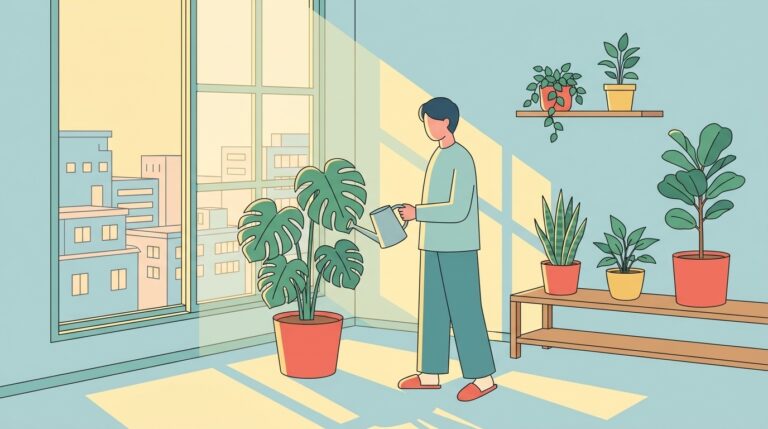
Picture this: You’re watching a modern slice-of-life K-Drama like My Liberation Notes or Crash Course in Romance. The protagonist returns to their tiny, cramped Seoul apartment after a grueling 12-hour workday. They don’t turn on the TV. They don’t call a friend. Instead, they quietly walk over to a Monstera plant in the corner, gently wipe its leaves, and just stare at it for 20 minutes in absolute silence.
Why? Because in the hyper-competitive, fast-paced rhythm of modern Korea, that quiet green corner is the only place where no one is judging them.
Welcome to the world of the 식집사 (Sikjipsa – Plant Butler). As a C2 learner, you already know basic vocabulary like ‘식물’ (plant) and ‘취미’ (hobby). But to truly converse with modern Koreans about mental health, stress relief, and hobbies, you need to understand the profound emotional weight behind why everyone in Seoul is suddenly obsessing over indoor plants.
This guide is built from the real conversations I’ve had with my advanced students who wanted to talk about their weekends without sounding like a 1990s textbook. Let’s dive into the psychology and the language of Korean plant therapy.
Phase 2: Core Expressions Deep Dive
1. 식집사 (Sikjipsa)
- Pronunciation: [sik-jip-sa] (The ‘jip’ sounds like a short, sharp ‘jeep’, and ‘sa’ is light and crisp.)
- Meaning: (Literal) Plant Butler -> (Real Nuance) A devoted plant parent who serves their plants with love and care.
- K-Culture Moment: You’ll see this all over Korean Instagram (#식집사). Originally, ‘집사’ (butler) was humorously adopted by cat owners (고양이 집사) because cats act like royalty. Now, it has evolved for plants. It shows humility—you don’t ‘own’ the plant; you serve its needs (sunlight, water, humidity).
- Editor’s Insight: Using this word instantly signals that you are tuned into modern Korean internet culture. It carries a warm, slightly self-deprecating humor.
- Situation Spectrum:
- Casual with friends: ✅
- Semi-formal (coworkers): ✅
- Formal (Boss/Elders): ⚠️ (They might understand it, but it’s internet slang.)
- 🤔 Think About It: Why do Koreans prefer the term ‘butler’ over ‘owner’ for pets and plants? How does this reflect the modern shift away from hierarchical dominance toward empathy?
2. 풀멍 때리다 (Pulmeong ttaerida)
- Pronunciation: [pul-meong ttae-ri-da] (The ‘meong’ sounds like the deep resonance of a muted gong echoing in your head.)
- Meaning: (Literal) To strike a grass-blank -> (Real Nuance) To zone out while looking at plants.
- K-Culture Moment: Korea has a massive ‘멍’ (zoning out) culture as an antidote to Pali-pali (hurry up) culture. There’s 불멍 (fire-zoning out), 물멍 (water-zoning out), and now 풀멍 (plant-zoning out). When a Korean friend says they did ‘풀멍’ all weekend, they are saying, “I was so burnt out that I needed absolute cognitive silence.”
- Editor’s Insight: ‘때리다’ literally means ‘to hit’, but in modern slang, it means ‘to do an action intensely’. Saying ‘풀멍 때리다’ sounds incredibly native and slightly edgy.
- Situation Spectrum:
- Casual with friends: ✅
- Semi-formal (coworkers): ⚠️ (Use ‘풀멍하면서 쉬었어요’ instead of ‘때리다’)
- Formal (Boss/Elders): 🚫
- 🤔 Think About It: “Zoning out” is often seen as lazy in some cultures. Why has it become a highly commercialized and celebrated healing activity in Korea?
3. 반려식물로 힐링하다 (Ballyeosikmullo hillinghada)
- Pronunciation: [bal-lyeo-sing-mul-lo hil-ling-ha-da]
- Meaning: (Literal) To heal through a companion plant -> (Real Nuance) Finding emotional solace and recovery by raising a plant.
- K-Culture Moment: In K-Pop idol V-lives, fans often ask how the idols relieve stress. Many mention their ‘반려식물’ (companion plant). The prefix ‘반려’ (companion) replaced ‘애완’ (pet/toy) in recent years, showing a shift towards respecting living beings as life partners.
- Editor’s Insight: Notice how Koreans use the English word “healing” (힐링). In Korea, ‘힐링’ isn’t just medical; it’s a social concept meaning ‘emotional rest’.
- Situation Spectrum:
- Casual with friends: ✅
- Semi-formal (coworkers): ✅
- Formal (Boss/Elders): ✅
- 🤔 Think About It: The concept of ‘healing’ in Korea is everywhere—from cafes to TV shows. What does the constant societal need for ‘healing’ tell you about the baseline stress levels?
Phase 3: Textbook vs. Real Korean
[Describing your weekend hobby]
* 📖 Textbook Korean: 저는 주말에 식물을 기르면서 푹 쉽니다. (I rest well on weekends while growing plants.)
* 🗣️ Real Korean: 주말엔 폰 끄고 풀멍 때리는 게 최고죠. 완전 식집사 모드예요. (Turning off my phone and zoning out at plants is the best on weekends. I’m in total plant butler mode.)
* 💡 Why the difference?: Textbooks focus on standard verbs (기르다 – to grow). Real Korean focuses on the state of mind (풀멍, 모드) and uses hyper-specific cultural slang to convey emotional relief.
[Noticing a plant growing well]
* 📖 Textbook Korean: 식물이 아주 잘 자라고 있네요. (The plant is growing very well.)
* 🗣️ Real Korean: 어머, 새순 돋은 거 봐! 완전 힐링돼. (Oh my, look at the new shoot sprouting! It’s so healing.)
* 💡 Why the difference?: Koreans deeply connect the physical growth of the plant (새순 – new shoot) to their own emotional recovery (힐링돼 – it heals me).
Bottom Note for C2 Learners: Avoid sounding too academic. To speak C2 Korean is to master the emotional vocabulary of the culture. Use words like ‘힐링’, ‘멍’, and ‘소확행’ (small but certain happiness) to sound like a local.
Phase 4: Cultural Context — K-Culture Deep Dive
4-1. The Non-Verbal ‘Nunchi’ of Plants
Why plants over pets? Let’s talk about 눈치 (Nunchi)—the Korean art of reading the room. From the moment a Korean person steps out of their house, they are constantly using Nunchi. What does the boss want? Am I blocking the subway door? Is my friend secretly upset?
Pets, while lovable, also require Nunchi. They bark, they demand attention, they show emotion. But a plant? A plant asks for nothing but water and light. It judges you silently and gracefully. For a socially exhausted Seoulite, raising a ‘반려식물’ is the ultimate escape from the Nunchi ecosystem.
4-2. Planterior & Hipster Cafes (K-Travel & Daily Life)
If you visit hip neighborhoods like Seongsu-dong (성수동) or Yeonnam-dong (연남동), you will notice that almost every trendy cafe is designed around 플랜테리어 (Planterior = Plant + Interior). This isn’t just aesthetic; it’s psychological marketing.
Koreans, who often live in dense apartment complexes (아파트 단지) without backyards, crave a connection to nature. By bringing the jungle indoors, cafes offer a micro-vacation. When you visit these cafes, complimenting the ‘플랜테리어’ is a surefire way to impress the owner or your Korean date.
Phase 5: Real-Life Roleplay Scenario
Setting: A rainy Friday evening at a minimalist cafe in Seongsu-dong. The cafe is filled with giant Monstera and Philodendron plants. You are meeting your Korean friend, Ji-yeon, after a brutally long work week.
Characters:
– YOU: An expat professional living in Seoul. You’ve been feeling the ‘burnout’ recently.
– Ji-yeon (30): Your close Korean friend. A seasoned ‘Sikjipsa’ who treats her plants like her children.
Dialogue:
Ji-yeon: 어우, 너 얼굴이 반쪽이 됐다. 요새 회사 일 힘들어? 🥺
(Eou, neo eolguri banjjogi dwaetda. Yosae hoesa il himdeureo?)
[Oh man, your face has halved (you look exhausted). Is work hard these days?]
(🎭 Stage Direction: Ji-yeon pushes a warm cup of tea toward you with a worried look.)
YOU: 말도 마. 진짜 번아웃 올 것 같아. 주말 내내 잠만 자. 😩
(Maldo ma. Jinjja beonaut ol geot gata. Jumal naenae jamman ja.)
[Don’t even mention it. I feel like burnout is coming. I just sleep all weekend.]
Ji-yeon: 안 되겠다. 너도 나처럼 식집사 길로 들어설 때가 왔어. 식물 키워볼래? 🌱
(An doegetda. Neodo nacheoreom sikjipsa gillo deureoseol ttaega wasseo. Sikmul kiwobollae?)
[This won’t do. The time has come for you to step onto the path of the plant butler like me. Want to try raising a plant?]
YOU: 내가? 내 방에선 선인장도 죽을걸? 🌵
(Naega? Nae bangeseon seoninjangdo jugeulgeol?)
[Me? Even a cactus would die in my room.]
Ji-yeon: 에이, 내가 초보용으로 하나 예쁜 거 골라줄게. 퇴근하고 풀멍 때리면 진짜 힐링돼.
(Ei, naega choboyongeuro hana yeppeun geo gollajulge. Toegeunhago pulmeong ttaerimyeon jinjja hillingdoe.)
[Hey, I’ll pick out a pretty one for beginners for you. Zoning out looking at plants after work is truly healing.]
🔀 Your Turn! How do you respond to Ji-yeon’s offer?
– A) “그래, 하나 사줘!” (Sure, buy me one!)
– B) “진짜? 아휴, 귀찮은데… 그래도 네가 골라주면 한 번 키워볼게. 고마워!” (Really? Ugh, it sounds like a hassle… but if you pick it out, I’ll try raising it. Thanks!)
– C) “아니, 난 식물 싫어해.” (No, I hate plants.)✅ Best Choice: B — Why? In Korean interpersonal dynamics, showing a slight hesitation (“it’s a hassle”) but eventually accepting the offer because of their kindness (“since you are picking it”) builds immense ‘정’ (affection/bond). It shows you value their effort more than the object itself. Option A is too direct (even for close friends), and C kills the mood.
Ji-yeon: 좋았어! 이번 주말에 양재꽃시장 같이 가자. 내가 화분 쏜다!
(Joasseo! Ibeon jumare Yangjaekkot-sijang gachi gaja. Naega hwabun ssonda!)
[Awesome! Let’s go to Yangjae Flower Market together this weekend. I’m treating you to a pot!]
Phase 6: 10-Second Shadowing Drill
Try this out loud. Pay attention to the pauses and the emotional tone!
😌 주말에는 / 핸드폰 다 끄고 / 풀멍 때리는 게 / 제~~~일 힐링돼요.
(Jumareneun / haendeupon da kkeugo / pulmeong ttaerineun ge / je~~~il hillingdoeyo.)
[On weekends, turning off the phone completely and plant-zoning out is the mo~~~st healing.]
Editor’s Tip: Stretch the ‘제’ in ‘제일’ to emphasize just how much you need that healing!
Phase 7: K-Culture Mini Dictionary
| 한국어 | Romanization | English | Context |
|---|---|---|---|
| 식집사 | sikjipsa | Plant Butler | The modern, affectionate term for a dedicated plant owner. |
| 풀멍 | pulmeong | Plant-zoning out | Staring blankly at plants to clear the mind and relieve stress. |
| 반려식물 | ballyeosikmul | Companion Plant | Treating a plant as a life partner rather than just an object. |
| 플랜테리어 | peullaenterieo | Planterior | Plant + Interior. The trend of decorating cafes/homes heavily with foliage. |
| 소확행 | sohwakhaeng | Small but certain happiness | A lifestyle philosophy focusing on tiny, achievable joys (like a new leaf sprouting) rather than grand ambitions. |
Phase 8: Traveler’s Survival Kit (Yangjae Flower Market Edition)
If you live in or visit Seoul, the Yangjae Flower Market (양재꽃시장) is a must-visit for any aspiring Sikjipsa. Here is how to navigate it like a pro.
🆘 Survival Expression #1: Asking about the watering cycle
– 🇰🇷 “이거 물은 며칠 주기로 줘야 해요?” (Igeo mureun myeochil jugiro jwoya haeyo?)
– 🗣️ Meaning: How many days is the watering cycle for this?
– 📍 Where to use: Nurseries, flower shops.
– 💡 Pro Tip: Don’t just ask “When do I give water?” Asking about the ‘주기’ (cycle) sounds incredibly natural and shows you are serious about caring for it.🆘 Survival Expression #2: Sun exposure needs
– 🇰🇷 “직사광선 피해야 하나요?” (Jiksagwangseon pihaeya hanayo?)
– 🗣️ Meaning: Do I need to avoid direct sunlight?📌 Editor’s Travel Note
– Navigating: The Yangjae market is huge. Use KakaoMap to find specific ‘동’ (buildings). The greenhouse area (온실) is where the indoor plants are.
– Payment: While many stalls accept cards now, having bank transfer (계좌이체) ready on your Korean banking app or carrying some cash will often get you a small discount or a free bag of fertilizer!
Phase 9: Critical Thinking — “One Step Deeper”
Korean in the Global Era & Social Changes: The Rise of the ‘Companion’ (반려)
Let’s analyze the evolution of language. Twenty years ago, Koreans used the word ‘애완’ (Pet – literally ‘to love and play with as a toy’) for animals. Today, the standard is ‘반려동물’ (Companion Animal) and now ‘반려식물’ (Companion Plant).
This linguistic shift deeply reflects the structural change in Korean society. With the explosive rise of 1인 가구 (single-person households), people are delaying or rejecting marriage due to economic pressure and the immense social burdens of traditional family roles. Instead, they are finding their ‘반려’ (life companions) in cats, dogs, and Monsteras. A plant doesn’t ask you when you are getting promoted, and it doesn’t judge your bank account. In a society that is hyper-connected yet incredibly lonely, elevating a plant to the status of a “companion” is a quiet, green rebellion for mental survival.
💬 Your Turn: Does your native language have a word that shifted meaning to reflect a change in how people view relationships or mental health? Share it with us in the comments!
Phase 10: FAQ & Mistake Prevention
Q: Can I use “풀멍 때리다” with my boss if we are talking about hobbies?
– A: NO. ‘때리다’ is slang. If you are talking to a superior, say “저는 주말에 식물 보면서 멍하니 쉬는 걸 좋아해요” (I like to rest blankly while looking at plants on weekends).
Q: Is there a difference between 화분 (flowerpot) and 반려식물 (companion plant)?
– A: YES. ‘화분’ is just the physical object. You buy a ‘화분’ at the store. But once you bring it home, name it, and talk to it, it becomes your ‘반려식물’.
❌ Common Mistake #1: Saying “애완식물” (Pet plant).
✅ Do this instead: Never use ‘애완’ for plants. It sounds bizarre and outdated. Always stick to ‘반려식물’.
Phase 11: Summary & Action Items
One-Liner Summary: To speak C2 Korean about mental wellness, embrace the identity of the 식집사, let yourself do some 풀멍, and heal through your 반려식물.
Action Mission 3 Steps:
– 🥉 Bronze (Solo): Look at a plant in your room or outside and whisper, “너 보니까 힐링된다” (Looking at you heals me).
– 🥈 Silver (Online): Go to Instagram, search the hashtag #식집사, and read 5 captions. You’ll see today’s vocabulary everywhere!
– 🥇 Gold (Action): Visit a local plant shop or a Planterior cafe in Korea, and ask the owner: “이 화분 물은 며칠 주기로 줘야 해요?”
K-Culture Mission: Watch an episode of a modern K-Drama (like Hospital Playlist or My Liberation Notes) and try to spot a scene where a character is doing ‘풀멍’ to de-stress. Notice the camera angles and the silence used in those scenes.
Phase 12: Quiz — Interactive Challenge
1. Fill in the blank (Situational Judgment):
Your Korean coworker asks what you did over the weekend. You were so exhausted you just stared at your indoor garden. What is the most natural casual response?
“주말 내내 집에서 _________ 때렸어.”
A) 식집사
B) 풀멍
C) 눈치
2. True or False – K-Culture Edition:
“The term ‘반려식물’ is used because Koreans view plants as toys to play with (애완).” (T/F)
3. Roleplay Consequence:
In Phase 5, if you had chosen Option C (“I hate plants”) when Ji-yeon offered to buy you one, what would likely happen to the conversational dynamic in a Korean context?
A) Ji-yeon would respect your boundaries and move on immediately.
B) The atmosphere would instantly freeze (갑분싸 – sudden cold mood) because rejecting a heartfelt offer of ‘healing’ without softening the blow damages the ‘정’ (bond).
(Answers: 1: B, 2: False – they view them as companions, not toys. 3: B – always soften rejections in Korean culture!)
Frequently Asked Questions (FAQ)
Q: What does "식집사 (Sikjipsa)" mean in Korean and how do you pronounce it?
A: In Korean, "식집사 (Sikjipsa)" is pronounced [sik-jip-sa] and means: (Literal) Plant Butler -> (Real Nuance) A devoted plant parent who serves their plants with love and care.
Q: What does "풀멍 때리다 (Pulmeong ttaerida)" mean in Korean and how do you pronounce it?
A: In Korean, "풀멍 때리다 (Pulmeong ttaerida)" is pronounced [pul-meong ttae-ri-da] and means: (Literal) To strike a grass-blank -> (Real Nuance) To zone out while looking at plants.
Q: What does "반려식물로 힐링하다 (Ballyeosikmullo hillinghada)" mean in Korean and how do you pronounce it?
A: In Korean, "반려식물로 힐링하다 (Ballyeosikmullo hillinghada)" is pronounced [bal-lyeo-sing-mul-lo hil-ling-ha-da] and means: (Literal) To heal through a companion plant -> (Real Nuance) Finding emotional solace and recovery by raising a plant.






