

Phase 1: Empathy & Immersion (Welcome to the K-Angler’s World!)
Hello! I’m the lead editor of Daily Hangul, your local culture navigator.
Picture this: You are watching a Korean variety show like City Fisherman (도시어부) or Three Meals a Day (삼시세끼). The celebrities have been sitting on a boat for eight hours in the freezing wind. Suddenly, someone screams, the camera shakes, and dramatic K-Drama music starts playing. They pull up a massive fish, and immediately, the scene cuts to them slicing it into raw sashimi (Hoe, 회) right on the deck, cheering with a shot of Soju.
Or maybe you’ve heard K-Pop idols like BTS’s Jin writing a whole trot song (“Super Tuna”) about his love for fishing. Why are Koreans so passionate about this hobby?
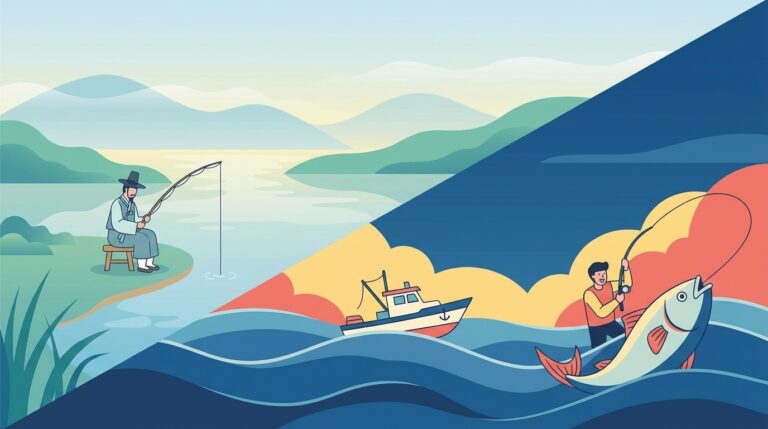
Fishing in Korea isn’t just about catching fish; it’s a profound cultural activity divided into two distinct worlds: 민물낚시 (Minmul-naksi, Freshwater fishing) and 바다낚시 (Bada-naksi, Seawater fishing). If you understand the difference, you won’t just be learning vocabulary; you’ll understand Korean patience, bonding, and our absolute obsession with eating things as fresh as possible. Let’s dive in!
Phase 2: Core Expressions Deep Dive
Here are the absolute must-know terms if you ever find yourself holding a fishing rod in Korea.
1. 손맛 (The Thrill of the Catch)
- Pronunciation: son-mat [sounds like “sown-maht”]
- Meaning: Literal: Hand taste / Real nuance: The thrilling physical sensation and resistance you feel in your hands when a fish bites the hook.
- K-Culture Moment: You’ll see older Korean men at a reservoir aggressively pulling their rod and yelling, “아, 손맛 죽이네!” (Ah, the son-mat is killer!). It’s the ultimate dopamine hit for Korean anglers.
- Editor’s Insight: Koreans use the word 맛 (taste) for many non-food things. Son-mat is specifically about the tactile feedback. It’s so deeply embedded in our culture that gamers even use “손맛” to describe the satisfying feeling of a well-designed combat mechanic in a video game!
- Situation Spectrum:
- Casual with friends: ✅
- Semi-formal with colleagues: ✅
- Formal with bosses (if talking about hobbies): ✅
- 🤔 Think About It: Why do you think Koreans associate “taste” (맛) with a physical sensation in the hands? Does your native language have a way to describe the physical “thrill” of an action using sensory words?
2. 입질 온다! (I’m getting a bite!)
- Pronunciation: ip-jil on-da! [sounds like “eep-jeel own-dah!”]
- Meaning: Literal: The mouth action is coming! / Real nuance: The fish is nibbling at the bait!
- K-Culture Moment: In K-Dramas, when detectives are waiting in a stakeout for a criminal to make a move, they often say “입질이 오네” (I’m getting a bite).
- Editor’s Insight: Ip-jil technically refers to the fish’s mouth touching the bait, but it’s widely used as slang for “getting a reaction” or “seeing signs of success” in business or dating.
- Situation Spectrum:
- Casual with friends: ✅
- Semi-formal with colleagues: ⚠️ (Okay for casual banter)
- Formal with bosses: 🚫
- 🤔 Think About It: How does patience in fishing reflect the “waiting game” in human relationships?
3. 꽝 쳤어 (I got skunked / caught nothing)
- Pronunciation: kkwang chyeoss-eo [sounds like “kwahng chuh-suh”]
- Meaning: Literal: I hit a ‘bang’ / Real nuance: I completely failed; I caught absolutely nothing today.
- K-Culture Moment: On variety shows, when a team spends all day fishing and catches seaweed instead of fish, a giant cartoon “꽝!” (BOOM/FAIL) stamp appears on the screen with a sad trombone sound.
- Editor’s Insight: “꽝” (Kkwang) is an onomatopoeia for a loud thud or explosion, but it means “blank” or “dud” (like a losing lottery ticket). It’s a very self-deprecating, funny way to admit defeat.
- Situation Spectrum:
- Casual with friends: ✅
- Semi-formal with colleagues: ✅
- Formal with bosses: ⚠️ (Better to use “못 잡았습니다” – I couldn’t catch any)
- 🤔 Think About It: Koreans love using dramatic sound effects to describe failure. Do you have a similar funny term for failing miserably at a hobby?
Phase 3: Textbook vs. Real Korean
How do real Korean anglers speak compared to your textbook?
[Expressing a successful catch]
* 📖 Textbook Korean: 저는 큰 물고기를 잡았어요. (I caught a big fish.)
* 🗣️ Real Korean: 와, 대박! 완전 월척이다! (Wow, jackpot! Total monster catch!)
* 💡 Why is it different?: “월척” (Wolcheok) originally means a fish over one cheok (an old measurement, about 30cm). It’s now the standard slang for hitting the jackpot in any situation.
[Admitting you caught nothing]
* 📖 Textbook Korean: 오늘은 한 마리도 못 잡았습니다. (I did not catch a single fish today.)
* 🗣️ Real Korean: 아, 오늘 완전 꽝이야. 공쳤어. (Ah, today is a total dud. Hit nothing.)
* 💡 Why is it different?: Using “꽝” (Kkwang) or “공치다” (Gong-chi-da) adds a sense of humor to a disappointing situation, lightening the mood among friends.
[Suggesting a fishing trip]
* 📖 Textbook Korean: 주말에 낚시하러 갈까요? (Shall we go fishing on the weekend?)
* 🗣️ Real Korean: 주말에 출조 한번 가시죠? (Shall we go on a chul-jo this weekend?)
* 💡 Why is it different?: “출조” (Chul-jo) is a professional/enthusiast term meaning “going out to fish.” Using it makes you sound like a true insider, especially among older Korean men who love fishing.
(Bottom Note: For B2 learners, using terms like “꽝” and “월척” in your daily life—even outside of fishing—will make your Korean sound incredibly natural and witty!)
Phase 4: Cultural Context — K-Culture Deep Dive
4-1. The Vibe: 민물 (Freshwater) vs. 바다 (Seawater)
If a Korean invites you to go fishing, you MUST ask which one it is, because the non-verbal culture is completely different:
- 민물낚시 (Freshwater/Reservoir): This is all about Zen and Patience. You sit on a small chair by a quiet lake, staring at a glowing float (찌) in the dark. It’s meditative. Non-verbal tip: Keep your voice down. Don’t make loud splashing noises. The food culture here usually involves boiling Cup Ramyeon using a portable gas stove while waiting in the chill of the dawn.
- 바다낚시 (Seawater/Boat): This is Action and Excitement. You’re on a boat, the waves are crashing, and you’re fighting the fish. Non-verbal tip: High energy, teamwork, and strong sea legs are required! The pinnacle of seawater fishing is the immediate reward: the boat captain will often slice your catch into fresh Sashimi (회) right on the deck, served with spicy pepper paste (초고추장).
4-2. K-Culture Connections (Food & TV)
Fishing in Korea is inextricably linked to K-Food. Unlike in some Western cultures where catch-and-release is the norm, Korean recreational fishing is heavily focused on the joy of eating the catch together.
If you watch the K-Drama Hometown Cha-Cha-Cha, you’ll notice the deep connection between the sea, the local fishermen, and communal dining. If you catch a big one, you don’t eat it alone. You bring it back, someone makes a bubbling 매운탕 (Maeun-tang: Spicy Fish Stew) from the leftover bones and head, and you share it with lots of Soju. It’s the ultimate expression of Jeong (정 – Korean warm-heartedness).
Phase 5: Real-Life Roleplay Scenario
Setting: A Friday night at a bustling Korean BBQ restaurant in Gangnam. The table is filled with empty Soju bottles. You are chatting with your Korean colleague, Minsu, who is a hardcore fishing enthusiast.
Characters:
– YOU: An expat working in Seoul, curious but inexperienced in fishing.
– Minsu (35): Your senior colleague. Warm, loud, and very proud of his fishing gear.
Dialogue:
Minsu: 땡땡 씨, 주말에 보통 뭐 해요? 취미 있어요?
(Ttaeng-ttaeng ssi, jumal-e botong mwo haeyo? Chwimi isseoyo?)
[What do you usually do on weekends? Do you have any hobbies?]
YOU: 그냥 집에서 쉬거나 넷플릭스 봐요. 민수 선배님은요?
(Geunyang jib-eseo swigeona netpeullikseu bwayo. Minsu seonbaenim-eunyo?)
[I just rest at home or watch Netflix. What about you, Minsu?]
Minsu: (Eyes lighting up) 에이, 젊은 사람이! 저는 무조건 낚시하러 가죠!
(Ei, jeolmeun saram-i! Jeoneun mujogeon naksi-hareo gajyo!)
[Hey, you’re young! For me, I go fishing no matter what!]
YOU: 아, 진짜요? 어디로 가세요?
(Ah, jinjjayo? Eodiro gaseyo?)
[Oh, really? Where do you go?]
Minsu: 저는 주로 바다낚시 가요. 저번 주에는 배 타고 나가서 완전 월척 낚았잖아요!
(Jeoneun juro bada-naksi gayo. Jeobeon ju-eneun bae tago nagaseo wanjeon wolcheok nakk-at-janayo!)
[I mostly go seawater fishing. Last week, I took a boat out and caught a total monster!]
(🎭 Stage Direction: Minsu proudly pulls out his phone to show you a picture of him holding a giant red sea bream)
Minsu: 어때요? 크기 장난 아니죠? 이게 손맛이 끝내주거든요.
(Eottaeyo? Keugi jangnan anijyo? Ige sonmas-i kkeut-nae-jugeodeunyo.)
[How is it? The size is no joke, right? The ‘hand taste’ on this is absolutely killer.]
🔀 Your Turn! How should you respond to Minsu’s boasting?
– A) “아, 그렇군요. 물고기가 참 크네요.” (Ah, I see. The fish is very big.)
– B) “우와! 대박! 진짜 월척이네요. 저도 그 손맛 한번 느껴보고 싶어요!” (Wow! Jackpot! That’s a real monster. I want to feel that ‘hand taste’ too!)
– C) “근데 낚시 너무 지루하지 않아요? 꽝 칠 때도 많잖아요.”
(But isn’t fishing too boring? You fail a lot too, right?)✅ Best Choice: B — Korean anglers love it when you react with high energy to their catches. Using “월척” and “손맛” will instantly make Minsu feel like you truly understand his passion.
⚠️ Choice C Analysis: While factually true, asking if it’s boring and bringing up “꽝” (failing) will deflate his pride. Remember Nunchi!
Minsu: (Laughing loudly) 오! 땡땡 씨 말 좀 통하는데? 다음 달에 바다낚시 갈 건데, 같이 갈래요?
(Oh! Ttaeng-ttaeng ssi mal jom tonghaneunde? Da-eum dal-e bada-naksi gal geonde, gachi gallaeyo?)
[Oh! We’re on the same wavelength! I’m going seawater fishing next month, wanna come along?]
YOU: 헐, 좋아요! 근데 저 낚싯대 없는데 어떡하죠?
(Heol, joayo! Geunde jeo naksitdae eomneunde eotteokhajo?)
[OMG, I’d love to! But I don’t have a fishing rod, what should I do?]
Minsu: 걱정 마요! 배에서 다 빌려줘요. 몸만 오면 돼요. 대신 배 멀미약은 꼭 챙겨요!
(Geokjeong mayo! Bae-eseo da billyeojwoyo. Mom-man omyeon dwaeyo. Daesin bae meolmi-yag-eun kkok chaeng-gyeoyo!)
[Don’t worry! You can rent everything on the boat. Just bring yourself. But make sure to pack seasickness pills!]
Phase 6: 10-Second Shadowing Drill
Practice reacting like a true Korean angler!
😲 우와! / 이거 진짜 / 월~~~척인데요?
(u-wa! / i-geo jin-jja / wol~~~cheog-in-de-yo?)
Wow! Is this a real monster catch?
😆 와~ / 손맛이 / 장난 아니겠어요!
(wa~ / son-mas-i / jang-nan a-ni-ges-seo-yo!)
Wow~ The ‘hand taste’ (thrill) must be unbelievable!
Phase 7: K-Culture Mini Dictionary
| Korean | Romanization | English | Context & Nuance |
|---|---|---|---|
| 민물낚시 | minmul-naksi | Freshwater fishing | Done in rivers/lakes. Quiet, waiting, uses floats (찌). |
| 바다낚시 | bada-naksi | Seawater fishing | Done on rocks or boats. Dynamic, fighting the waves. |
| 매운탕 | maeun-tang | Spicy fish stew | The mandatory bubbling soup made from fish heads/bones after eating sashimi. |
| 손맛 | son-mat | The thrill of the catch | The tactile feedback in your hands. Used in gaming too! |
| 입질 | ip-jil | Fish biting/nibbling | Also used metaphorically when someone shows interest in you (dating/business). |
| 멀미 | meol-mi | Motion sickness | Essential to know for boat fishing (배멀미 – seasickness). |
Phase 8: Traveler’s Survival Kit
Even if you don’t go to the actual sea, Seoul is famous for 실내 낚시카페 (Indoor Fishing Cafes) where you can catch freshwater fish right in areas like Hongdae or Myeongdong!
🆘 Survival Expressions for Fishing/Renting
– 🇰🇷 “낚싯대 하나 빌려주세요.” (Naksitdae hana billyeojuseyo.)
– 🗣️ English: Please rent me one fishing rod.
- 🇰🇷 “미끼는 어떻게 끼워요?” (Mikkineun eotteoke kkiwoyo?)
- 🗣️ English: How do I put the bait on?
🇰🇷 “물고기 바늘 좀 빼주세요!” (Mulgogi baneul jom ppaejuseyo!)
- 🗣️ English: Please take the hook out of the fish! (Crucial if you are scared to touch it!)
📌 Editor’s Travel Note
– Indoor Fishing Cafes: These are usually “catch and release” (민물/freshwater style). You earn points for the weight of the fish and win prizes like plushies or drones!
– Bait Warning: Indoor cafes usually give you dough bait (떡밥), but outdoor places might give you live worms (지렁이) or shrimp (새우). Be prepared!
– Safety first: If you book a sea fishing boat (배낚시) on apps like Naver, you must bring your passport or ARC (Alien Registration Card). The Coast Guard checks IDs before anyone boards a boat.
Phase 9: Critical Thinking Corner — “Going Deeper”
Food & Identity: The Communal Catch
🧠 Think Deeper:
In many Western countries, fishing is viewed purely as a sport—you catch a beautiful trout, take a photo, and gently release it. However, in Korea, fishing is deeply intertwined with our collective food culture. Catching a fish is only 50% of the experience; the other 50% is the ritual of the captain slicing the sashimi, someone boiling the Maeuntang, and everyone sitting in a circle to share the meal with Soju. This reflects the Korean “우리 (We/Our)” mindset. Food is not meant to be eaten alone, especially not a hard-earned catch. Sharing the food is sharing the Jeong (affection).💬 Your Turn:
Does your culture practice catch-and-release, or do you eat what you catch? How is the catch shared among your community? Let me know in the comments!
Phase 10: FAQ & Avoiding Misunderstandings
Q: Can I use “월척이다” (It’s a monster catch/jackpot) in daily life?
Yes! If you find a rare vintage jacket at a thrift store, or you get a great deal on an apartment, you can absolutely say “와, 이거 완전 월척인데?” It shows you have a great grasp of Korean idioms.
Q: If I’m eating sashimi at a restaurant, can I ask for Maeuntang?
Yes! In most traditional Korean seafood restaurants (횟집), Maeuntang is included in the price of the sashimi platter or costs a tiny extra fee (like 5,000 KRW). Just ask: “매운탕 준비해 주세요!” (Please prepare the Maeuntang!).
❌ Common Mistake:
Translating “I caught a cold” using the verb “잡다” (to catch a fish/object).
✅ Do this instead:
Never say “감기를 잡았어요” (which sounds like you literally grabbed a cold with your hands). Say “감기에 걸렸어요” (I am caught/hung in a cold).
Phase 11: Summary & Action Items
- One-Liner Summary: Korean fishing is divided into meditative freshwater (민물) and dynamic seawater (바다), but both are ultimately about the thrill of the son-mat (손맛) and sharing the catch!
-
Action Mission 3 Steps:
- 🥉 Bronze (Solo): Say “입질 온다!” (I’m getting a bite!) out loud next time you are waiting for a text message reply from a crush.
- 🥈 Silver (Online): Look up “도시어부” (City Fisherman) on YouTube, watch 5 minutes, and try to spot them eating Sashimi or Ramyeon on the boat.
- 🥇 Gold (Real-world): Search for “낚시카페” (Fishing Cafe) on Naver Maps in Seoul, go there, and use the survival phrases to rent a rod!
- K-Culture Mission: Try listening to Jin’s (BTS) song “Super Tuna” (슈퍼 참치) with lyrics. You’ll hear the pure, chaotic joy of Korean sea fishing!
Phase 12: Quiz — Interactive Challenge
1. Situational Judgment:
You spent 4 hours at a fishing cafe but caught absolutely zero fish. The staff asks how you did. What is the most natural, humorous Korean response?
* A) 생선이 없어요. (There are no fishes.)
* B) 오늘 완전 꽝 쳤어요. (Today was a total dud/blank.)
* C) 물고기가 저를 싫어해요. (The fish hate me.)
2. Fill in the Blank:
When the fish finally starts nibbling the bait, you should excitedly whisper: “어? (_____) 온다!”
* A) 손맛 (Sonmat)
* B) 입질 (Ipjil)
* C) 월척 (Wolcheok)
3. True or False — K-Culture Edition:
In Korea, if you go seawater boat fishing (배낚시), you must bring a physical ID (like a passport or ARC) to board the boat. (T/F)
(Answers: 1: B, 2: B, 3: True – The Coast Guard strictly checks IDs for safety before departure!)
Frequently Asked Questions (FAQ)
Q: What does "손맛 (The Thrill of the Catch)" mean in Korean and how do you pronounce it?
A: In Korean, "손맛 (The Thrill of the Catch)" is pronounced [son-mat [sounds like "sown-maht"] and means: Literal: Hand taste / Real nuance: The thrilling physical sensation and resistance you feel in your hands when a fish bites the hook.
Q: What does "입질 온다! (I'm getting a bite!)" mean in Korean and how do you pronounce it?
A: In Korean, "입질 온다! (I'm getting a bite!)" is pronounced [ip-jil on-da! [sounds like "eep-jeel own-dah!"] and means: Literal: The mouth action is coming! / Real nuance: The fish is nibbling at the bait!
Q: What does "꽝 쳤어 (I got skunked / caught nothing)" mean in Korean and how do you pronounce it?
A: In Korean, "꽝 쳤어 (I got skunked / caught nothing)" is pronounced [kkwang chyeoss-eo [sounds like "kwahng chuh-suh"] and means: Literal: I hit a 'bang' / Real nuance: I completely failed; I caught absolutely nothing today.







