

Phase 1: Empathy (The K-Culture Cold Open)
Hello! I am the lead editor of Daily Hangul.
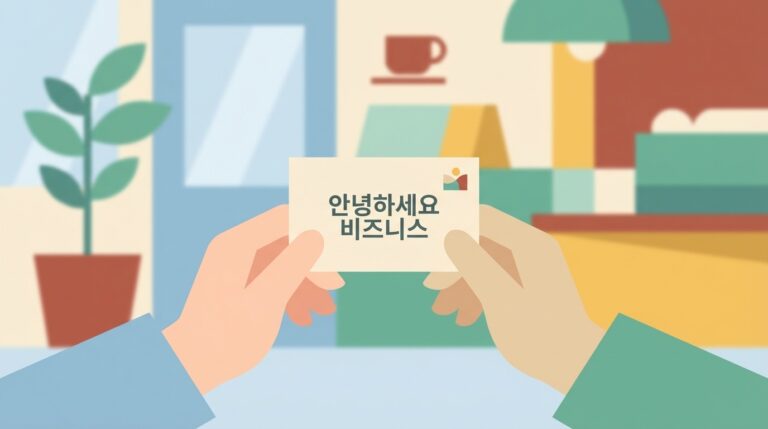
Imagine this: You are watching a tense K-Drama about a corporate rivalry. The main character walks into a sleek meeting room, faces their opponent, and slowly slides a small piece of paper across the table. But notice how they do it. They don’t just toss it. They use both hands, bow slightly, and the other person receives it like it’s a piece of fragile glass, studying it intensely for a few seconds.
Why all the drama over a simple piece of paper? Because in Korea, a business card (명함 – myeongham) is not just contact info. It is a paper representation of the person’s face, status, and identity.
If you ever plan to work in Korea, do business with Korean partners, or even just attend a networking event in Seoul, knowing how to exchange business cards is a crucial survival skill. Handing a card with one hand while looking away? That might just ruin the relationship before it even begins!
Don’t worry. This guide is based on real questions from my students who successfully navigated the Korean corporate world. Let’s learn the secrets behind the Korean business card exchange!
Phase 2: In-Depth Analysis of Key Expressions
Let’s learn the three essential phrases you need for this situation.
1. 처음 뵙겠습니다.
- Pronunciation: [cheo-eum / boep-get-seum-ni-da] (Think of cheo-eum sounding like a soft “cho-um” and boep rhyming with “yep” but with a B.)
- Meaning: Literal: “I am seeing you for the first time.” / Real nuance: “How do you do? / Nice to meet you.”
- K-Culture Moment: This is the ultimate formal greeting. In dramas, when the CEO’s secret heir is finally introduced to the board of directors, they bow 45 degrees and say this.
- Editor’s Insight: This phrase feels very polite and professional. You only use it the very first time you meet someone. If you use it on the second meeting, things will get awkward!
- Situation Spectrum:
- Friends (Casual): 🚫
- Co-workers (Semi-formal): ⚠️ (Only if it’s your first day)
- Boss/Seniors (Formal): ✅
- 🤔 Think About It: Why does Korean have a specific, formal phrase just for the “first” meeting? How does your culture differentiate between meeting someone for the first time vs. seeing an acquaintance?
2. 제 명함입니다.
- Pronunciation: [je myeong-ham-im-ni-da]
- Meaning: Literal & Real nuance: “This is my business card.”
- K-Culture Moment: You will hear this everywhere in Yeouido or Gangnam (the business districts of Seoul) as professionals meet at cafes to discuss projects.
- Editor’s Insight: It’s short, simple, and standard. As you say this, you should be extending your card toward the person.
- Situation Spectrum:
- Friends (Casual): 🚫 (Friends don’t usually exchange cards)
- Co-workers (Semi-formal): ✅
- Boss/Seniors (Formal): ✅
- 🤔 Think About It: Notice the polite ending “-입니다 (-imnida)”. In business settings, Koreans default to the most formal speech level to show respect.
3. 잘 부탁드립니다.
- Pronunciation: [jal / bu-tak-deu-rim-ni-da]
- Meaning: Literal: “I ask you well.” / Real nuance: “I look forward to working with you. / Please take good care of me.”
- K-Culture Moment: The scene where the new employee introduces themselves to the team and does a deep bow.
- Editor’s Insight: This is the magic phrase of Korean business. Say it right after exchanging cards. It sets a positive, cooperative tone for your future relationship.
- Situation Spectrum:
- Friends (Casual): 🚫
- Co-workers (Semi-formal): ✅
- Boss/Seniors (Formal): ✅
- 🤔 Think About It: This phrase assumes a mutual relationship of relying on each other. What does this tell us about the Korean emphasis on teamwork and community?
Phase 3: Textbook vs. Real Korean
Let’s see how textbook phrases change in the real world.
[When offering your card]
* 📖 Textbook Korean: 제 명함을 드리겠습니다. (I will give you my business card.)
* 🗣️ Real Korean: 제 명함입니다. (Here is my card.)
* 💡 Why the difference?: The textbook version sounds a bit too stiff and overly dramatic for a simple action. Keep it simple!
[When asking for someone’s card]
* 📖 Textbook Korean: 당신의 명함을 주시겠습니까? (Will you give me your business card?)
* 🗣️ Real Korean: 혹시 명함 하나 주실 수 있나요? (By any chance, could you give me a card?)
* 💡 Why the difference?: Never use “당신 (dangsin – you)” in a professional setting! Using “혹시 (hoksi – by any chance)” softens the request politely.
Bottom Note: For an A2 level learner, sticking to “제 명함입니다” and “잘 부탁드립니다” will make you sound 100% natural and respectful. You don’t need complicated grammar here!
Phase 4: Cultural Context — K-Culture Deep Dive
4-1. Non-verbal Elements: The Core of Korean Etiquette
In Korea, how you give the card is more important than what you say. This requires 눈치 (Nunchi)—reading the room.
- The Two-Hand Rule: Always give and receive cards with both hands. If your hands are full, at least use your right hand to give the card, and support your right elbow with your left hand.
- The Orientation: Hand the card so the text is facing the receiver, making it easy for them to read.
- The 5-Second Read: When you receive a card, DO NOT put it away immediately! Hold it with two hands, look at it carefully for about 3-5 seconds, and nod as if you are memorizing their name and title.
4-2. K-Drama Connection: The Meeting Room Trope
If you’ve watched K-Dramas like Misaeng (Incomplete Life) or Extraordinary Attorney Woo, you’ve seen business card exchanges.
In dramas, characters often read the card aloud: “Ah, you are the General Manager of Marketing…” This is actually real life! Reading the title aloud confirms you’ve acknowledged their status, which dictates the level of politeness you must use in the conversation.
Critical View: Dramas sometimes show arrogant villains throwing their business cards on the table. In reality, doing this in Korea is considered incredibly insulting and will likely burn the bridge instantly.
Phase 5: Practical Roleplay Scenario
Setting: 2:00 PM, a brightly lit conference room in Gangnam, Seoul. You are attending your first meeting with a potential Korean partner company. Coffee is on the table.
Characters:
* YOU: A foreign professional visiting Korea for a project. You want to make a great first impression.
* Mr. Kim (김민수 부장님): A 45-year-old manager at the Korean company. Friendly but professional.
Dialogue:
Mr. Kim: 어서 오세요. 김민수입니다. 처음 뵙겠습니다.
(eoseo oseyo. gim-minsu-imnida. cheo-eum boep-get-seum-ni-da.)
[Welcome. I am Kim Min-su. Nice to meet you.]
YOU: 안녕하세요! 저는 [Your Name]입니다. 처음 뵙겠습니다.
(annyeonghaseyo! jeo-neun [Your Name]-imnida. cheo-eum boep-get-seum-ni-da.)
[Hello! I am [Your Name]. Nice to meet you.]
(🎭 Stage Direction: Mr. Kim pulls out a sleek silver cardholder, takes out a card with both hands, and extends it toward you with a slight bow.)
Mr. Kim: 제 명함입니다.
(je myeong-ham-im-ni-da.)
[This is my business card.]
YOU: 감사합니다. 제 명함입니다.
(gamsahamnida. je myeong-ham-im-ni-da.)
[Thank you. Here is my business card.]
(🎭 Stage Direction: You take his card and hand him yours. You look at his card carefully for a few seconds.)
Mr. Kim: 아, 마케팅 부서이시군요. 잘 부탁드립니다.
(a, maketing buseo-isi-gun-yo. jal bu-tak-deu-rim-ni-da.)
[Ah, you are in the marketing department. I look forward to working with you.]
🔀 YOUR TURN! What do you do with Mr. Kim’s card now?
– A) Fold it and put it in your back pants pocket.
– B) Take out a pen and write his phone number on the back of his card.
– C) Place it carefully on the table in front of you for the duration of the meeting.✅ Best Choice: C — Reason: In Korea, treating the card with respect means keeping it visible and safe during the meeting.
⚠️ Choice A & B Analysis: Putting it in a back pocket means you might sit on his “face.” Writing on someone’s business card in front of them is a huge taboo in Korea!
Phase 6: 10-Second Shadowing Drill
Read this out loud to practice the rhythm! Pay attention to the pauses (/) and the emotion tags.
😊 (Brightly, with a slight bow)
처음 / 뵙겠습니다. / 제 명함입니다.
(cheo-eum / boep-get-seum-ni-da. / je myeong-ham-im-ni-da.)
🤝 (Sincere and respectful)
감사합니다. / 잘 부탁 / 드립니다.
(gam-sa-ham-ni-da. / jal bu-tak / deu-rim-ni-da.)
Phase 7: K-Culture Mini-Dictionary
| Korean | Romanization | English | Context |
|---|---|---|---|
| 명함 | myeongham | Business card | The physical card, heavily used in networking. |
| 두 손 | du son | Two hands | The standard way to give/receive anything from a senior. |
| 직급 | jikgeup | Job title/Rank | Crucial to check on the card to determine the hierarchy. |
| 인사 | insa | Greeting/Bow | The act of saying hello and bowing. |
| 미팅 | miting | Business meeting | Konglish word used for professional meetings. |
Phase 8: Traveler’s Survival Kit
Even if you aren’t doing corporate business, you might attend a social event, a language exchange, or a cafe meetup where cards are exchanged!
🆘 Survival Phrases for Networking
– 🇰🇷 “명함 하나 주시겠어요?” (myeongham hana ju-si-get-seo-yo?)
– 🗣️ English: Could I get a business card?
– 📍 Where to use: Asking a cafe owner, a store manager, or a new contact.
– 💡 Pro Tip: If you don’t have a card, say: “죄송하지만, 명함을 안 가져왔습니다” (I’m sorry, but I didn’t bring my card.)📌 Editor’s Travel Note
– Digital vs. Paper: While younger Koreans might exchange Instagram handles or KakaoTalk IDs, paper business cards are still 100% the rule in professional settings.
– Cardholders: If you are traveling for business, buy a nice cardholder. Pulling a crumpled card out of your wallet is considered unprofessional.
Phase 9: Critical Thinking Corner — “One Step Deeper”
Language & Power (언어와 권력)
🧠 Think Deeper:
Why do Koreans study the business card so intensely upon receiving it? It’s not just to learn your name. They are looking for your title (직급) and age. Korean society is deeply influenced by a hierarchy based on age and rank. Knowing your exact status helps them decide which level of polite speech (존댓말) to use with you, and how deep to bow. The business card acts as a map to navigate the social relationship.💬 Your Turn: Does your culture rely heavily on job titles to determine how people talk to each other? Let us know in the comments!
Phase 10: FAQ & Avoiding Misunderstandings
- Q: “Can I hand my card with one hand if I am holding a coffee?”
- A: Maybe, but avoid it. Put the coffee down first. If you absolutely must, give it with your right hand, and place your left hand on your right elbow to simulate “two hands.”
- Q: “What if I don’t have a Korean name?”
- A: That’s completely fine. It’s very helpful to have your English name printed on one side and a Korean translation (written in Hangul) on the other. It shows great preparation!
- Q: “Can I ask someone’s age directly if it’s not on the card?”
- A: Not in a professional setting. Wait until you are at an informal dinner or let the conversation naturally reveal it.
❌ Common Mistake #1: Shoving the card into your wallet and putting it in your back pants pocket.
✅ Do this instead: Put it gently into a cardholder, or inside your jacket breast pocket, close to your heart!
Phase 11: Summary & Action Items
- One-Liner Summary: Treat a Korean business card like the person’s face: use two hands, read it carefully, and never write on it!
-
Action Mission 3 Steps:
- 🥉 Bronze (Solo): Grab any card from your wallet, stand in front of a mirror, bow slightly, and practice saying “제 명함입니다” with two hands.
- 🥈 Silver (Online): Share in our community board: “My title in Korean would be [Your Title].”
- 🥇 Gold (Real Life): The next time you visit a Korean restaurant or cafe in your city, ask the owner, “명함 하나 주시겠어요?” using two hands!
- K-Culture Mission: Watch episode 1 of any Korean office drama (like Misaeng). Count how many times you see people exchanging cards with two hands!
Phase 12: Quiz — Interactive Challenge
1. Situational Judgment: You are sitting at a meeting table. The Korean CEO hands you his card. What should you do with it after reading it?
* A) Play with the corners while talking.
* B) Place it neatly on the table in front of you.
* C) Use it as a coaster for your coffee.
2. Fill in the Blank:
( _______ ) 뵙겠습니다. (Nice to meet you / Seeing you for the first time).
* A) 처음 (cheo-eum)
* B) 내일 (nae-il)
3. True or False — K-Culture Edition:
It is considered polite to write the date you met the person on the front of their business card while they are watching. (T/F)
(Answers below)
Click to reveal answers!
1. B (Treat it with respect! Playing with it or resting drinks on it is highly offensive.)
2. A (처음 – First time)
3. False (Never write on a Korean person’s business card in front of them. It is seen as defacing their ‘face’.)
Frequently Asked Questions (FAQ)
Q: What does "처음 뵙겠습니다." mean in Korean and how do you pronounce it?
A: In Korean, "처음 뵙겠습니다." is pronounced [cheo-eum / boep-get-seum-ni-da] and means: Literal: "I am seeing you for the first time." / Real nuance: "How do you do? / Nice to meet you."
Q: What does "제 명함입니다." mean in Korean and how do you pronounce it?
A: In Korean, "제 명함입니다." is pronounced [je myeong-ham-im-ni-da] and means: Literal & Real nuance: "This is my business card."
Q: What does "잘 부탁드립니다." mean in Korean and how do you pronounce it?
A: In Korean, "잘 부탁드립니다." is pronounced [jal / bu-tak-deu-rim-ni-da] and means: Literal: "I ask you well." / Real nuance: "I look forward to working with you. / Please take good care of me."







