

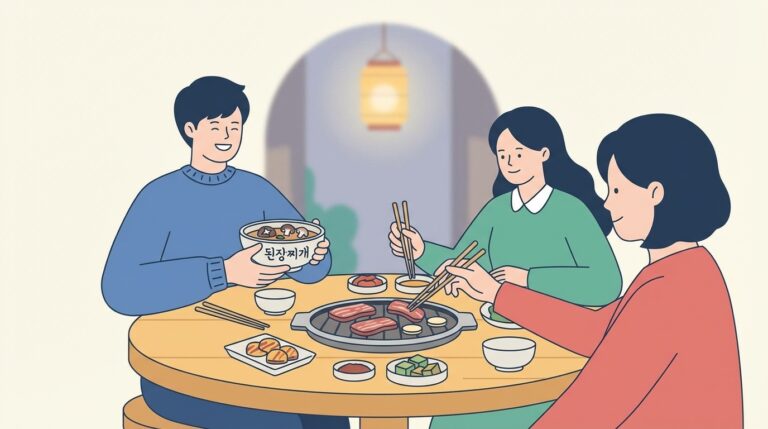
Phase 1: The Panic of the Sizzling Grill 🥩🥬
Hello! It’s your Daily Hangul Editor.
Picture this: You are watching a classic K-Drama. The team just finished a big project, and the boss shouts, “Let’s go for Hoesik (company dinner)! Samgyeopsal (pork belly) is on me!” The scene cuts to a smoky, vibrant K-BBQ joint. Soju glasses are clinking, the meat is sizzling, and everyone is laughing. It looks like the ultimate Korean bonding experience.
But wait… you are a vegetarian.
Suddenly, the K-Drama dream turns into a real-life anxiety attack. As the plates of raw pork arrive, you stare at your lonely piece of lettuce, wondering, “How do I tell my Korean boss that I don’t eat meat without ruining the mood? Will I get fired? Will I starve?”
Don’t worry! Navigating Korean collective dining culture (Hoesik) with dietary restrictions is a masterclass in Nunchi (reading the room). As a B2 level learner, you’re ready to move beyond simply saying “I am a vegetarian” and learn how to tactfully secure your own meal while maintaining group harmony.
This guide is based on real struggles from our vegan and vegetarian expats living in Seoul. Let’s dive in and survive that K-BBQ together!
Phase 2: Core Expressions Deep Dive
Here are the top 3 expressions you need to smoothly navigate menu selection at a Korean company dinner.
1. 저는 고기를 못 먹어서, 따로 식사류를 시켜도 될까요?
- Pronunciation: [Jeoneun gogireul mot meogeoseo, ttaro siksaryureul sikyeodo doelkkayo?]
- Sound-alike guide: Jeo-neun go-gi-reul moht meo-geo-seo, tta-ro shik-sa-ryu-reul shi-kyeo-do dwehl-kka-yo?
- Meaning: I can’t eat meat, so may I order a separate meal dish for myself?
- K-Culture Moment: At a K-BBQ place, the menu is divided into ‘Meat’ and ‘Meals’ (식사류 – like Doenjang-jjigae, cold noodles, or bibimbap). When everyone is sharing the grill, ordering a personal ‘meal’ from the start is your golden ticket to eating something substantial.
- Editor’s Insight: Notice how we used ‘못 먹어서’ (can’t eat) instead of ‘안 먹어서’ (don’t eat/choose not to eat). In Korean culture, saying “I can’t eat it” (implying health, digestion, or allergy) is met with much more sympathy and less questioning than “I choose not to eat it.”
- Situation Spectrum:
- Casual with friends: ✅ (Though you can drop the “요” and just say “시킬게”)
- Semi-formal (Co-workers): ✅
- Formal (Boss/Elders): ✅ (Very polite and considerate)
- 🤔 Think About It: Why does Korean society accept “health reasons” more easily than “personal beliefs” when refusing food? How does this reflect the value placed on collective harmony over individual preference?
2. 혹시 이 찌개에 고기 육수가 들어가나요?
- Pronunciation: [Hoksi i jjigaee gogi yuksuga deureoganayo?]
- Sound-alike guide: Hohk-shi ee jji-gae-eh go-gi yook-soo-ga deu-reo-ga-na-yo?
- Meaning: By any chance, does this stew contain meat broth?
- K-Culture Moment: You order a seemingly safe “Tofu Stew.” It arrives, and you take a bite… only to taste the distinct flavor of beef bone stock. In Korea, meat broth (육수) is the default base for almost everything.
- Editor’s Insight: The word ‘혹시’ (by any chance) acts as a verbal cushion. It softens the question so you don’t sound like a strict health inspector interrogating the restaurant owner.
- Situation Spectrum:
- Casual with friends: ✅
- Semi-formal (Co-workers/Waiters): ✅
- Formal (Boss/Elders): ✅
- 🤔 Think About It: In many Western countries, “vegetarian” automatically implies no meat broth. Why might a Korean restaurant owner genuinely say a dish is “meat-free” even if it’s boiled in bone broth?
3. 신경 써 주셔서 감사합니다. 저는 이것만 먹어도 충분해요!
- Pronunciation: [Singyeong sseo jusyeoseo gamsahamnida. Jeoneun igeotman meogeodo chungbunhaeyo!]
- Sound-alike guide: Shin-gyoung sseo joo-shyeo-seo gahm-sa-ham-ni-da. Jeo-neun ee-guht-mahn meo-geo-do choong-boon-hae-yo!
- Meaning: Thank you for caring. I’m totally fine just eating this!
- K-Culture Moment: Your Korean boss, feeling guilty that you aren’t eating the expensive Hanwoo (Korean beef), keeps trying to order you a fruit platter or asks the chef to make something special. You need to politely stop them from fussing over you.
- Editor’s Insight: Koreans express affection (Jeong) by feeding people. If you eat little, they feel they are failing as hosts. Assuring them that you are happy and full is crucial to easing their anxiety.
- Situation Spectrum:
- Casual with friends: ⚠️ (A bit too formal, say “나 진짜 괜찮아!” instead)
- Semi-formal (Co-workers): ✅
- Formal (Boss/Elders): ✅
Phase 3: Textbook vs. Real Korean
How you learn it in class vs. how you actually survive in Gangnam.
[Explaining your dietary restriction]
* 📖 Textbook Korean: 저는 채식주의자입니다. (I am a vegetarian.)
* 🗣️ Real Korean: 제가 고기를 잘 못 먹어서요. 속이 좀 안 좋아져서요. (I can’t eat meat well. It makes my stomach upset.)
* 💡 Why the difference?: While “Vegetarian” (비건 / 채식주의자) is becoming more understood, older generations might view it as picky. Blaming your digestion avoids debate and instantly brings out their protective, caring side.
[Asking to remove an ingredient]
* 📖 Textbook Korean: 고기를 넣지 마십시오. (Do not put meat in it.)
* 🗣️ Real Korean: 사장님~ 혹시 여기 고기 빼고도 되나요? (Boss~ by any chance, is it possible to make this without meat?)
* 💡 Why the difference?: Ordering in Korea is highly conversational. Using “사장님” (Boss/Owner) builds rapport, and ending with “되나요?” (Is it possible?) is softer than a direct command.
Bottom Note: At the B2 level, your goal is smooth communication without causing friction. Using these softer, indirect phrases shows high emotional intelligence in Korean!
Phase 4: Cultural Context — K-Culture Deep Dive
4-1. Non-Verbal Communication: The Art of Pouring
Even if you aren’t eating the meat, you can still be the star of the Hoesik by participating in the drinking culture (or pouring cider/water!).
– Always use two hands: When pouring a drink for your boss or receiving one, support your pouring arm with your free hand.
– The Turnaway: If you drink alcohol, remember to turn your head slightly away from the senior person when taking a sip. It’s a sign of respect.
4-2. K-Food Connection: The “Broth” Trap
If you’ve watched K-Dramas, you know the soul of Korean food is Gukbap (soup and rice) and Jjigae (stew).
For vegetarians, Korea is both a paradise (so many vegetable side dishes!) and a minefield. Why? Because of Anchovy Broth (멸치육수) and Fish Sauce (액젓).
– Kimchi is rarely vegan (fermented with shrimp or fish sauce).
– Tteokbokki is almost always boiled in fish cake/anchovy broth.
– Pro Tip: If you are a strict vegan or vegetarian, look for “사찰음식” (Temple Food). Korean Buddhist monks have been perfecting gourmet vegan cuisine for over a thousand years!
Phase 5: Interactive Roleplay Scenario
Scenario A: The Gangnam BBQ Test
Setting: Friday, 7 PM. A smoky, bustling Samgyeopsal restaurant in Gangnam. Your team just finished a massive project. Manager Kim is already handing out menus and ordering Soju.
Characters:
– YOU: A B2 Korean learner and a vegetarian trying not to ruin the vibe.
– Manager Kim (45): Your boss. Loves meat, a bit old-school, but very generous.
– Minsu (30): Your friendly coworker who speaks a little English but prefers Korean.
Dialogue:
Manager Kim: 자, 오늘 고기는 내가 쏜다! 사장님, 여기 삼겹살 4인분 먼저 주세요! 🥩
(Ja, oneul gogineun naega ssonda! Sajangnim, yeogi samgyeopsal sainbun meonjeo juseyo!)
[Alright, meat is on me tonight! Boss, give us 4 servings of pork belly to start!]
(🎭 Stage Direction: Manager Kim rolls up his sleeves, ready to grill.)
Minsu: 부장님 최고! (Looks at you) 어, 근데 [Your Name] 씨는 고기 잘 안 드시지 않아요?
(Bujangnim choego! Eo, geunde [Name] ssineun gogi jal an deusiji anayo?)
[Manager, you’re the best! Oh, but [Your Name], don’t you usually not eat meat?]
Manager Kim: (Surprised, lowering his tongs) 그래요? 삼겹살을 안 먹어? 왜?
(Geuraeyo? Samgyeopsareul an meogeo? Wae?)
[Really? You don’t eat pork belly? Why?]
🔀 Your Turn! How do you respond?
– A) “저는 채식주의자라서 고기를 싫어합니다.” (I am a vegetarian so I hate meat.)
– B) “네, 고기를 먹으면 속이 안 좋아서요. 저는 된장찌개 하나 따로 시켜도 될까요?”
– C) “진짜요? 대박! 그럼 저는 그냥 집에 갈게요!”✅ Best Choice: B — “Yes, my stomach gets upset if I eat meat. May I order a Doenjang-jjigae separately for myself?”
Why? It gives a culturally acceptable reason (digestion) and immediately provides a solution (ordering a stew) so the boss doesn’t panic and feel like a bad host.
⚠️ Choice A Analysis: Saying you “hate” meat right as your boss is buying it for everyone is a massive Nunchi fail. It kills the mood.
Manager Kim: 아유, 진작 말을 하지! 사장님! 여기 된장찌개 하나 고기 싹 빼고 끓여주세요!
(Ayu, jinjak mareul haji! Sajangnim! Yeogi doenjangjjigae hana gogi ssak ppaego kkeuryeojuseyo!)
[Oh my, you should have told me earlier! Boss! Please make one Doenjang-jjigae here, completely without meat!]
YOU: 신경 써 주셔서 감사합니다. 부장님!
(Singyeong sseo jusyeoseo gamsahamnida. Bujangnim!)
[Thank you for caring, Manager!]
Scenario B: Bonus — Street Food Survival
Setting: Gwangjang Market. You want to try K-Street Food.
YOU: 사장님, 이 떡볶이에 어묵 국물 들어가나요?
(Sajangnim, i tteokbokie eomuk gungmul deureoganayo?)
[Boss, does this Tteokbokki have fish cake broth in it?]
Vendor Auntie: 그럼~ 우리 집 비법 육수지! 맛있어!
(Geureom~ uri jip bipeop yuksuji! Masisseo!)
[Of course~ It’s my secret broth! It’s delicious!]
YOU: 아… 제가 해산물을 못 먹어서요. 아쉽네요. 많이 파세요!
(Ah… jega haesanmureul mot meogeoseoyo. Aswipneyo. Mani paseyo!)
[Ah… I can’t eat seafood. What a shame. Have a good day (sell a lot)!]
Phase 6: 10-Second Shadowing Drill
Practice making your refusal sound polite, bright, and apologetic. Pay attention to the pauses!
🥺 제가 / 고기를 먹으면 / 속이 좀 안 좋아서요. / 따로 식사류 / 시켜도 될까요?
(Je-ga / gogi-reul meogeumyeon / sog-i jom an jo-a-seo-yo. / Tta-ro sik-sa-ryu / si-kyeo-do dwehl-kka-yo?)
Phase 7: K-Culture Mini Dictionary
| Korean | Romanization | English | Context |
|---|---|---|---|
| 회식 | hoesik | Company Dinner | The ultimate test of K-workplace politics and bonding. |
| 눈치 | nunchi | Social Awareness | The art of reading the room. Essential for surviving Hoesik. |
| 식사류 | siksaryu | Meal Dishes | Rice/noodle dishes at a BBQ place (Naengmyeon, Jjigae). |
| 육수 | yuksu | Broth/Stock | The hidden boss for vegetarians in Korea. Often beef or anchovy. |
| 채식주의자 | chaesikjuuija | Vegetarian | The formal term. Younger Koreans also just use ‘비건’ (Vegan). |
Phase 8: Traveler Survival Kit
Even if you aren’t at a company dinner, eating out as a vegetarian in Korea requires these essential survival phrases.
🆘 Survival Phrase #1: The Ingredient Check
– 🇰🇷 “여기 고기나 해산물 들어가나요?” (yeogi gogina haesanmul deureoganayo?)
– 🗣️ Meaning: Does this have meat or seafood in it?
– 📍 Where to use: Any restaurant before ordering.🆘 Survival Phrase #2: The Customization
– 🇰🇷 “고기는 다 빼고 조리해 주세요.” (gogineun da ppaego jorihae juseyo.)
– 🗣️ Meaning: Please cook it with all the meat taken out.
– 💡 Pro Tip: Say “다 빼고” (take all of it out) to ensure they don’t leave minced meat for ‘flavor’.
📌 Editor’s Travel Note
– Useful Apps: Download HappyCow or MangoPlate (search “비건” or “채식”).
– Safe Bets: Bibimbap (ask for no beef/egg), Gimbap (ask to remove ham/crab stick), Temple Food (100% vegan).
– Cafe Culture: Almost every major cafe in Korea now offers oat milk (오트 밀크) or soy milk (두유) alternatives!
Phase 9: Critical Thinking Corner — “A Step Deeper”
Food & Identity: The Concept of ‘Woori’ (Us)
🧠 Think Deeper:
In Korea, eating isn’t just about fuel; it’s the physical manifestation of Woori (우리 – We/Us). Sharing a single pot of stew, grilling meat on the same fire, and pouring each other’s drinks blurs the lines between individuals. This is why having individual dietary restrictions historically caused friction—it felt like stepping out of the “We” circle. However, as global awareness and individualism rise among Gen Z and Millennials, veganism is sparking a massive shift in Korea. We are slowly learning how to be an “I” while still cherishing the “We.”💬 Your Turn: How does your culture handle communal eating vs. individual dietary needs? Do people get offended if you refuse their food? Share in the comments!
Phase 10: FAQ & Avoiding Misunderstandings
Q: Can I use the word “비건” (Vegan) with older restaurant owners?
A: Maybe. While trendy places in Hongdae or Itaewon understand it perfectly, a grandmother at a traditional market might not. It’s always safer to list what you can’t eat: “고기랑 우유, 계란 안 먹어요” (I don’t eat meat, milk, or eggs).
Q: Is it okay to ask for refills on side dishes (Banchan) if I’m only eating that?
A: Absolutely YES! Banchan refills are free and a point of pride in Korea. Just say, “사장님, 여기 반찬 좀 더 주세요~” (Boss, please give us some more side dishes~).
❌ Common Mistake #1: Assuming Kimchi is vegan.
✅ Do this instead: Most Kimchi has fish sauce (멸치액젓) or salted shrimp (새우젓). If you are strictly vegan, look for “백김치” (White Kimchi) or specify “비건 김치” at vegan-friendly spots.❌ Common Mistake #2: Saying “고기 싫어해요” (I hate meat) at a Hoesik.
✅ Do this instead: Use “못 먹어요” (I can’t eat it) or “먹으면 배가 아파서요” (My stomach hurts if I eat it) to maintain harmony.
Phase 11: Summary & Action Items
One-Liner Summary: To survive a Korean BBQ as a vegetarian, politely blame your digestion, ask for a separate meal dish (식사류), and assure your boss that you are perfectly happy!
Action Mission 3 Steps:
– 🥉 Bronze (Solo): Stand in front of a mirror and practice saying: “제가 고기를 못 먹어서 식사류 시킬게요!” 3 times.
– 🥈 Silver (Online): Find a Korean menu online (search ‘삼겹살집 메뉴판’) and identify 2 ‘식사류’ (meals) you could order for yourself.
– 🥇 Gold (Real Life): Next time you go to a Korean restaurant, try asking the waiter “혹시 여기 고기 육수 들어가나요?” in Korean!
K-Culture Mission:
Watch a K-Drama Hoesik scene this week (shows like Misaeng or Hospital Playlist have great ones). Watch how the characters pour drinks for each other using two hands!
Phase 12: Quiz — Interactive Challenge
1. Situational Judgment:
Your boss just ordered expensive beef for the team. You are a vegetarian. What is the most “Nunchi-friendly” response?
– A) “부장님, 저는 비건이라서 쇠고기는 입에도 안 댑니다.”
– B) “와! 근데 제가 고기를 못 먹어서, 따로 냉면 하나 시켜도 될까요?”
– C) “저는 샐러드만 먹겠습니다. 신경 쓰지 마세요.”
2. True or False – K-Culture Edition:
– At a Korean restaurant, you have to pay extra if you want more vegetable side dishes (Banchan). (T / F)
3. Fill in the Blank:
If you want to ensure your tofu stew doesn’t have a hidden meat base, you should ask:
“사장님, 혹시 이거 고기 ____ 들어가나요?”
(Scroll down for answers!)
💡 Click to reveal answers
1. B – It shows enthusiasm for the boss’s gesture but clearly states your boundary and provides an immediate, easy solution (ordering cold noodles).
2. False – Banchan refills are almost always free in Korea! Enjoy your veggies.
3. 육수 (Yuksu – Broth) – The invisible enemy of vegetarians in Korea!
Frequently Asked Questions (FAQ)
Q: What does "저는 고기를 못 먹어서, 따로 식사류를 시켜도 될까요?" mean in Korean and how do you pronounce it?
A: In Korean, "저는 고기를 못 먹어서, 따로 식사류를 시켜도 될까요?" is pronounced [Jeoneun gogireul mot meogeoseo, ttaro siksaryureul sikyeodo doelkkayo?] and means: I can't eat meat, so may I order a separate meal dish for myself?
Q: What does "혹시 이 찌개에 고기 육수가 들어가나요?" mean in Korean and how do you pronounce it?
A: In Korean, "혹시 이 찌개에 고기 육수가 들어가나요?" is pronounced [Hoksi i jjigaee gogi yuksuga deureoganayo?] and means: By any chance, does this stew contain meat broth?
Q: What does "신경 써 주셔서 감사합니다. 저는 이것만 먹어도 충분해요!" mean in Korean and how do you pronounce it?
A: In Korean, "신경 써 주셔서 감사합니다. 저는 이것만 먹어도 충분해요!" is pronounced [Singyeong sseo jusyeoseo gamsahamnida. Jeoneun igeotman meogeodo chungbunhaeyo!] and means: Thank you for caring. I'm totally fine just eating this!







