

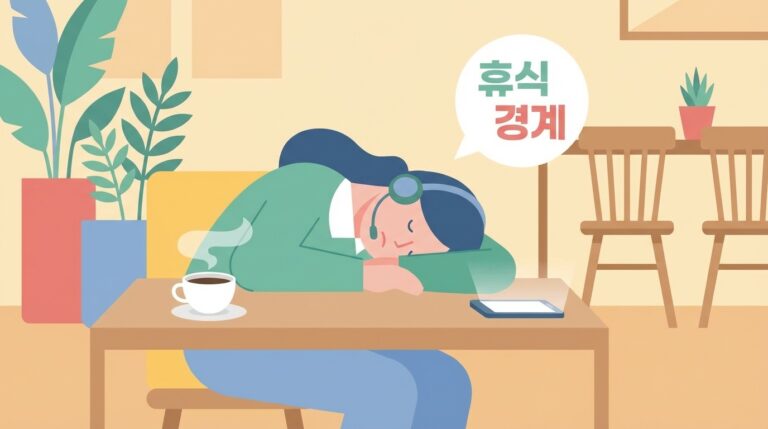
Phase 1: Empathy (The K-Drama Cold Open)
Hello! It’s your Daily Hangul Editor.
Picture this scene from almost every slice-of-life K-Drama you’ve watched: It’s 10 PM. The protagonist, still wearing their slightly wrinkled cafe or office uniform, sits at a neon-lit pojangmacha (포장마차, street food tent). They down a shot of soju, sigh so heavily that the steam from the udon bowl scatters, and mutter something about “energy vampires” and gapjil (갑질). The subtitles simply read: “Work was hard today.”
But was it just “hard”? Not quite.
If you work in Korea, deal with Korean clients, or even just observe the fast-paced service culture here, you quickly realize that the phrase “The customer is king” (손님은 왕이다) is taken very literally. This immense pressure creates a massive burden on service workers, known as 감정노동 (gamjeong nodong, emotional labor).
Today, we are diving deep into the advanced C1 vocabulary of emotional survival in the Korean workplace. Whether you need to set polite but absolute boundaries with a demanding client, vent to your colleagues without sounding unprofessional, or simply show empathy as a customer, knowing these expressions is your ultimate survival kit. Let’s learn how to navigate the nuanced world of Korean customer service (CS) without losing your mind!
Phase 2: Deep Dive into Core Expressions
1. 기 빨린다 (I’m emotionally drained)
- Pronunciation: gi ppal-lin-da (gi sounds like ‘key’ but softer, ppal is a tense ‘p’ like the ‘p’ in ‘spot’)
- Meaning: Literal: “My energy/chi is being sucked out.” Real nuance: “I am mentally and emotionally exhausted from dealing with difficult people.”
- K-Culture Moment: You just finished a 40-minute phone call with a customer who wanted a refund for a half-eaten cake. You hang up, collapse onto your desk, and say this to your coworker.
- Editor’s Insight: This isn’t about physical tiredness (like after a workout). It is purely psychological. Think of it as encountering an “energy vampire” (에너지 뱀파이어).
- Situation Spectrum:
- Casual with friends/close colleagues: ✅
- Semi-formal at the office: ⚠️ (Only if your team culture is very relaxed)
- Formal/To superiors: 🚫
- 🤔 Think About It: The concept of “기” (Gi/Chi) is central to East Asian philosophy, representing life force. How does your native language express psychological exhaustion? Do you also use physical metaphors like “drained” or “sucked dry”?
2. 제가 도와드릴 수 있는 선은 여기까지입니다 (This is the extent of my assistance)
- Pronunciation: je-ga do-wa-deu-ril su in-neun seo-neun yeo-gi-kka-ji-im-ni-da
- Meaning: Literal: “The line where I can help you is up to here.” Real nuance: “I’ve done everything I can, and I am politely telling you to stop asking for more.”
- K-Culture Moment: A legendary de-escalation tactic. When a customer demands the impossible and starts raising their voice, a seasoned CS manager will lower their tone, look the customer in the eye, and deliver this line with polite finality.
- Editor’s Insight: The beauty of this phrase lies in the word “선” (seon, line/boundary). It establishes a boundary without sounding aggressive. You aren’t saying “I won’t help,” you are saying “My hands are tied beyond this boundary.”
- Situation Spectrum:
- Casual with friends: 🚫 (Too robotic)
- Semi-formal with clients: ✅
- Formal/CS situations: ✅
- 🤔 Think About It: Why does Korean rely so heavily on indirect refusals (talking about “lines” and “boundaries”) rather than a direct “No”?
3. 수고가 많으십니다. 천천히 하셔도 돼요 (Thank you for your hard work, take your time)
- Pronunciation: su-go-ga ma-neu-sim-ni-da. cheon-cheon-hi ha-syeo-do dwae-yo.
- Meaning: Literal: “Your effort is a lot. You can do it slowly.” Real nuance: “I see you’re overwhelmed. I appreciate your work, so please don’t rush on my account.”
- K-Culture Moment: It’s 12:30 PM in Yeouido. The cafe is packed with office workers. The lone barista looks like they are about to cry. You step up to order and gently drop this phrase. You instantly become their favorite customer.
- Editor’s Insight: Korean service speed is notoriously fast (빨리빨리 – ppalli-ppalli). Giving someone the “permission” to go slowly is the highest form of empathy you can show a Korean worker.
- Situation Spectrum:
- Customer to Service Worker: ✅
- To your boss: 🚫 (Never say “수고가 많으십니다” to a superior!)
Phase 3: Textbook vs. Real Korean
[Refusing an Impossible Demand]
* 📖 Textbook Korean: 안 됩니다. 할 수 없습니다. (No. I cannot do it.)
* 🗣️ Real Korean: 고객님, 규정상 처리가 어렵습니다. (Customer, due to regulations, processing is difficult.)
* 💡 Why the difference?: A direct “No” feels like a personal attack in Korean service culture. Blaming “the regulations” (규정) removes personal responsibility and saves face for both parties.
[Venting About a Terrible Customer]
* 📖 Textbook Korean: 그 손님은 아주 나쁩니다. (That customer is very bad.)
* 🗣️ Real Korean: 아, 오늘 완전 역대급 진상 만났어. (Ah, I met a legendary ‘jinsang’ today.)
* 💡 Why the difference?: “진상” (jinsang) is the exact cultural equivalent of the Western “Karen” or an entitled customer. It’s the go-to slang for anyone working in service.
[Sympathizing with a Colleague]
* 📖 Textbook Korean: 스트레스 받지 마세요. (Don’t get stressed.)
* 🗣️ Real Korean: 진상 때문에 고생했어. 단거 먹고 당 충전하자! (You suffered because of that ‘jinsang’. Let’s recharge our sugar levels with something sweet!)
* 💡 Why the difference?: In Korea, emotional stress is often “treated” with food or sugar (당 충전 – sugar recharge). It’s a practical, actionable way of showing care.
Bottom Note: For C1 learners, mastering the term “규정상” (due to company policy/regulations) is a game-changer. It instantly makes you sound like a seasoned Korean professional.
Phase 4: Cultural Context — K-Culture Deep Dive
4-1. The Non-verbal Art of “De-escalation”
Language is only half the battle. When setting boundaries with an upset customer, your body language must match the cultural expectation.
– The CS Bow vs. The Apology Bow: A standard greeting bow is 30 degrees. If a customer is furious, workers are often forced to do a 45-degree apology bow, accompanied by lowered eyes. However, modern C1 speakers should know that looking someone firmly (but not aggressively) in the eyes while saying “제가 도와드릴 수 있는 선은 여기까지입니다” is how you establish authority.
4-2. The “Gapjil” (갑질) Epidemic in K-Dramas and Reality
If you’ve watched dramas like Itaewon Class or The Glory, you’ve seen Gapjil (abuse of power). It comes from the contractual terms “Gap” (갑, the one with power/the buyer) and “Eul” (을, the subordinate/the provider).
In the past, the mantra was “무조건 죄송합니다” (Apologize unconditionally). But recently, Korea has seen a massive shift. The MZ generation is pushing back against toxic customers. Now, many call centers play an automated warning message before you connect to an agent: “Our agents are someone’s precious family. Verbal abuse will result in termination of the call and legal action.”
Critical Viewpoint: While dramas often portray a dramatic, heroic moment where the underdog punches the wealthy “Gap,” reality is much quieter. Real empowerment in the Korean workplace comes from knowing how to use hyper-polite Korean (like “규정상 어렵습니다”) as a shield.
Phase 5: Real-world Roleplay Scenario
Setting: Friday night, 8 PM. A smoky Samgyeopsal joint near Gangnam Station. The table is cluttered with empty soju bottles. You are sitting with Min-su.
Characters:
– YOU: A foreign manager at a Korean tech firm. You understand the corporate culture well.
– Min-su (32): Your Korean colleague. He handles the toughest, most demanding client accounts and looks utterly defeated today.
Dialogue:
Min-su: 하아… 오늘 A사 담당자 진짜 엎어버리고 싶었어요.
(Ha-a… oneul A-sa damdangja jinjja eopeobeorigo sipeosseoyo.)
[Sigh… I really wanted to flip the table on Company A’s manager today.]
(🎭 Stage Direction: Min-su aggressively pours himself a shot of soju without waiting for you to pour it—a sign he is deeply upset.)
YOU: 또 무리한 요구를 한 거예요?
(Tto murihan yogureul han geoeyo?)
[Did they make an unreasonable demand again?]
Min-su: 네. 계약서에도 없는 걸 금요일 퇴근 10분 전에 해달라고 하잖아요. 완전 갑질이죠.
(Ne. gyeyakseoedo eomneun geol geumyoil toegeun sip-bun jeone haedallago hajanayo. Wanjeon gapjirijyo.)
[Yeah. Asking for something not even in the contract, 10 minutes before Friday clock-out. It’s total gapjil.]
Min-su: 저도 참다 참다, 결국 “규정상 불가합니다” 하고 끊어버렸어요. 아휴, 진짜 기 빨려.
(Jeodo chamda chamda, gyeolguk “gyujeongsang bulgahamnida” hago kkeuneobeoryeosseoyo. A-hyu, jinjja gi ppallyeo.)
[I held it in and held it in, and finally just said “Due to regulations, it’s impossible” and hung up. Phew, I am so drained.]
🔀 Your Turn! How should you respond to comfort Min-su?
– A) “그냥 잊어버리세요. 주말이잖아요!” (Just forget it. It’s the weekend!)
– B) “팀장님한테 보고해야 하는 거 아니에요?” (Shouldn’t you report this to the team leader?)
– C) “진짜 기 빨렸겠네요. 오늘 고기는 제가 쏠 테니까 많이 드세요!”✅ Best Choice: C — “You must be so drained. I’m paying for the meat today, so eat up!”
Reason: In Korea, validating the emotional exhaustion (“기 빨렸겠네요”) and offering food/drinks is the ultimate comforting gesture.
⚠️ Choice A Analysis: While common in English, “Just forget it” can sound dismissive of their hard work in Korean.
Phase 6: 10-Second Shadowing Drill
Read these out loud to master the intonation of a seasoned CS worker!
- 😤 Firmly: 고객님, / 원칙상 / 더 이상의 보상은 / 어렵습니다.
(Go-geng-nim, / won-chik-sang / deo i-sang-ui bo-sang-eun / eo-ryeop-seum-ni-da.) - 😩 Exhausted: 아휴… / 오늘 하루 종일 / 진상 상대했더니 / 기 빨린다.
(A-hyu… / o-neul ha-ru jong-il / jin-sang sang-dae-haet-deo-ni / gi ppal-lin-da.) - 😊 Warmly: 수고가 / 많으십니다. / 천천히 하셔도 / 돼요.
(Su-go-ga / ma-neu-sim-ni-da. / cheon-cheon-hi ha-syeo-do / dwae-yo.)
Phase 7: K-Culture Mini Dictionary
| Korean | Romanization | English | Context & Explanation |
|---|---|---|---|
| 감정노동 | gamjeong nodong | Emotional labor | The psychological burden of hiding your true feelings to satisfy a customer. |
| 갑질 | gapjil | Abuse of power | When a superior or a client exploits their position to harass a worker. |
| 진상 | jinsang | Entitled customer | The worst kind of customer; someone who makes unreasonable demands and throws tantrums. |
| 당 충전 | dang chungjeon | Sugar recharge | Eating sweets to recover from the stress of dealing with awful people. |
| 블랙컨슈머 | beullaek keonsyumeo | Black consumer | A malicious customer who intentionally causes trouble for financial compensation (Konglish). |
Phase 8: Traveler’s Survival Kit
Even if you aren’t working in Korea, you are interacting with emotional laborers every time you buy a coffee or ride a taxi. Here is how you can be the anti-jinsang!
🆘 Traveler’s Top 3 Anti-Stress Phrases
1. 🇰🇷 “천천히 하셔도 돼요.” (Take your time.)
– 📍 Where to use: Crowded cafes, convenience stores, or when a hotel clerk is visibly rushing.
2. 🇰🇷 “네, 괜찮습니다.” (Yes, that is fine / I understand.)
– 📍 Where to use: When they tell you something is sold out or will take 20 minutes. A quick reassurance reduces their anxiety.
3. 🇰🇷 “감사합니다, 수고하세요!” (Thank you, keep up the good work!)
– 📍 Where to use: Exiting a taxi, leaving a small shop.📌 Editor’s Travel Note
– No Tipping: Remember, Korea does not have a tipping culture. Giving extra money to a stressed worker will confuse them. Instead, a warm “수고하세요” and a slight bow is the greatest tip you can give.
Phase 9: Critical Thinking Corner — “One Step Deeper”
🧠 Think Deeper: Language & Power (언어와 권력)
In Korean, the hierarchical nature of honorifics plays a massive role in the stress of emotional laborers. A customer can easily slip into casual language (반말, banmal) if they feel they are older or “above” the worker. Meanwhile, the worker is trapped in the “Eul” (을) position, forced to use extreme formal honorifics (존댓말, jondaetmal), sometimes even applying honorifics to objects just to sound extra polite (e.g., “Your Americano has come out” – 아메리카노 나오셨습니다). This linguistic imbalance makes it incredibly difficult for workers to defend themselves without sounding “disrespectful.” Language isn’t just communication here; it’s a structural power dynamic.💬 Your Turn: Does your native language have specific grammatical ways that customers exert power over service workers? Or is the power dynamic expressed purely through tone of voice? Let me know in the comments!
Phase 10: FAQ & Avoiding Misunderstandings
Q: Can I tell a visibly stressed service worker “화이팅!” (Fighting!) to cheer them up?
– Maybe, but be careful. While well-intentioned, “화이팅” can sometimes feel a bit tone-deaf or overly energetic to someone who is entirely drained. “수고가 많으십니다” (You’re working so hard) is a safer, more culturally appropriate acknowledgment.
Q: Can I use the word “진상” (jinsang) in front of my boss?
– Only if your boss says it first. It is slang. If your boss is complaining about a “jinsang” client, you can agree. But do not introduce the word in a formal report.
❌ Common Mistake: Using “수고하세요” to an older colleague or your boss.
✅ Do this instead: “수고하세요” (Keep working hard) implies you are evaluating their labor. Use it only for service workers (taxi drivers, cashiers) or subordinates. To your boss who just finished a hard task, say “고생 많으셨습니다!” (You’ve gone through a lot of trouble/hard work!).
Phase 11: Summary & Action Items
- One-Liner Summary: Surviving Korean customer service requires mastering the art of polite boundaries (“규정상 어렵습니다”) and protecting your own energy (“기 빨린다”).
-
Action Mission:
- 🥉 Bronze (Solo): Say “제가 도와드릴 수 있는 선은 여기까지입니다” three times in the mirror with a firm, professional face.
- 🥈 Silver (Online): Leave a comment below using the word “기 빨린다” to describe a recent tiring event in your life.
- 🥇 Gold (Real World): The next time you visit a busy Korean cafe or restaurant, look the worker in the eye, smile, and say “수고 많으십니다. 천천히 하셔도 돼요.”
- K-Culture Mission: Watch an episode of a modern office K-Drama (like Misaeng or My Mister). Try to spot the moment someone mentions a “갑질” (power trip) or sighs about “감정노동” (emotional labor)!
Phase 12: Interactive Quiz
1. Situational Judgment: Your Korean coworker returns to their desk after dealing with a screaming customer. They look pale. What is the BEST thing to say?
– A) “그 손님 완전 진상이네요. 단거 드실래요?”
– B) “고객님은 왕이니까 참으세요.”
– C) “수고하세요.”
2. Fill in the Blank:
“아휴, 저 팀장님 또 시작이네. 맨날 자기 일 떠넘기고… 완전 ( ____ )이야.”
(Sigh, that team leader is at it again. Always pushing his work onto others… total ____.)
– A) 갑질 (Gapjil)
– B) 정 (Jeong)
3. True or False – K-Culture Edition:
“To show appreciation to a deeply stressed Korean barista, you should leave a 20% cash tip in the tip jar.”
– True / False
Answers & Explanations (Click to reveal)
- A (“That customer is a total jinsang. Do you want something sweet?”). Validates their pain and offers a practical Korean remedy (sugar recharge). B is terrible advice. C is disrespectful to a colleague.
- A (갑질 – Gapjil). Using power to abuse subordinates.
- False. There is no tipping culture in Korea. Give them a warm “수고 많으십니다” instead!
Frequently Asked Questions (FAQ)
Q: What does "기 빨린다 (I'm emotionally drained)" mean in Korean and how do you pronounce it?
A: In Korean, "기 빨린다 (I'm emotionally drained)" is pronounced [gi ppal-lin-da (gi sounds like 'key' but softer, ppal is a tense 'p' like the 'p' in 'spot'] and means: Literal: "My energy/chi is being sucked out." Real nuance: "I am mentally and emotionally exhausted from dealing with difficult people."
Q: What does "제가 도와드릴 수 있는 선은 여기까지입니다 (This is the extent of my assistance)" mean in Korean and how do you pronounce it?
A: In Korean, "제가 도와드릴 수 있는 선은 여기까지입니다 (This is the extent of my assistance)" is pronounced [je-ga do-wa-deu-ril su in-neun seo-neun yeo-gi-kka-ji-im-ni-da] and means: Literal: "The line where I can help you is up to here." Real nuance: "I've done everything I can, and I am politely telling you to stop asking for more."
Q: What does "수고가 많으십니다. 천천히 하셔도 돼요 (Thank you for your hard work, take your time)" mean in Korean and how do you pronounce it?
A: In Korean, "수고가 많으십니다. 천천히 하셔도 돼요 (Thank you for your hard work, take your time)" is pronounced [su-go-ga ma-neu-sim-ni-da. cheon-cheon-hi ha-syeo-do dwae-yo.] and means: Literal: "Your effort is a lot. You can do it slowly." Real nuance: "I see you're overwhelmed. I appreciate your work, so please don't rush on my account."







