

Phase 1: Welcome to the Holiday Chaos!
Hello! I’m the Lead Editor at Daily Hangul.
Have you ever watched a K-Pop idol variety show (like Run BTS or Going Seventeen) or a cozy K-Drama family scene, and suddenly, everyone is screaming, jumping, and throwing wooden sticks on a blanket?
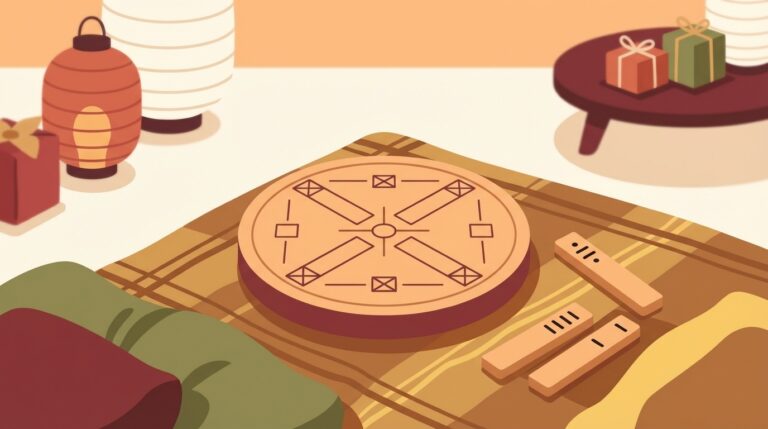
Welcome to Yut Nori (윷놀이)! This traditional board game is the absolute centerpiece of Korean holidays (Korean Holidays) like Seollal (Lunar New Year) and Chuseok (Korean Thanksgiving).
At first glance, it just looks like you’re throwing sticks. But if you sit down to play, you’ll realize it’s a high-stakes battle of strategy, luck, and loud reactions. If you know how to react in Korean during a Yut Nori game, you won’t just be a guest; you’ll be the MVP of the holiday gathering. Let’s dive in!
Phase 2: Core Expressions for Yut Nori
Here are the top phrases you need to shout (yes, shout!) during the game.
1. 내 차례야! (It’s my turn!)
- Pronunciation: Nae charyeya! [Nyeh cha-rye-yah!]
- Meaning: It is my turn!
- K-Culture Moment: You’ll hear this in every Korean variety show when idols are fighting over who goes next. It’s an enthusiastic way to claim your spotlight.
- Editor’s Insight: The word 차례 (charye) means ‘turn’ or ‘order’. Adding 야 (ya) makes it casual and energetic. If you’re playing with older adults, simply change it to “제 차례예요! (Je charyeyeyo!)”.
- Situation Spectrum:
- Casual (Friends): ✅
- Semi-formal (Co-workers): ⚠️ (Use 제 차례예요 instead)
- Formal (Elders): 🚫
- 🤔 Think About It: In many cultures, waiting patiently is key. But in a Korean game setting, enthusiastically claiming your turn shows you are fully engaged and enjoying the moment!
2. 잡았다! (Caught you!)
- Pronunciation: Jabatda! [Jah-baht-dah!]
- Meaning: I caught it! (Literal) / I captured your piece! (Real nuance)
- K-Culture Moment: In Yut Nori, if your piece lands on the same spot as your opponent’s, you ‘catch’ them, sending them back to the start. The room will erupt when someone yells “잡았다!”
- Editor’s Insight: This comes from the verb 잡다 (to catch). You can also use this in daily life when you catch a mosquito or finally hail a taxi!
- Situation Spectrum:
- Casual (Friends): ✅
- Semi-formal (Co-workers): ✅ (Usually acceptable in the heat of a game)
- Formal (Elders): ⚠️ (Add a cute smile so you don’t look too ruthless!)
- 🤔 Think About It: Notice how Koreans use the past tense “Caught it!” right at the moment it happens? It adds impact and finality to the action.
3. 한 번만 봐주세요~ (Please let it slide just this once~)
- Pronunciation: Han beonman bwajuseyo~ [Hahn bun-mahn bwa-joo-seh-yo~]
- Meaning: Please look at me once (Literal) / Please give me a break this one time (Real nuance)
- K-Culture Moment: When a younger K-Drama character makes a mistake, or when a K-Pop idol is begging the variety show PD for another chance, they clasp their hands and use this exact phrase.
- Editor’s Insight: 봐주다 (Bwajuda) literally means ‘to see and give’, but it’s universally used as ‘to let someone off the hook’ or ‘to go easy on someone’. It’s the ultimate survival phrase!
- Situation Spectrum:
- Casual (Friends): ✅ (Say: 한 번만 봐줘~)
- Semi-formal (Co-workers): ✅
- Formal (Elders): ✅ (Perfect for begging your Korean grandma not to capture your Yut piece!)
- 🤔 Think About It: Why does ‘looking’ at someone equate to ‘forgiving’ them? It reflects the idea of acknowledging their human flaw and showing grace.
Phase 3: Textbook vs. Real Korean
Let’s see how game-day Korean differs from the textbook!
[When it is your turn to throw]
* 📖 Textbook Korean: 저의 차례입니다. (It is my turn.)
* 🗣️ Real Korean: 내 차례! 가자! (My turn! Let’s go!)
* 💡 Why the difference?: Games are fast-paced! Koreans drop the formal subject markers and use short, punchy exclamations to keep the energy high.
[When you make a mistake or get caught]
* 📖 Textbook Korean: 오, 안타깝습니다. (Oh, that is regrettable.)
* 🗣️ Real Korean: 아, 안 돼! / 헐! (Ah, no way! / OMG!)
* 💡 Why the difference?: ‘헐’ (Heol) is a very common slang used to express shock or mild disappointment. It’s the ultimate ‘Oh my goodness’ sound!
Bottom Note: At an A2 (Beginner) level, mastering short emotional sounds like “아싸!” (Assa! / Yay!) or “헐!” (Heol! / OMG!) will make you sound incredibly natural without needing complex grammar.
Phase 4: Cultural Context — K-Culture Deep Dive
4-1. The Non-Verbal Game: Nunchi and Floor Culture
First, you don’t play Yut Nori at a dining table. You clear the living room, lay down a traditional blanket (담요 – dam-yo), and sit on the Ondol (heated floor).
Also, playing Yut requires intense 눈치 (Nunchi)—the ability to read the room. If you are playing against your boss or an elder, you have to read their Nunchi. Do you capture their piece and win, or do you strategically ‘miss’ it to make them happy?
4-2. The Variety Show Chaos
If you watch K-Pop idols on their YouTube content (like Time to Twice or Run BTS), you’ll notice that Yut Nori is never quiet. It’s a game of psychological warfare. Players will distract the person throwing the sticks, chant loud songs, and playfully argue over the rules. Don’t be shy—the louder you are, the better!
Phase 5: Real-life Roleplay Scenario
Setting: It’s the evening of Seollal (Lunar New Year). You are at your Korean friend Minho’s house. You’re sitting on a warm blanket in the living room with Minho and his Grandma (할머니 – Halmeoni). The game board is set!
Characters:
– YOU: An international student experiencing a Korean holiday for the first time.
– Minho (25): Your energetic Korean friend.
– Grandma (70): Minho’s grandmother, who looks sweet but is a ruthless Yut Nori champion.
Dialogue:
Minho: 준비됐어? 우리 먼저 던진다!
(Junbidwaesseo? Uri meonjeo deonjinda!)
[English] Ready? We’re throwing first!
(🎭 Stage Direction: Minho throws the four sticks high into the air. They land with a clatter.)
YOU: 우와! 윷이다!
(Uwa! Yuchida!)
[English] Wow! It’s ‘Yut’ (4 flat sides up, moving 4 spaces)!
Grandma: 아이고, 잘하네. 내 차례예요.
(Aigo, jalhane. Nae charyeyeyo.)
[English] Oh my, you’re good. It’s my turn.
YOU: 할머니, 파이팅!
(Halmeoni, paiting!)
[English] Grandma, fighting (good luck)!
Minho: 안 돼! 할머니가 우리 잡으려고 해!
(An dwae! Halmeoniga uri jabeuryeogo hae!)
[English] Oh no! Grandma is trying to catch us!
(🎭 Stage Direction: Grandma throws the sticks. It’s a perfect roll to land on your piece!)
Grandma: 잡았다! 너희들 처음부터 다시 해~
(Jabatda! Neohuideul cheoeumbuteo dasi hae~)
[English] Caught you! You guys start over from the beginning~
Minho: 아, 할머니!
(Ah, Halmeoni!)
[English] Ah, Grandma!
🔀 Your Turn! How should you reply to Grandma?
– A) “알겠습니다. 다시 하겠습니다.” (Understood. I will do it again.)
– B) “할머니~ 한 번만 봐주세요! 네?🥺” (Grandma~ Please let it slide just this once! Right?🥺)
– C) “진짜 짜증나요!” (This is really annoying!)✅ Best Choice: B — Begging playfully with aegyo (cuteness) is the ultimate cheat code in Korean family games! Grandma will probably laugh and still capture your piece, but she’ll love your reaction.
⚠️ Choice A Analysis: Too formal and robotic for a fun game.
🚫 Choice C Analysis: Never say this to an elder! It sounds genuinely angry and rude.
Grandma: (Laughs) 안 돼~ 승부는 승부야!
(An dwae~ Seungbuneun seungbuya!)
[English] No way~ A game is a game!
YOU: 헐! 다음엔 제가 이길 거예요!
(Heol! Daeumen jaega igil geoyeyo!)
[English] OMG! I will win next time!
Minho: 좋아, 가자!
(Joa, gaja!)
[English] Good, let’s go!
Phase 6: 10-Second Shadowing Drill
Try this right now! Emphasize the long ‘~’ at the end to sound pleading and cute.
🥺 할머니~ / 한 번만 / 봐주세요~~~! (halmeoni~ / han beonman / bwajuseyo~~~!)
Phase 7: K-Culture Mini Dictionary
| Korean | Romanization | English | Context |
|---|---|---|---|
| 명절 | myeongjeol | Traditional Holiday | Refers to big holidays like Seollal and Chuseok. |
| 윷판 | yut-pan | Game Board | The map where you move your tokens. |
| 빽도 | bbaek-do | Backwards Do | One marked stick makes you go backwards! The ultimate plot twist. |
| 윷 / 모 | yut / mo | 4 steps / 5 steps | The highest rolls. Everyone cheers when these happen! |
| 벌칙 | beolchik | Penalty | The loser usually has to do a penalty, like washing dishes (설거지) or getting a flick on the forehead (딱밤). |
Phase 8: Traveler’s Survival Kit
If you’re visiting Korea during a holiday, you might want to buy your own Yut Nori set to play at your guesthouse!
🆘 Survival Phrases for Buying a Game
– 🇰🇷 “이거 얼마예요?” (igeo eolmayeyo?) – How much is this?
– 🇰🇷 “윷놀이 세트 있어요?” (Yunnori sete isseoyo?) – Do you have a Yut Nori set?
– 📍 Where to use: Daiso (다이소), Emart, or local convenience stores (편의점) during holiday seasons.📌 Editor’s Travel Note
– Shopping during Holidays: Major holidays mean many small shops close! But don’t worry, Daiso and convenience stores (CU, GS25, 7-Eleven) usually stay open and always sell traditional games near the entrance during Seollal/Chuseok.
– Payment: Korea is a cashless society. You can use your credit card (or T-money card) for a cheap 2,000 KRW Yut Nori set at Daiso without any awkwardness!
Phase 9: Critical Thinking Corner — “A Step Deeper”
🧠 Think Deeper: Language & Power in Korean Games
Notice how in our roleplay, even when you were fiercely competing against Grandma, you still added ‘요 (yo)’ at the end of your sentences? (e.g., “제가 이길 거예요!”). In English, when a game gets heated, age and status often disappear, and everyone speaks the same way. But in Korean, the polite speech level (존댓말 – Jondaetmal) remains an unbreakable rule, even when you’re playfully ‘destroying’ your elder on the game board! The hierarchy of language stays intact, but the emotional bond strengthens.💬 Your Turn: Does your language change depending on who you are playing a game with? Let us know in the comments!
Phase 10: FAQ & Avoiding Mistakes
Q: “Can I cheer loudly if I beat my Korean boss or father-in-law at Yut Nori?”
A: Maybe! It depends entirely on their personality. Usually, during holiday games, people loosen up. Cheering “아싸!” (Assa!) is fine, but avoid mocking them. A humble “제가 운이 좋았네요” (I guess I was lucky) after winning is always a safe bet!
❌ Common Mistake #1: Being too quiet and polite during the game.
✅ Do this instead: Yut Nori is about HYPE! Clap your hands, gasp loudly, and shout “가자!” (Let’s go!). Silence is the enemy of a good Korean game.❌ Common Mistake #2: Throwing the sticks off the blanket.
✅ Do this instead: Keep the sticks on the mat! If one stick rolls off the blanket, it’s called 낙 (Nak – Fall/Foul), and your turn is invalidated. People will laugh and shout “낙이다!” (It’s a foul!).
Phase 11: Summary & Action Items
One-Liner Summary: Yut Nori isn’t just about moving pieces on a board; it’s about loud cheers, playful begging (“한 번만 봐주세요!”), and bonding over the holiday blanket!
Your Action Mission:
– 🥉 Bronze (Solo): Stand up and enthusiastically shout “내 차례야!” (It’s my turn!) to your empty room.
– 🥈 Silver (Online): Comment below using “아싸!” to celebrate something good that happened today.
– 🥇 Gold (Real Life): If you have a Korean friend, ask them: “이번 명절에 윷놀이 해요?” (Are you playing Yut Nori this holiday?)
🎯 K-Culture Mission: Search for “Idol Yut Nori” (아이돌 윷놀이) on YouTube. Watch just 5 minutes and see if you can hear them shout “잡아!” (Catch them!) or “낙이다!” (Foul!).
Phase 12: Interactive Quiz
1. Situational Judgment:
Your piece lands exactly on your opponent’s piece! What should you shout to celebrate capturing them?
– A) 한 번만 봐주세요!
– B) 잡았다!
– C) 내 차례야!
2. True or False — K-Culture Edition:
– “When playing traditional Korean games like Yut Nori, it is considered polite to stay very quiet and respectful so you don’t disturb others.”
– (T / F)
(Check your answers by highlighting the blank space below!)
[1. B (Jabatda! – Caught you!) / 2. False! Korean games are notoriously loud and energetic!]
Did you survive the Yut Nori chaos? Let me know your score in the comments! Happy Holidays! 🌕🎉
Frequently Asked Questions (FAQ)
Q: What does "내 차례야! (It's my turn!)" mean in Korean and how do you pronounce it?
A: In Korean, "내 차례야! (It's my turn!)" is pronounced [Nae charyeya! [Nyeh cha-rye-yah!] and means: It is my turn!
Q: What does "잡았다! (Caught you!)" mean in Korean and how do you pronounce it?
A: In Korean, "잡았다! (Caught you!)" is pronounced [Jabatda! [Jah-baht-dah!] and means: I caught it! (Literal) / I captured your piece! (Real nuance)
Q: What does "한 번만 봐주세요~ (Please let it slide just this once~)" mean in Korean and how do you pronounce it?
A: In Korean, "한 번만 봐주세요~ (Please let it slide just this once~)" is pronounced [Han beonman bwajuseyo~ [Hahn bun-mahn bwa-joo-seh-yo~] and means: Please look at me once (Literal) / Please give me a break this one time (Real nuance)







