

Phase 1: Empathy & Immersion (The Cold Open)
Hello! This is your Lead Editor at Daily Hangul.
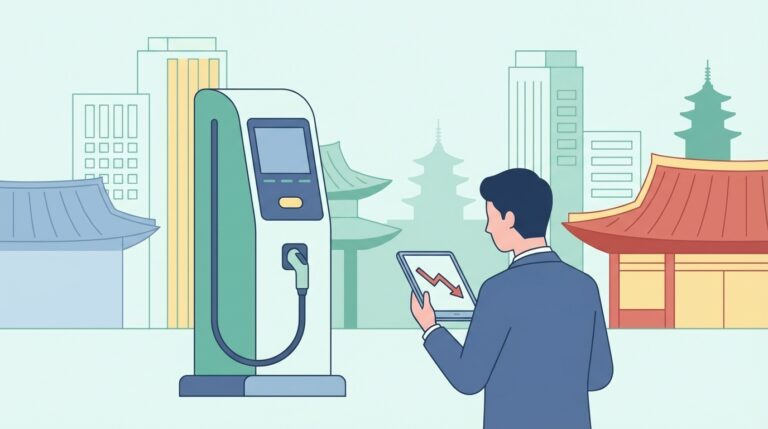
Picture this K-Drama scene: A sleek, glass-walled boardroom in Yeouido. The young, ambitious CEO of an automotive conglomerate slams a report onto the mahogany table. The camera zooms in on the chart—a steep, red downward curve. He sighs, loosens his tie, and mutters, “It’s the Chasm. The subsidies were slashed, and now the consumers are turning away.” The English subtitles simply read: “Sales are down due to lower subsidies.”
But as an advanced (C2) learner of Korean, you know that subtitles rarely capture the raw, corporate anxiety or the specific socio-economic buzzwords trending in Korean society.
Currently, South Korea is fiercely debating Environmental Regulations (환경 규제), specifically the reduction of EV subsidies (전기차 보조금 축소) and the resulting slowdown in sales (판매량 둔화 우려). If you are doing business in Korea, reading local news, or even just sitting at a café in Gangnam eavesdropping on corporate workers, you will hear these exact frustrations.
Today, we are going to dive deep into high-level, authentic business Korean. We aren’t just learning words; we are decoding the corporate Nunchi (눈치) behind Korea’s green energy transition. Let’s bridge the gap between textbook Korean and the real boardroom!
Phase 2: Deep Dive into Core Expressions
To discuss EV market trends like a true insider, you need these three powerhouse expressions.
1. 반토막 나다 (To be cut in half)
- Pronunciation: [ban-to-mang na-da] Sounds like: ban-toe-mang-nah-dah (Notice the nasal assimilation: 막 becomes 망 before 나).
- Meaning: (Literal) To be broken into two halves. (Real Nuance) A dramatic, often negative, 50% plunge in value, budget, or subsidies.
- K-Culture Moment: You’ll hear this constantly in Korean stock market circles (주식 시장) or when the government announces the new yearly EV subsidy plans. It carries a heavy sigh of disappointment.
- Editor’s Insight: This isn’t just “decreased” (감소하다). This expression carries an emotional weight of sudden loss. When the EV subsidy goes from 10 million won to 5 million won, Koreans don’t say “it was reduced.” They say “it was slashed in half.”
- Situation Spectrum:
- Close Friends (Casual): ✅
- Co-workers (Semi-formal): ✅ (Very common in business meetings to emphasize severity)
- Senior Boss/Public Speech (Formal): ⚠️ (Better to use 절반으로 감소했다 in an official public press release)
- 🤔 Think About It: Why does Korean use physical, visceral imagery (breaking into halves, getting cut) to describe economic data? How does your native language express a sudden financial drop?
2. 수요가 꺾이다 (Demand is dampened/broken)
- Pronunciation: [su-yo-ga kkeo-kki-da] Sounds like: soo-yo-gah kkuh-kkee-dah (The ‘ㄲ’ is a tense, sharp sound, like a snapping branch).
- Meaning: (Literal) Demand is bent/broken. (Real Nuance) The upward momentum of consumer demand has abruptly stalled or reversed.
- K-Culture Moment: Think of a news anchor reporting on the EV market. The moment the subsidy drops, the graph “snaps.” It perfectly captures the current “EV Chasm” where early adopters have bought their cars, and the mainstream market is hesitating.
- Editor’s Insight: ‘꺾이다’ is a beautiful verb. You can use it for weather (더위가 꺾이다 – the heatwave has broken), spirits (기가 꺾이다 – to lose confidence), and economics. It implies a loss of power or momentum.
- Situation Spectrum:
- Close Friends (Casual): ✅
- Co-workers (Semi-formal): ✅
- Senior Boss/Public Speech (Formal): ✅ (Perfectly acceptable in high-level business analysis)
- 🤔 Think About It: What does the use of “꺾이다” (to be bent/broken) tell us about how Koreans view market trends—as living entities with momentum rather than just static numbers?
3. 시기상조다 (It is premature / Too early to tell)
- Pronunciation: [shi-gi-sang-jo-da] Sounds like: shee-gee-sahng-jo-dah
- Meaning: (Literal) The time is still early. (Real Nuance) Society or the market isn’t ready for this yet (usually referring to infrastructure like EV charging stations).
- K-Culture Moment: A classic phrase used by the “devil’s advocate” in a corporate K-Drama boardroom. When the eager young manager pitches a 100% transition to EVs, the seasoned director leans back and says, “Isn’t it sigisangjo?”
- Editor’s Insight: This is a four-character Sino-Korean idiom (Hanja: 時機尙早). Using Hanja-based idioms instantly elevates your Korean to C2 level. It shows you understand complex socio-economic debates.
- Situation Spectrum:
- Close Friends (Casual): ⚠️ (A bit too formal for grabbing beers, unless used sarcastically)
- Co-workers (Semi-formal): ✅
- Senior Boss/Public Speech (Formal): ✅ (Highly recommended)
- 🤔 Think About It: Korea is known for “Ppalli-Ppalli” (hurry up) culture. Yet, terms like sigisangjo act as a cultural brake. How do societies balance rapid tech adoption with necessary infrastructure?
Phase 3: Textbook vs. Real Korean
Let’s see how C2 business professionals actually talk compared to textbooks.
[Describing the EV Market Slowdown]
* 📖 Textbook Korean: 전기자동차의 판매가 부진합니다. (EV sales are sluggish.)
* 🗣️ Real Korean: 전기차 시장이 캐즘(Chasm)에 빠졌어요. (The EV market has fallen into the chasm.)
* 💡 Why the difference?: Korean business culture loves adopting global economic frameworks (like Geoffrey Moore’s “Chasm” theory) and using them as everyday corporate buzzwords to sound cutting-edge.
[Reacting to Subsidy Cuts]
* 📖 Textbook Korean: 정부의 지원금이 크게 감소했습니다. (Government support funds have decreased significantly.)
* 🗣️ Real Korean: 올해 보조금 완전 칼질 당했어요. (This year’s subsidies got totally slashed/stabbed.)
* 💡 Why the difference?: ‘칼질’ (knife work) vividly expresses the frustration of consumers and manufacturers feeling “attacked” by sudden policy changes.
[Debating the Feasibility of Buying an EV]
* 📖 Textbook Korean: 아직 충전소가 부족해서 불편합니다. (It is inconvenient because there are not enough charging stations yet.)
* 🗣️ Real Korean: 인프라 생각하면 아직은 시기상조죠. 하이브리드가 답이에요. (Considering the infrastructure, it’s still premature. Hybrids are the answer.)
* 💡 Why the difference?: Native professionals summarize complex realities (lack of chargers, battery fires) into a single overarching concept like ‘인프라’ (infrastructure) and ‘시기상조’ (premature).
Bottom Note: At the C2 level, your goal is to blend high-level Hanja vocabulary (시기상조, 인프라) with dynamic, slightly dramatic verbs (꺾이다, 반토막 나다) to match the rhythm of Korean corporate speech.
Phase 4: Cultural Context — K-Culture Deep Dive
4-1. Non-Verbal Cues: The Corporate “Sigh & Nod”
When discussing negative market trends like “수요가 꺾이다”, do not smile. The culturally appropriate non-verbal cue is a slight frown, a slow nod, and perhaps a subtle sigh (한숨). It shows you are deeply engaged with the gravity of the business situation. It is the ultimate display of corporate Nunchi—aligning your mood with the company’s P&L statement.
4-2. K-Culture Connection: The K-Drama Boardroom Trope
The debate over environmental regulations and EV subsidies is playing out right now in Korean automotive conglomerates (like Hyundai/Kia). In K-Dramas like Misaeng or Reborn Rich, boardroom scenes are battlegrounds of rhetoric.
Using words like 시기상조 (Premature) or 캐즘 (Chasm) makes you sound exactly like the brilliant strategy analyst character who saves the day.
Critical Perspective: While K-Dramas often portray business decisions being made by one dramatic, table-slapping chairman, real Korean corporate culture relies heavily on consensus building (품의서 – internal proposal documents) and aligning with government policy trends (정부 기조). You can’t just mandate EVs; you have to ride the wave of government subsidies.
Phase 5: Real-World Roleplay Scenario
Setting: Friday, 7 PM. A high-end Izakaya in Yeouido (Seoul’s finance district). The table is covered in skewers and Asahi draft beers. You and your Korean strategy team are unwinding after a grueling Q3 automotive industry seminar.
Characters:
– YOU: A foreign strategy analyst working in Seoul. You are sharp, observant, and trying to impress your senior.
– Min-su (38): Your Team Leader (팀장님). Sharp, a bit stressed about the Q3 numbers, but relaxed after a beer.
Dialogue:
Min-su: 오늘 세미나 들으니까, 전기차 시장 분위기 심상치 않던데? 🍺
(oneul semina deureunikka, jeongicha sijang bunwigi simsangchi andeonde?)
[Listening to the seminar today, the vibe in the EV market seems unusual, right?]
YOU: 네, 팀장님. 특히 올해 보조금 개편안 나오면서 수요가 확 꺾인 것 같습니다.
(ne, timjangnim. teuki olhae bojogum gaepeonan naomyeonseo suyoga hwak kkeokkin geot gatseumnida.)
[Yes, Team Leader. Especially with this year’s subsidy reform plan, it seems demand has sharply dampened.]
Min-su: 내 말이. 작년만 해도 보조금 빵빵해서 다들 테슬라니 아이오닉이니 난리였는데.
(nae mari. jangnyeonman haedo bojogum ppangppanghaeseo dadeul teseullani aionigini nalliyeonneunde.)
[That’s what I’m saying. Just last year, subsidies were generous, so everyone was going crazy over Teslas and Ioniqs.]
YOU: 보조금이 거의 반토막 나니까, 소비자들 지갑이 닫힌 거죠.
(bojogeu-mi geoui bantomak nanikka, sobijadeul jigabi dachin geojyo.)
[Since subsidies were almost cut in half, consumers’ wallets have closed.]
(🎭 Stage Direction: Min-su nods vigorously and clinks his glass against yours.)
Min-su: 게다가 충전 인프라도 아직 멀었잖아. 아파트 주차장 가보면 전기차 충전칸에서 맨날 싸움 나.
(gedaga chungjeon inpeurado ajik meoreotjana. apateu juchajang gabomyeon jeongicha chungjeonkaneseo maennal ssaum na.)
[Plus, the charging infrastructure is still far off. If you go to an apartment parking lot, there are always fights at the EV charging spots.]
🔀 Your Turn! How do you respond to Team Leader Min-su?
– A) “맞아요. 그래서 전기차는 나빠요.” (Too simplistic, A1 level textbook answer.)
– B) “네, 그래서 당분간 100% 전동화는 시기상조인 것 같습니다. 하이브리드가 대세죠.”
– C) “대박! 진짜 싸워요? 한국 사람들 무섭네요 ㅋㅋㅋ”✅ Best Choice: B — Reason: It perfectly uses the C2 Hanja idiom (시기상조) and smoothly transitions into business strategy (hybrids being the trend). It proves you understand both the language and the industry landscape.
⚠️ Choice C Analysis: While casual and native-like, saying “Koreans are scary” to your boss during a serious industry discussion is highly unprofessional.
Phase 6: 10-Second Shadowing Drill
Speak aloud to master the intonation of a Korean business strategist!
😤 아무리 / 친환경이 대세라지만, / 인프라 없이 100% 전환은 / 시기상조 아닌가요?
(amuri / chin-hwangyeongi daeserajiman, / inpeura eopsi baekpeosenteu jeonhwaneun / sigisangjo aningayo?)
[No matter how much eco-friendly is the trend, isn’t a 100% transition without infrastructure premature?]
Tip: Place a strong, firm emphasis on 시.기.상.조. Drop your pitch slightly at the end to sound persuasive and analytical.
Phase 7: K-Culture Mini Dictionary
| Korean | Romanization | English | Contextual Meaning |
|---|---|---|---|
| 보조금 | bojogum | Subsidy | The core driver of EV sales in Korea. Usually announced by the government early in the year. |
| 캐즘 | kaejeum | Chasm | The “Death Valley” curve in tech adoption. Currently the most used buzzword in Korean auto news. |
| 친환경 | chin-hwangyeong | Eco-friendly | ESG term. Literally “friends with the environment.” |
| 내연기관차 | naeyeon-gigwancha | ICE Vehicle | Internal Combustion Engine cars (gas/diesel). The counterpart to EVs. |
| 인프라 | inpeura | Infrastructure | Used broadly to discuss charging stations (충전소) and battery tech. |
Phase 8: Traveler’s Survival Kit (Jeju EV Edition)
Even if you aren’t in a boardroom, you will encounter the EV reality if you travel to Jeju Island, Korea’s “EV Capital.” Most rental cars there are EVs. Here is how to survive the charging infrastructure.
🆘 Survival Expressions for EV Renters
– 🇰🇷 “근처에 급속 충전소 있나요?” (geuncheo-e geupsok chungjeonso innayo?)
– 🗣️ Meaning: Is there a fast charging station nearby?
– 📍 Where to use: Gas stations, rental car desks, convenience stores.
- 🇰🇷 “이거 완충하는 데 얼마나 걸려요?” (igeo wanchunghaneun de eolmana geollyeoyo?)
- 🗣️ Meaning: How long does it take to fully charge this?
🇰🇷 “환경부 카드 되나요?” (hwangyeongbu kadeu doenayo?)
- 🗣️ Meaning: Do you accept the Ministry of Environment card? (Essential for using public chargers).
📌 Editor’s Travel Note
– Apps to download: ‘EV Infra’ or ‘Kakao Navi’ are lifesavers for finding working charging stations in Korea.
– Nunchi Game: Never leave your fully charged EV at a public charging spot. In Korea, “charging etiquette” (충전 예절) is taken very seriously. If you block a charger, you might get reported via the ‘Safety Sinmungo’ app!
Phase 9: Critical Thinking Corner — “One Step Deeper”
Korean in the Global Era & Tech Adoption
🧠 Think Deeper:
The rapid adoption—and subsequent sudden slowdown—of EVs in Korea perfectly illustrates the collision between Korea’s “Ppalli-Ppalli” (hurry up) tech enthusiasm and the physical limits of urban infrastructure. Korean society loves to adopt global trends (hence the heavy use of borrowed words like 캐즘 (Chasm) and 인프라 (Infrastructure) over pure Korean equivalents). However, as subsidies drop, the pragmatic reality sets in. The language shifts from hyped English buzzwords to grounded, heavy Sino-Korean warnings like 시기상조 (Premature). Language here reflects the exact temperature of the economy: from rapid global optimism to localized, cautious realism.💬 Your Turn: Does your country heavily subsidize EVs? How does the media in your country describe the transition away from gas cars? Share your thoughts in the comments!
Phase 10: FAQ & Avoiding Common Mistakes
Q1: Can I say “수요가 반토막 났다” (Demand was cut in half) to my CEO in a formal presentation?
Maybe, but proceed with caution. While it’s very native-sounding, “반토막” is slightly colloquial. In a highly formal PowerPoint presentation, it is safer to use “수요가 50% 급감했습니다” (Demand sharply decreased by 50%). Save “반토막” for the Q&A session or verbal discussions.
Q2: Are Hybrid cars (하이브리드) considered EVs in Korea?
Legally, no, but conversationally, they are part of the “친환경차” (Eco-friendly car) category. Currently, because of the EV Chasm, hybrids are the hottest trend in Korea.
❌ Common Mistake #1: Translating “Subsidy” as “돈” (Money) or “할인” (Discount).
✅ Do this instead: Always use 보조금 (Subsidy) or 지원금 (Support fund). Saying “정부가 할인을 안 해줘요” (The government isn’t giving discounts) sounds very unnatural (like A1 level) in a C2 business context.
Phase 11: Summary & Action Items
One-Liner Summary: To master Korean business discussions on environmental regulations, drop the textbook metrics and use visceral market phrases like “반토막 나다”, “수요가 꺾이다”, and “시기상조”.
Your 3-Step Action Mission:
– 🥉 Bronze (Solo): Read a Korean financial news headline about EVs and locate the word 보조금 or 캐즘.
– 🥈 Silver (Online): Write a comment on a Korean YouTube video about cars: “아직은 인프라 때문에 시기상조인 것 같아요.”
– 🥇 Gold (Real World): At your next Korean business meeting or class, play the devil’s advocate and use “그건 시기상조 아닙니까?” to impress your peers.
K-Culture Special Mission:
Go to Naver News (네이버 뉴스) -> Economy (경제) -> Automobile (자동차) section today. I guarantee you will find the word “캐즘” or “보조금 반토막” in the top 5 articles. Find it, read it, and feel the C2 Korean power!
Phase 12: Interactive Challenge — Quiz Time!
1. Situational Judgment:
You are drafting an internal email to your Korean team explaining that due to recent environmental policy changes, consumer interest in EVs has suddenly dropped. Which phrase makes you sound like a C2 Korean Strategy Manager?
– A) 전기차를 좋아하는 사람이 줄었습니다.
– B) 전기차 수요가 꺾인 것으로 분석됩니다.
– C) 전기차가 반토막입니다.
2. Fill in the Blank (K-Drama Edition):
(Chairman slams desk) “충전소도 없는데 전동화 100%라니! 이건 명백한 _______다!”
– A) 캐즘
– B) 보조금
– C) 시기상조
3. True or False – K-Culture Edition:
In Korea, it is perfectly acceptable to unplug someone else’s EV at a public charging station if their car is already at 100%. (T/F)
🚨 Click here for the Answers!
- B (A is too basic. C means the car itself is cut in half!).
- C (It means ‘Premature’).
- False. Never unplug someone else’s car without permission. You could face legal or civil disputes. Always use proper charging etiquette or report abandoned cars via official channels.
Did you survive the EV Chasm in the Korean boardroom today? Drop a comment below using one of today’s phrases!
Frequently Asked Questions (FAQ)
Q: What does "반토막 나다 (To be cut in half)" mean in Korean and how do you pronounce it?
A: In Korean, "반토막 나다 (To be cut in half)" is pronounced [ban-to-mang na-da] and means: (Literal) To be broken into two halves. (Real Nuance) A dramatic, often negative, 50% plunge in value, budget, or subsidies.
Q: What does "수요가 꺾이다 (Demand is dampened/broken)" mean in Korean and how do you pronounce it?
A: In Korean, "수요가 꺾이다 (Demand is dampened/broken)" is pronounced [su-yo-ga kkeo-kki-da] and means: (Literal) Demand is bent/broken. (Real Nuance) The upward momentum of consumer demand has abruptly stalled or reversed.
Q: What does "시기상조다 (It is premature / Too early to tell)" mean in Korean and how do you pronounce it?
A: In Korean, "시기상조다 (It is premature / Too early to tell)" is pronounced [shi-gi-sang-jo-da] and means: (Literal) The time is still early. (Real Nuance) Society or the market isn't ready for this yet (usually referring to infrastructure like EV charging stations).







