

Hello! I’m the Senior Editor of Daily Hangul. Welcome back!
Phase 1: Empathy (The K-Culture Cold Open)
Picture this: You’re on vacation in Jeju Island, or perhaps you’re visiting a trendy eco-friendly cafe in Seoul. You confidently walk up to the counter to order what every K-Drama protagonist drinks: an Ah-Ah (Iced Americano).
But wait. Instead of the usual price, the barista rings up an extra 300 won and asks you something about a “bo-jeung-geum.” You panic. Did you accidentally order a Venti? Are you being charged a tourist tax? In K-Dramas, they just grab their coffee and look cool walking down the street! Why is there a pop quiz at the register?
Don’t worry. You haven’t done anything wrong. You’ve just encountered Korea’s Disposable Cup Deposit System (일회용 컵 보증금제). Navigating Korea’s cafe culture and its strict, yet highly efficient recycling systems can be daunting for foreigners. But once you understand these expressions, you won’t just save money—you’ll look like a savvy, eco-conscious insider.
Let’s dive in! This guide is based on real moments of panic my students have faced at Korean cafes.
Phase 2: Deep Dive into Core Expressions
Let’s look at the absolute must-know phrases when dealing with the deposit system and eco-friendly cafes.
1. 일회용 컵 보증금
- Pronunciation: il-hoe-yong keop bo-jeung-geum (il-hoe sounds like ‘ill-ho’, bo-jeung-geum ends with a sound like the ‘gum’ you chew)
- Meaning: Disposable cup deposit (Literal: one-time-use cup guarantee money)
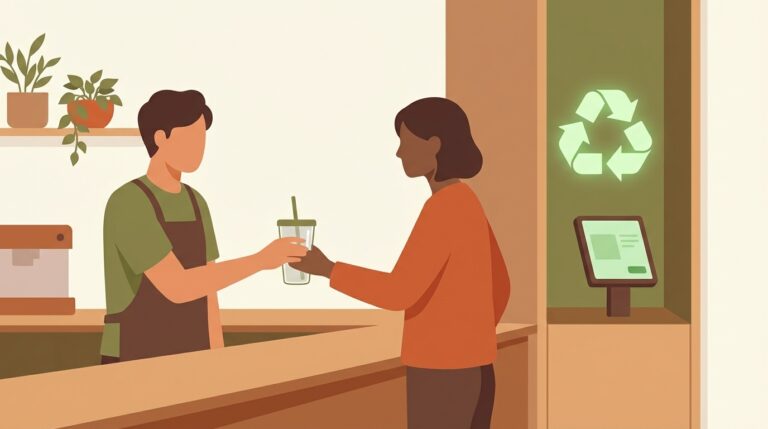
- K-Culture Moment: The barista points to a small sign on the counter with a recycling logo while tapping the POS machine. They’re explaining why your 4,500 won coffee is suddenly 4,800 won.
- Editor’s Insight: Bojeunggeum is a crucial word in Korea. You’ll hear it when renting an apartment (key money), but here it’s just your 300 won cup deposit. It’s not an extra fee; you get it back when you return the cup!
- Situation Spectrum:
- Casual cafes: ✅
- Formal/Franchise cafes: ✅
- Asking a friend to pay it: ✅
- 🤔 Think About It: Why does Korea charge a deposit instead of just trusting people to recycle? What does this system tell us about the Korean approach to civic duty and efficiency?
2. 다회용 컵으로 드릴까요?
- Pronunciation: da-hoe-yong keo-beu-ro deu-ril-kka-yo?
- Meaning: Shall I give it to you in a reusable cup? (Literal: Shall I give via multi-use cup?)
- K-Culture Moment: You tell the barista you’re going to sit and study (Kagongjok – cafe study tribe). By law, cafes cannot give you a disposable plastic cup if you are staying inside the store.
- Editor’s Insight: This phrase sounds extremely polite because of ‘드릴까요?’ (Shall I give?). If you hear da-hoe-yong (multi-use) or mae-jang-yong (store-use), just nod and say “Ne!” if you plan to sit down.
- Situation Spectrum:
- From staff to customer: ✅
- Between friends: 🚫 (You wouldn’t ask a friend this unless you own a cafe!)
- 🤔 Think About It: Notice the prefix il (one) vs da (multi). Korean vocabulary relies heavily on these logical Hanja (Chinese character) roots. Does your language have a similar root system?
3. 컵 반납은 어디에 해요?
- Pronunciation: keop ban-na-beun eo-di-e hae-yo?
- Meaning: Where do I return the cup?
- K-Culture Moment: You’ve finished your drink. You want your 300 won back. You look around the cafe, but you don’t want to just hand an empty, icy cup to the busy barista making 10 drinks at once.
- Editor’s Insight: Bannap (return) is the key verb noun here. You’ll use this word for returning library books, rental cars, and yes, sticky plastic cups to the automated kiosk (무인 반납기).
- Situation Spectrum:
- To a cafe staff member: ✅
- To a stranger asking for help: ✅
Phase 3: Textbook vs. Real Korean
[Situation 1: You brought your own tumbler to get a discount]
* 📖 Textbook Korean: 저는 제 텀블러를 가져왔습니다. 여기에 커피를 넣어 주시겠습니까? (I have brought my tumbler. Would you please put coffee in here?)
* 🗣️ Real Korean: 텀블러에 담아주세요. / 개인 컵 할인되나요? (Put it in the tumbler, please. / Is there a personal cup discount?)
* 💡 Why the difference?: Koreans value Palli-Palli (speed). In a busy cafe, long textbook sentences disrupt the flow. A short, polite request using “~에 담아주세요” is the standard.
[Situation 2: Asking for a plastic bag/carrier for your takeout]
* 📖 Textbook Korean: 비닐봉지를 주실 수 있습니까? (Could you give me a plastic bag?)
* 🗣️ Real Korean: 봉투(캐리어) 환경부담금 있나요? (Is there an environmental charge for the bag/carrier?) OR 그냥 들고 갈게요. (I’ll just carry it.)
* 💡 Why the difference?: Due to strict environmental laws, cafes/stores must charge for bags (usually 100 won). Asking if there is a “hwangyeong-budam-geum” (environmental charge) shows you deeply understand Korean society.
Phase 4: Cultural Context — K-Culture Deep Dive
4-1. Non-verbal Communication: The Art of Recycling Nunchi
In Korea, waste sorting (분리수거 – bullisugeo) is practically a national sport. If you walk up to a cafe trash bin (분리수거대), don’t just toss your whole cup in! Use your Nunchi (reading the room). Watch the locals: they pour out the leftover ice into a specific liquid bin, throw the plastic straw in general waste, and stack the plastic cup neatly. Doing this correctly earns you immense respect from Koreans.
4-2. K-Drama vs. Reality: The Takeout Coffee Trope
In almost every modern K-Drama, characters walk into the office holding a tray of iced coffees in plastic cups. It’s a symbol of modern corporate life (and often product placement). However, if you look closely at recent dramas, you’ll notice a shift! Characters are increasingly holding colorful tumblers. In reality, large Korean corporations have banned disposable cups in their headquarters, requiring employees to use the cup deposit system or bring their own mugs. The drama aesthetics are slowly catching up to the eco-friendly reality!
Phase 5: Real-Life Roleplay Scenario
Setting: It’s 1:00 PM on a Tuesday. You are at a bustling, aesthetic seaside cafe in Jeju Island with your Korean colleague, Min-su. You step up to the counter to order.
Characters:
– YOU: A B2 Korean learner, confident but easily thrown off by fast-talking baristas.
– Barista (NPC): Friendly, but has a long line of customers behind you.
– Min-su (NPC): Your supportive Korean coworker who loves his post-lunch coffee.
Dialogue:
YOU: 아이스 아메리카노 두 잔 주세요.
(aiseu amerikano du jan juseyo.)
[Two iced americanos, please.]
Barista: 네, 드시고 가시나요?
(ne, deusigo gasinayo?)
[Yes, will you be drinking it here?]
YOU: 아니요, 테이크아웃 할게요.
(aniyo, teikeu-aut halgeyo.)
[No, we will take it out.]
Barista: 일회용 컵 보증금 600원 추가되는데 괜찮으세요?
(ilhoeyong keop bojeunggeum yungbaegwon chugadoeneunde gwaenchaneuseyo?)
[There is a 600 won deposit for the disposable cups added, is that okay?]
🔀 Your Turn! How should you respond?
– A) “보증금이요? 안 낼게요.” (A deposit? I won’t pay it.)
– B) “네, 영수증도 같이 버려주세요.” (Yes, and please throw away the receipt for me.)
– C) “진짜요? 대박 비싸요!” (Really? That’s crazy expensive!)✅ Best Choice: B — Reason: You confidently accept the system (since it’s legally mandated, you can’t refuse it anyway) and use a highly natural native phrase “throw away the receipt” to keep things moving quickly.
⚠️ Choice A Analysis: Refusing it isn’t an option if you want the coffee to go!
(Assuming you chose B)
Barista: 네, 결제 도와드리겠습니다. 컵 반납은 저기 무인 반납기를 이용해 주세요!
(ne, gyeolje dowadeurigetseumnida. keop bannabeun jeogi muin bannapgireul iyonghae juseyo!)
[Yes, I’ll process the payment. Please use the automated return kiosk over there to return the cups!]
(🎭 Stage Direction: The barista points to a sleek machine near the door.)
Min-su: 오, 여기 컵 반납기 생겼네. 우리 산책하고 다시 와서 반납하자!
(o, yeogi keop bannapgi saenggyeonne. uri sanchaekhago dasi waseo bannaphaja!)
[Oh, they got a cup return kiosk here. Let’s take a walk and come back to return them!]
Phase 6: 10-Second Shadowing Drill
Practice this sentence to sound like a polite, eco-conscious local. Pay attention to the pauses (/) and the intonation!
😊 다 마신 컵은 / 어디에 / 반납하면 되나요? ⤴️
(da masin keobeun / eodie / bannaphamyeon doenayo?)
[Where should I return the completely finished cup?]
Phase 7: K-Culture Mini Dictionary
| 한국어 | Romanization | English | Cultural Context |
|---|---|---|---|
| 보증금 | bojeunggeum | Deposit | Not just for cups! Renting an apartment in Korea requires a massive bojeunggeum. |
| 분리수거 | bullisugeo | Waste sorting | Korea is one of the top countries globally for recycling. Knowing how to sort trash is a basic survival skill. |
| 키오스크 | kioseukeu | Kiosk | Automated ordering and returning machines. They are everywhere in modern Korea! |
| 텀블러 할인 | teombeulleo harin | Tumbler discount | Most franchise cafes offer 300-400 won off if you bring your own mug. |
| 카공족 | kagongjok | Cafe study tribe | People who stay at cafes for hours to study. Cafes love/hate them! |
Phase 8: Traveler Survival Kit
Navigating cafes is essential for any traveler. Here are your lifesavers!
🆘 Survival Expression #1: Dealing with Receipts
– 🇰🇷 “영수증 버려주세요.” (yeongsujeung beoryeojuseyo.)
– 🗣️ Meaning: Please throw away the receipt.
– 📍 Where to use: Convenience stores, cafes, restaurants.
– 💡 Pro Tip: Baristas will almost always ask “영수증 드릴까요?” (Shall I give you the receipt?). You can just say “아니요, 버려주세요” to save paper and wallet space!🆘 Survival Expression #2: Finding the Trash Bin
– 🇰🇷 “이거 어디에 버려요?” (igeo eodie beoryeoyo?)
– 🗣️ Meaning: Where do I throw this away?
– 📍 Where to use: Anywhere in public when you can’t find a trash can (which is common in Korea!).
📌 Editor’s Travel Note:
– App to Download: If you are staying in Korea for a while, download the “자원순환보증금” (Resource Circulation Deposit) app. It links to your bank account, so when you scan your cup at the kiosk, the 300 won deposit instantly drops into your account!
– Trash Cans on the Street: You won’t find many public trash cans in Seoul. This is to encourage people to take their trash home to recycle properly.
Phase 9: Critical Thinking Corner — “One Step Deeper”
🌍 Global Era vs. Fast Culture (Palli-Palli)
Korea’s famous Palli-Palli (hurry up) culture created a booming coffee delivery and takeout industry. This resulted in a massive plastic waste problem. However, the same Palli-Palli mindset also allowed the government to rapidly implement world-class recycling systems, high-tech return kiosks, and strict deposit laws practically overnight. It’s fascinating how a culture’s greatest weakness (fast-paced consumption) can become the driving force behind its greatest strength (fast-paced environmental innovation).
💬 Your Turn: How does your home country handle plastic waste from cafes? Is it a voluntary cultural choice, or a legally enforced system like in Korea? Share in the comments!
Phase 10: FAQ & Mistake Prevention
Q: Can I just take my store mug (매장용 컵) outside if I haven’t finished my drink?
A: No! It is illegal for cafes to let you take store mugs outside, and they can be heavily fined. You must ask the barista to transfer the remaining drink to a takeout cup (테이크아웃 잔에 담아주세요).
Q: Do I have to wash the disposable cup before returning it to the kiosk?
A: You don’t need to scrub it, but it must be completely empty of ice and liquid. Dump the contents in the designated liquid bin first!
❌ Common Mistake #1: Throwing a cup with a deposit sticker into a regular street trash can. You lose your 300 won, and it ruins the recycling process!
✅ Do this instead: Look for a return kiosk or take it back to the cafe brand you bought it from.
Phase 11: Summary & Action Items
One-Liner Summary: Mastering the word bojeunggeum (deposit) and bannap (return) will make you a confident, eco-friendly cafe patron in Korea!
Action Mission 3 Steps:
– 🥉 Bronze (Solo): Read the 10-second shadowing drill out loud 3 times, focusing on your intonation.
– 🥈 Silver (Online): Look up “일회용 컵 무인 반납기” (Disposable cup automated return kiosk) on YouTube or Naver to see what they look like in real life!
– 🥇 Gold (Real-world): Next time you visit a Korean cafe, confidently say “테이크아웃 할게요” and observe how they handle the cups and recycling station.
K-Culture Mission:
Next time you watch a K-Drama set in an office (like Extraordinary Attorney Woo or Queen of Tears), pay attention to the desks! Are they using plastic cups or personal tumblers? You’ll notice the subtle shift towards eco-consciousness!
Phase 12: Quiz — Interactive Challenge
1. Situational Judgment:
You are sitting inside a cafe studying. You need to leave soon, but you still have half your coffee left in a glass mug. What should you say to the barista?
– A) 이거 버려주세요. (Throw this away.)
– B) 테이크아웃 잔에 담아주세요. (Please put this in a takeout cup.)
– C) 다회용 컵으로 드릴까요? (Shall I give it in a reusable cup?)
2. True or False – K-Culture Edition:
– “In Korea, if you ask a convenience store clerk for a plastic bag, they will give it to you for free because they are polite.” (T/F)
(Scroll down for answers!)
…
…
…
Answers: 1. B (You need to switch from a store mug to a takeout cup before leaving) / 2. False (They are legally required to charge a small environmental fee, usually 20 to 100 won!)
Frequently Asked Questions (FAQ)
Q: What does "일회용 컵 보증금" mean in Korean and how do you pronounce it?
A: In Korean, "일회용 컵 보증금" is pronounced [il-hoe-yong keop bo-jeung-geum (il-hoe sounds like 'ill-ho', bo-jeung-geum ends with a sound like the 'gum' you chew] and means: Disposable cup deposit (Literal: one-time-use cup guarantee money)
Q: What does "다회용 컵으로 드릴까요?" mean in Korean and how do you pronounce it?
A: In Korean, "다회용 컵으로 드릴까요?" is pronounced [da-hoe-yong keo-beu-ro deu-ril-kka-yo?] and means: Shall I give it to you in a reusable cup? (Literal: Shall I give via multi-use cup?)
Q: What does "컵 반납은 어디에 해요?" mean in Korean and how do you pronounce it?
A: In Korean, "컵 반납은 어디에 해요?" is pronounced [keop ban-na-beun eo-di-e hae-yo?] and means: Where do I return the cup?







