

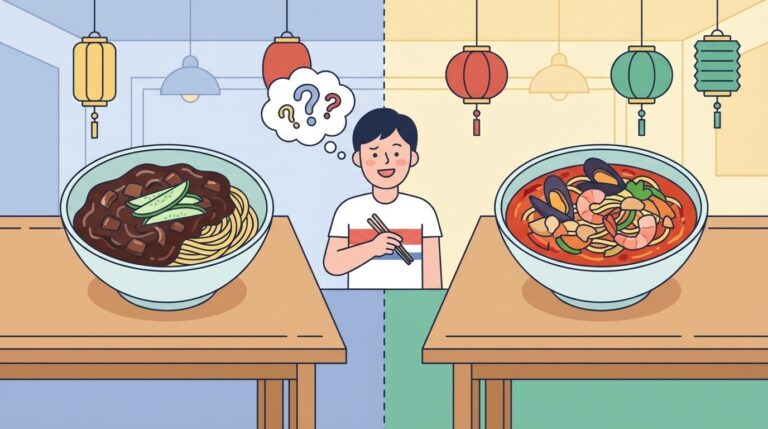
Phase 1: Empathy & The “Jjajang vs. Jjamppong” Moment
Hello there! It’s your lead editor from Daily Hangul.
Picture this: You’re watching a classic K-Drama. The detectives have been on a stakeout all night in a cramped car. Suddenly, the junior detective pulls out a black iron box (철가방), slides out two bowls wrapped in cling film, and peels it off with the swiftness of a ninja. One bowl is a thick, savory black bean noodle dish (Jjajangmyeon). The other is a fiery, red seafood noodle soup (Jjamppong).
Now, imagine you’re sitting in a Korean-Chinese restaurant in Myeongdong. The waiter stands beside your table, pen in hand. You look at the menu. You look at the waiter. You have three seconds to make the most stressful culinary decision in Korea.
If you’ve ever frozen up trying to express “I like this more than that” or “I’m trying to decide between A and B” in Korean, you are not alone! Today, we’re going to master the grammar of comparison and contrast (B1 Level) through Korea’s greatest dilemma: Jjajangmyeon vs. Jjamppong. By the end of this guide, you won’t just know how to order food—you’ll know how to weigh your options like a true Seoulite.
Phase 2: Core Expressions — Deep Dive
Let’s look at the three essential expressions you need when comparing options.
1. [A]보다 [B]가 나아요. (B is better than A)
- Pronunciation: [A]boda [B]ga naayo. (The ‘boda’ sounds like “bow-dah”, and ‘naayo’ sounds like “nah-ah-yo”.)
- Meaning: (Literal) Compared to A, B is better. / (Real nuance) I prefer B over A.
- K-Culture Moment: You’re at a company dinner (회식). Your boss asks if you’d rather drink Soju or Beer. You say, “소주보다 맥주가 나아요.” (Beer is better than Soju.)
- Editor’s Insight: While textbook Korean teaches “더 좋아해요” (like more), native speakers love using the verb 낫다 (to be better). It implies a slight sense of relief, like “given the choices, B is the safer/better bet.”
- Situation Spectrum:
- Casual (Friends): ✅ (짜장면보다 짬뽕이 나아.)
- Semi-formal (Co-workers): ✅ (짜장면보다 짬뽕이 나아요.)
- Formal (Boss/Elders): ⚠️ (Use cautiously; sounds a bit direct. Better: 저는 짬뽕이 더 좋은 것 같습니다.)
- 🤔 Think About It: Why does Korean put the “compared to” (A보다) before the preferred item (B)? How does this subject-object-verb structure change the way you build a sentence in your head compared to English?
2. ~할까 ~할까 고민 중이에요. (I’m debating whether to do A or B)
- Pronunciation: ~halkka ~halkka gomin jungieyo.
- Meaning: (Literal) I am in the middle of agonizing whether to do A or do B. / (Real nuance) I’m torn between A and B.
- K-Culture Moment: Standing in front of Olive Young, looking at two different cushion foundations, telling your friend: “이거 살까 저거 살까 고민 중이에요.”
- Editor’s Insight: “고민(gomin)” is a beautiful Korean word. It doesn’t mean a serious problem (like ‘worry’); it means ‘deep thinking’ or ‘deliberating’. Adding “중이에요” (in the middle of) makes you sound incredibly fluent.
- Situation Spectrum:
- Casual: ✅ (~할까 고민 중이야)
- Semi-formal: ✅ (~할까 고민 중이에요)
- Formal: ✅ (~할지 고민하고 있습니다)
- 🤔 Think About It: The repetition of “~할까” creates a bouncy, rhythmic sound. Can you feel how the language itself mimics a scale tipping back and forth?
3. 짬짜면으로 할게요. (I’ll go with Jjamjjamyeon – Half & Half)
- Pronunciation: Jjamjjamyeoneuro halgeyo.
- Meaning: (Literal) I will do Jjamjjamyeon. / (Real nuance) I’ll have the half-and-half bowl.
- K-Culture Moment: When you just can’t decide, Korea has your back. Jjamjjamyeon is a brilliant invention: a bowl split down the middle, holding both noodles!
- Editor’s Insight: “~으로 할게요” is the ultimate ordering phrase. It means “I’ve made my decision, and I will go with [Item].” It’s much more natural than saying “이거 주세요” (Give me this) every time.
- Situation Spectrum:
- Casual: ✅ (짬짜면으로 할게)
- Semi-formal/Restaurant staff: ✅ (짬짜면으로 할게요)
- Formal: ✅ (짬짜면으로 하겠습니다)
- 🤔 Think About It: From Jjamjjamyeon to “Ban-ban” (half-and-half) fried chicken, Korean culture loves finding a compromise so you don’t miss out. Does your culture have food combos like this?
Phase 3: Textbook vs. Real Korean
Let’s see how our B1 grammar evolves when you step out of the classroom and onto the streets of Seoul.
[Situation 1: Expressing a strong preference today]
* 📖 Textbook Korean: 저는 오늘 짬뽕을 먹고 싶습니다. (I want to eat Jjamppong today.)
* 🗣️ Real Korean: 아, 오늘 비도 오고 완전 짬뽕 각인데? (Ah, it’s raining, today is totally a Jjamppong vibe.)
* 💡 Why is it different?: “각(Gak)” literally means ‘angle’ (like in billiards). Slang users adopted it to mean “the conditions align perfectly for something.”
[Situation 2: Asking a friend what they want]
* 📖 Textbook Korean: 짜장면을 먹을래요, 짬뽕을 먹을래요? (Do you want to eat Jjajangmyeon or Jjamppong?)
* 🗣️ Real Korean: 넌 짜장? 난 짬뽕. (You Jjajang? Me Jjamppong.)
* 💡 Why is it different?: Koreans love efficiency (Pali-pali culture). In casual settings, verbs are often entirely dropped if the context (holding a menu) is obvious.
[Situation 3: Commenting on a mix-up]
* 📖 Textbook Korean: 제 머릿속이 복잡합니다. (My mind is complicated.)
* 🗣️ Real Korean: 아, 머릿속이 완전 짬뽕됐어. (Ah, my brain completely became Jjamppong.)
* 💡 Why is it different?: Because Jjamppong is a mix of various seafood, veggies, and noodles in a chaotic red soup, “짬뽕되다” became a slang term for things getting confusingly mixed up!
(Bottom Note: B1 learners, stick to “완전 짬뽕 각” with your close friends—it will definitely earn you some insider points!)
Phase 4: Cultural Context — K-Culture Deep Dive
4-1. Non-Verbal Cues: The Art of “Nunchi” at the Table
When dining out with Korean colleagues, you might notice a subtle game of Nunchi (눈치, reading the room). If four people are ordering Jjajangmyeon, ordering a complicated dish like “Stir-fried Seafood Rice” might slow down the kitchen. While individualism is growing, there is still a lingering “통일(Tong-il, Unification)” culture where people might casually match their orders to get the food faster.
Tip: If you genuinely want something different, you can say, “저는 짬뽕 먹어도 될까요?” (Is it okay if I have Jjamppong?). It shows great manners!
4-2. The Ultimate Comparison: “Tang-su-yuk” (Sweet & Sour Pork) Dilemma
If you order Chinese food in Korea, you will order Tangsuyuk to share. This brings us to Korea’s second greatest debate: Pouring vs. Dipping.
– 부먹 (Bu-meok): Pouring the sauce over the meat.
– 찍먹 (Jjik-meok): Dipping the meat into the sauce.
This debate is so intense that K-Pop idols are frequently asked during fan-signs: “Oppa, are you a Bu-meok or Jjik-meok?” To use your new comparison grammar, you can proudly declare: “저는 부먹보다 찍먹이 나아요!” (I prefer dipping over pouring!)
Phase 5: Real-Life Roleplay Scenario
Setting: It’s 12:30 PM on a rainy Friday. You and your Korean coworkers are sitting in the office lounge. The rain is hitting the windows, which means only one thing in Korea: It’s weather for hot, soupy noodles or crispy pancakes.
Characters:
– YOU (The Reader): A B1 Korean learner, working in a Seoul marketing firm.
– Min-su (32, Coworker): Friendly, loves food, currently scrolling rapidly through the ‘Baemin’ delivery app.
(🎭 Stage Direction: Min-su holds up his phone, showing pictures of steaming food.)
Min-su: 밖에 비도 오는데, 오늘 점심은 중국집 배달 어때요? ☔️
(Bakke bido oneunde, oneul jeomsimeun junggukjip baedal eottaeyo?)
[It’s raining outside, how about Chinese delivery for lunch today?]
YOU: 좋아요! 저는 짜장면 먹을까 짬뽕 먹을까 고민 중이에요.
(Joayo! Jeoneun jjajangmyeon meogeulkka jjamppong meogeulkka gomin jungieyo.)
[Sounds good! I’m debating whether to have Jjajangmyeon or Jjamppong.]
Min-su: 비 올 때는 무조건 짬뽕이죠! 국물이 끝내주잖아요.
(Bi ol ttaeneun mujogeon jjamppong-ijyo! Gungmuri kkeunnaeju-janayo.)
[When it rains, it’s unconditionally Jjamppong! The broth is amazing, you know.]
YOU: 음… 그럼 저도 짬뽕으로 할게요!
(Eum… geureom jeodo jjamppong-euro halgeyo!)
[Hmm… Then I’ll go with Jjamppong too!]
Min-su: 오케이. 짬뽕 두 그릇. 그리고 탕수육도 하나 시킬까요?
(Okei. Jjamppong du geureut. Geurigo tangsuyukdo hana sikilkkayo?)
[Okay. Two bowls of Jjamppong. And shall we order one Tangsuyuk too?]
YOU: 당연하죠! 탕수육은 필수예요.
(Dangyeonhajyo! Tangsuyugeun pilsu-yeyo.)
[Of course! Tangsuyuk is a must.]
(🎭 Stage Direction: 30 minutes later. The food arrives. Min-su opens the Tangsuyuk box and grabs the bowl of thick, sweet sauce, hovering it over the crispy meat…)
Min-su: 소스 부을까요?
(Soseu bueulkkayo?)
[Shall I pour the sauce?]
🔀 YOUR TURN! How do you stop him?
– A) 안 돼요! 저는 부먹보다 찍먹이 나아요! (No! I prefer dipping over pouring!)
– B) 네, 다 부으세요. (Yes, pour it all.)
– C) 소스 싫어요. (I hate sauce.)✅ Best Choice: A — It perfectly uses the comparison grammar
[A]보다 [B]가 낫다and asserts your “Jjik-meok” (dipping) identity!
⚠️ Choice C Analysis: “싫어요” is grammatically correct but culturally a bit too blunt/negative for a friendly lunch.
Phase 6: 10-Second Shadowing Drill
Let’s practice the rhythm of Korean comparison! Follow the pauses (/) and try to match the emotion.
🤔 Deliberating:
짜장면 / 먹을까 / 짬뽕 / 먹을까 / 고~민 중이에요.
(jjajangmyeon / meogeulkka / jjamppong / meogeulkka / go~min jungieyo.)
Feel the bouncy rhythm on the ‘halkka’ parts!
😤 Making a firm choice:
오늘은 / 무조건 / 짬뽕으로 / 할게요!
(oneureun / mujogeon / jjamppongeuro / halgeyo!)
Put a strong emphasis on ‘무조건’ (unconditionally/absolutely)!
Phase 7: K-Culture Mini Dictionary
| Korean | Romanization | English | Context |
|---|---|---|---|
| 중국집 | junggukjip | Korean-Chinese Restaurant | They serve Koreanized Chinese food. Uniquely Korean! |
| 단무지 | danmuji | Pickled Yellow Radish | The crunchy, sweet-and-sour side dish always served with Jjajangmyeon. |
| 찍먹 / 부먹 | jjik-meok / bu-meok | Dip / Pour | The great Tangsuyuk debate (Dipping the pork vs. Pouring sauce over it). |
| 철가방 | cheolgabang | Iron Delivery Box | The iconic silver metal briefcase used for delivering noodles on motorcycles. |
| 반반 | ban-ban | Half and Half | The ultimate Korean compromise (e.g., Ban-ban chicken, Jjamjjamyeon). |
Phase 8: Traveler’s Survival Kit
If you’re traveling in Korea, you will find yourself in a local restaurant. Here are the top survival phrases for ordering and customizing your meal.
🆘 Survival Phrases: The Restaurant Combo
– 🇰🇷 “여기 짜장 하나, 짬뽕 하나요!” (yeogi jjajang hana, jjamppong hanayo!)
– Meaning: “One Jjajang and one Jjamppong here, please!” (Using ‘hana, dul’ is more natural than full grammatical counters like ‘han geureut’ in busy spots).
– 🇰🇷 “앞접시 좀 주실 수 있나요?” (apjeopsi jom jusil su innayo?)
– Meaning: “Could we get some small plates to share?”
– 🇰🇷 “단무지 좀 더 주세요.” (danmuji jom deo juseyo.)
– Meaning: “Please give us a little more yellow radish.”📌 Editor’s Travel Note
– Sharing is Caring: In Korea, if you order different dishes, people often ask for an “앞접시” (apjeopsi – personal sharing plate) to taste each other’s food. Don’t be surprised if a friend reaches over to grab a bite of your noodles!
– No Tipping: Remember, do not leave a tip at the restaurant! Just take your bill to the counter near the exit to pay.
Phase 9: Critical Thinking — “A Step Deeper”
Food & Identity: Why does Korea love “Ban-ban” (Half & Half)?
🧠 Think Deeper:
The invention of “Jjamjjamyeon” (half Jjajang, half Jjamppong) or “Ban-ban Chicken” is a fascinating reflection of Korean society. It showcases the Pali-pali (hurry up) culture—why waste time deciding when you can have both instantly? But deeper than that, it reflects a culture that values collective harmony without entirely sacrificing individual desires. Instead of fighting over what to share, Korea simply splits the bowl in two. It’s a physical manifestation of cultural compromise.💬 Your Turn: Does your culture have a famous “half-and-half” food combo? Or are meals strictly individual? Share your thoughts in the comments!
Phase 10: FAQ & Avoiding Common Mistakes
Q: Can I use “~으로 할게요” (I’ll go with ~) to my boss?
Yes! If you are at a cafe or restaurant and the boss asks what you want, “저는 아이스 아메리카노로 하겠습니다” (I will go with iced Americano – formal version) is incredibly polite and natural.
Q: Can I ask for ‘half-and-half’ for any food in Korea?
No! The “Ban-ban” magic usually only applies to Korean-Chinese food (Jjamjjamyeon) and Korean Fried Chicken (Half original, half spicy). Please don’t ask for half-Bibimbap and half-Kimchi Stew! 😂
❌ Common Mistake #1: Saying “A가 B보다 더 낫다.”
✅ How to fix it: “더” (more) and “낫다” (to be better) have overlapping meanings. While native speakers sometimes make this mistake, grammatically it’s redundant. Stick to “A보다 B가 낫다” (Without 더) or “A보다 B를 더 좋아하다” (With 더).
Phase 11: Summary & Action Items
💡 One-Liner Summary: Use “A보다 B가 나아요” to compare, and “~할까 고민 중이에요” when your brain is turning into Jjamppong trying to decide!
🚀 Your Action Missions:
– 🥉 Bronze (Solo): Stand in front of your fridge, look at two ingredients, and say out loud: “[A] 먹을까 [B] 먹을까 고민 중이에요.”
– 🥈 Silver (Online): Drop a comment below using today’s grammar: Are you Team Jjajang (Black Bean) or Team Jjamppong (Spicy Seafood)?
– 🥇 Gold (Real Life): Next time you go to a Korean restaurant, don’t just point at the menu. Say confidently: “저는 [Food Name]으로 할게요!”
🎬 Special K-Culture Mission:
Go to YouTube and search for “짜장면 짬뽕 먹방” (Jjajangmyeon Jjamppong Mukbang). Listen closely—I guarantee you’ll hear the creators comparing the two bowls using today’s expressions!
Phase 12: Quiz — Interactive Challenge
Test your B1 comparison skills!
1. Situational Judgment: You are at a cafe with a Korean friend. You prefer cold drinks over hot drinks. How should you say this naturally?
– A) 뜨거운 것보다 차가운 것이 나아요.
– B) 차가운 것보다 뜨거운 것이 나아요.
– C) 차가운 것은 뜨거운 것 낫다.
(Answer: A. “Compared to hot (A보다), cold is better (B가 나아요)”.)
2. Fill in the Blank:
You are looking at a menu, totally torn between Pizza and Chicken.
“피자 먹을까 치킨 먹을까 ______ 중이에요.”
(Answer: 고민 – gomin)
3. True or False – K-Culture Edition:
In a Korean-Chinese restaurant, “찍먹” (Jjik-meok) means pouring the sauce completely over the fried pork.
(Answer: False! Jjik-meok means dipping. Bu-meok means pouring. Don’t mix them up unless you want to start a debate!)
Happy learning, and may your noodles never get soggy! See you in the next unit!
Frequently Asked Questions (FAQ)
Q: What does "[A]보다 [B]가 나아요. (B is better than A)" mean in Korean and how do you pronounce it?
A: In Korean, "[A]보다 [B]가 나아요. (B is better than A)" is pronounced [A] and means: (Literal) Compared to A, B is better. / (Real nuance) I prefer B over A.
Q: What does "~할까 ~할까 고민 중이에요. (I'm debating whether to do A or B)" mean in Korean and how do you pronounce it?
A: In Korean, "~할까 ~할까 고민 중이에요. (I'm debating whether to do A or B)" is pronounced [~halkka ~halkka gomin jungieyo.] and means: (Literal) I am in the middle of agonizing whether to do A or do B. / (Real nuance) I'm torn between A and B.
Q: What does "짬짜면으로 할게요. (I'll go with Jjamjjamyeon - Half & Half)" mean in Korean and how do you pronounce it?
A: In Korean, "짬짜면으로 할게요. (I'll go with Jjamjjamyeon - Half & Half)" is pronounced [Jjamjjamyeoneuro halgeyo.] and means: (Literal) I will do Jjamjjamyeon. / (Real nuance) I'll have the half-and-half bowl.







