

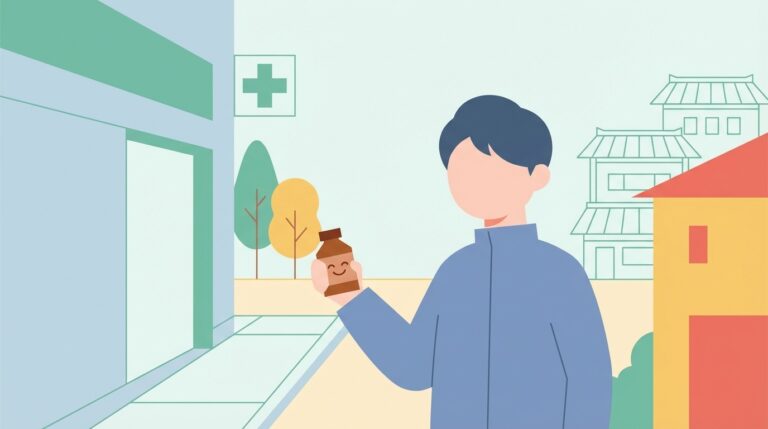
Ate Too Much K-BBQ? The Magic Phrases to Save Your Stomach in Korea
Phase 1: The ‘Too Much K-Food’ Dilemma
Hello! I’m the Lead Editor at Daily Hangul.
Picture this: You’re in Seoul. It’s Friday night, and you just had the best Samgyeopsal (Korean pork belly) of your life. You wrapped the meat in lettuce, added garlic, dipped it in spicy Ssamjang, and washed it down with a cold drink. It was perfect! …Until an hour later.
Because the food was so good (and maybe because of the energetic, fast-paced atmosphere), you ate way too fast. Now, you feel like a balloon about to pop. In a K-Drama, this is the exact moment a caring mother would take out a needle, tie your thumb with a thread, and prick your finger to let a drop of dark blood out. Yikes! 😱
Don’t worry, you don’t need a needle today. You just need to find a pharmacy with a green cross and say a few magic words. If you don’t know these expressions, you might end up buying painkillers instead of what you actually need.
This guide is based on real SOS messages from my beginner students who suffered from the legendary ‘K-Food Food Coma.’ Let’s get your stomach fixed, Korean style!
Phase 2: Core Expressions Deep Dive
Here are the 3 lifesaver phrases you need at an A2 (Beginner) level.
1. 체했어요.
- Pronunciation: [che-hae-sseo-yo]
(Think of ‘che’ like the start of ‘cherry’, and ‘hae’ like ‘head’. Say it while touching your chest.)- Meaning: I have indigestion. / My food is stuck.
- K-Culture Moment: This is the ultimate Korean stomachache word. When an idol tells their fans on a live stream, “저 오늘 체했어요 (I have indigestion today),” the chat immediately fills with crying emojis and fans telling them to drink plum tea.
- Editor’s Insight: This isn’t just “my tummy hurts.” It specifically means that heavy, blocked feeling in your upper stomach or chest after eating too fast or feeling stressed while eating.
- Situation Spectrum:
- Friends (Casual – 체했어): ✅
- Pharmacist/Coworkers (Semi-formal – 체했어요): ✅
- Boss/Elders (Formal – 체했습니다): ⚠️ (A bit too stiff, ‘체했어요’ is perfectly fine here too.)
- 🤔 Think About It: Why does Korean have a specific verb just for “food being stuck”? Does your native language have a single word for this exact feeling, or do you have to explain the symptoms?
2. 소화제 주세요.
- Pronunciation: [so-hwa-je ju-se-yo]
(‘so’ like ‘soap’, ‘hwa’ like ‘hwan’, ‘je’ like ‘jelly’. ‘ju-se-yo’ means ‘please give me’.)- Meaning: Please give me digestive medicine.
- K-Culture Moment: You walk into a Yakguk (약국, Pharmacy), point at your stomach, and say this. The pharmacist will instantly nod in understanding and turn to their magical shelf of remedies.
- Editor’s Insight: So-hwa means digestion, and je means medicine. Just attach Noun + 주세요 (ju-se-yo), and you can buy anything in Korea!
- Situation Spectrum:
- Friends (Casual): 🚫 (You don’t ask friends to give you medicine from a store)
- Pharmacist (Semi-formal): ✅
- Boss/Elders (Formal): 🚫
- 🤔 Think About It: In Korea, pharmacies don’t just hand you a box. They often customize a mix of pills and drinks for you. How does buying medicine differ in your country?
3. 마시는 걸로 주세요.
- Pronunciation: [ma-si-neun geol-lo ju-se-yo]
(‘ma-shi’ like ‘machine’, ‘neun’ like ‘nun’.)- Meaning: Please give me a drinkable one.
- K-Culture Moment: In Korea, the holy grail of indigestion is a small brown glass bottle filled with a herbal, minty, fizzy liquid (like the famous Gas Whal Myung Su). If you just buy pills, you’re missing out on the authentic Korean healing experience!
- Editor’s Insight: Koreans believe liquid medicine absorbs faster. If you say this, the pharmacist will look at you like, “Wow, this foreigner knows our culture!”
- Situation Spectrum:
- Friends (Casual): 🚫
- Pharmacist (Semi-formal): ✅
- Boss/Elders (Formal): 🚫
- 🤔 Think About It: Why do Koreans love liquid medicine so much? It dates back to traditional herbal medicine (한약) which was always brewed and drunk!
Phase 3: Textbook vs. Real Korean
Let’s see how textbooks teach it versus how real people talk in the streets of Seoul.
[Describing your stomachache]
* 📖 Textbook Korean: 저는 소화 불량입니다. (I am experiencing indigestion.)
* 🗣️ Real Korean: 아, 저 체한 것 같아요. (Ah, I think my food got stuck.)
* 💡 Why the difference?: “소화 불량” is a medical term you only see on paper. Koreans prefer expressing how they feel rather than giving a medical diagnosis.
[Asking for medicine]
* 📖 Textbook Korean: 위장약이 있습니까? (Do you have gastrointestinal medication?)
* 🗣️ Real Korean: 소화제 하나 주세요. (Please give me one digestive medicine.)
* 💡 Why the difference?: Daily language values speed and simplicity. “하나 주세요” (Give me one) is the most natural way to buy single items.
Phase 4: Cultural Context — K-Culture Deep Dive
4-1. Non-verbal Communication
When you say “체했어요 (chehaesseoyo),” don’t point at your lower belly! In Korea, che-ha-da refers to the upper stomach/chest area. Lightly tapping the center of your chest with your fist while looking a bit distressed is the universal Korean sign for “I ate too much and it’s stuck.”
4-2. The Convenience Store (편의점) Savior
Did you know you don’t always need a pharmacy? In K-Dramas, you might see characters running to the convenience store late at night. Korean convenience stores (CU, GS25, 7-Eleven) legally sell Safety Convenience Medicines (안전상비의약품).
If it’s 2 AM and your stomach is killing you, go to the cashier counter at a convenience store. You will see a small medical display box. Just grab the small brown bottle (usually Hwal Myung Su or We-saeng-su) and you’re saved!
Phase 5: Real-Life Roleplay Scenario
Setting: Saturday afternoon in Myeongdong. You just ate a huge plate of spicy Tteokbokki and deep-fried snacks from a street vendor. You feel terribly stuffed. You find a pharmacy with a glowing green cross.
Characters:
– YOU: A traveler who loves Korean food a bit too much.
– Pharmacist (약사님): Friendly professional in a white coat.
Dialogue:
Pharmacist: 어서 오세요. 어떻게 오셨어요? 😊
(eoseo oseyo. eotteoke osyeosseoyo?)
[Welcome. What brings you here?]
YOU: 저… 배가 너무 아파요.
(jeo… baega neomu apayo.)
[I… my stomach hurts a lot.]
Pharmacist: 혹시 체했어요?
(hoksi chehaesseoyo?)
[Did you perhaps get indigestion (food stuck)?]
YOU: 네, 체했어요. 소화제 주세요.
(ne, chehaesseoyo. sohwaje juseyo.)
[Yes, I have indigestion. Please give me digestive medicine.]
Pharmacist: 알약으로 드릴까요? 마시는 걸로 드릴까요?
(alyageuro deurilkkayo? masineun geollo deurilkkayo?)
[Shall I give you pills? Or drinkable ones?]
🔀 Your Turn! How should you reply?
– A) “아니요, 괜찮아요.” (No, it’s okay.)
– B) “마시는 걸로 주세요.” (Please give me the drinkable one.)
– C) “대박!” (Awesome!)✅ Best Choice: B! You want the fast-acting liquid magic!
⚠️ Choice A Analysis: If you say this, you won’t get any medicine!
⚠️ Choice C Analysis: It’s great you’re enthusiastic, but shouting “Daebak!” at a pharmacist might make them think you’re slightly crazy.
(🎭 Stage Direction: You choose B.)
YOU: 마시는 걸로 주세요.
(masineun geollo juseyo.)
[Please give me the drinkable one.]
Pharmacist: 네, 여기 있습니다. 1,000원입니다.
(ne, yeogi itseumnida. cheon-wonimnida.)
[Yes, here you go. It’s 1,000 won.]
(Bonus K-Culture moment: They often pop the bottle cap open for you so you can drink it right there!)
Phase 6: 10-Second Shadowing Drill
Let’s practice! Speak aloud following the slashes (pauses) and the emotion tags.
🥺 (Looking slightly pained)
저기요… / 저 / 체했어요.
(jeogiyo… / jeo / che-hae-sseo-yo.)💊 (Pointing respectfully)
마시는 / 소화제 / 주세요.
(ma-si-neun / so-hwa-je / ju-se-yo.)
Phase 7: K-Culture Mini Dictionary
| Korean | Romanization | English | Cultural Context |
|---|---|---|---|
| 약국 | yakguk | Pharmacy | Look for the bright green cross (약) on the streets. |
| 소화제 | sohwaje | Digestive medicine | Available as pills (알약) or liquid (물약). |
| 매실차 | maesilcha | Plum tea | A traditional home remedy for stomachaches. Sweet and sour! |
| 편의점 | pyeonuijeom | Convenience Store | Open 24/7. Sells basic emergency medicine. |
| 까스활명수 | ggasuhwalmyungsu | Gas Whal Myung Su | The most famous brand of liquid digestive medicine. It’s fizzy! |
Phase 8: Traveler Survival Kit 🆘
If you’re traveling in Korea, pharmacies are incredibly helpful. Here are your top survival phrases for the Yakguk:
🆘 Survival Phrase #1: Painkillers
– 🇰🇷 “진통제 주세요.” (jintongje juseyo)
– 📍 Use for: Headaches, muscle cramps.🆘 Survival Phrase #2: Cold Medicine
– 🇰🇷 “감기약 주세요.” (gamgiyak juseyo)
– 📍 Use for: Cough, runny nose, fever.🆘 Survival Phrase #3: Band-aids
– 🇰🇷 “반창고 주세요.” (banchanggo juseyo)
– 📍 Use for: Blisters from walking too much in Hongdae!📌 Editor’s Travel Note:
– Weekend Sickness: Many pharmacies close on Saturday afternoons and Sundays. If it’s Sunday and your stomach hurts, search for a large 편의점 (Convenience store). Ask the cashier: “소화제 있어요?” (Do you have digestive medicine?).
– Water: Pharmacies often have a small water dispenser (정수기) so you can take your pills immediately.
Phase 9: Critical Thinking — “One Step Deeper”
🧠 Think Deeper: Food & Identity (The “Ppalli Ppalli” Culture)
Why is the digestive medicine market so huge in Korea? It comes down to the famous Ppalli Ppalli (hurry, hurry) culture. Koreans often eat hot, spicy, and heavy meals very quickly during their short lunch breaks. Furthermore, eating is a highly communal activity. You eat when others eat, and you drink when others drink (Hoesik or dining together). This collective dining culture builds deep relationships (정, Jeong), but it also means you sometimes overeat to keep up with the group’s pace. The little brown bottle of digestive medicine is a modern remedy for the social side effects of Korea’s passionate food culture.
💬 Your Turn: Do people in your culture eat fast or slow? What is your traditional home remedy for an upset stomach? Share in the comments!
Phase 10: FAQ & Common Mistakes
Q: Is it polite to use Noun + “주세요(ju-se-yo)” to an older pharmacist?
Yes! “주세요” is perfectly polite for customer-to-staff interactions. You don’t need complicated formal grammar to buy things.
Q: What if I have allergies to certain medicines?
Show them this phrase on your phone: “저는 [알레르기]가 있어요.” (I have an allergy to [allergy]).
Q: Should I buy medicine before going to Korea?
Bring your prescription meds, but for basic things like indigestion, colds, or headaches, Korean pharmacies are incredibly cheap and effective!
❌ Common Mistake #1: Trying to explain exactly what part of the digestive tract hurts in broken Korean.
✅ Do this instead: Just say “체했어요 (Chehaesseoyo).” It covers 99% of food-related stomachaches!
Phase 11: Summary & Action Items
One-Liner Summary: When K-Food defeats your stomach, go to a pharmacy (약국) and say “체했어요, 소화제 주세요!”
Your Action Missions:
– 🥉 Bronze (Solo): Stand in front of a mirror, point to your chest, and say “체했어요” 3 times with a sad face.
– 🥈 Silver (Online): Go to YouTube, search “까스활명수 광고 (Gas Whal Myung Su commercial)” and see how Koreans portray indigestion!
– 🥇 Gold (Real Life): Next time you visit a Korean convenience store or pharmacy, buy a liquid digestive drink just to try the unique herbal taste!
K-Culture Mission:
The next time you watch a K-Drama and characters are eating Samgyeopsal or Ramyeon, pay attention to how fast they eat. Do you think they’ll need Sohwaje later?
Phase 12: Quiz — Interactive Challenge
Q1. Situational Judgment: It’s 11:00 PM. You ate too much Fried Chicken and your stomach hurts. All pharmacies are closed. Where should you go?
– A) Hospital ER
– B) A nearby Convenience Store (편의점)
– C) A cafe
Q2. Fill in the Blank:
Pharmacist: 어떻게 오셨어요?
You: 속이 너무 답답해요. _________ 주세요. (Please give me digestive medicine.)
– A) 진통제
– B) 소화제
– C) 감기약
Q3. True or False — K-Culture Edition:
In Korea, it is common to drink a liquid medicine (물약) for indigestion rather than just taking pills. (T/F)
(Answers: Q1: B, Q2: B, Q3: True! The little brown bottles are legendary!)
Enjoy your K-Food journey, and remember: eat delicious things, but chew slowly! See you in the next lesson! 🇰🇷✨
Frequently Asked Questions (FAQ)
Q: What does "체했어요." mean in Korean and how do you pronounce it?
A: In Korean, "체했어요." is pronounced [che-hae-sseo-yo] and means: I have indigestion. / My food is stuck.
Q: What does "소화제 주세요." mean in Korean and how do you pronounce it?
A: In Korean, "소화제 주세요." is pronounced [so-hwa-je ju-se-yo] and means: Please give me digestive medicine.
Q: What does "마시는 걸로 주세요." mean in Korean and how do you pronounce it?
A: In Korean, "마시는 걸로 주세요." is pronounced [ma-si-neun geol-lo ju-se-yo] and means: Please give me a drinkable one.







