

안녕하세요! (Hello!) I am your Lead Editor at Daily Hangul.
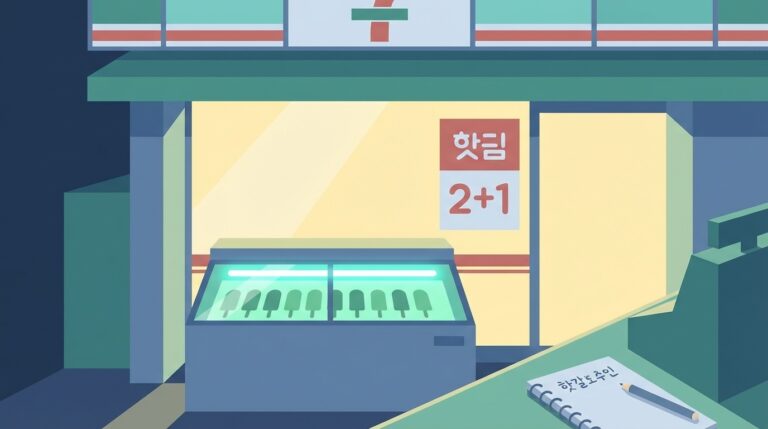
Imagine this: You are watching your favorite K-Drama. The main couple had a tiny argument, and now they are making up outside a brightly lit CVS (Convenience Store). They are sitting on those classic green plastic chairs, sharing a green melon-flavored popsicle. The summer night breeze is blowing. It looks incredibly romantic, doesn’t it?
Now, you are finally in Seoul! It’s a hot July night. You walk into a GS25 or CU to recreate this exact K-Drama moment. You find the ice cream freezer, grab a Melona… but wait! There’s a bright yellow tag saying “2+1”. The cashier says something super fast in Korean about a bag. Panic sets in!
Don’t worry. This guide is crafted specifically from the panic moments of my A1-level students. By the end of this post, you’ll be grabbing that 2+1 ice cream deal like a true Seoulite.
Phase 2: Core Expressions Deep Dive
Let’s look at the absolute must-know phrases to survive the Korean CVS ice cream run.
1. 이거 투플러스원이에요?
- Pronunciation: igeo tu-peulleoseu-won-ieyo? [Sound-alike: ee-geo too-plus-won-ee-eh-yo?]
- Meaning: (Literal) Is this two-plus-one? / (Real nuance) “Does this item have a Buy 2 Get 1 Free deal?”
- K-Culture Moment: Korean CVS are famous for their “1+1” (one-plus-one) and “2+1” (two-plus-one) deals. You will see these tags everywhere. Often, you might accidentally grab only 2 items for a 2+1 deal, and the cashier will kindly remind you!
- Editor’s Insight: English speakers usually say “Buy One Get One” (BOGO). In Korea, we just use the numbers! Just read the “+” as “plus” in English. It’s so much shorter and catchier.
- Situation Spectrum:
- Casual with friends: ✅ (이거 투플러스원이야?)
- To a CVS cashier (Semi-formal): ✅
- Formal: ⚠️ (Not really applicable as CVS interactions are quick and casual-polite)
- 🤔 Think About It: Why do Koreans love abbreviation and number-based phrases (like 1+1)? Could it be linked to the famous ‘빨리빨리’ (ppalli-ppalli, hurry-hurry) culture where efficiency is everything?
2. 봉투 필요하세요?
- Pronunciation: bongtu piryohaseyo? [Sound-alike: bong-too pee-ryo-hah-seh-yo?]
- Meaning: (Literal) Is a bag needed? / (Real nuance) “Do you need a plastic bag?”
- K-Culture Moment: Due to strict environmental laws in Korea, plastic bags at CVS cost extra (usually 20 to 50 won). The cashier will always ask you this before ringing you up completely.
- Editor’s Insight: You don’t need to ask for a bag; they will ask you. You just need to know how to answer. If you don’t need one, just wave your hands and say “괜찮아요 (gwaenchanayo – it’s okay)”.
- Situation Spectrum:
- To cashier: ✅ (You are the listener here!)
- 🤔 Think About It: In many Western countries, bags are sometimes given automatically. How does the extra charge for plastic bags reflect Korea’s approach to recycling and the environment?
3. 먹고 갈게요.
- Pronunciation: meokgo galgeyo. [Sound-alike: muk-go gal-geh-yo]
- Meaning: (Literal) I will eat and go. / (Real nuance) “I’ll eat this here (in the store).”
- K-Culture Moment: Korean convenience stores often have seating areas inside or outside! If you buy cup noodles or ice cream and plan to sit at those K-Drama tables, you can say this.
- Editor’s Insight: It’s helpful to let the cashier know, especially if they are trying to bag your items. It signals, “Hey, no bag needed, I’m eating this right now!”
- Situation Spectrum:
- To cashier (Semi-formal): ✅
- 🤔 Think About It: CVS are seen as “fast food restaurants” and “rest stops” for students and office workers in Korea. Do convenience stores in your country serve this same social function?
Phase 3: Textbook vs. Real Korean
[Situation 1: Asking if there’s a deal]
* 📖 Textbook Korean: “행사 상품입니까?” (Is this a promotional product?)
* 🗣️ Real Korean: “이거 원플원(1+1)이에요?” (Is this 1+1? – ‘원플원’ is the trendy slang abbreviation!)
* 💡 Why the difference?: Koreans love shortening words for maximum efficiency. “원플러스원” becomes “원플원”!
[Situation 2: Refusing the plastic bag]
* 📖 Textbook Korean: “아니요, 비닐봉투는 주지 않으셔도 됩니다.” (No, you do not have to give me a plastic bag.)
* 🗣️ Real Korean: “아, 봉투 괜찮아요.” (Ah, bag is fine/not needed.)
* 💡 Why the difference?: “괜찮아요(It’s okay)” is the ultimate magic word in Korea for politely declining something without sounding harsh.
Bottom Note: As an A1 learner, sticking to “괜찮아요” with a polite smile will save you in 90% of CVS situations!
Phase 4: Cultural Context — K-Culture Deep Dive
4-1. Non-Verbal Cues: The Card Hand-off
When handing over your credit card to pay for your ice cream, try to use two hands, or place your left hand lightly under your right elbow as you hand it over. This is a subtle sign of respect. Also, a quick, small bow (just a nod of the head) when leaving is the ultimate local touch.
4-2. The K-Drama CVS Trope & The “Hangover Ice Cream”
Have you noticed in K-Dramas that characters often eat ice cream after drinking Soju? In Korea, eating ice cream (especially sweet, fruity ones like Melona or pear-flavored Tank Boy) is a famous ‘해장’ (haejang – hangover cure) method! The sugar and coldness help wake you up and soothe the stomach.
Critical View: While dramas make the CVS tables outside look like the perfect romantic date spot, in reality, during summer, you might be fighting off mosquitos! But the vibes? Still 100% authentic.
Phase 5: Real-Life Roleplay Scenario
Setting: A brightly lit CVS in Hongdae. It’s 10 PM. The air conditioning inside is a blessing. You are standing at the counter with two Melona ice creams.
Characters:
– YOU: A traveler exploring Seoul, craving a late-night sweet treat.
– Cashier (Minho): A 20-something university student working the night shift. He is scanning your items very fast.
(Dialogue)
Minho: (Scans the first ice cream) 삑-
(Romanization) ppik-
(English) Beep-
Minho: (Scans the second ice cream) 삑-
(Romanization) ppik-
(English) Beep-
Minho: 손님, 이거 투플러스원(2+1)이에요.
(Romanization) Sonnim, igeo tu-peulleoseu-won-ieyo.
(English) Customer, this is 2+1.
(🎭 Stage Direction: Minho points to the promotional tag on the counter monitor)
YOU: 아, 진짜요?
(Romanization) Ah, jinjayo?
(English) Oh, really?
Minho: 네, 아이스크림 하나 더 가져오세요.
(Romanization) Ne, aiseukeurim hana deo gajyeo-oseyo.
(English) Yes, please bring one more ice cream.
🔀 Your Turn! What do you do next?
– A) Just say “No” in English and pay for two.
– B) Run back to the freezer, grab one more, and say “감사합니다! (Thank you!)”
– C) Leave all the ice cream and walk out in panic.✅ Best Choice: B — The cashier is trying to help you get a free item! Just go grab it, say thank you, and enjoy your free ice cream.
⚠️ Choice A Analysis: You can do this if you really don’t want a third one, but the cashier will feel bad that you missed the deal!
YOU: (Comes back with a 3rd Melona) 여기요!
(Romanization) Yeogiyo!
(English) Here you go!
Minho: 봉투 필요하세요?
(Romanization) Bongtu piryohaseyo?
(English) Do you need a bag?
YOU: 아니요, 괜찮아요. 먹고 갈게요.
(Romanization) Aniyo, gwaenchanayo. Meokgo galgeyo.
(English) No, it’s okay. I’ll eat it here.
(🎭 Stage Direction: You hand over your credit card using two hands)
Minho: 네, 결제되었습니다. 안녕히 가세요!
(Romanization) Ne, gyeolje-doeeotseumnida. Annyeonghi gaseyo!
(English) Yes, the payment is complete. Goodbye!
Phase 6: 10-Second Shadowing Drill
Practice these lines with the right rhythm. The slashes (/) show you where to pause!
- 😊 밝게 (Brightly): 이거 / 투플러스원 / 맞아요? (i-geo / tu-peulleoseu-won / ma-ja-yo?)
- 🙅♀️ 부드럽게 거절하며 (Gently declining): 봉투는 / 괜찮아요. (bong-tu-neun / gwaen-cha-na-yo.)
Phase 7: K-Culture Mini Dictionary
| 한국어 | Romanization | English | Cultural Context |
|---|---|---|---|
| 편의점 | pyeonuijeom | Convenience Store | Open 24/7. A hub for snacks, ramen, drinks, and package deliveries. |
| 투플러스원 | tu-peulleoseu-won | 2+1 Deal | Buy 2, get 1 free. A staple marketing tactic in Korean retail. |
| 해장 | haejang | Hangover cure | Relieving a hangover. Ice cream is a popular modern haejang item! |
| 봉투 | bongtu | Plastic/Paper bag | You must pay extra for this by law to protect the environment. |
Phase 8: Traveler’s Survival Kit
Since buying ice cream means navigating a store and a transaction, here are the top survival phrases for any Korean shop!
🆘 Survival Phrases TOP 3
1. 🇰🇷 “이거 얼마예요?” (igeo eolmayeyo?) – How much is this?
2. 🇰🇷 “카드 돼요?” (kadeu dwaeyo?) – Do you accept credit cards?
3. 🇰🇷 “영수증 버려주세요.” (yeongsujeung beoryeojuseyo) – Please throw away the receipt.💡 Pro Tip: In Korea, almost no one carries cash anymore. Even for a 1,500 won ice cream, using a credit card is completely normal and preferred!
📌 Editor’s Travel Note
– Useful Apps: Naver Map or KakaoMap. Google Maps doesn’t work well for walking directions in Korea!
– Tipping Culture: DO NOT TIP the cashier. There is absolutely no tipping culture in Korea. Tipping will cause intense confusion.
Phase 9: Critical Thinking — “Think Deeper”
Media vs Reality (미디어와 현실)
🧠 Think Deeper:
K-Dramas often portray convenience stores as romantic hotspots where the main characters share deep conversations over cup noodles and ice cream. While it is a common hangout spot for teenagers and college students on a budget, for adults, it is primarily a place of extreme efficiency. Interactions with cashiers are fast, quiet, and transactional. The “2+1” culture reflects this fast-paced, practical society where consumers constantly look for the most efficient, cost-effective choices.💬 Your Turn: Do convenience stores in your culture have a specific ‘vibe’ or stereotype in movies compared to real life? Share in the comments!
Phase 10: FAQ & Avoiding Mistakes
- Q: The cashier spoke so fast, I didn’t understand. What should I do?
- A: They are 99% likely asking if you need a receipt (영수증) or a bag (봉투). Just politely smile and say “괜찮아요 (gwaenchanayo – it’s fine)”, and they will proceed to charge your card.
- Q: Can I mix and match flavors for a 2+1 deal?
- A: Yes! Usually, if the items are from the same brand and same price (e.g., Strawberry, Melon, and Banana popsicles from the same line), you can mix them known as 교차지원 (gyocha-jiwon).
❌ Common Mistake #1: Eating your ice cream inside the store while walking around the aisles.
✅ Do this instead: Pick your items, pay first, and THEN eat it at the designated seating area or outside.
Phase 11: Summary & Action Items
One-Liner Summary: Master the magic of “투플러스원(2+1)” and confidently decline bags with “괜찮아요” to snack like a Seoulite!
Action Mission 3 Steps:
* 🥉 Bronze: Stand in front of your mirror and practice asking “이거 투플러스원이에요?” three times.
* 🥈 Silver: Search “Korean convenience store ice cream” on YouTube or TikTok. Comment on a video asking which one is the best flavor!
* 🥇 Gold (For travelers!): Walk into a Korean CVS tonight, find a 2+1 tag, and buy three items using the exact phrases we learned.
✨ K-Culture Mission:
Next time you watch a modern K-Drama, look closely at any convenience store scene. Try to spot a yellow “1+1” or “2+1” tag on the shelves!
Phase 12: Interactive Quiz
1. Fill in the Blank:
You have two items, but there is a 2+1 promotion. The cashier says: “손님, 이거 ____________ 이에요.”
(Hint: Think of the English numbers!)
2. Situational Judgment:
The cashier asks: “봉투 필요하세요?” (Do you need a bag?). You are just buying one ice cream and don’t need a bag. What is the most natural A1-level response?
* A) 비닐봉투는 안 주셔도 됩니다.
* B) 아, 괜찮아요.
* C) 네, 주세요.
3. True or False – K-Culture Edition:
“It is polite to tip the convenience store cashier 1,000 won for their hard work.”
(Answers: 1. 투플러스원, 2. B, 3. False – never tip in Korea!)
Frequently Asked Questions (FAQ)
Q: What does "이거 투플러스원이에요?" mean in Korean and how do you pronounce it?
A: In Korean, "이거 투플러스원이에요?" is pronounced [igeo tu-peulleoseu-won-ieyo? [Sound-alike: ee-geo too-plus-won-ee-eh-yo?] and means: (Literal) Is this two-plus-one? / (Real nuance) "Does this item have a Buy 2 Get 1 Free deal?"
Q: What does "봉투 필요하세요?" mean in Korean and how do you pronounce it?
A: In Korean, "봉투 필요하세요?" is pronounced [bongtu piryohaseyo? [Sound-alike: bong-too pee-ryo-hah-seh-yo?] and means: (Literal) Is a bag needed? / (Real nuance) "Do you need a plastic bag?"
Q: What does "먹고 갈게요." mean in Korean and how do you pronounce it?
A: In Korean, "먹고 갈게요." is pronounced [meokgo galgeyo. [Sound-alike: muk-go gal-geh-yo] and means: (Literal) I will eat and go. / (Real nuance) "I'll eat this here (in the store)."







