

Phase 1: Empathy & Immersion (Cold Open)
Hello! I’m your Daily Hangul Editor.
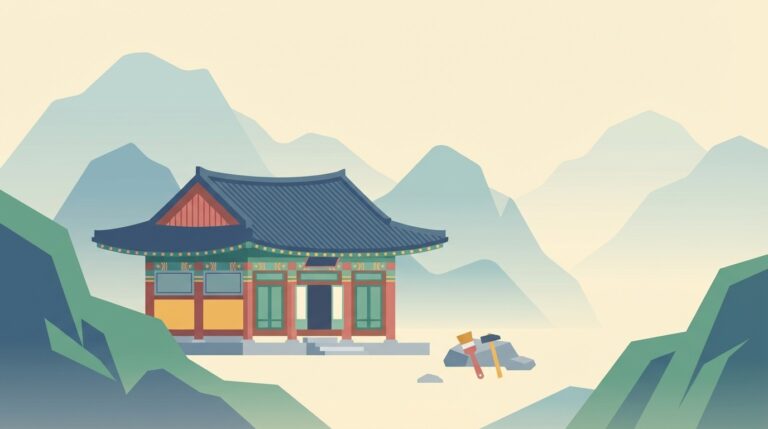
Imagine this: You are watching a historical K-Drama (사극), and the camera pans over a breathtaking, brightly painted wooden temple nestled deep within misty mountains. Or perhaps you’ve seen a vlog of a K-Pop idol visiting a quiet, centuries-old temple just to escape the flashing cameras and find some peace.
When foreign visitors come to Korea, they are often surprised. Right in the middle of the hyper-modern, neon-lit streets of Gangnam or Jongno, you’ll suddenly find a serene, ancient Buddhist temple or a majestic Gothic-style Catholic church. And here is the fascinating part: to Koreans, these aren’t just “religious buildings.” They are the very soul of Korean history, proudly protected as cultural heritage (문화재).
If you are at a C2 level in Korean, simply saying “이 절은 아름다워요” (This temple is beautiful) is no longer enough. You want to articulate the profound historical weight, the architectural brilliance, and the philosophical reasons why Koreans go to such lengths to preserve these sites. Today, we are diving deep into the sophisticated language of cultural heritage preservation. Ready to sound like a true Korean intellectual? Let’s begin.
Phase 2: Core Expressions Deep Dive
At the C2 level, we move beyond basic descriptions and focus on nuance, intent, and cultural weight.
1. 원형을 훼손하지 않고 보존하다 (Preserving the original form without damage)
- Pronunciation: [won-hyeong-eul hoe-son-ha-ji an-ko bo-jon-ha-da] / ‘won-hyeong’ sounds like ‘won’ + ‘young’ with an H.
- Meaning: Literal: To preserve without damaging the original form. / Real nuance: Maintaining the absolute historical integrity of a site without modern contamination.
- K-Culture Moment: You’ll hear this constantly in Korean documentaries or on news reports when a famous temple (like Sungnyemun or a major temple’s main hall) undergoes restoration. It reflects the Korean philosophy that rewriting history with modern materials is a form of disrespect.
- Editor’s Insight: The word ‘훼손’ (damage/vandalism) carries a heavy emotional weight in Korean. It implies not just physical breaking, but a disrespect to the ancestors.
- Situation Spectrum:
- Casual with friends: ⚠️ (A bit too academic for a coffee chat, unless discussing history)
- Intellectual debate/Semi-formal: ✅
- Formal/Academic/Tour guide: ✅
- 🤔 Think About It: Why does Korean restoration emphasize “original materials” (like specific types of pine wood) even if it takes decades? Does your culture prioritize the original material, or the visual outcome in historical restoration?
2. 종교적 의미를 넘어 민족의 얼이 담긴 유산이다 (It is a heritage containing the spirit of the people, beyond religious meaning)
- Pronunciation: [jong-gyo-jeok eui-mi-reul neo-meo, min-jok-ui eol-i dam-gin yu-san-i-da]
- Meaning: Literal: Beyond religious meaning, it’s a heritage filled with the people’s spirit. / Real nuance: This site belongs to all Koreans, regardless of what god they pray to.
- K-Culture Moment: This is the exact sentiment expressed when discussing places like Bulguksa Temple or Myeongdong Cathedral. Myeongdong Cathedral isn’t just for Catholics; it was the sanctuary for democratic protests in the 1980s (often depicted in modern history K-Dramas).
- Editor’s Insight: The word ‘얼’ (eol) is magical. It means soul, spirit, or collective consciousness. Using ‘얼’ in a sentence instantly elevates your Korean to a masterful, poetic level.
- Situation Spectrum:
- Casual: 🚫 (Too dramatic for daily life)
- Intellectual/Formal: ✅
- Writing/Essays: ✅
- 🤔 Think About It: Modern Korea is highly secular and multi-religious. Yet, ancient Buddhist sites are viewed as national identity markers. How does language bridge the gap between religion and national identity?
3. 세월의 풍파를 견뎌낸 흔적이 고스란히 남아있다 (The traces of enduring the weathering of time remain intact)
- Pronunciation: [se-wol-ui pung-pa-reul gyeon-dyeo-naen heun-jeok-i go-seu-ran-hi nam-a-it-da]
- Meaning: Literal: The marks of enduring the wind and waves of time remain untouched. / Real nuance: You can see the beautiful aging and history in the architecture itself.
- K-Culture Moment: Perfect for describing the faded Dancheong (traditional colorful painting on wooden buildings). Instead of saying “the paint is peeling,” Koreans appreciate the faded colors as a sign of authenticity and resilience.
- Editor’s Insight: ‘고스란히’ (intactly/untouched) is a beautiful native Korean adverb. It evokes a sense of delicate preservation against the harshness of ‘풍파’ (hardships/weathering).
- Situation Spectrum:
- Casual (appreciation): ✅
- Semi-formal: ✅
- Formal: ✅
- 🤔 Think About It: “Wabi-sabi” is a known concept in Japan, but Korea has its own appreciation for natural aging, often called “멋” (meot). How does the Korean language express the beauty of old, weathered things?
Phase 3: Textbook vs. Real Korean
Let’s see how a C2 speaker transforms robotic textbook phrases into natural, sophisticated observations.
[Describing an Old Temple]
* 📖 Textbook Korean: 이 건물은 아주 오래되었고 역사가 깊습니다. (This building is very old and has deep history.)
* 🗣️ Real Korean: 천 년 역사의 숨결이 곳곳에 배어 있네요. (The breath of a thousand years of history is permeated everywhere.)
* 💡 Why the difference?: At an advanced level, Koreans use sensory metaphors like ‘숨결’ (breath) and ‘배어 있다’ (permeated/soaked into) to describe history, making the space feel alive.
[Observing Restoration Work]
* 📖 Textbook Korean: 지금 수리하고 있습니다. (They are fixing it now.)
* 🗣️ Real Korean: 문화재 보수 및 복원 작업이 한창이네요. (Cultural heritage repair and restoration work is in full swing.)
* 💡 Why the difference?: ‘수리’ is for your broken smartphone. For national heritage, you must use ‘보수’ (maintenance/repair) or ‘복원’ (restoration).
[Expressing Awe at Architecture]
* 📖 Textbook Korean: 나무로 만든 것이 대단합니다. (It is amazing that it is made of wood.)
* 🗣️ Real Korean: 못 하나 쓰지 않고 조립한 목조 건축의 미학이 경이롭습니다. (The aesthetics of wooden architecture assembled without a single nail is marvelous.)
* 💡 Why the difference?: Highlighting specific traditional techniques (like building without nails) and using words like ‘미학’ (aesthetics) and ‘경이롭다’ (marvelous) shows deep cultural appreciation.
Phase 4: Cultural Context — K-Culture Deep Dive
4-1. Non-verbal Elements & ‘Nunchi’ in Sacred Spaces
When discussing or visiting these heritage sites, non-verbal respect is paramount.
– The Threshold Rule (문지방): Never step on the wooden threshold of a traditional Hanok or temple door; always step over it. Stepping on it is considered bad luck and disrespectful to the structural integrity and the spirits of the building.
– Voice Volume (눈치): Even if you are enthusiastically discussing the architectural value, lower your voice. Koreans use Nunchi here—observing if monks are chanting or people are praying, and adjusting their scholarly debates to a whisper.
4-2. K-Culture Connection: The ‘Temple Stay’ Healing Trend
In recent years, Korean religious architecture has taken on a new role in K-Culture: Mental Detox.
K-Pop superstars (like BTS’s RM) and actors frequently post photos of themselves at quiet mountain temples. They aren’t necessarily there for religious rituals; they are there for Temple Stay (템플스테이) programs. To modern Koreans, these preserved architectures provide an analog escape from a hyper-digital society. The preservation of these buildings is thus not just about the past; it’s about providing a psychological sanctuary for the modern generation. When you discuss these sites, linking their historical preservation to modern “healing” (힐링) culture will make your Korean friends nod in deep agreement.
Phase 5: Real-life Roleplay Scenario
Setting: Saturday afternoon, deep in the mountains at Haeinsa Temple, home to the Tripitaka Koreana (팔만대장경 – 80,000 wooden printing blocks from the 13th century). You are here with a Korean friend who is a history buff. The air is crisp, and the smell of pine and incense fills the air.
Characters:
– YOU: A foreign professional working in Seoul, fascinated by Korean architecture.
– Ji-hoon (34): Your Korean friend, proud of his country’s history but a bit cynical about modern over-tourism.
Dialogue:
Ji-hoon: 여기 팔만대장경 보관하는 장경판전은 에어컨이나 제습기 하나 없이 수백 년을 버틴 거 알아요? 진짜 과학적이죠.
(yeogi pal-man-dae-jang-gyeong bo-gwan-ha-neun jang-gyeong-pan-jeon-eun e-eo-keon-i-na je-seup-gi ha-na eop-si su-baek nyeon-eul beo-tin geo al-a-yo? jin-jja gwa-hak-jeok-i-jyo.)
[Translation] Did you know the Janggyeong Panjeon, where they keep the Tripitaka Koreana, has survived hundreds of years without a single AC or dehumidifier? It’s truly scientific.
YOU: 맞아요. 창문 크기를 다르게 해서 자연 통풍을 유도한 건축 기법이잖아요. 선조들의 지혜가 돋보여요.
(ma-ja-yo. chang-mun keu-gi-reul da-reu-ge hae-seo ja-yeon tong-pung-eul yu-do-han geon-chuk gi-beop-i-ja-na-yo. seon-jo-deul-ui ji-hye-ga dot-bo-yeo-yo.)
[Translation] That’s right. It’s the architectural technique of inducing natural ventilation by making the windows different sizes. The wisdom of the ancestors really stands out.
Ji-hoon: 근데 요새는 관광객이 너무 많이 와서 훼손될까 봐 걱정이에요.
(geun-de yo-sae-neun gwang-gwang-gaek-i neo-mu ma-ni wa-seo hoe-son-doel-kka bwa geok-jeong-i-e-yo.)
[Translation] But these days I’m worried it might get damaged because too many tourists are visiting.
🔀 Your Turn! How do you respond?
– A) “경찰을 더 많이 배치해야 해요.” (We need to deploy more police.)
– B) “맞아요. 문화재 보존과 대중 공개 사이에서 균형을 찾는 게 참 어려운 과제인 것 같아요.” (True. Finding the balance between preserving cultural heritage and opening it to the public seems like a very difficult task.)
– C) “에이, 그래도 돈을 버니까 좋잖아요!” (Hey, but it’s good because they make money!)✅ Best Choice: B — This is the ultimate C2-level response. It acknowledges the complexity of the issue (preservation vs. public access) using sophisticated vocabulary like ‘균형을 찾다’ (finding a balance) and ‘과제’ (task/challenge).
⚠️ Choice A & C Analysis: ‘A’ is grammatically fine but overly aggressive and misses the cultural tone. ‘C’ is a highly inappropriate capitalist view in front of a sacred national treasure; it shows a severe lack of Nunchi.
Ji-hoon: 정확해요. 그래서 일부 구역은 출입을 엄격하게 통제하고 있잖아요. 아, 저기 단청 보수 작업하는 곳으로 가볼래요?
(jeong-hwak-hae-yo. geu-rae-seo il-bu gu-yeok-eun chul-ip-eul eom-gyeok-ha-ge tong-je-ha-go it-ja-na-yo. a, jeo-gi dan-cheong bo-su jak-eop-ha-neun got-eu-ro ga-bol-lae-yo?)
[Translation] Exactly. That’s why access to some areas is strictly restricted. Ah, do you want to go over there where they are doing the Dancheong restoration work?
(🎭 Stage Direction: You nod and walk gently toward the construction scaffolding, careful not to disturb the monks nearby.)
Phase 6: 10-Second Shadowing Drill
Let’s practice delivering a profound, sophisticated thought with the right pacing and emotion.
😌 이 공간은 / 단순한 종교 시설을 넘어서, / (pause) / 한국인의 얼이 담긴 / 귀중한 문화유산이에요.
(i gong-gan-eun / dan-sun-han jong-gyo si-seol-eul neo-meo-seo, / … / han-guk-in-ui eol-i dam-gin / gwi-jung-han mun-hwa-yu-san-i-e-yo.)
Tips: Keep your voice calm and respectful. Emphasize ‘얼’ (spirit) slightly to show your deep understanding of the culture.
Phase 7: K-Culture Mini Dictionary
| 한국어 | Romanization | English | Context |
|---|---|---|---|
| 단청 | dan-cheong | Traditional colorful painting | The vivid red, green, and blue patterns on wooden temple roofs. It protects the wood from insects and weather while representing Buddhist cosmology. |
| 문화재청 | mun-hwa-jae-cheong | Cultural Heritage Administration | The government body responsible for preservation. (Recently rebranded to 국가유산청 – Korea Heritage Service). |
| 템플스테이 | tem-peul-seu-te-i | Temple Stay | A cultural program allowing visitors to experience monastic life. A huge trend for stress relief among young Koreans. |
| 대웅전 | dae-ung-jeon | Main Hall | The primary building in a Korean Buddhist temple housing the main Buddha statue. |
| 복원 | bok-won | Restoration | Rebuilding or restoring a damaged heritage site to its original historical state. |
Phase 8: Traveler’s Survival Kit
Even as a C2 speaker, navigating the practicalities of a historical site requires specific phrasing.
🆘 Survival Phrases for Heritage Sites
– 🇰🇷 “내부 촬영이 제한된 구역인가요?” (nae-bu chwal-yeong-i je-han-doen gu-yeok-in-ga-yo?)
– 🗣️ English: Is this a restricted area for indoor photography?
– 📍 Where to use: Before taking photos inside any religious building.
– 💡 Pro Tip: Even if there is no sign, taking photos of the main Buddha statue from the center aisle is often frowned upon. Shoot from the side!
- 🇰🇷 “영어 해설이 포함된 문화재 안내 책자가 있나요?” (yeong-eo hae-seol-i po-ham-doen mun-hwa-jae an-nae chaek-ja-ga it-na-yo?)
- 🗣️ English: Do you have a cultural heritage brochure with English explanations?
- 📍 Where to use: Ticket booths or information centers at heritage sites.
📌 Editor’s Travel Note
– Scaffolding everywhere?: Korean wooden architecture requires constant maintenance. If a temple is under ‘보수 공사’ (repair work), don’t be disappointed! Koreans view this as a beautiful process of extending the building’s life, not an inconvenience.
– Respecting the Space: You don’t need to bow, but maintaining a quiet demeanor and taking off your shoes before entering any hall is mandatory.
Phase 9: Critical Thinking Corner — “One Step Deeper”
🧠 Think Deeper: Religion & Identity in Modern Korea
How does a nation where over 50% of the population identifies as having no religion, and a large portion is Christian, still view Buddhist temples as the core of their national identity?
In Korea, Buddhism isn’t just a religion; it was the state ideology for a thousand years (Goryeo Dynasty) and deeply influenced the nation’s art, literature, and philosophy. Therefore, preserving a temple isn’t seen as “funding a religion” by the government, but as “protecting the Korean DNA.” The language reflects this: we rarely call them ‘종교 건물’ (religious buildings); we elevate them to ‘문화유산’ (cultural heritage) or ‘국보’ (national treasures). By decoupling the architecture from purely religious function, Korea unites its diverse modern citizens under a shared pride for their ancestors’ aesthetic and scientific brilliance.💬 Your Turn: Does your country have religious buildings that are preserved more for national identity than for religious practice? How do people talk about them? Share your thoughts below!
Phase 10: FAQ & Avoiding Common Mistakes
Q: “Can I debate the historical accuracy of a restoration with a tour guide?”
Yes, at a C2 level, polite academic debate is highly respected. You can say: “일각에서는 복원 과정이 원형과 다르다는 비판도 있던데, 어떻게 생각하시나요?” (I’ve heard some criticism that the restoration differs from the original form, what do you think?)
Q: “Is it okay to use the word ‘절’ instead of ‘사찰’?”
‘절’ is the pure Korean, casual word for temple. ‘사찰’ (sachal) is the Sino-Korean word. In formal writing or serious discussions about heritage, use ‘사찰’ or ‘전통 사찰’.
❌ Common Mistake #1: Calling a historic temple just a ‘건물’ (building) or ‘집’ (house).
✅ Do this instead: Use ‘건축물’ (architecture) or ‘문화재’ (cultural property). “오래된 건물이네요” sounds like you are looking at an old apartment. “역사적인 건축물이네요” sounds like an educated observation.❌ Common Mistake #2: Confusing 보수 (repair/maintenance) and 복원 (restoration).
✅ Do this instead: If they are just repainting the roof or fixing a pillar, it’s 보수. If the building burned down in a war and they are rebuilding it from old blueprints, it’s 복원.
Phase 11: Summary & Action Items
- One-Liner Summary: Mastering the vocabulary of preservation (‘원형 보존’, ‘문화유산’) transforms you from a casual tourist into someone who truly understands the soul of Korean history.
-
Action Mission 3 Steps:
- 🥉 Bronze (Solo): Read a Wikipedia article about a Korean National Treasure (like Bulguksa or Jongmyo) in Korean, highlighting the C2 vocabulary we learned.
- 🥈 Silver (Online): Leave a comment on a YouTube documentary about Korean heritage restoration using the phrase “선조들의 지혜가 돋보이네요” (The wisdom of the ancestors stands out).
- 🥇 Gold (Real-world): Visit a historic site in Korea, go to the information desk, and ask a sophisticated question about their ‘보수 공사’ (repair work) schedule or restoration efforts!
- K-Culture Mission: Watch an episode of a historical K-Drama or a K-Pop idol’s Temple Stay vlog. Listen carefully to how the background music changes when they show the architecture—that sense of awe is exactly what your words should convey.
Phase 12: Interactive Quiz — C2 Challenge
1. Situational Judgment: You are watching a news report about a famous temple whose wooden roof is being completely replaced due to termite damage. What is the most appropriate C2-level comment?
– A) “아이고, 건물이 부서졌네요.”
– B) “원형을 훼손하지 않고 완벽하게 복원되기를 바랍니다.”
– C) “새 나무로 바꾸면 더 깨끗하고 예쁘겠네요!”
2. Fill in the Blank:
“이 사찰은 단순한 종교 시설을 넘어, 민족의 ( _____ )이/가 담긴 문화유산입니다.”
(Hint: A magical one-syllable word meaning spirit/soul)
3. True or False (K-Culture Edition):
“When visiting a traditional Korean temple, it is considered polite to stand firmly on the wooden threshold (문지방) of the main hall to show respect to the Buddha.”
(Answers: 1. B – At C2, we wish for perfect restoration without damaging the original essence. A is too simplistic, C ignores the value of historical aging. / 2. 얼 (eol) / 3. False. You must never step on the threshold!)
Frequently Asked Questions (FAQ)
Q: What does "원형을 훼손하지 않고 보존하다 (Preserving the original form without damage)" mean in Korean and how do you pronounce it?
A: In Korean, "원형을 훼손하지 않고 보존하다 (Preserving the original form without damage)" is pronounced [won-hyeong-eul hoe-son-ha-ji an-ko bo-jon-ha-da] and means: Literal: To preserve without damaging the original form. / Real nuance: Maintaining the absolute historical integrity of a site without modern contamination.
Q: What does "세월의 풍파를 견뎌낸 흔적이 고스란히 남아있다 (The traces of enduring the weathering of time remain intact)" mean in Korean and how do you pronounce it?
A: In Korean, "세월의 풍파를 견뎌낸 흔적이 고스란히 남아있다 (The traces of enduring the weathering of time remain intact)" is pronounced [se-wol-ui pung-pa-reul gyeon-dyeo-naen heun-jeok-i go-seu-ran-hi nam-a-it-da] and means: Literal: The marks of enduring the wind and waves of time remain untouched. / Real nuance: You can see the beautiful aging and history in the architecture itself.







