

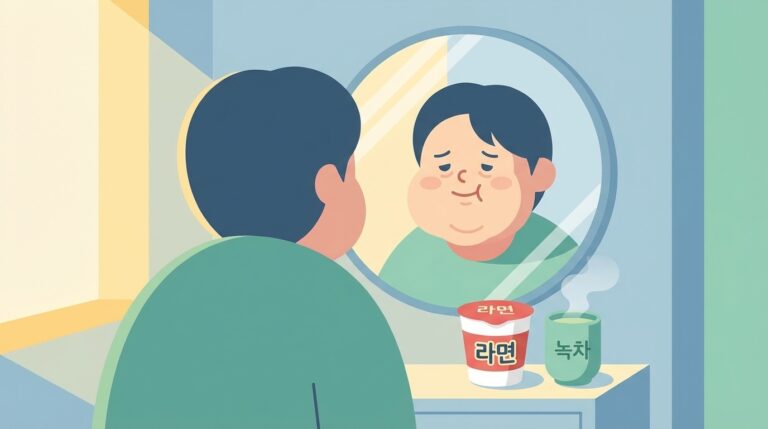
Phase 1: Empathy (Immersive Open)
Hello! I’m the lead editor at Daily Hangul.
Imagine this: It’s 1:30 AM. You’re watching the latest hit K-Drama. The main characters are sitting at a cozy Pojangmacha (street tent), or maybe they’re just in their kitchen, slurping down a steaming bowl of Ramyeon with kimchi. Your stomach growls. You give in. You boil water, eat the Ramyeon, and go to sleep happy.
Fast forward to 7:00 AM. You look in the mirror and… gasp! Your face looks like a full moon.
If you’ve ever watched K-Dramas or followed K-Pop idols, you know that ‘Butgi’ (붓기, swelling or bloating) is practically a national enemy in Korea. Idols drink special teas to get rid of it before going on stage, and drama heroines press frozen spoons against their eyes.
If you’re living in or visiting Korea, eating Yashik (야식, late-night snacks) is unavoidable. But what do you say the next morning when your coworkers look at you? Let’s learn how to navigate the hilarious and culturally rich world of the “post-Yashik bloated face.”
(Note: This guide is based on real questions from my intermediate students who wanted to know why their Korean friends keep telling them to drink pumpkin juice!)
Phase 2: Deep Dive into Core Expressions
1. 얼굴이 퉁퉁 부었어요.
- Pronunciation: Eolguri tungtung bueosseoyo. (The ‘퉁퉁’ sounds like the bouncing of a fully inflated, tight balloon. Say it with a little pout!)
- Meaning:
- Literal: My face is swollen ‘tung-tung’.
- Real Nuance: My face is super puffy/swollen right now.
- K-Culture Moment: You walk into the office. Your Korean coworker looks at you with concern. You laugh, point at your cheeks, and say this. It immediately breaks the ice, and they’ll probably offer you an iced Americano.
- Editor’s Insight: The word ‘부었어요’ comes from the verb ‘붓다’ (to swell). But the magic here is the mimetic word ‘퉁퉁’. Korean loves words that mimic shapes or feelings. Using ‘퉁퉁’ makes your Korean sound incredibly natural and native-like.
- Situation Spectrum:
- Friends (Casual): ✅ (얼굴 퉁퉁 부었어!)
- Coworkers (Semi-formal): ✅
- Boss/Elders (Formal): ⚠️ (Okay to say about yourself, but NEVER tell your boss their face is swollen!)
- 🤔 Think About It: Why does Korean have so many specific words for swelling and bloating? How does this tie into the strong emphasis on self-presentation and beauty in Korean society?
2. 붓기 좀 빼야겠어요.
- Pronunciation: Butgi jom ppaeyagesseoyo. (Emphasize the ‘빼’ like you are physically extracting something.)
- Meaning:
- Literal: I guess I need to take out the swelling.
- Real Nuance: I need to depuff / I need to get rid of this bloating.
- K-Culture Moment: This is the exact phrase K-Pop idols use in their morning V-Live or YouTube vlogs while vigorously massaging their jawlines with a jade roller.
- Editor’s Insight: Notice the verb ‘빼다’ (to subtract/remove). In English, swelling ‘goes down’. In Korean, you actively ‘pull it out’. It shows a proactive attitude toward self-care!
- Situation Spectrum:
- Friends (Casual): ✅ (나 붓기 좀 빼야겠다.)
- Coworkers (Semi-formal): ✅
- Boss/Elders (Formal): ⚠️
- 🤔 Think About It: “빼다” is also used for losing weight (살을 빼다). Why do you think Korean language frames physical reduction as an active extraction rather than a passive process?
3. 우유 마시고 자면 덜 부어요.
- Pronunciation: Uyu masigo jamyeon deol bueoyo.
- Meaning:
- Literal: If you drink milk and sleep, it swells less.
- Real Nuance: Drinking milk before bed prevents morning puffiness.
- K-Culture Moment: The classic K-Drama Ramyeon scene! If someone boils Ramyeon at midnight, they will inevitably pour a glass of milk to drink with it, or even pour milk into the Ramyeon soup.
- Editor’s Insight: This is a famous Korean folk remedy. The science? Milk is high in potassium, which helps flush out the sodium from the Ramyeon. Whether it works or not, it’s a staple cultural conversation piece.
- Situation Spectrum:
- Friends (Casual): ✅
- Coworkers (Semi-formal): ✅
- Boss/Elders (Formal): ✅
Phase 3: Textbook vs. Real Korean
Let’s upgrade your Korean from the textbook to the streets of Seoul!
[Situation 1: Explaining your puffy face]
* 📖 Textbook Korean: 어제 밤에 음식을 많이 먹어서 얼굴이 부었습니다. (I ate a lot of food last night, so my face is swollen.)
* 🗣️ Real Korean: 아, 어제 야식 먹고 잤더니 얼굴 빵빵해졌어요 ㅠㅠ (Ah, I ate late-night snacks and slept, so my face got fully inflated ㅠㅠ)
* 💡 Why the difference?: Using “-았/었더니” shows a natural cause-and-effect realization, and “빵빵하다” (tightly inflated) is a fun, slightly self-deprecating slang compared to the clinical “부었습니다”.
[Situation 2: Asking a friend for a remedy]
* 📖 Textbook Korean: 어떻게 하면 붓기가 사라집니까? (How does the swelling disappear?)
* 🗣️ Real Korean: 붓기 빼는 꿀팁 좀 알려줘! (Give me some honey-tips for depuffing!)
* 💡 Why the difference?: “꿀팁” (Honey + Tip = highly valuable advice) is universally used across all generations on the Korean internet to ask for life hacks.
(Bottom Note: As a B2 learner, using words like 꿀팁 or 퉁퉁 will instantly make native speakers impressed. They show you understand the cultural vibe, not just the grammar!)
Phase 4: Cultural Context — K-Culture Deep Dive
4-1. Non-Verbal Cues (Nunchi & Depuffing)
When you walk into work with a swollen face, you don’t need to announce it formally. A sheepish smile, lightly patting your own cheeks with both hands, and a sigh of “아… 붓기…” is enough. Koreans are masters of Nunchi (reading the room); they’ll instantly know you had chicken and beer (Chimaek) at 1 AM.
4-2. The “Idol Water” & K-Beauty Connection
If you watch K-Pop idol behind-the-scenes videos, you’ll see them drinking a strange yellowish liquid before music shows. This is the legendary “Idol Water” (아이돌 물). It’s a mixture of green tea, a slice of lemon, and a tiny bit of sugar. It’s believed to reduce facial swelling in under 20 minutes!
Koreans are highly invested in the “V-line” (a sharp, V-shaped jawline). Because late-night eating culture (Yashik) is so massive here, the “Depuffing” (Butgi-ppaegi) industry is equally huge. From jade rollers to specific teas (pumpkin, corn silk), managing your morning face is considered a standard part of K-Beauty routines.
Critical View: While it’s fun to try, remember that this stems from incredibly strict beauty standards broadcasted by Korean media. It’s perfectly okay to just look a bit puffy—you’re human, not an idol on a 4K camera!
Phase 5: Real-Life Roleplay Scenario
Let’s put you in the scene.
- Setting: 8:30 AM on a Wednesday. The office pantry. Last night, you went to a team Hoesik (company dinner) and ate spicy pork belly until midnight. You feel sluggish and your face is puffy.
- Characters:
- YOU: An expat working in Seoul, trying to survive the morning.
- Minji (28): Your friendly Korean coworker who always knows the best life hacks.
Minji: 좋은 아침이에요! 어제 회식 즐거웠죠?
(Joeun achimieyo! Eoje hoesik jeulgeowotjyo?)
[Good morning! Last night’s company dinner was fun, right?]
YOU: 네, 너무 재밌었는데… 제 얼굴 좀 보세요. 퉁퉁 부었어요.
(Ne, neomu jaemisseonneunde… je eolgul jom boseyo. Tungtung bueosseoyo.)
[Yes, it was so much fun but… look at my face. It’s super swollen.]
(🎭 Stage Direction: You pat your cheeks with a tragic sigh.)
Minji: ㅋㅋㅋ 어제 삼겹살 너무 많이 드시더라고요! 붓기 좀 빼야겠네요.
(Kkk eoje samgyeopsal neomu mani deusideoragoyo! Butgi jom ppaeyagenneyo.)
[Hahaha, you were eating so much pork belly yesterday! You definitely need to depuff.]
YOU: 맞아요. 붓기 빼는 꿀팁 좀 알려주세요.
(Majayo. Butgi ppaeneun kkultip jom allyeojuseyo.)
[Right. Please give me some honey-tips for depuffing.]
Minji: 음, 저는 보통 아이스 아메리카노 마셔요. 아니면 편의점 가서 이거 사다 드릴까요?
(Eum, jeoneun botong aiseu amerikano masyeoyo. Animyeon pyeonijeom gaseo igeo sada deurilkkayo?)
[Well, I usually drink iced Americano. Or should I go to the convenience store and buy you this?]
🔀 Your Turn! How should you respond?
– A) “네! 콜라 하나 사다 주세요!” (Yes! Please buy me a Cola!)
– B) “아, 옥수수수염차 하나 부탁드려도 될까요? 제가 살게요!” (Ah, could I ask for a Corn Silk Tea? I’ll pay for it!)
– C) “괜찮습니다. 저는 우유 마시겠습니다.” (It is fine. I will drink milk.)✅ Best Choice: B — Why? Corn silk tea (옥수수수염차) is the ultimate, culturally recognized drink for depuffing in Korea! Also, offering to pay (“제가 살게요”) shows great manners since she’s doing you a favor.
⚠️ Choice A & C Analysis: Cola will make you bloat more. Milk is good before bed, but drinking it the morning after won’t help much with the swelling!
Minji: 오, 옥수수수염차! 역시 한국인 다 되셨네요.
(O, oksususeuyeomcha! Yeoksi hangugin da doesyeonneyo.)
[Oh, Corn Silk Tea! You’ve practically become a Korean.]
YOU: ㅋㅋㅋ 다 민지 씨 덕분이죠.
(Kkk da Minji ssi deokbunijyo.)
[Hahaha, it’s all thanks to you, Minji.]
Minji: 잠시만요, 제 자리에 얼린 숟가락도 있는데, 눈에 좀 대고 있을래요?
(Jamsimanyo, je jarie eollin sutgarakdo inneunde, nune jom daego isseullaeyo?)
[Wait a second, I have frozen spoons at my desk, do you want to press them on your eyes?]
YOU: 대박… 진짜 꿀팁이네요. 감사합니다!
(Daebak… jinjja kkultibineyo. Gamsahamnida!)
[Jackpot… that’s a real honey-tip. Thank you!]
Phase 6: 10-Second Shadowing Drill
Let’s practice your rhythm and intonation! Follow the slash marks for natural pauses.
😢 아, / 어제 야식 먹고 잤더니 / 얼굴이 퉁퉁 부었어요.
(Ah, / eoje yashik meokgo jatdeoni / eolguri tungtung bueosseoyo.)
😊 붓기 빼는 데는 / 옥수수수염차가 / 최고예요!
(Butgi ppaeneun deneun / oksususeuyeomchaga / choegoyeyo!)
Phase 7: K-Culture Mini Dictionary
| 한국어 | Romanization | English | Cultural Context |
|---|---|---|---|
| 야식 | yashik | Late-night snack | Delivery apps in Korea run 24/7. Yashik (Ramyeon, Jokbal, Chicken) is a major social bonding tool. |
| 붓기 | butgi | Swelling / Bloating | Water retention from eating high-sodium Korean food late at night. |
| 꿀팁 | kkultip | Honey-tip (Life hack) | A highly useful piece of advice. Very commonly used online and in daily life. |
| V라인 | beui-rain | V-line | A sharp, v-shaped jawline. A very prominent beauty standard in Korea, hindered by ‘Butgi’. |
| 옥수수수염차 | oksususeuyeomcha | Corn silk tea | A very popular convenience store tea known for its diuretic effects, helping reduce bloating. |
Phase 8: Traveler’s Survival Kit
Whether you are an expat or just traveling in Seoul, you will end up at a GS25 or CU convenience store the morning after a big night out. Here is what you need to know:
🆘 Survival Phrases for the Convenience Store
– 🇰🇷 “붓기 빠지는 차 있어요?” (Butgi ppajineun cha isseoyo?)
– 🗣️ English Guide: Do you have tea that reduces swelling?
– 📍 Where to use: Convenience stores (CU, GS25, 7-Eleven), Pharmacies (약국).
– 💡 Pro Tip: If the worker looks confused, just look for bottles that say 호박즙 (Pumpkin juice) or 옥수수수염차 (Corn silk tea) in the beverage aisle.📌 Editor’s Travel Note
– Pharmacies are your friend: If your face is severely swollen (not just from food, maybe allergies), go to a Korean pharmacy (Yakguk) and say “얼굴이 부었어요” (My face is swollen). Korean pharmacists are incredibly helpful and will give you exact medicine.
– 2+1 Culture: Convenience store teas are almost ALWAYS on a “2+1” sale. Check the price tag for the “2+1” badge!
Phase 9: Critical Thinking — A Step Deeper
Media vs. Reality: The Obsession with “Depuffing”
🧠 Think Deeper:
K-Dramas and K-Pop portray an image of Korea where everyone looks perfectly sculpted, leading to the massive “Depuffing” trend. You’ll see ads everywhere for teas, facial massagers, and even dietary supplements aimed solely at preventing a puffy face. But here’s the reality: Korean food is extremely high in sodium (soups, stews, kimchi, soy sauce). Biologically, eating a traditional Korean meal will make you retain water. The language reflects this constant tug-of-war: we have a rich vocabulary for eating late-night snacks (Yashik) and an equally rich vocabulary for fixing the consequences (Butgi-ppaegi). It’s a fascinating paradox of loving hearty, salty food while aspiring to strict media beauty standards.💬 Your Turn: Does your culture have a specific food that you regret (but secretly love) eating late at night? Do you have “depuffing” remedies in your country? Share in the comments!
Phase 10: FAQ & Avoiding Mistakes
Q: Can I say “얼굴이 부었네요” (Your face is swollen) to my Korean boss?
NO. Even with the polite “-네요” ending, commenting on an elder or a superior’s physical appearance is a major taboo. It can sound like you are saying they look bad or tired. Only use it on yourself, or with very close friends who won’t take offense.
Q: Why does everyone tell me to drink pumpkin juice (호박즙)?
In Korean traditional medicine (Hanbang), pumpkin is known to have diuretic properties that flush out toxins and reduce swelling. It’s especially famous for post-surgery swelling, but people drink it for morning puffiness too!
❌ Common Mistake #1: Saying “붓기를 죽이다” (Kill the swelling).
✅ Do This Instead: Say “붓기를 빼다” (Pull out/remove the swelling). In Korean, swelling is extracted, not killed!
Phase 11: Summary & Action Items
- One-Liner Summary: When your face feels puffy after late-night Ramyeon, sigh and say, “얼굴이 퉁퉁 부었어요! 붓기 좀 빼야겠어요.”
-
Action Mission:
- 🥉 Bronze (Solo): Look in the mirror tomorrow morning and say “아, 얼굴 부었다!” (Ah, my face is swollen!) naturally.
- 🥈 Silver (Online): Go to a K-Pop idol’s vlog on YouTube and look for the word “붓기” in the Korean subtitles.
- 🥇 Gold (Real Life): Go to a Korean convenience store or Asian market and successfully find and buy a bottle of “옥수수수염차” (Corn silk tea).
- Engagement: What is your go-to late-night snack (Yashik) that you just can’t resist? Let me know below!
Phase 12: Quiz — Interactive Challenge
1. Situational Judgment:
You meet your close Korean friend for brunch. She looks a bit tired and her face is puffier than usual. What is the most culturally natural (and playful) thing to say?
– A) “어제 밤에 나트륨을 많이 섭취하셨군요.” (You consumed a lot of sodium last night.)
– B) “어? 얼굴 완전 퉁퉁 부었네! 어제 야식 먹었지? ㅋㅋㅋ” (Oh? Your face is super swollen! You ate late-night snacks yesterday, right? lol)
– C) “병원에 가야 합니다.” (You must go to the hospital.)
2. Fill in the Blank:
“아침에 일어나니까 얼굴이 ( ______ ) 부었어요.”
– A) 반짝반짝 (Twinkle twinkle)
– B) 퉁퉁 (Puffy/bouncy)
– C) 주룩주룩 (Rain pouring sound)
3. True or False — K-Culture Edition:
Drinking milk with spicy Ramyeon at night is a popular Korean method to try and prevent morning swelling. (True / False)
🚨 Click here for Answers!
- B – It shows closeness. A sounds like a doctor, and C is too dramatic!
- B – 퉁퉁 is the exact mimetic word for a swollen face.
- True – While the science is debated, drinking milk (or putting it in the broth) is a classic Korean Ramyeon hack!
Frequently Asked Questions (FAQ)
Q: What does "얼굴이 퉁퉁 부었어요." mean in Korean and how do you pronounce it?
A: In Korean, "얼굴이 퉁퉁 부었어요." is pronounced [Eolguri tungtung bueosseoyo. (The '퉁퉁' sounds like the bouncing of a fully inflated, tight balloon. Say it with a little pout!] and means: Literal: My face is swollen 'tung-tung'.
Q: What does "붓기 좀 빼야겠어요." mean in Korean and how do you pronounce it?
A: In Korean, "붓기 좀 빼야겠어요." is pronounced [Butgi jom ppaeyagesseoyo. (Emphasize the '빼' like you are physically extracting something.] and means: Literal: I guess I need to take out the swelling.
Q: What does "우유 마시고 자면 덜 부어요." mean in Korean and how do you pronounce it?
A: In Korean, "우유 마시고 자면 덜 부어요." is pronounced [Uyu masigo jamyeon deol bueoyo.] and means: Literal: If you drink milk and sleep, it swells less.







