

Hello there! It’s your friendly Daily Hangul Editor.
Phase 1: The “Oh No” Moment 😱
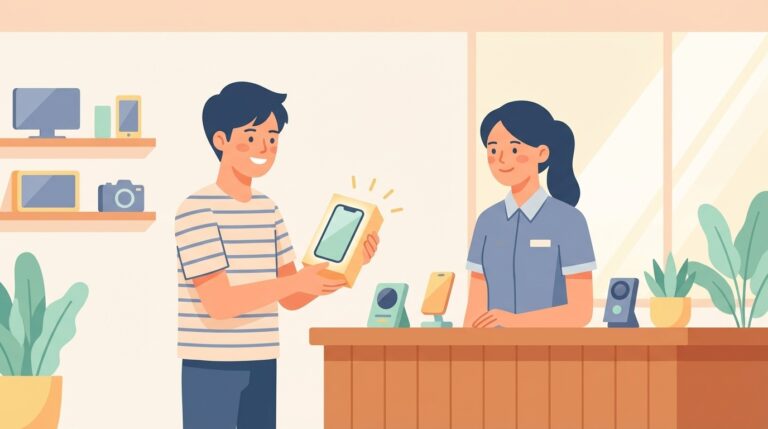
Imagine this: You are in Seoul. You finally bought that sleek new K-Beauty skincare device you saw in your favorite K-Drama, or maybe you just splurged on the official K-Pop lightstick for tomorrow’s concert. You run back to your hotel, excitedly unbox it, pop in the batteries, and… nothing. It won’t turn on.
Panic sets in. Your mind races: “How do I explain this? Will they think I broke it? How do I say ‘give me a new one’ without sounding like an angry “Karen”?”
In Korea, AS (After-Sales Service, pronounced 에이에스) is legendary for being incredibly fast and hassle-free. But approaching the counter with a broken gadget can be intimidating if you don’t know the right words.
Don’t worry. As a tutor who has helped countless expats survive the infamous ‘Korean exchange/refund desk’, I’m here to equip you with the exact phrases to get your shiny new replacement with a smile. Let’s dive in!
Phase 2: Core Expressions — Deep Dive
Here are the magic phrases to turn a stressful situation into a breeze.
1. 이거 불량인 것 같아요.
- Pronunciation: i-geo bul-ryang-in geot ga-ta-yo. (The ‘ryang’ sounds like a light ‘r’ and ‘L’ mixed together)
- Meaning: I think this is defective. (Literal: It seems like this is a defect.)
- K-Culture Moment: In K-Dramas, you might see an angry customer yelling, “이거 고장 났잖아!” (This is broken!). But in real-life Korean society, harmony is key. Using “~것 같아요” (it seems like) is the ultimate social lubricant. It points out the flaw without directly attacking the staff or the store.
- Editor’s Insight: ‘불량’ (bul-ryang) means a factory defect. It’s much better than saying ‘고장 났어요’ (It’s broken), which might imply you broke it after using it.
- Situation Spectrum:
- Casual store / K-Pop pop-up: ✅
- Premium AS Center: ✅
- Yelling it at the staff: 🚫
- 🤔 Think About It: Why does Korean language use so many “softening” phrases like “I think” or “It seems” even for obvious facts? Does your native language value directness or indirectness in customer service?
2. 새 걸로 교환해 주세요.
- Pronunciation: sae geol-lo gyo-hwan-hae ju-se-yo. (‘sae’ sounds like ‘say’, ‘geol’ rhymes with ‘gull’)
- Meaning: Please exchange it for a new one.
- K-Culture Moment: You are at Olive Young, and the hair straightener you bought has a scratch. You politely show the receipt and say this. The staff immediately bows, opens a new drawer, and hands you a fresh box.
- Editor’s Insight: “새 것” (new thing) is often shortened to “새 걸” in spoken Korean. “교환” (exchange) is the keyword here. If you say “바꿔주세요” (change it), it’s okay, but “교환해 주세요” sounds much more natural and polite in a retail setting.
- Situation Spectrum:
- Friends (Casual): ⚠️ (Friends don’t exchange products!)
- Retail Staff / AS Center (Semi-formal/Formal): ✅
- 🤔 Think About It: In some cultures, returning items is a long, suspicious process. In Korea, “교환/환불” (Exchange/Refund) is often done in under 2 minutes if you have the receipt. How does trust play a role in commerce here?
3. 박스 그대로 가져왔어요.
- Pronunciation: bak-seu geu-dae-ro ga-jyeo-wa-sseo-yo.
- Meaning: I brought it exactly as it was in the box.
- Editor’s Insight: This is your defense shield. Electronics stores usually require all original packaging for a seamless 1-to-1 exchange. Saying this preemptively shows you know the rules!
- Situation Spectrum:
- Customer Service Desk: ✅
Phase 3: Textbook vs. Real Korean
Let’s see how textbook Korean compares to what you’ll actually hear at the Yongsan Electronics Market or a Samsung/LG service center.
[Situation 1: Pointing out the problem]
* 📖 Textbook Korean: 이 기계가 작동하지 않습니다. (This machine does not operate.)
* 🗣️ Real Korean: 이거 전원이 안 들어와요. (The power won’t turn on.) / 이거 아예 안 켜져요. (It doesn’t turn on at all.)
* 💡 Why the difference?: Koreans prefer speaking specifically about the symptom (전원 – power) rather than using formal, robotic terms like “기계” (machine) or “작동” (operate).
[Situation 2: Asking for the resolution]
* 📖 Textbook Korean: 새로운 제품으로 바꾸어 주시겠습니까? (Would you please change it to a new product?)
* 🗣️ Real Korean: 환불 말고 새 걸로 교환할게요. (I’ll do an exchange for a new one, not a refund.)
* 💡 Why the difference?: Efficiency! By immediately stating you want an exchange (교환) and not a refund (환불), you save the staff from asking a follow-up question. Pali-pali (hurry) culture at its finest.
Bottom Note: At a B1 level, dropping overly formal textbook endings like “~지 않습니다” for “~안 켜져요” (doesn’t turn on) makes you sound instantly more fluent and relatable.
Phase 4: Cultural Context — K-Culture Deep Dive
4-1. Non-Verbal Communication: The ‘Two-Hand’ Rule & The Waiting Ticket
When handing over your broken item and the receipt, always use two hands (or support your right arm with your left hand). It shows respect. Also, when you enter an AS Center (like Samsung or LG) or a bank, the very first thing you must do is look for the 번호표 (Number Ticket) machine. Do not just walk up to the counter! Grab a ticket, sit on the comfortable sofa, and wait for the screen to flash your number with a soft “ding-dong.”
4-2. The “AS” (에이에스) Culture: Beyond Just Service
In Korea, “AS” (After-Sales service) is practically a lifestyle. Unlike some countries where repairing an electronic device requires mailing it out and waiting weeks, Korean AS centers are built like premium lounges.
You walk in, grab a free cup of mixed coffee (믹스커피), sit in a massage chair, and within 30 minutes, an engineer comes out to explain the issue. Because the consumer electronics market is so competitive, companies use their lightning-fast “AS” as a major marketing point.
Phase 5: Real-Life Roleplay Scenario
Setting: Saturday afternoon, bright fluorescent lights, Olive Young flagship store in Myeongdong. You bought a heated eyelash curler yesterday, but it doesn’t heat up. You walk up to the busy counter.
Characters:
– YOU: A savvy traveler who knows their consumer rights.
– Staff (직원): 20s, wearing the iconic Olive Young uniform, moving at the speed of light.
Dialogue:
직원: 안녕하세요, 결제 도와드릴까요? 🛒
(an-nyeong-ha-se-yo, gyeol-je do-wa-deu-ril-kka-yo?)
[Hello, can I help you with checkout?]
YOU: 아, 결제 아니고요. 어제 산 건데, 이거 불량인 것 같아요.
(a, gyeol-je a-ni-go-yo. eo-je san geon-de, i-geo bul-ryang-in geot ga-ta-yo.)
[Ah, not checkout. I bought this yesterday, but I think it’s defective.]
직원: 앗, 죄송합니다 고객님. 어디가 안 되시나요?
(at, joe-song-ham-ni-da go-gaeng-nim. eo-di-ga an doe-si-na-yo?)
[Ah, I apologize customer. What seems to be the problem?]
YOU: 전원이 아예 안 켜져요.
(jeon-won-i a-ye an kyeo-jyeo-yo.)
[The power doesn’t turn on at all.]
직원: 영수증이랑 결제하신 카드 혹시 챙겨오셨을까요?
(yeong-su-jeung-i-rang gyeol-je-ha-sin ka-deu hok-si chaeng-gyeo-o-syeos-seul-kka-yo?)
[Did you happen to bring the receipt and the card you used to pay?]
🔀 Your Turn! How do you reply?
– A) “네, 영수증 여기요. 환불해 주세요.” (Yes, here’s the receipt. Refund it.)
– B) “네, 박스 그대로 가져왔어요. 새 걸로 교환해 주세요.” (Yes, I brought it in the box as is. Please exchange it for a new one.)
– C) “영수증 버렸는데요?” (I threw the receipt away?)✅ Best Choice: B — By stating you have the original packaging and clearly asking for an exchange (not a refund), you make the staff’s job infinitely easier.
⚠️ Choice C Analysis: Without a receipt, physical stores in Korea usually cannot process an exchange. Always keep receipts for electronics!
직원: 네, 확인했습니다. 바로 새 제품으로 교환해 드릴게요!
(ne, hwa-gin-haet-seum-ni-da. ba-ro sae je-pum-eu-ro gyo-hwan-hae deu-ril-ge-yo!)
[Yes, I’ve confirmed it. I will exchange it for a new product right away!]
Phase 6: 10-Second Shadowing Drill
Practice this sentence until it rolls off your tongue. Follow the slashes for natural pauses!
🥺 어제 / 산 건데요, / 이거 불량인 것 같아요. / 새 걸로 / 교환해 주세요.
(eo-je / san geon-de-yo, / i-geo bul-ryang-in geot ga-ta-yo. / sae geol-lo / gyo-hwan-hae ju-se-yo.)
Emotion Tag: Slightly apologetic but firm. Do not sound angry! A gentle tone will get you the best service.
Phase 7: K-Culture Mini Dictionary
| Korean | Romanization | English | Context |
|---|---|---|---|
| AS 센터 | a-i-eu-seu sen-teo | After-Sales Service Center | The magical place where broken things are fixed instantly. |
| 불량 | bul-ryang | Defective (product) | Factory flaw. Crucial word to avoid blaming yourself. |
| 번호표 | beon-ho-pyo | Number Ticket | You must pull this paper from the machine to wait your turn. |
| 영수증 | yeong-su-jeung | Receipt | Keep this! “영수증 드릴까요?” (Would you like the receipt?) is asked at every store. |
| 진상 | jin-sang | Rude customer | A slang term for an entitled customer. Don’t be a jin-sang! |
Phase 8: Traveler Survival Kit
Are you traveling in Korea right now and facing a gadget crisis? Keep these cards handy!
🆘 Survival Phrase #1: Finding Help
– 🇰🇷 “근처에 삼성/애플 AS 센터가 어디 있어요?” (geun-cheo-e sam-seong/ae-peul a-i-eu-seu sen-teo-ga eo-di i-sseo-yo?)
– 🗣️ Meaning: Where is the nearest Samsung/Apple AS center?
– 📍 Where to use: Hotel front desk, tourist information.🆘 Survival Phrase #2: Asking about time
– 🇰🇷 “오늘 바로 받을 수 있나요?” (o-neul ba-ro ba-deul su in-na-yo?)
– 🗣️ Meaning: Can I get it back today?
– 💡 Pro Tip: Since travelers have limited time, always check if it’s a same-day repair (당일 수리) or if it takes days.
📌 Editor’s Travel Note
– Map Apps: Google Maps doesn’t work well for walking/transit in Korea. Download Naver Map or KakaoMap to search for “AS 센터”.
– No Tipping: Never tip the repair engineer or the store clerk. Excellent service is just the standard here!
Phase 9: Critical Thinking Corner — “A Step Deeper”
🧠 Think Deeper: “Pali-Pali” Culture & Consumer Rights
Korea is known globally for its “Pali-pali” (hurry, hurry) culture, and nowhere is this more evident than in customer service. While some cultures view returning a product as a negotiation or a long bureaucratic process, Korean society views it as a basic consumer right that must be fulfilled with maximum efficiency. This stems from a highly competitive market where brand loyalty is won through post-purchase care. However, this also places immense pressure on service workers to be flawlessly polite and fast. The language reflects this: customers use softened language (“~것 같아요”) to maintain harmony, while staff use hyper-polite honorifics to ensure smooth transactions.
💬 Your Turn: In your home country, is returning or exchanging an electronic device easy or difficult? Does the customer service language there feel more casual or strictly formal? Share in the comments!
Phase 10: FAQ & Common Mistakes
Q: Do I need the original box to get an exchange?
Yes! For a “새 제품으로 교환” (1-to-1 exchange for a brand new product), Korean stores are very strict. You usually need the device, the receipt, the original box, and even the little plastic wrappers inside, all within 7 to 14 days of purchase.
Q: Can I just say “바꿔주세요” (Change it) to an older staff member?
It’s grammatically correct, but it can sound a bit demanding. If you add “새 걸로 교환해 주시겠어요?” (Could you exchange it for a new one?), you sound incredibly polite and culturally aware.
❌ Common Mistake #1: Saying “이거 고장 냈어요” (I broke this) instead of “이거 고장 났어요” (This is broken).
✅ How to fix it: Pay attention to the verb! “고장 났어요” is passive (it broke/it is broken). “고장 냈어요” means you actively destroyed it—they won’t give you a free exchange if you admit to breaking it!
Phase 11: Summary & Action Items
- One-Liner Summary: To exchange a defective item without stress, soften your words with “불량인 것 같아요” (I think it’s defective) and ask for “새 걸로 교환” (exchange for a new one).
🎯 Action Missions:
– 🥉 Bronze (Solo): Stand in front of your mirror, hold a random object, and practice saying “이거 불량인 것 같아요” with a slightly confused but polite expression.
– 🥈 Silver (Online): Find an unboxing video of a Korean product on YouTube and leave a comment: “만약 불량이면, 새 걸로 교환할 수 있어요?” (If it’s defective, can I exchange it for a new one?)
– 🥇 Gold (Real Life): Next time you buy something in a Korean store, look at the receipt and ask, “며칠 안에 교환돼요?” (Within how many days can I exchange this?)
Phase 12: Interactive Quiz!
Test your new AS Center survival skills!
1. Situational Judgment: You just bought a wireless charger, but it doesn’t charge. You go to the counter. Which is the MOST polite and natural thing to say?
– A) 야! 이거 고장 났어! (Hey! This is broken!)
– B) 이거 불량인 것 같아요. 새 걸로 교환해 주세요. (I think this is defective. Please exchange it for a new one.)
– C) 기계가 작동하지 않습니다. (The machine does not operate.)
2. Fill in the Blank:
Staff: 결제하신 카드랑 ______ 챙겨오셨나요?
(Did you bring the card you paid with and the ______?)
– A) 번호표 (Number ticket)
– B) 영수증 (Receipt)
3. True or False (K-Culture Edition):
If your phone breaks in Korea, you should bring cash to tip the AS center engineer for their fast repair service.
– True / False
(Answers: 1. B, 2. B, 3. False – There is no tipping culture in Korea!)
Did you enjoy today’s guide? Don’t let a broken gadget ruin your trip or your K-Pop concert! Bookmark this page and travel with confidence. See you in the next Daily Hangul post! 👋
Frequently Asked Questions (FAQ)
Q: What does "이거 불량인 것 같아요." mean in Korean and how do you pronounce it?
A: In Korean, "이거 불량인 것 같아요." is pronounced [i-geo bul-ryang-in geot ga-ta-yo. (The 'ryang' sounds like a light 'r' and 'L' mixed together] and means: I think this is defective. (Literal: It seems like this is a defect.)
Q: What does "새 걸로 교환해 주세요." mean in Korean and how do you pronounce it?
A: In Korean, "새 걸로 교환해 주세요." is pronounced [sae geol-lo gyo-hwan-hae ju-se-yo. ('sae' sounds like 'say', 'geol' rhymes with 'gull'] and means: Please exchange it for a new one.
Q: What does "박스 그대로 가져왔어요." mean in Korean and how do you pronounce it?
A: In Korean, "박스 그대로 가져왔어요." is pronounced [bak-seu geu-dae-ro ga-jyeo-wa-sseo-yo.] and means: I brought it exactly as it was in the box.







