

Phase 1: Empathy (The K-Culture Cold Open)
Hello! Daily Hangul Editor here.
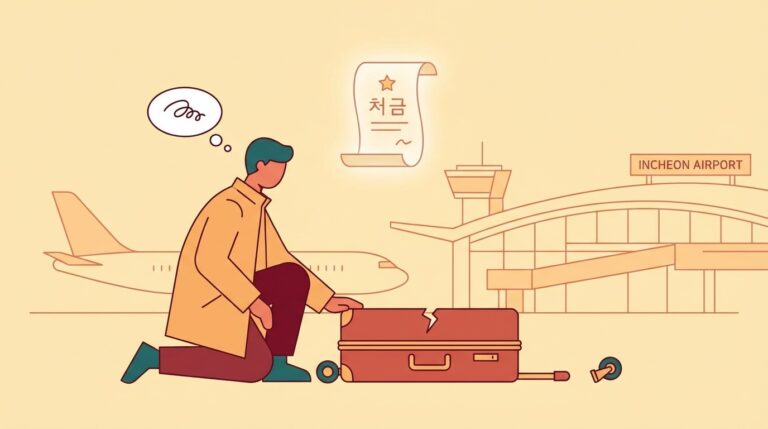
Picture this: You’ve just landed at Incheon International Airport. You grab your luggage from the carousel, completely ready to live your best K-Drama life in Seoul… only to find the wheel of your $500 suitcase completely shattered. Or maybe you’re at a packed K-Pop concert, navigating a sea of passionate fans, when suddenly someone bumps your arm and your smartphone screen meets the hard asphalt.
Panic sets in. Not just because your stuff is broken, but because you realize your textbook Korean—“제 가방이 고장났어요” (My bag is broken)—isn’t going to cut it when you need official documentation for your travel insurance.
At the C2 level, you already know how to order food and chat with friends. But navigating Korean bureaucracy, customer service, and official claims requires a completely different set of linguistic tools. It requires Hanja (Sino-Korean) administrative vocabulary.
I’ve written this guide based on frantic, real-life SOS calls I’ve received from my advanced students. Let’s upgrade your Korean from “conversational” to “bureaucratically bulletproof” so you can get your compensation and get back to enjoying your trip!
Phase 2: Core Expressions Deep Dive
When dealing with official matters like insurance claims, Koreans drop native Korean verbs and switch to formal, Hanja-based nouns. Here are the crucial ones you need.
1. 파손 확인서 (Damage Certificate)
- Pronunciation: [pa-son hwa-gin-seo] + Sounds like ‘pah-sohn hwa-geen-suh’ (Make the ‘p’ soft, not overly aspirated).
- Meaning: (Literal) Damage Confirmation Document -> (Real nuance) Official Incident/Damage Report required by insurance companies.
- K-Culture Moment: If you watch Korean legal or police dramas, you’ll hear the word 확인서 (certificate/written confirmation) constantly. Korean bureaucracy runs on official stamps and written proof. Without this paper, to an insurance company, the event didn’t happen.
- Editor’s Insight: This is the magic password. Asking for this document immediately signals to Korean staff that you are filing an insurance claim, and they will shift into their highly efficient “official protocol” mode.
- Situation Spectrum:
- Customer Service/Police (Formal): ✅
- Friends (Casual): 🚫 (Too bureaucratic! Say “망가졌어” instead)
- 🤔 Think About It: Why does Korean have completely different vocabularies for everyday speaking (망가졌다) and official writing (파손되었다)? How does this reflect the traditional societal divide between the scholarly class and the commoners?
2. 본인 과실 (Personal Negligence / User Fault)
- Pronunciation: [bon-in gwa-sil] + Sounds like ‘bohn-een gwah-sheel’.
- Meaning: (Literal) One’s own fault -> (Real nuance) Negligence on the part of the user.
- K-Culture Moment: You’ll see this phrase on the back of every K-Beauty product or electronics warranty in Korea: “본인 과실로 인한 파손은 보상 불가” (No compensation for damage caused by personal negligence).
- Editor’s Insight: This is the phrase insurance adjusters use to deny your claim. When reporting an accident, you must clearly state that the damage occurred due to external shock (외부 충격), not your own clumsiness.
- Situation Spectrum:
- Official claims / Legal disputes: ✅
- Everyday apologies: 🚫 (Say “제 잘못이에요” instead)
- 🤔 Think About It: In disputes, Koreans often use passive voice or abstract nouns (과실, 부주의) instead of directly pointing fingers. Does your native language soften blame in official contexts similarly?
3. 보상 청구 (Claim for Compensation)
- Pronunciation: [bo-sang cheong-gu] + Sounds like ‘boh-sahng chung-goo’.
- Meaning: (Literal) Request for compensation -> (Real nuance) Filing an insurance claim.
- K-Culture Moment: Think of those dramatic scenes where a chaebol heir throws an envelope of cash on the table as “보상” (compensation). In real life, it’s done via paperwork.
- Editor’s Insight: Using “청구하다” (to claim/bill) instead of “돈을 주세요” (give me money) is the hallmark of a fluent, C2-level speaker. It shows you understand the legal system.
- Situation Spectrum:
- Bank / Insurance / Airline desk: ✅
Phase 3: Textbook vs. Real Korean
Let’s look at how language transforms in high-stakes travel situations.
[Situation 1: Explaining the damage to an airline agent]
* 📖 Textbook Korean: 제 캐리어가 부서졌습니다. 변상해 주세요. (My carrier is broken. Please reimburse me.)
* 🗣️ Real Korean: 수하물이 파손된 채로 나왔는데요, 여행자 보험사에 제출할 파손 확인서 발급이 가능할까요? (My baggage came out damaged. Is it possible to issue a damage certificate to submit to my travel insurance?)
* 💡 Why the difference?: C2 Korean is about indirectness and procedural knowledge. By asking for the document rather than demanding money directly, you sound more reasonable and sophisticated, prompting faster service.
[Situation 2: Dropping your phone at a tourist spot]
* 📖 Textbook Korean: 제가 실수로 떨어뜨렸어요. (I dropped it by mistake.)
* 🗣️ Real Korean: 인파에 밀려서 떨어뜨렸는데, 혹시 CCTV 확인이 가능할까요? (I dropped it because I was pushed by the crowd, is it possible to check the CCTV?)
* 💡 Why the difference?: To claim insurance, you often need to prove it wasn’t purely “본인 과실” (your fault). Blaming the “인파” (crowd) using the passive voice “밀려서” changes the legal nature of the accident.
Bottom Note: At the C2 level, focus on using Hanja words (파손, 발급, 제출) instead of pure Korean verbs (부서지다, 주다, 내다) when dealing with institutions.
Phase 4: Cultural Context — K-Culture Deep Dive
4-1. The Non-Verbal Language of Claims
In Korea, asserting your rights doesn’t mean raising your voice. The “Karen” approach (yelling at customer service) will immediately label you as a 진상 (entitled customer), and people will become less helpful.
The key is polite persistence. Keep your tone calm, use “요” or “다/까” endings, and present your evidence logically. Hand your passport or receipts with two hands.
4-2. The “Pali-Pali” Insurance Culture
Korea is the land of extreme efficiency. If you’ve watched K-Dramas like Hospital Playlist or Extraordinary Attorney Woo, you know that Koreans love standardized procedures.
When you travel in Korea, this works to your advantage. If your luggage is damaged at Incheon Airport, the airline often has a designated counter just for this. If you have the right terms (파손 확인서), they will literally print the document, stamp it, and hand it to you in under 5 minutes. They might even offer you a replacement suitcase on the spot!
Critical Perspective: While the “Pali-Pali” culture is great for fast processing, it can be rigidly inflexible. If you lack the required documentation, no amount of emotional pleading will bend the rules. Bureaucratic “Nunchi” means knowing exactly what paper they need to cover their own liability.
Phase 5: Real-Life Roleplay Scenario
Setting: Friday afternoon at Incheon Airport, Terminal 1 Baggage Claim. You just pulled your Rimowa suitcase off the belt, and there is a massive dent on the side. You approach the airline’s baggage service counter.
Characters:
* YOU: An experienced expat who knows their rights but wants to handle this smoothly.
* Agent Lee (28, polite but strictly follows the manual): A baggage claim agent who handles 50 of these cases a day.
Dialogue:
YOU: 안녕하세요, 수하물을 방금 찾았는데 심하게 파손되어 있어서요.
(Annyeonghaseyo, suhamureul banggeum chajanneunde simhage pason-dwe-eo isseoseoyo.)
[Hello, I just picked up my baggage and it is severely damaged.]
Agent Lee: 아, 고객님. 많이 놀라셨겠습니다. 탑승권과 수하물 태그 확인 도와드리겠습니다.
(A, gogaengnim. Mani nollasyeotgetseumnida. Tapseung-gwon-gwa suhamul taegeu hwagin dowadeurigetseumnida.)
[Ah, sir/ma’am. You must be very surprised. I will help check your boarding pass and baggage tag.]
YOU: 네, 여기 있습니다.
(Ne, yeogi itseumnida.)
[Yes, here they are.]
(🎭 Stage Direction: You hand over the tags with both hands)
Agent Lee: 확인 감사합니다. 외부 충격에 의한 파손으로 보이는데요. 혹시 안에 취급 주의 물품이나 귀중품이 들어있었나요?
(Hwagin gamsahamnida. Oebu chunggyeog-e uihan pason-euro boineundeyo. Hoksi an-e chwigeup ju-ui mulpum-ina gwijungpum-i deureoisseonnayo?)
[Thank you for confirming. It looks like damage from an external impact. By any chance, were there any fragile items or valuables inside?]
🔀 Your Turn! How do you respond?
* A) “네, 노트북이 있었는데 다행히 안 망가졌어요.” (Yes, I had a laptop but luckily it’s not broken.)
* B) “아니요, 일반 의류와 세면도구만 있었습니다. 항공사 측 보상 규정이 어떻게 되나요?” (No, just general clothing and toiletries. What is the airline’s compensation policy?)
* C) “안에 뭐가 들었든 가방을 던지시면 안 되죠!” (Regardless of what’s inside, you shouldn’t throw the bag!)✅ Best Choice: B — Reason: Choice A admits you violated airline policy (valuables/electronics shouldn’t be in checked bags), which could nullify your claim. Choice B is smart, factual, and seamlessly asks for the policy using advanced vocabulary (보상 규정). Choice C makes you sound like a Jinsang (rude customer).
Agent Lee: 저희 규정상, 감가상각을 적용하여 현금 보상을 해드리거나, 대체 캐리어를 지급해 드리고 있습니다.
(Jeohi gyujeongsang, gamgasanggag-eul jeogyonghayeo hyeongeum bosang-eul haedeurigeona, daeche kaerieo-reul jigeuphae deurigo itseumnida.)
[According to our policy, we offer either cash compensation applying depreciation, or we provide a replacement carrier.]
YOU: 저는 제가 가입한 여행자 보험으로 처리하고 싶습니다. 보험사 제출용 파손 확인서 발급해 주실 수 있나요?
(Jeoneun jega gaipan yeohaengja boheom-euro cheorihago sipseumnida. Boheomsa jechullyong pason hwaginseo balgeuphae jusil su innayo?)
[I would like to process this through my travel insurance. Could you issue a damage certificate for submission to the insurance company?]
Agent Lee: 네, 알겠습니다. 바로 서류 작성해 드리겠습니다.
(Ne, algetseumnida. Baro seoryu jakseonghae deurigetseumnida.)
[Yes, understood. I will prepare the documents for you right away.]
Phase 6: 10-Second Shadowing Drill
Practice this C2-level sentence. Pay attention to the professional intonation. It shouldn’t sound angry; it should sound calm and factual.
- 😤 단호하지만 정중하게 (Firm but polite)
- 보험사에 / 제출할 / 파손 확인서 / 발급이 / 가능할까요?
- (boheomsa-e / jechulhal / pason hwaginseo / balgeubi / ganeunghalkkayo?)
Phase 7: K-Culture Mini Dictionary
| 한국어 | Romanization | English | Cultural Context |
|---|---|---|---|
| 규정 | gyujeong | Protocol / Regulation | The ultimate shield of Korean customer service. If something is “규정상 불가” (impossible due to policy), arguing is usually futile. |
| 진상 | jinsang | Entitled/Rude customer | The Korean equivalent of a “Karen.” Avoid being labeled this at all costs if you want good service. |
| 융통성 | yungtongseong | Flexibility / Leeway | Often requested by customers (“융통성 있게 좀 해주세요” – Please be a bit flexible), but rarely granted in corporate settings. |
| 감가상각 | gamgasanggak | Depreciation | Advanced vocab! Airlines will use this to explain why they won’t pay the full original price of your 5-year-old bag. |
| 지구대 | jigudae | Local Police Checkpoint | Smaller than a full police station (경찰서). This is where you go to get a “Police Report” (사고경위서) for lost/stolen items. |
Phase 8: Traveler’s Survival Kit
If you need to make an insurance claim for broken or lost items while traveling in Korea, keep this kit handy!
🆘 Survival Expression #1: Asking for CCTV
* 🇰🇷 “분실/파손 때문에 그러는데, CCTV 좀 확인할 수 있을까요?” (bun-sil/pa-son ttaemune geureoneunde, CCTV jom hwaginhal su isseulkkayo?)
* 📍 Where to use: Cafes, hotels, tourist spots if an item is broken or goes missing.🆘 Survival Expression #2: Reporting to Police
* 🇰🇷 “여행자 보험 청구용으로 사고 경위서가 필요합니다.” (yeohaengja boheom cheongguyong-euro sago gyeongwiseo-ga piryohamnida.)
* 📍 Where to use: 지구대 (Local Police Box).
📌 Editor’s Travel Note:
* Photos First: Before moving anything, take a picture of the damaged item exactly where it happened. Korean insurance companies are incredibly strict about visual evidence.
* 112 vs. 119: 112 is for police (crime, lost items, traffic accidents). 119 is for fire and medical emergencies.
* The Golden Rule of CCTV: Due to strict privacy laws (개인정보보호법), ordinary store owners cannot legally show you CCTV footage. You must bring a police officer with you to view it!
Phase 9: Critical Thinking Corner — “A Step Deeper”
Language & Power: The Bureaucratization of Korean
🧠 Think Deeper:
At the C2 level, you notice a fascinating phenomenon in Korean society: the shift from “Pure Korean” to “Sino-Korean” (Hanja) to project authority. When you break a cup at home, it’s just “깨졌다” (broken). But the moment money, insurance, or corporations are involved, it becomes “파손(破損)되었다” (damaged). This linguistic duality stems from Korea’s history, where Hanja was the language of the elite scholars and government, while Hangul was for the commoners. Even today, mastering these complex Hanja terms grants you a kind of ‘linguistic power’—it signals to Korean clerks that you are educated, serious, and cannot be easily dismissed.💬 Your Turn: Does your native language have a “legal/bureaucratic” register that feels like a completely different language? How does it affect the way regular citizens interact with authorities? Share your thoughts below!
Phase 10: FAQ & Error Prevention
Q: Should I use honorifics (시/으시) when talking about my broken phone to the police?
* No! A common C2 mistake is over-applying honorifics. Remember, you never elevate objects. Saying “제 핸드폰이 파손되셨습니다” (My phone has been honorably damaged) sounds comical. Say “파손되었습니다.”
Q: Can I just write the damage report myself?
* No. For travel insurance, the 파손 확인서 must have the official stamp (직인) of the airline, hotel, or a police officer. Self-written notes are useless.
❌ Common Mistake #1: Saying “제가 고장냈어요” (I broke it).
✅ Do this instead: To protect your insurance claim, use the passive voice: “망가졌어요” or “파손되었어요” (It was broken). Admitting direct fault immediately voids many policies!
Phase 11: Summary & Action Items
- One-Liner Summary: To survive Korean bureaucracy and claim your travel insurance, drop the casual verbs and master formal Hanja terms like 파손 확인서 (Damage Certificate).
Action Mission:
* 🥉 Bronze (Solo): Practice saying “파손 확인서 발급이 가능할까요?” with a calm, assertive tone 3 times in front of the mirror.
* 🥈 Silver (Online): Check your own travel insurance policy. Look up how to say its specific coverage limits in Korean and write them down.
* 🥇 Gold (Real World): The next time you deal with customer service (even in your home country), mentally translate your request into formal, C2-level Korean!
K-Culture Mission:
Watch a Korean legal drama or police procedural (like Signal or Stranger) this weekend. Keep your ears open—I guarantee you will hear the words 확인서, 보상, and 진상 within the first two episodes!
Phase 12: Interactive Challenge (Quiz)
1. Situational Judgment: You are at a crowded market in Myeongdong, and a passing delivery scooter clips your arm, causing you to drop and shatter your camera. What is the first thing you should say to the driver?
* A) “아저씨! 왜 그래요! 내놔요!” (Mister! What’s wrong with you! Hand over the money!)
* B) “괜찮아요, 제가 칠칠맞아서요.” (It’s okay, I’m just clumsy.)
* C) “다치신 데는 없나요? 보험 처리 해야 하니 경찰을 부르겠습니다.” (Are you hurt anywhere? We need to process insurance, so I will call the police.)
Answer: C. Never take the blame (B), and never lose your temper (A). Check for injuries, mention insurance, and involve the police to get the official report.
2. True or False – K-Culture Edition:
“If a cafe owner refuses to show you the CCTV after your laptop is stolen, it’s because they are hiding something.”
Answer: False! By Korean privacy laws, they can be sued if they show CCTV footage of other customers to a civilian. You must bring a police officer (경찰대동) to view it.
Frequently Asked Questions (FAQ)
Q: What does "파손 확인서 (Damage Certificate)" mean in Korean and how do you pronounce it?
A: In Korean, "파손 확인서 (Damage Certificate)" is pronounced [pa-son hwa-gin-seo] and means: (Literal) Damage Confirmation Document -> (Real nuance) Official Incident/Damage Report required by insurance companies.
Q: What does "본인 과실 (Personal Negligence / User Fault)" mean in Korean and how do you pronounce it?
A: In Korean, "본인 과실 (Personal Negligence / User Fault)" is pronounced [bon-in gwa-sil] and means: (Literal) One's own fault -> (Real nuance) Negligence on the part of the user.
Q: What does "보상 청구 (Claim for Compensation)" mean in Korean and how do you pronounce it?
A: In Korean, "보상 청구 (Claim for Compensation)" is pronounced [bo-sang cheong-gu] and means: (Literal) Request for compensation -> (Real nuance) Filing an insurance claim.







