

Phase 1: Empathy (Cold Open)
Hello! I’m your Lead Editor at Daily Hangul. Welcome back to another deep dive into the heart of the Korean language.
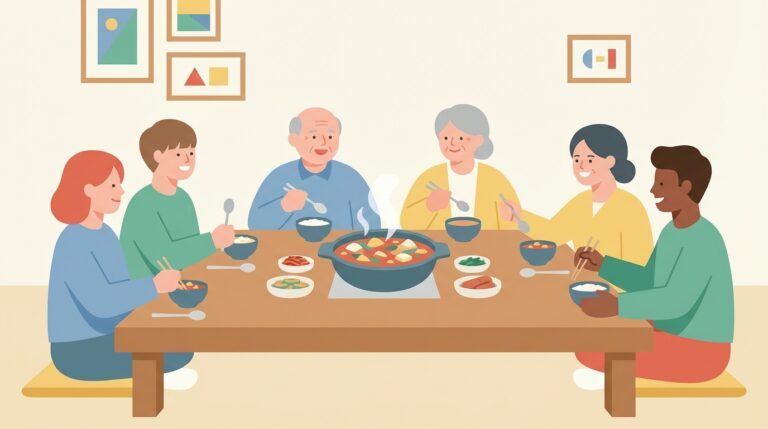
Imagine a classic K-Drama dinner scene. The table is packed with side dishes, a warm stew is bubbling in the center, and the matriarch places a piece of fish on the protagonist’s spoon. The subtitles might just say, “Eat up, family.” But in Korean, she doesn’t use the word Gajok (가족, family). She uses Sikgu (식구)—literally, “mouths that eat together.”
In South Korea, a society historically deeply rooted in Hyeol-yeon (혈연, bloodlines), the definition of family is rapidly evolving. Today, we are seeing more public conversations about adoption (입양) and foster families (위탁 가정). However, navigating these conversations requires high-level linguistic tact and profound cultural Nunchi (눈치).
If you’re living in Korea, working here, or simply interacting with Koreans at a C1 level, you can’t just rely on dictionary definitions. You need to know the words that carry warmth, the phrases that avoid unintentional hurt, and the shifting social paradigms behind them. This guide is crafted from real questions asked by advanced learners and expat families navigating the Korean social landscape.
Phase 2: Core Expressions Deep Dive
At the C1 level, we move beyond basic vocabulary and dive into expressions that carry heavy cultural weight.
1. 가슴으로 낳은 아이
- Pronunciation: [gaseumeuro na-eun a-i] (Think of the ‘eu’ like the disgusted sound you make when stepping in gum, and let the syllables flow smoothly into one another.)
- Meaning: Literal: “A child born from the heart.” / Real Nuance: “My adopted child.”
- K-Culture Moment: You’ll often hear this phrase in Korean documentaries or heartwarming talk shows when adoptive parents introduce their children. It was popularized as a way to emphasize that emotional bonds are just as profound as biological ones.
- Editor’s Insight: While beautiful, some modern adoptive parents find this phrase a bit cliché or overly dramatic. However, older generations use it as the ultimate expression of acceptance. It’s a poetic phrase you must recognize, even if you choose to simply say “우리 아이” (my child) in daily life.
- Situation Spectrum:
- Casual with close friends: ✅ (If opening up emotionally)
- Public speaking/Interviews: ✅
- Everyday casual introductions: ⚠️ (A bit too heavy for a quick intro at a playground)
- 🤔 Think About It: Why did Korean society feel the need to create a poetic metaphor for adoption instead of just using the legal term? How does this reflect the historical stigma surrounding non-biological children?
2. 공개 입양
- Pronunciation: [gong-gae ibyang]
- Meaning: Literal & Real: “Open adoption.”
- K-Culture Moment: In the past, many K-Dramas featured “birth secrets” (출생의 비밀) where a child suddenly discovers they were adopted. This reflected the era of Bimil Ibyang (비밀 입양, secret adoption). Today, celebrity couples and advocates champion Gong-gae Ibyang, publicly celebrating adoption to break the stigma.
- Editor’s Insight: If an acquaintance mentions they are doing “공개 입양,” it means they are raising their child with full knowledge of their adoption story and are open about it with their community. Your reaction should be warm and supportive, not shocked.
- Situation Spectrum:
- Close friends: ✅
- Colleagues (Semi-formal): ✅
- Strangers: 🚫 (Don’t pry into their private choices)
- 🤔 Think About It: The shift from ‘secret’ to ‘open’ adoption represents a massive cultural earthquake in Korea. How does the vocabulary we use shape societal acceptance?
3. 위탁 가정
- Pronunciation: [witak gajeong]
- Meaning: Literal & Real: “Foster family” or “Foster care.”
- K-Culture Moment: Unlike adoption, foster care is a relatively newer concept in the public consciousness of Korea. You might see campaigns on the subway or in neighborhood centers (주민센터) looking for Witak Bumo (위탁 부모, foster parents).
- Editor’s Insight: It’s crucial not to confuse this with adoption. If someone is a foster parent, recognize their dedication. They are providing a temporary, loving home.
- Situation Spectrum:
- All situations: ✅ (It is the standard, respectful term)
- 🤔 Think About It: In a society that highly values permanence and blood ties, how might the concept of temporary care challenge traditional Korean family values?
Phase 3: Textbook vs. Real Korean
Let’s look at how C1 learners can sound more like empathetic locals and less like translated textbooks.
[Situation 1: Explaining your family structure]
* 📖 Textbook Korean: 우리는 입양 가족입니다. (We are an adoptive family.)
* 🗣️ Real Korean: 저희는 공개 입양을 했어요. / 새 식구를 맞이했어요. (We did an open adoption. / We welcomed a new family member.)
* 💡 Why the difference?: The textbook version sounds clinical. “새 식구를 맞이하다” sounds warm, celebratory, and focuses on the addition of a loved one.
[Situation 2: Asking about the child’s origins (Tread Carefully!)]
* 📖 Textbook Korean: 진짜 부모님은 어디 계신가요? (Where are the real parents? – Rude!)
* 🗣️ Real Korean: 낳아주신 부모님 / 친생부모님 (Birth parents / Biological parents)
* 💡 Why the difference?: NEVER use “진짜” (real) or “가짜” (fake) when discussing adoptive/foster families. It invalidates their bond. Use “친생부모” (biological parents) if the legal/medical distinction is absolutely necessary, but generally, it’s none of your business!
Bottom Note: At the C1 level, true fluency is about empathy. Your vocabulary choices in these situations show your emotional intelligence (EQ) in Korean.
Phase 4: Cultural Context — K-Culture Deep Dive
4-1. Non-verbal Elements & Nunchi
When discussing non-traditional family structures in Korea, Nunchi (눈치, reading the room) is your best friend.
* The Tone: Keep your voice warm and steady. Avoid overly dramatic reactions of pity (e.g., “오모나, 어떡해!” – Oh my, what a shame!). Pity is the last thing adoptive or foster families want.
* The Gaze: Smile warmly. If a parent introduces their adopted child, greet the child exactly as you would any other child. Normalcy is the highest form of respect.
4-2. K-Culture Connections
The K-Drama Evolution:
If you’ve watched over 200 K-Dramas like I have, you’ve noticed a shift. Twenty years ago, adoption was a tragic plot device—the “evil stepmother” or the “abandoned child seeking revenge.” Today, dramas like Our Blues or Reply 1988 redefine family. They heavily lean into the concept of Sikgu (식구)—people who share meals together.
K-Food & Identity:
Why Sikgu? In Korea, eating together isn’t just sustenance; it’s the ultimate bonding ritual. You ask “밥 먹었어?” (Did you eat?) to say “How are you?” When an adoptive family or foster family sits down to share a jjigae (stew), sharing from the same pot, the biological differences dissolve. They are Sikgu. If you want to honor someone’s chosen family, acknowledge them as Sikgu.
Phase 5: Real-life Roleplay Scenario
Setting: Saturday afternoon. A bright, bustling kid-friendly cafe in Yeonnam-dong. You are catching up with Ji-yoon, a Korean friend you haven’t seen in two years.
Characters:
* YOU: An expat working in Seoul, fluent enough to navigate deep conversations.
* Ji-yoon (34): Your warm-hearted Korean friend.
Dialogue:
Ji-yoon: 진짜 오랜만이다! 그동안 잘 지냈어?
(Jinjja oraenmanida! Geudong-an jal jinaesseo?)
[It’s been so long! Have you been well?]
YOU: 응, 나야 뭐 늘 똑같지. 근데 너 좋은 소식 있다며? SNS 보니까 웬 꼬마랑 같이 있더라!
(Eung, naya mwo neul ttokgatji. Geunde neo joeun sosik itdame? SNS bonikka wen kkomarang gachi itdeora!)
[Yeah, same old for me. But I heard you have good news? I saw you with a little kid on social media!]
Ji-yoon: 아, 봤구나! 응… 사실 우리 부부, 최근에 위탁 가정이 되기로 했어.
(A, bwatguna! Eung… sasil uri bubu, choegeune witak gajeong-i doegiro haesseo.)
[Ah, you saw! Yeah… actually, my husband and I recently became a foster family.]
YOU: 우와, 정말?
(Uwa, jeongmal?)
[Wow, really?]
Ji-yoon: 응, 아직은 서툰 초보 엄마 아빠지만, 너무 행복해.
(Eung, ajigeun seotun chobo eomma appajiman, neomu haengbokhae.)
[Yeah, we’re still clumsy beginner parents, but we’re so happy.]
🔀 Your Turn! How do you respond?
* A) “근데 나중에 친부모한테 돌아가면 너무 슬프지 않을까?” (But won’t it be too sad if they go back to their birth parents later?)
* B) “진짜 멋진 결정이다! 육아 동지 필요하면 언제든 불러!” (What a wonderful decision! Call me anytime you need a parenting comrade!)
* C) “애기가 친부모를 닮았어, 아님 너희 부부를 닮았어?” (Does the baby look like the birth parents or you guys?)✅ Best Choice: B — It focuses on her new role as a parent and offers practical, warm support without prying into the sensitive mechanics of foster care.
⚠️ Analysis of A & C: Choice A is a valid fear but inappropriate to bring up as a first reaction (it kills the joy). Choice C is highly insensitive and misses the point of fostering completely.
(Continuing with Option B)
YOU: 진짜 멋진 결정이다! 육아 동지 필요하면 언제든 불러. 내가 키즈카페는 꽉 잡고 있잖아!
(Jinjja meotjin gyeoljeong-ida! Yuga dongji piryohamyeon eonjedeun bulleo. Naega kijeukapeneun kkwak japgo itjana!)
[What a wonderful decision! Call me anytime you need a parenting comrade. You know I’m an expert on kids’ cafes!]
Ji-yoon: (Laughs) 고마워. 진짜 든든하다. 나중에 우리 식구 다 같이 밥 한 번 먹자!
(Gomawo. Jinjja deundeunhada. Najung-e uri sikgu da gachi bap han beon meokja!)
[Thank you. That’s so reassuring. Let’s all have a meal together as a family later!]
Phase 6: 10-Second Shadowing Drill
Let’s practice a beautiful, C1-level phrase you can use when talking about diverse families. Focus on the intonation and pauses!
😊 가족의 형태는 / 달라도 // 우리는 / 사랑하는 식구예요.
(gajogui hyeongtaeneun / dallado // urineun / saranghaneun sikguyeyo.)
[Even if the shape of our family is different, we are a family that loves each other (shares meals).]
Pro-tip: Pause slightly at the double slashes (//) to give the listener time to absorb the meaning. Keep your tone warm and bright!
Phase 7: K-Culture Mini Dictionary
| 한국어 | Romanization | English | Cultural Context |
|---|---|---|---|
| 혈연 | hyeol-yeon | Blood ties | Historically the most important factor in Korean family registries (호적). |
| 식구 | sikgu | Family (Meal-sharers) | A warmer, more inclusive term for family, emphasizing living and eating together. |
| 친생부모 | chinsaengbumo | Biological parents | The respectful, legal term used instead of “진짜 부모” (real parents). |
| 편견 | pyeongyeon | Prejudice | What advocates for open adoption are fighting against in society. |
| 입양특례법 | ibyangteungnyeobeop | Special Adoption Act | Laws governing adoption, ensuring child welfare over secretive practices. |
Phase 8: Traveler (and Expat) Survival Kit
Even if you’re just visiting Korea, understanding family dynamics helps. If you are an expat with an adopted child, or visiting family, here are survival tips for navigating public spaces and administrative offices (like the 주민센터).
🆘 Survival Phrases for Expats/Travelers
* 🇰🇷 “가족관계증명서 발급하러 왔는데요.” (gajokgwangyejeungmyeongseo balgeuphareo wanneundeyo.)
* 🗣️ Meaning: “I’m here to issue a family relations certificate.”
* 📍 Where to use: Community center (주민센터) or District office (구청).
* 💡 Pro Tip: Korea relies heavily on paperwork to prove family ties. If you have a non-traditional family structure, carrying this document (or having a digital copy on your phone) saves a lot of explaining at hospitals or immigration.📌 Editor’s Note on Social Boundaries
* Curious Elders: Older Koreans (아줌마, 할머니) on the subway might ask, “엄마 안 닮았네?” (They don’t look like mom?). It’s usually harmless curiosity, not malice. A polite smile and “네, 저희 식구예요” (Yes, they are my family) is enough to gracefully end the inquiry.
Phase 9: Critical Thinking Corner — “한 발 더 깊이”
🧠 Think Deeper: Media vs. Reality
Historically, Korean media has done a massive disservice to adopted children. Dramas often portrayed adoptees as tragic figures searching for their “true” identity, reinforcing the prejudice (편견) that blood is the only valid bond. However, reality is shifting faster than the media. Today, grassroots campaigns by adoptive parents are fighting to normalize open adoption (공개 입양) and celebrate diverse family structures. When learning Korean, it is vital to recognize that the dramatic tropes we see on TV do not reflect the modern, progressive conversations happening in actual Korean living rooms.
💬 Your Turn: How is adoption portrayed in the media of your home country? Is it similar to the K-Drama tropes, or is it normalized? Share your thoughts in the comments!
Phase 10: FAQ & Avoiding Mistakes
Q: Someone told me my adopted friend is “주워온 자식” (a picked-up child). What does this mean?
A: This is an outdated, highly offensive term historically used to tease children or refer to orphans. If you hear this, recognize it as a major red flag of ignorance. Never use it.
Q: Can I ask “친부모는 한국인이에요?” (Are the biological parents Korean?)
A: While technically polite in grammar, it’s generally intrusive. Wait for the parents to share their child’s background story on their own terms.
❌ Common Mistake #1: Calling foster parents “가짜 엄마/아빠” (Fake mom/dad) or “임시 부모” (Temporary parents).
✅ Do This Instead: Always use “위탁 부모님” (Foster parents) and treat them with the exact same respect as any other parents.
Phase 11: Summary & Action Items
- One-Liner Summary: In modern Korean, honoring adoptive and foster families means moving beyond bloodlines (혈연) and embracing the warmth of shared lives (식구).
Action Mission 3-Steps:
* 🥉 Bronze (Solo): Read the “10-Second Shadowing Drill” out loud 3 times, focusing on an empathetic, warm tone.
* 🥈 Silver (Online): Write a short journal entry in Korean about what the word Sikgu (식구) means to you.
* 🥇 Gold (Real World): The next time you dine with close friends or chosen family in Korea, toast to them by saying, “우리는 식구잖아!” (We are family!).
🎬 K-Culture Mission:
Watch an episode of Our Blues (우리들의 블루스) or Reply 1988 (응답하라 1988) and spot the moments where characters who are not blood-related eat together and treat each other as Sikgu.
Phase 12: Quiz — Interactive Challenge
1. Situational Judgment: Your Korean coworker tells you they are preparing to become a Witak Gajeong (위탁 가정). What is the best response?
* A) “왜 입양 안 하고 위탁을 해요?” (Why foster instead of adopt?)
* B) “정말 뜻깊은 결정이네요. 응원할게요!” (That’s a very meaningful decision. I’ll support you!)
* C) “애기가 친부모 보고 싶어 하면 어떡해요?” (What if the baby misses their birth parents?)
2. Fill in the Blank:
한국에서는 피가 섞이지 않아도 밥을 같이 먹고 살면 보통 ‘____'(이)라고 부릅니다.
(In Korea, even if you don’t share blood, if you live and eat together, you are usually called ‘____’.)
3. True or False — K-Culture Edition:
Older Korean dramas perfectly reflect how modern Korean society views adoption today. (T/F)
(Answers below – don’t peek!)
Click to reveal answers
1. B – It shows high emotional intelligence and support without prying.
2. 식구 (Sikgu)
3. False – Media often lags behind reality. Modern Korea is much more accepting of open adoption than old dramas suggest.
Frequently Asked Questions (FAQ)
Q: What does "가슴으로 낳은 아이" mean in Korean and how do you pronounce it?
A: In Korean, "가슴으로 낳은 아이" is pronounced [gaseumeuro na-eun a-i] and means: Literal: "A child born from the heart." / Real Nuance: "My adopted child."
Q: What does "공개 입양" mean in Korean and how do you pronounce it?
A: In Korean, "공개 입양" is pronounced [gong-gae ibyang] and means: Literal & Real: "Open adoption."
Q: What does "위탁 가정" mean in Korean and how do you pronounce it?
A: In Korean, "위탁 가정" is pronounced [witak gajeong] and means: Literal & Real: "Foster family" or "Foster care."







