

Phase 1: Empathy (The K-Culture Cold Open)
Hello! This is your Daily Hangul Editor.
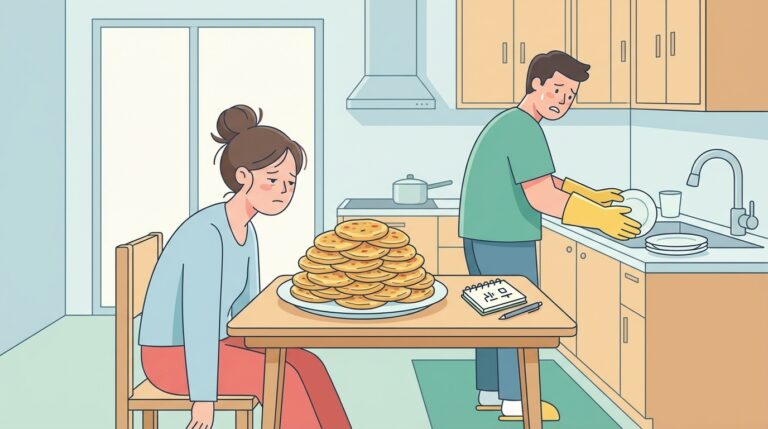
Picture this classic K-Drama scene: It’s the evening after the Chuseok holiday. A married couple is in the car, driving back to their apartment in Seoul. The silence is deafening. The husband nervously grips the steering wheel, glancing at his wife through the rearview mirror. He clears his throat and carefully asks, “Yeobo… are you okay?” She stares out the window and lets out a long, heavy sigh.
Why is she mad? Because for the last 48 hours, while he was happily eating fruit and chatting with his relatives in the living room, she was sitting on the kitchen floor frying an endless mountain of jeon (Korean savory pancakes) and dealing with her mother-in-law’s nagging.
Welcome to the intense reality of ‘Holiday Syndrome’ (명절 증후군).
If you are at a C2 level in Korean, you already know how to say “Happy Chuseok.” But to truly understand Korean society, gender dynamics, and the juicy gossip you hear at cafes post-holidays, you need to understand the cultural battlefield of holiday chores and the husband’s crucial role in it. Today, we are diving deep into the expressions real Koreans use when the holiday honeymoon is over.
Phase 2: Core Expressions Deep Dive
1. 명절 증후군 (Holiday Syndrome)
- Pronunciation: [myeongjeol jeunghugun] (sounds like myung-jull jeung-hoo-goon)
- Meaning: Literal: Holiday Syndrome. / Real nuance: The intense physical fatigue and psychological stress experienced (mostly by women, but increasingly by both genders) before, during, and after traditional holidays due to ancestral rites, massive food prep, and in-law conflicts.
- K-Culture Moment: Right after Lunar New Year or Chuseok, every morning talk show and news broadcast in Korea features doctors discussing how to relieve “Holiday Syndrome” through stretching and couples counseling.
- Editor’s Insight: This isn’t just a slang word; it’s a recognized social phenomenon. Using this word shows you deeply understand the weight of Korean patriarchal traditions and modern growing pains.
- Situation Spectrum:
- Casual with friends: ✅
- Semi-formal (Coworkers): ✅ (Great small talk post-holidays)
- Formal (Elders/In-laws): 🚫 (Do NOT say this to your mother-in-law!)
- 🤔 Think About It: Why does a festive holiday result in a “syndrome”? What happens when a country’s rapid modernization clashes with its deeply rooted Confucian traditions?
2. 눈치껏 하다 (To act with tact / To read the room)
- Pronunciation: [nunchikkeot hada] (sounds like noon-chee-kkut ha-da)
- Meaning: Literal: To do something to the extent of your nunchi. / Real nuance: To proactively assess the situation and do what needs to be done without being explicitly told.
- K-Culture Moment: The wife is aggressively scrubbing pots in the sink. The mother-in-law is lecturing her. A smart husband will 눈치껏 step in, put on rubber gloves, and say, “Mom, let me wash these, my wife’s wrists hurt!”
- Editor’s Insight: The suffix ~껏 means “to the utmost limit of.” A husband who lacks nunchi during the holidays is the #1 cause of marital fights.
- Situation Spectrum:
- Casual: ✅
- Semi-formal: ✅
- Formal: ⚠️ (Use carefully depending on context)
- 🤔 Think About It: Does your language have a single word for “figuring out what I want you to do without me having to tell you, and doing it perfectly”?
3. 손 하나 까딱 안 하다 (To not lift a single finger)
- Pronunciation: [son hana kkatttak an hada]
- Meaning: Literal: To not move a single finger. / Real nuance: To be completely useless and lazy while everyone else is working hard.
- K-Culture Moment: Walk into any Starbucks in Seoul the week after a holiday. You will hear groups of married women (아줌마) venting: “Can you believe my husband? He didn’t lift a single finger all weekend!”
- Editor’s Insight: 까딱 is a mimetic word (의태어) representing a very small, slight nodding or moving motion.
- Situation Spectrum:
- Casual: ✅
- Semi-formal: ⚠️
- Formal: 🚫
- 🤔 Think About It: How does the use of sound/movement words (ideophones) in Korean make complaints sound more vivid and dramatic?
Phase 3: Textbook vs. Real Korean
At the C2 level, we move past polite requests into the realm of passive-aggressiveness and high-context venting.
[Scenario 1: Asking the husband to help with holiday chores]
* 📖 Textbook Korean: 여보, 설거지 좀 도와줄래요? (Honey, can you help with the dishes?)
* 🗣️ Real Korean: 당신 눈치껏 좀 움직이지? (Can you move with a little bit of nunchi?)
* 💡 Why the difference?: In Korean marital dynamics, explicitly asking means you’ve already failed. The expectation is that the partner should read the atmosphere and act preemptively.
[Scenario 2: Complaining about a lazy spouse to a friend]
* 📖 Textbook Korean: 제 남편은 집안일을 전혀 안 해요. (My husband doesn’t do any housework at all.)
* 🗣️ Real Korean: 우리 남편은 아주 상전이야, 상전. 손 하나 까딱 안 해. (My husband acts like a royal boss. He doesn’t lift a finger.)
* 💡 Why the difference?: 상전 (Sangjeon) historically means a master or lord. Sardonically calling a husband 상전 perfectly captures the patriarchal resentment.
[Scenario 3: The husband bragging about doing the bare minimum]
* 📖 Textbook Korean: 제가 어제 요리를 도왔습니다. (I helped cook yesterday.)
* 🗣️ Real Korean: 나 어제 전 부치면서 와이프한테 생색 좀 냈잖아~ (I totally showed off/took credit to my wife while frying pancakes yesterday~)
* 💡 Why the difference?: 생색내다 (to take credit for doing something, making a big deal out of it) is a highly advanced, incredibly common concept. Husbands often do one chore and expect endless praise, which is a major point of comedy and frustration in Korea.
Phase 4: Cultural Context — K-Culture Deep Dive
4-1. Non-Verbal Cues: The Heavy Artillery
Language is only 50% of the battle. If a Korean wife says “아니야, 내가 할게” (No, I’ll do it) while sighing deeply (한숨 푹 쉬기) and aggressively clinking the plates together, she absolutely does not mean “I’ll do it.” She means, “If you don’t take this sponge from my hand right now, you are a dead man.” This is the peak of high-context nunchi culture applied to domestic life.
4-2. The K-Drama Trope: The “Si-World” (시월드) Survival
If you’ve watched dramas like “No, Thank You” (며느라기), you’ve seen this exact unit in action. Si-world (시월드) is a modern slang combining “Si” (from 시댁 – husband’s family) and “World,” referring to the intimidating territory of the in-laws.
In these dramas, the husband’s role as a “Shield” (방패막이) is a massive plot point. A “good” male lead doesn’t just wash the dishes; he acts as a shield when his mother criticizes his wife’s cooking.
Critical Viewpoint: While K-Dramas are slowly starting to portray husbands taking an equal share of the labor (reflecting modern MZ generation values), many shows still frame the husband doing chores as him “helping” (도와주다) the wife, implying the chores are still inherently her responsibility.
Phase 5: Real-Life Roleplay Scenario
Setting: Tuesday afternoon, the day after the Chuseok holiday ends. You are at a trendy cafe in Yeonnam-dong with two married Korean friends, Ji-young and Min-su. Ji-young looks exhausted, sipping her iced Americano like it’s a survival potion.
Characters:
– YOU: A foreign expat working in Korea, highly fluent, observant.
– Ji-young (34): Your female friend, married for 3 years. Just survived Si-world.
– Min-su (34): Your male friend, newly married, trying to be a “modern” husband.
The Dialogue:
Ji-young: 하아… 진짜 명절 증후군 때문에 온몸이 다 쑤신다. ☕
(Haa… jinjja myeongjeol jeunghugun ttaemune onmomi da ssusinda.)
[Sigh… my whole body aches because of Holiday Syndrome.]
Min-su: 왜? 시어머니가 또 잔소리하셨어?
(Wae? Sieomeoniga tto jansorihasyeosseo?)
[Why? Did your mother-in-law nag you again?]
Ji-young: 잔소리? 말도 마. 나 혼자 부엌에서 전 부치고 있는데, 우리 남편은 거실에서 누워서 TV만 보잖아. 진짜 속 터져서!
(Jansori? Maldo ma. Na honja bueokeseo jeon buchigo inneunde, uri nampyeoneun geosireseo nuwoseo TV-man bojana. Jinjja sok teojyeoseo!)
[Nagging? Don’t even get me started. I was frying pancakes alone in the kitchen, and my husband was just lying in the living room watching TV. I was so frustrated!]
(🎭 Stage Direction: Ji-young aggressively stabs her iced coffee with her straw.)
🔀 Your Turn! How do you respond to comfort Ji-young?
– A) “아휴, 많이 힘들었겠다. 남편이 좀 피곤했나 보네.” (Oh, you must have had a hard time. I guess your husband was tired.)
– B) “대박… 남편분이 손 하나 까딱 안 했어? 눈치가 너무 없네!” (Wow… your husband didn’t lift a finger? He has zero nunchi!)
– C) “한국 전통문화니까 어쩔 수 없지 뭐.” (Well, it’s Korean traditional culture, so it can’t be helped.)✅ Best Choice: B — Reason: In Korea, when a friend vents about their spouse or in-laws, your job is absolute, unconditional solidarity. Criticizing the husband’s lack of nunchi validates her feelings perfectly.
⚠️ Choice A & C Analysis: Trying to logically defend the husband (A) or blaming tradition (C) will make Ji-young feel alienated. Empathy first, logic second!
YOU: 대박… 남편분이 손 하나 까딱 안 했어? 눈치가 너무 없네!
(Daebak… nampyeonbuni son hana kkatttak an haesseo? Nunchiga neomu eomne!)
[Wow… your husband didn’t lift a finger? He has zero nunchi!]
Ji-young: 내 말이!! 자기가 중간에서 눈치껏 방패막이를 해줘야 할 거 아냐!
(Nae mari!! Jagiga jungganeseo nunchikkeot bangpaemagireul haejwoya hal geo anya!)
[That’s what I’m saying! He should act as a shield with some tact in the middle!]
Min-su: 야, 나는 이번에 눈치껏 설거지 다우팅(전담)했어. 와이프한테 칭찬받았잖아.
(Ya, naneun ibeone nunchikkeot seolgeoji dautinghaesseo. Waipeuhante chingchanbadatjana.)
[Hey, I tactfully took charge of all the dishwashing this time. I got complimented by my wife.]
Ji-young: 칭찬은 무슨! 당연히 해야 할 일을 해놓고 생색내지 마라.
(Chingchaneun museun! Dangyeonhi haeya hal ireul haenoko saengsaengnaeji mara.)
[Compliment, my foot! Don’t take credit for doing something you’re obviously supposed to do.]
Phase 6: 10-Second Shadowing Drill
Practice the art of the frustrated Korean sigh. Read this out loud, focusing on the pauses!
😤 아휴, / 이번 명절에는 / 남편이 눈치껏 좀 / 도와줬으면 좋겠네.
(Ahyu, / ibeon myeongjeoreneun / nampyeoni nunchikkeot jom / dowajwosseumyeon joketne.)
Vibe Check: Start with a deep sigh (아휴). Emphasize 눈치껏 (tactfully) to show your true desire.
Phase 7: K-Culture Mini Dictionary
| 한국어 | Romanization | English | Contextual Meaning |
|---|---|---|---|
| 시월드 | si-woldeu | Si-world (In-law world) | The husband’s family territory, often perceived as an intimidating or stressful place for the wife. |
| 전 부치다 | jeon buchida | Frying savory pancakes | The quintessential, back-breaking holiday chore. Squatting on the floor for hours flipping greasy food. |
| 방패막이 | bangpaemagi | Shield / Buffer | A spouse’s duty to protect their partner from the nagging or unfair demands of the in-laws. |
| 생색내다 | saengsaengnaeda | To take/claim credit | Doing a small favor or chore and acting like you saved the world, demanding praise. |
Phase 8: Traveler’s Survival Kit (Holiday Visit Edition)
Are you visiting a Korean friend’s family or future in-laws during Chuseok or Seollal? Don’t just sit on the sofa like the husband we just talked about!
🆘 Survival Expressions for Visiting a Korean Home
– 🇰🇷 “제가 뭐 도와드릴 일 없을까요?” (jega mwo dowadeuril il eopseulkkayo?)
– 🗣️ Meaning: Is there anything I can help with?
– 📍 When to use: As soon as you see people bustling in the kitchen.
– 💡 Pro Tip: They will almost 100% say “No, no, go sit down!” (아이고, 앉아 있어요). In Korea, you must politely insist at least twice before actually sitting down. Bring the empty plates to the sink to show great nunchi!📌 Editor’s Note
– Gifts: Never show up empty-handed during holidays. A box of high-quality fruit (apples/pears), premium beef (Hanwoo), or red ginseng is standard.
– Praise the food: Loudly and frequently say “너무 맛있어요!” (It’s so delicious). Mothers-in-law live for this reaction.
Phase 9: Critical Thinking Corner — “One Step Deeper”
🧠 Think Deeper: Language & Power — Why “Help” is a Problematic Word
In Korean, the most common phrase husbands use regarding chores is “제가 집안일을 도와줍니다” (I help with the housework). Recently, Korean feminists and sociologists have heavily criticized this phrasing. Why? Because the word “도와주다” (to help) implies that the core responsibility belongs to the wife, and the husband is merely acting as a generous assistant. Modern couples are trying to shift the language to “집안일을 같이 나누다” (to share the housework). The transition from “helping” to “sharing” in the Korean lexicon is a direct reflection of a society actively renegotiating gender roles and power dynamics.💬 Your Turn: In your culture, how is the division of holiday labor handled? Do people use words like “help” or “share”? Let me know in the comments!
Phase 10: FAQ & Avoiding Misunderstandings
Q: After a long holiday weekend, can I ask my female coworkers “Did you have a good holiday?” (명절 잘 보내셨어요?)
Yes, but pay attention to their tone. If they sigh and say “네… 뭐…” (Yes… well…), it means they suffered from Holiday Syndrome. A great C2-level follow-up is: “명절 증후군 때문에 피곤하시죠? 커피 한잔 하세요.” (You must be tired from Holiday Syndrome, right? Have a coffee on me.)
Q: Can I use “손 하나 까딱 안 하다” to describe my boss?
Absolutely not. This phrase carries a strong sense of judgment and disrespect. Only use it for peers, yourself, or your spouse when venting to close friends.
❌ Common Mistake:
Saying “휴일이 길어서 좋으셨겠어요!” (It must have been nice because the holiday was long!) to a married Korean woman.
✅ Do This Instead:
Say “명절에 고생 많으셨죠?” (You worked hard during the holiday, didn’t you?). Recognizing their invisible labor will instantly make you their favorite person.
Phase 11: Summary & Action Items
One-Liner Summary: Surviving Korean holidays requires immense nunchi, and recognizing “Holiday Syndrome” is the key to deeply understanding Korean gender dynamics.
Action Mission:
– 🥉 Bronze (Solo): Say “명절 증후군” and “눈치껏 좀 해” out loud three times in front of a mirror with maximum attitude.
– 🥈 Silver (Online): Write a comment below using the word “생색내다” (taking credit) about a time someone annoyed you.
– 🥇 Gold (Real Life): Next time a Korean friend complains about their spouse or partner, vigorously agree using “대박… 완전 상전이네!” (Wow… acting like a royal boss!).
K-Culture Mission 🍿: Watch an episode of the drama “No, Thank You” (며느라기) or “Queen of Tears” (where the gender roles of ancestral rites are reversed!) and spot the exact moment someone is lacking nunchi.
Phase 12: Quiz — Interactive Challenge
1. Situational Judgment: Your friend is complaining that her husband bought a cake but didn’t help clean the house before the in-laws arrived, and now he is bragging about the cake. What is the best word to describe his behavior?
a) 눈치껏 돕다
b) 생색내다
c) 방패막이
2. True or False – K-Culture Edition:
“If the mother-in-law tells the foreign guest ‘You don’t need to help, just sit,’ the guest should immediately go to the living room and watch TV.”
3. Fill in the Blank:
우리 남편은 집에서 왕이에요. ________ 하나 까딱 안 해요.
(My husband is a king at home. He doesn’t lift a single ________.)
🚨 Click here for the Answers!
1. b) 생색내다 – He did the bare minimum (buying a cake) and is taking too much credit for it!
2. False – It is polite to insist on helping at least one or two more times before accepting the offer to rest. Taking the first “no” literally shows a lack of nunchi.
3. 손 (Hand) – “손 하나 까딱 안 하다” means “not lifting a single finger.”
Frequently Asked Questions (FAQ)
Q: What does "명절 증후군 (Holiday Syndrome)" mean in Korean and how do you pronounce it?
A: In Korean, "명절 증후군 (Holiday Syndrome)" is pronounced [myeongjeol jeunghugun] and means: Literal: Holiday Syndrome. / Real nuance: The intense physical fatigue and psychological stress experienced (mostly by women, but increasingly by both genders) before, during, and after traditional holidays due to ancestral rites, massive food prep, and in-law conflicts.
Q: What does "눈치껏 하다 (To act with tact / To read the room)" mean in Korean and how do you pronounce it?
A: In Korean, "눈치껏 하다 (To act with tact / To read the room)" is pronounced [nunchikkeot hada] and means: Literal: To do something to the extent of your nunchi. / Real nuance: To proactively assess the situation and do what needs to be done without being explicitly told.
Q: What does "손 하나 까딱 안 하다 (To not lift a single finger)" mean in Korean and how do you pronounce it?
A: In Korean, "손 하나 까딱 안 하다 (To not lift a single finger)" is pronounced [son hana kkatttak an hada] and means: Literal: To not move a single finger. / Real nuance: To be completely useless and lazy while everyone else is working hard.







