

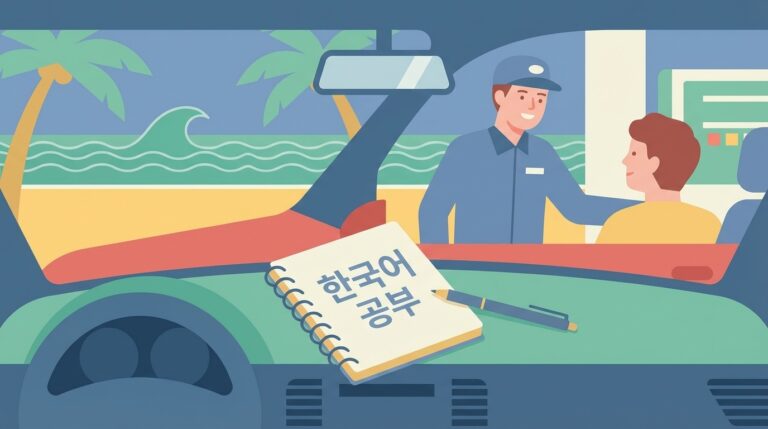
Phase 1: Empathy — The ‘Oh No’ Moment at the Pump
Hello! I’m your lead editor from Daily Hangul.
Picture this: You are driving along the breathtaking coastal roads of Jeju Island. The ocean breeze is blowing, your favorite K-Pop playlist is on, and you feel exactly like the main character in a K-Drama. But suddenly, the low fuel light blinks on your rental car. You pull into a nearby gas station, expecting to hop out and pump the gas yourself. Instead, an attendant rushes to your window, waiting for your order. Panic sets in. What do I say? How do I say ‘regular gas’?
If you’re an A2-level learner, you might know how to order an Iced Americano, but pumping gas? That’s a whole different survival skill. Unlike many Western countries where “self-service” is the only option, Korea still has a huge “Full Service” (직원 주유) culture.
Don’t worry! Today, we are going to learn exactly how to pull up to a Korean gas station like a local. This guide is built from the real panics of my foreign students who rented cars in Jeju. Let’s make sure you never put the wrong fuel in your car!
Phase 2: Core Phrases Deep Dive
Here are the absolute must-know phrases when the attendant approaches your window.
1. 가득이요! (Full, please!)
- Pronunciation: ga-deug-i-yo [Sounds like: gah-deug-ee-yo]
- Meaning: Literal (Full, please) vs Real (Fill the tank to the top, please)
- K-Culture Moment: In K-Dramas, when the rich chaebol heir pulls up in his sports car, he doesn’t calculate liters. He just casually rolls down the window, hands over his premium black card, and says, “가득이요.”
- Editor’s Insight: 가득 means “full.” By simply adding 이요 (the polite ending for nouns), you immediately sound polite but incredibly natural. It’s the most efficient way to get exactly what you need.
- Situation Spectrum:
- Casual (Friends): ✅ (Say “가득!”)
- Semi-formal (Gas station attendant): ✅
- Formal (Boss): 🚫 (You wouldn’t order gas from your boss!)
- 🤔 Think About It: Notice how we don’t use verbs here? In Korean, context is king. If you are at a gas station, they know you want gas. Why use a full sentence when a noun + 요 does the job perfectly?
2. 휘발유 / 경유 (Gasoline / Diesel)
- Pronunciation: hwi-bal-yu [hwee-bal-yoo] / gyeong-yu [gyung-yoo]
- Meaning: Gasoline (Petrol) / Diesel
- K-Culture Moment: Rental cars in Jeju are very frequently Diesel (경유) to save money. If you tell the attendant the wrong one, your vacation is over!
- Editor’s Insight: 휘발유 (Gasoline) pumps are usually Yellow or Red. 경유 (Diesel) pumps are almost always Green or Blue/Black.
- Situation Spectrum:
- Universal usage: ✅
- 🤔 Think About It: Did you know that the word “Oil” (오일) in Korea usually refers to cooking oil or engine oil, not gasoline?
3. 오만 원어치 넣어 주세요 (Put in 50,000 won worth, please)
- Pronunciation: o-man won-eo-chi neo-eo ju-se-yo
- Meaning: Put in 50,000 won worth of fuel.
- Editor’s Insight: If you don’t want a full tank before returning a rental car, you ask by the currency amount, not by liters! “[Amount] + 원어치” means “worth of [Amount].”
Phase 3: Textbook vs. Real Korean
Let’s see how the language changes from the textbook to the driver’s seat.
[Situation 1: Asking to fill up the tank]
* 📖 Textbook Korean: 제 자동차에 연료를 가득 채워 주시겠습니까? (Would you please fill my car with fuel?)
* 🗣️ Real Korean: 가득이요! (Full, please!)
* 💡 Why the difference?: Korea runs on 빨리빨리 (Bbali-bbali / Hurry-up) culture. Gas stations are busy, and drive-through interactions prioritize speed. Keep it short!
[Situation 2: Paying the attendant]
* 📖 Textbook Korean: 신용카드로 결제하겠습니다. (I will pay with a credit card.)
* 🗣️ Real Korean: (Just handing the card) 카드요. (Card.)
* 💡 Why the difference?: Cash is rarely used nowadays. Handing the card while saying “카드요” is perfectly polite and expected.
Phase 4: Cultural Context — K-Culture Deep Dive
4-1. Non-Verbal Nunchi (눈치) at the Pump
When the attendant approaches, roll down your window about halfway—you don’t need to roll it down all the way. When handing over your credit card, try to use two hands, or hold your right elbow with your left hand. Even in a 5-second interaction from a car window, this small gesture shows respect and instantly makes you a “polite foreigner.”
4-2. K-Travel Connection: The Jeju Road Trip
Driving in Korea, especially on Jeju Island, is a massive part of K-Travel. You’ll notice many gas stations have huge signs saying “셀프” (Self).
If you see “셀프”, you must pump it yourself. But if you don’t see it, it’s Full Service! Also, many rental cars in Korea run on LPG (Liquid Petroleum Gas). If you rent an LPG car, you cannot go to a regular gas station; you must find an LPG 충전소 (Charging Station).
Phase 5: Real-Life Roleplay Scenario
Setting: It’s 2 PM on a sunny day in Jeju. You are driving your rental Hyundai Avante. The gas tank is almost empty. You pull into a brightly lit GS Caltex station. An attendant in a uniform jogs up to your window.
Characters:
– YOU: A traveler trying not to mess up the rental car.
– Attendant (Ajussi): Fast-paced, friendly, wearing work gloves.
Dialogue:
Attendant: 어서 오세요! 얼마 넣어 드릴까요?
(eoseo oseyo! eolma neoeo deurilkkayo?)
[Welcome! How much should I put in?]
You: 안녕하세요. 휘발유 가득이요.
(annyeonghaseyo. hwibalyu gadeug-iyo.)
[Hello. Gasoline, full please.]
Attendant: 네, 휘발유 가득입니다. 결제는 카드로 하시겠어요?
(ne, hwibalyu gadeug-imnida. gyeoljeneun kadeuro hasigesseoyo?)
[Yes, gasoline full. Will you be paying by card?]
🔀 Your Turn! How do you respond and act?
– A) “카드요.” (While tossing the card onto the dashboard)
– B) “네, 카드요.” (While handing the card with two hands)
– C) “아니요, 달러 있어요?” (No, do you take dollars?)✅ Best Choice: B — Handing items with two hands (or supporting your arm) is a golden rule in Korea.
⚠️ Choice C Analysis: Gas stations in Korea do not accept foreign currency. Always use a credit card (Visa/Mastercard usually work) or Korean Won!
Attendant: (Swiping the card) 영수증 필요하세요?
(yeongsujeung piryohaseyo?)
[Do you need a receipt?]
You: 네, 주세요. 감사합니다!
(ne, juseyo. gamsahamnida!)
[Yes, please. Thank you!]
Phase 6: 10-Second Shadowing Drill
Practice this phrase before you roll down the window! Pay attention to the pauses.
😊 안녕하세요, / 휘발유 / 가득 / 넣어 주세요!
(an-nyeong-ha-se-yo, / hwi-bal-yu / ga-deuk / neo-eo ju-se-yo!)
“Hello, gasoline full please!”
Phase 7: K-Culture Mini Dictionary
| Korean | Romanization | English | Cultural Context |
|---|---|---|---|
| 셀프 주유소 | selpeu juyuso | Self-service gas station | Usually cheaper. The machine screen has an English language option! |
| 렌터카 | renteoka | Rental Car | The Konglish word for rental car. |
| 휴게소 | hyugeso | Highway Rest Area | Korean rest stops are famous for amazing street food. A must-visit after getting gas! |
| 영수증 | yeongsujeung | Receipt | Always ask for this if you are driving a rental car, just in case! |
Phase 8: Traveler’s Survival Kit
🆘 Survival Phrases for the Gas Station
– 🇰🇷 “영수증 버려 주세요.” (yeongsujeung beoryeo juseyo.)
– 🗣️ Meaning: “Please throw away the receipt.” (If you don’t need it).
– 🇰🇷 “셀프예요?” (selpeu-yeyo?)
– 🗣️ Meaning: “Is this self-service?”
– 🇰🇷 “화장실 어디예요?” (hwajangsil eodiyeyo?)
– 🗣️ Meaning: “Where is the restroom?” (Gas stations usually have free restrooms!)📌 Editor’s Travel Note
– Navigating: Google Maps doesn’t work well for driving in Korea. Download Naver Map or KakaoMap for your road trip.
– Tipping: Do I tip the gas station attendant for full service? NO! Korea has absolutely no tipping culture. If you give them money, they will run after your car thinking you forgot your change!
Phase 9: Critical Thinking Corner — “한 발 더 깊이”
Korean in the Global Era (글로벌 시대의 한국어)
🧠 Think Deeper:
If you listen closely at a Korean gas station or repair shop, you’ll hear a lot of English. But it’s not the English you know—it’s “Konglish.” The steering wheel is a handle (핸들), the gas pedal is an axel (악셀), the rearview mirror is a room mirror (룸미러), and pumping gas yourself is just self (셀프). As Western car culture entered Korea, English terms were adopted but modified to fit Korean efficiency. It’s fascinating how language adapts to make things shorter and easier to pronounce for locals.💬 Your Turn: Does your native language borrow words from other languages for driving or cars? Share in the comments!
Phase 10: FAQ & Avoiding Mistakes
Q: “Can I just say ‘Gas’ instead of Hwibalyu?”
No! If you say “Gas” (가스), the attendant will think you mean LPG (Liquid Petroleum Gas). If you want standard gasoline, you must say 휘발유 (Hwibalyu) or “Gasoline” (가솔린).
Q: “What if I put the wrong fuel in my rental car?”
This is called 혼유 사고 (Wrong fuel accident) and it’s a nightmare. Your engine could be ruined. If you realize the mistake before starting the engine, DO NOT turn the car on. Call the rental company immediately.
❌ Common Mistake #1: Assuming all gas stations are self-service.
✅ How to fix it: Look for the word “셀프” (Self) on the big price sign. If it’s not there, wait in your car for the attendant!
Phase 11: Summary & Action Items
One-Liner Summary: When the attendant approaches, just say the fuel type and “가득이요” (Full, please) while politely handing over your card.
Action Mission 3 Steps:
– 🥉 Bronze (Solo): Look at your own car keys and practice saying “휘발유 가득이요!” out loud 3 times.
– 🥈 Silver (Online): Go to Google Street View, drop yourself somewhere in Jeju Island, find a gas station, and see if it’s “셀프” or not!
– 🥇 Gold (Real Life): Next time you rent a car in Korea, successfully navigate a Full-Service gas station without breaking a sweat.
K-Culture Mission:
Watch an episode of a K-Drama featuring a road trip (like Welcome to Samdal-ri or Our Blues). Notice how the characters interact at gas stations or rest stops!
Phase 12: Quiz — Interactive Challenge
1. Situational Judgment:
You pull up to a gas station. An attendant comes to your window. You want a full tank of standard gasoline. What is the most natural A2-level phrase?
– A) 제 자동차에 가스를 넣어주세요.
– B) 휘발유 가득이요.
– C) 경유 오만 원어치요.
(Answer: B. A is incorrect because “가스” means LPG. C means 50,000 won of Diesel.)
2. True or False – K-Culture Edition:
You should give the gas station attendant a small 1,000 won tip for pumping your gas.
(Answer: False! Korea is a strictly no-tipping culture. Just a polite “감사합니다” is the best tip!)
Frequently Asked Questions (FAQ)
Q: What does "가득이요! (Full, please!)" mean in Korean and how do you pronounce it?
A: In Korean, "가득이요! (Full, please!)" is pronounced [ga-deug-i-yo [Sounds like: gah-deug-ee-yo] and means: Literal (Full, please) vs Real (Fill the tank to the top, please)
Q: What does "휘발유 / 경유 (Gasoline / Diesel)" mean in Korean and how do you pronounce it?
A: In Korean, "휘발유 / 경유 (Gasoline / Diesel)" is pronounced [hwi-bal-yu [hwee-bal-yoo] and means: Gasoline (Petrol) / Diesel
Q: What does "오만 원어치 넣어 주세요 (Put in 50,000 won worth, please)" mean in Korean and how do you pronounce it?
A: In Korean, "오만 원어치 넣어 주세요 (Put in 50,000 won worth, please)" is pronounced [o-man won-eo-chi neo-eo ju-se-yo] and means: Put in 50,000 won worth of fuel.






