

Phase 1: Empathy (Immersive Open)
Hello! I’m your Daily Hangul Editor.
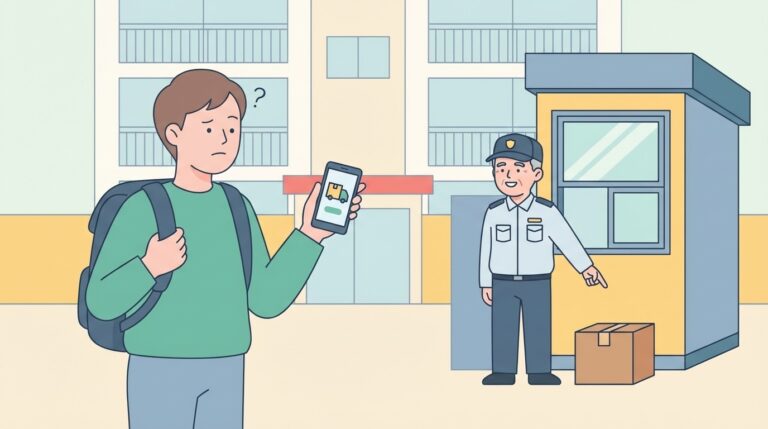
Imagine this: You’re watching a K-Drama, and the protagonist excitedly runs to their door, scoops up a Coupang box, and opens it with a bright smile. You want that feeling, too! You finally ordered that viral K-Beauty serum or a limited-edition K-Pop album. The delivery app sends you a notification: “배송 완료” (Delivery Complete). Your heart races. You open your front door… and nothing is there.
Panic sets in. Did someone steal it? Was it delivered to the wrong building? In Korea, delivery theft is incredibly rare (people will leave a $1,500 laptop on a cafe table but won’t touch your $10 package!). So, where did it go?
Nine times out of ten, it’s at the 경비실 (Gyeongbisil – Security Office). But walking up to the security guard (경비 아저씨) to explain a missing package can be terrifying. You don’t want to sound accusatory, but you really want your package! Today, we’re going to learn exactly how to handle this “missing delivery” crisis smoothly, politely, and like a true local.
(This guide is based on real panic moments experienced by our expat students in Seoul!)
Phase 2: Core Expressions Deep-Dive
Here are the lifesaver phrases you need when approaching the security office.
1. 택배가 안 와서요. (My package didn’t arrive, so…)
- Pronunciation: taekbae-ga an wa-seo-yo. [“wa” sounds like the beginning of “water”, “seo” sounds like the English word “saw” but shorter.]
- Meaning: Literal: The package didn’t come, so… / Real Nuance: I’m missing a package, could you help me?
- K-Culture Moment: Koreans love leaving sentences unfinished! By ending with ~서요 (-seoyo, meaning “because/so”), you are softening the blow. Instead of saying “Find my package!”, you are simply stating your situation and inviting the listener to help. It’s the verbal equivalent of a gentle nudge.
- Editor’s Insight: This phrase is perfect because it doesn’t blame anyone. You’re just stating a fact. It’s the best icebreaker when opening the security office door.
- Situation Spectrum:
- Close Friends (Casual): 🚫 (Too formal)
- Security Guard/Store Clerk (Semi-formal/Polite): ✅
- Formal Business: ⚠️ (A bit too casual for a board meeting)
- 🤔 Think About It: Why do Koreans avoid direct demands? How does leaving a sentence “hanging” build a sense of community problem-solving compared to your native language?
2. 혹시 제 택배 여기 있나요?
- Pronunciation: hoksi je taekbae yeogi innayo? [“hoksi” sounds like “hoke-shee”, “innayo” sounds like “in-nah-yo”]
- Meaning: Literal: By any chance, my package here? / Real Nuance: Did my package end up here by any chance?
- K-Culture Moment: 혹시 (Hoksi) is the magic word in Korea. It means “by any chance.” You will hear this in every K-Drama when a character cautiously asks a question. It immediately lowers the defenses of the person you are talking to.
- Editor’s Insight: The ending ~나요? (-nayo?) is a very soft, curious way to ask a question. It sounds much gentler than the standard “~아/어요?” ending.
- Situation Spectrum:
- Close Friends: ✅ (Without “yo”: 혹시 여기 있어?)
- Security Guard/Staff: ✅
- Senior Boss: ⚠️ (Use a higher honorific form for a boss)
- 🤔 Think About It: “Hoksi” acts as a verbal cushion. What is the equivalent “cushion” word in English when you have to bother someone who is working?
3. CCTV 확인 좀 할 수 있을까요?
- Pronunciation: ssisitibi hwagin jom hal su isseulkkayo? [“ssisitibi” is how Koreans pronounce CCTV. “jom” sounds like “johm”]
- Meaning: Literal: Could I do a little CCTV check? / Real Nuance: Could you please check the security cameras for me?
- K-Culture Moment: Korea is covered in CCTV. It’s why the country is so safe. If a package truly vanishes, checking the CCTV in the elevator or hallway is standard procedure. The guard will usually check it for you.
- Editor’s Insight: The word 좀 (jom) literally means “a little,” but functionally, it means “please.” It makes a heavy request (like checking video footage) feel small and manageable.
- Situation Spectrum:
- Close Friends: 🚫
- Security Guard/Police: ✅
- Boss/Seniors: ✅
- 🤔 Think About It: Why do Koreans use the word “a little” (좀) to mean “please”? Does minimizing the size of the favor make people more willing to say yes?
Phase 3: Textbook vs Real Korean
Let’s see how real people talk versus what your old textbooks might say.
[Telling them your package is missing]
* 📖 Textbook Korean: 제 소포가 분실되었습니다. (My parcel has been lost.)
* 🗣️ Real Korean: 택배가 안 보여서요. (taekbae-ga an boyeoseoyo / Lit. I can’t see my package.)
* 💡 Why the difference?: “분실되었습니다” sounds like a formal police report. “안 보여서요” is the natural, conversational way to say “I can’t find it.”
[Giving your apartment number]
* 📖 Textbook Korean: 저는 백일 동 이백삼 호에 삽니다. (I live in Building 101, Apartment 203.)
* 🗣️ Real Korean: 101동 203호인데요. (baek-il-dong i-baek-sam-ho-inde-yo / Lit. It’s 101-dong, 203-ho…)
* 💡 Why the difference?: Again, using “~인데요” (It is… so…) leaves the sentence open, expecting the guard to look up your information, rather than bluntly stating where you live.
Phase 4: Cultural Context — K-Culture Deep Dive
4-1. Non-verbal Nunchi (눈치)
Approaching the security guard requires a bit of Nunchi (reading the room). These guards are usually older gentlemen (어르신 – elders). When you approach the window, do a slight bow (목례, a polite head nod). If he hands you your package, always receive it with both hands and say “감사합니다!” (Thank you!). Never snatch it with one hand while looking at your phone.
4-2. The Secret Hiding Spots of Korean Delivery
Before you run to the security office, check the K-Apartment secret hiding spots! In Korea, if you aren’t home, the delivery driver (택배 기사님) might hide your box to keep the hallway neat.
1. 소화전 (Sohwajeon – Fire Hydrant box): The metal door in the hallway wall next to your apartment. Open it! Packages are often tucked inside.
2. 계단 (Gyedan – Stairs): Check half a flight of stairs up or down from your door.
3. 에어컨 실외기 (Air-con Outdoor Unit): If you live in a villa, it might be behind the AC unit outside.
The delivery app usually sends a photo of where they left it. Check the background of the photo carefully!
Phase 5: Real-Life Roleplay Scenario
Scenario A: The Security Office Encounter
- Setting: 7:30 PM. Your apartment complex’s tiny security office. It’s filled with monitors, and there’s a mountain of Coupang boxes in the corner.
- Characters:
- YOU: B1 Korean learner. Missing a box containing your favorite snacks from home.
- 경비 아저씨 (Security Guard – Mr. Kim): Mid-60s. Friendly, but a bit tired. Looks over his reading glasses at you.
YOU: 안녕하세요. 혹시 제 택배 여기 있나요?
(annyeonghaseyo. hoksi je taekbae yeogi innayo?)
[Hello. By any chance, is my package here?]
(🎭 Stage Direction: You bow slightly as you speak through the sliding window.)
아저씨: 몇 동 몇 호예요?
(myeot dong myeot ho-yeyo?)
[Which building and apartment number?]
YOU: 102동 304호인데요. 택배가 안 보여서요.
(baek-i-dong sam-baek-sa-ho-inde-yo. taekbae-ga an boyeoseoyo.)
[It’s building 102, room 304. I can’t see my package.]
아저씨: (Checking his logbook) 음… 304호는 오늘 맡겨진 거 없는데?
(eum… sam-baek-sa-ho-neun oneul matgyeojin geo eomneunde?)
[Hmm… Nothing was left for 304 today.]
YOU: 아, 진짜요? 배송 완료라고 문자가 왔거든요.
(a, jinjayo? baesong wallyo-rago munja-ga watgeodeunyo.)
[Ah, really? I got a text saying delivery is complete.]
아저씨: 사진 확인해 봤어요? 소화전 안에 넣었을 수도 있어.
(sajin hwagin-hae bwasseoyo? sohwajeon an-e neo-eosseul sudo isseo.)
[Did you check the photo? They might have put it inside the fire hydrant.]
🔀 Your Turn! How do you respond?
– A) “소화전이 뭐예요?” (What is a fire hydrant?)
– B) “네, 다 확인했는데 없어요. CCTV 확인 좀 할 수 있을까요?” (Yes, I checked everywhere but it’s not there. Could I check the CCTV?)
– C) “아저씨가 훔쳤어요?” (Did you steal it?)✅ Best Choice: B — It shows you’ve done your due diligence and politely asks for the next logical step.
⚠️ Choice A Analysis: Okay if you genuinely don’t know, but might delay the process.
🚫 Choice C Analysis: Never say this! You will insult him and ruin your relationship with the person who protects your building.
YOU: 네, 다 확인했는데 없어요. CCTV 확인 좀 할 수 있을까요?
아저씨: 알겠어요. 들어와 봐요. 같이 봅시다.
(algesseoyo. deureowa bwayo. gachi bopsida.)
[Understood. Come in. Let’s take a look together.]
Scenario B: The Hotel Concierge (Bonus)
If you are traveling and missing a package you ordered to your hotel:
YOU: 저기요, 제 이름으로 온 택배 있나요?
(jeogiyo, je ireum-euro on taekbae innayo?) – [Excuse me, is there a package that arrived under my name?]
Staff: 성함과 객실 번호가 어떻게 되십니까?
(seongham-gwa gaeksil beonho-ga eotteoke doesimnikka?) – [What is your name and room number?]
Phase 6: 10-Second Shadowing Drill
Practice this until it flows naturally. Pay attention to the pauses (/)!
🥺 아저씨, / 혹시 제 택배 / 여기 있나요?
(ajeossi, / hoksi je taekbae / yeogi innayo?)
(Tone: Slightly worried, very polite. Voice goes slightly up at the end!)
🙏 다 확인했는데 / 없어서요. / CCTV 확인 좀 / 할 수 있을까요?
(da hwaginhaenneunde / eopseoseoyo. / ssisitibi hwagin jom / hal su isseulkkayo?)
(Tone: Apologetic for asking a big favor, soft and pleading.)
Phase 7: K-Culture Mini Dictionary
| Korean | Romanization | English | Context |
|---|---|---|---|
| 택배 | taekbae | Delivery/Parcel | The lifeblood of modern Korea. Faster than you can imagine. |
| 경비실 | gyeongbisil | Security Office | Usually located at the entrance of an apartment complex. |
| 분실 | bunsil | Loss/Missing | Used in formal contexts (e.g., 분실물 센터 – Lost and Found). |
| 소화전 | sohwajeon | Fire Hydrant | In Korean apartments, the metal wall box used as a secret package drop. |
| 배송 완료 | baesong wallyo | Delivery Complete | The status you see on your app when the item arrives. |
| 동/호 | dong/ho | Building/Room No. | Korean addresses use Dong (Building) and Ho (Apartment Room). |
Phase 8: Traveler Survival Kit
Even if you don’t live in an apartment, missing items happen!
🆘 Survival Expression #1: Looking for lost items
– 🇰🇷 “혹시 분실물 들어온 거 있나요?” (hoksi bunsilmul deureoon geo innayo?)
– 🗣️ English: By any chance, has any lost item been turned in?
– 📍 Where to use: Subway station office, cafe counter, hotel front desk.
– 💡 Pro Tip: Korea has a very high return rate for lost wallets and phones. Always ask the nearest staff first!📌 Editor’s Travel Note
– CCTV Requests: By law, private businesses cannot show you CCTV footage directly due to privacy laws unless police are present. However, apartment guards can review it with you for building security purposes.
– Delivery to Hotels: Always ask the front desk before you order something online. Say: “이 주소로 택배 받아도 되나요?” (Can I receive a package at this address?).
Phase 9: Critical Thinking Corner — “A Step Deeper”
Language & Power: The Evolution of “Ajeossi”
For decades, Koreans comfortably called older male workers, like security guards or taxi drivers, 아저씨 (Ajeossi – middle-aged man). However, as society becomes more aware of the emotional labor and respect owed to service workers, there is a strong movement to change this. Today, younger Koreans prefer calling them 경비원님 (Gyeongbiwon-nim – Mr. Security Guard) or 기사님 (Gisa-nim – Mr. Driver) to show professional respect. While “Ajeossi” is still widely used and generally accepted by older generations, upgrading your vocabulary to “경비원님” shows a deep, nuanced understanding of modern Korean social shifts.
💬 Your Turn: How do you address service workers or security staff in your culture? Is there a specific title, or do you just say “Excuse me”? Let us know in the comments!
Phase 10: FAQ & Avoiding Mistakes
Q: Can I just say “CCTV 보여주세요” (Show me the CCTV)?
No. That is a direct command. It sounds like you are ordering a subordinate around. Always use “확인 좀 할 수 있을까요?” (Could I check…?).
Q: What if the guard says “나도 몰라요” (I don’t know either)?
Stay calm. Reply with “혹시 택배 기사님 연락처 알 수 있을까요?” (Could I get the delivery driver’s contact info?).
❌ Common Mistake #1: Calling the older guard “너” (You) or “당신” (You).
✅ Do this instead: Never use the word “You” in Korean when speaking to an elder. Omit the subject entirely or use their title (아저씨 / 경비원님).
Phase 11: Summary & Action Items
- One-Liner Summary: Soften your request with “혹시 (By any chance)” and “~서요 (because…)” to smoothly get help finding your missing package!
Action Mission 3 Steps:
– 🥉 Bronze (Solo): Stand in front of your mirror and practice looking slightly worried while saying “택배가 안 보여서요…” 3 times.
– 🥈 Silver (Online): Go to a Korean learning forum (like Reddit’s r/Korean) and write a short post about a time you lost something, using today’s vocabulary.
– 🥇 Gold (Real Life): Next time you receive a package, greet your building’s security guard and say “수고하십니다!” (Thank you for your hard work!).
K-Culture Mission: Open your favorite Korean delivery or food app (like Coupang or Baemin) and see if you can spot the words “배송 완료” (Delivery Complete) or “문 앞” (Front door) in the delivery options!
Phase 12: Quiz — Interactive Challenge
1. Situational Judgment: You checked everywhere, but the package is gone. You go to the guard. Which is the most polite and natural way to start the conversation?
– A) 내 상자 어딨어? (Where is my box?)
– B) 택배가 없어요. 찾아주세요. (The package is gone. Find it.)
– C) 혹시 제 택배 여기 있나요? (By any chance, is my package here?)
2. Fill in the Blank:
CCTV ( ) 좀 할 수 있을까요?
(Hint: The word for ‘check’ or ‘verify’)
3. True or False – K-Culture Edition:
In Korea, it is common for delivery drivers to hide your package inside the metal fire hydrant box in the hallway if you aren’t home.
Click to see answers!
1. C – Always start with “Hoksi” to be polite!
2. 확인 (hwagin)
3. True! It’s the most common secret hiding spot in Korean apartment buildings.
Frequently Asked Questions (FAQ)
Q: What does "택배가 안 와서요. (My package didn't arrive, so...)" mean in Korean and how do you pronounce it?
A: In Korean, "택배가 안 와서요. (My package didn't arrive, so...)" is pronounced [taekbae-ga an wa-seo-yo. ["wa" sounds like the beginning of "water", "seo" sounds like the English word "saw" but shorter.] and means: Literal: The package didn't come, so... / Real Nuance: I'm missing a package, could you help me?
Q: What does "혹시 제 택배 여기 있나요?" mean in Korean and how do you pronounce it?
A: In Korean, "혹시 제 택배 여기 있나요?" is pronounced [hoksi je taekbae yeogi innayo? ["hoksi" sounds like "hoke-shee", "innayo" sounds like "in-nah-yo"] and means: Literal: By any chance, my package here? / Real Nuance: Did my package end up here by any chance?
Q: What does "CCTV 확인 좀 할 수 있을까요?" mean in Korean and how do you pronounce it?
A: In Korean, "CCTV 확인 좀 할 수 있을까요?" is pronounced [ssisitibi hwagin jom hal su isseulkkayo? ["ssisitibi" is how Koreans pronounce CCTV. "jom" sounds like "johm"] and means: Literal: Could I do a little CCTV check? / Real Nuance: Could you please check the security cameras for me?







