

Phase 1: Empathy & The “K-Drama Boardroom” Cold Open
Hello! I’m your Daily Hangul lead editor.
Picture this: You are watching a tense K-Drama—maybe a corporate thriller like Misaeng or a revenge plot like Itaewon Class. The two rivals sit across from each other in a dimly lit, high-end Hanwoo (Korean beef) restaurant. They haven’t even touched the meat yet. The protagonist slightly bows, pours a glass of Soju with two hands, and says a single, seemingly polite sentence.
The subtitles read: “I see you’ve been busy lately.”
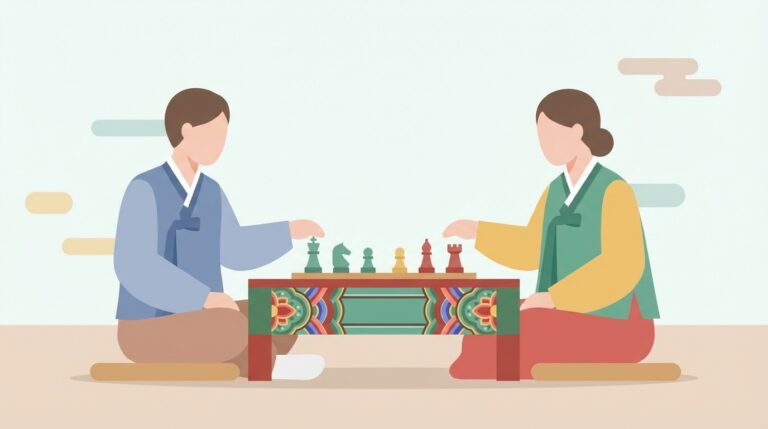
But the tension in the room explodes. Why? Because in Korean, conversations are rarely just exchanges of information; they are social chess. Every conversation is played on a complex board of hierarchy, age, and Nunchi (눈치). The opening words you choose—your “Opening Gambit”—dictate whether you will control the center of the board or be pushed onto the defensive.
As a C1 learner, you already know the grammar. You know how to say “Hello” and “Thank you.” But do you know how to politely disarm a superior? Do you know how to softly disagree without causing a loss of face (체면)? If you don’t master the strategic openings of the Korean language, you might unwittingly play a foolish move and lose your positional advantage before the conversation even begins.
This guide is based on real struggles from my advanced students who felt perfectly fluent on paper but felt “checkmated” in real Korean boardrooms and dinner tables. Let’s learn how to play the game.
Phase 2: Core Expressions — The “Chess Openings” of Korean
Here are three strategic opening moves you need to master.
1. 제가 잘 몰라서 그러는데… (The Réti Opening: The Probing Gambit)
- Pronunciation: [Jega jal mollaseo geureoneunde…] (The ‘ll’ in mol-la sounds like the soft tap in “million” but with your tongue flatter against the roof of your mouth).
- Meaning: Literal: “I’m saying this because I don’t know well…” / Real nuance: “I’m about to ask a sharp or critical question, but I’m softening the blow by playing the humble card.”
- K-Culture Moment: You’ll see this in office K-Dramas when a junior employee has found a fatal flaw in a senior’s project. They can’t just point it out aggressively. They use this phrase to protect the senior’s pride while delivering the checkmate.
- Editor’s Insight: This is pure conversational strategy. By lowering yourself (“I don’t know well”), you remove the aggression from your following statement. It’s the ultimate defensive-offensive move.
- Situation Spectrum:
- Close Friends (Casual): ⚠️ (Too formal, might sound sarcastic)
- Co-workers (Semi-formal): ✅ (Perfect for meetings)
- Boss/Elders (Formal): ✅ (Highly recommended)
- 🤔 Think About It: Why does Korean culture value Gyeomson (겸손 – modesty) so much that we must pretend not to know something just to ask a question? Does your native language have a “softening” strategy for criticism?
2. 말씀 낮추셔도 됩니다 (The Queen’s Gambit: Sacrificing Formality)
- Pronunciation: [Malsseum natchusyeodo doemnida] (The ‘tch’ is sharp, like catching a sneeze).
- Meaning: Literal: “You may lower your speech.” / Real nuance: “Please speak comfortably (use Banmal) to me; let’s be closer.”
- K-Culture Moment: The classic scene where a rigid, older mother-in-law finally accepts the protagonist and tells them this, signaling a shift from a cold, formal relationship to “family.”
- Editor’s Insight: You are giving the other person “permission” to drop honorifics. It’s a strategic sacrifice. You offer them higher status on the board in exchange for intimacy and a smoother relationship. Never use this to someone younger than you unless you want to sound incredibly arrogant.
- Situation Spectrum:
- Close Friends (Casual): 🚫 (You already use Banmal)
- Co-workers/Acquaintances older than you: ✅
- Boss/Elders (Formal): ✅ (Only if you are inviting them to be comfortable with you)
- 🤔 Think About It: In English, we might say “Please, call me John.” How is giving permission to use a first name different from giving permission to change the entire grammatical structure of the conversation?
3. 기분 나쁘게 듣지 마시고… (The Sicilian Defense: The Pre-emptive Strike)
- Pronunciation: [Gibun nappeuge deutji masigo…]
- Meaning: Literal: “Please don’t listen to this in a bad mood…” / Real nuance: “No offense, but…” or “Don’t take this the wrong way, but…”
- K-Culture Moment: Used heavily in reality TV shows (like dating shows such as Transit Love or Single’s Inferno) when participants are about to drop a harsh truth bomb on another contestant.
- Editor’s Insight: Be careful with this one. Just like “no offense” in English, it usually guarantees the next thing you say will be slightly offensive. It’s an aggressive defense used to shield yourself from the listener’s emotional reaction.
- Situation Spectrum:
- Close Friends (Casual): ✅ (Very common)
- Co-workers (Semi-formal): ⚠️ (Use with caution)
- Boss/Elders (Formal): 🚫 (Avoid entirely; it sounds presumptuous)
- 🤔 Think About It: Why is it necessary to manage the listener’s emotions before you even state your point? What does this say about the concept of Kibun (기분 – mood/feelings) in Korean society?
Phase 3: Textbook vs. Real Korean
When you play chess, book moves only get you so far. Once you are out of the opening theory, you need real-world tactics.
[Strategy 1: Disagreeing Politely]
* 📖 Textbook Korean: 제 생각은 다릅니다. (My thought is different.)
* 🗣️ Real Korean: 아, 그 말씀도 맞는데… (Ah, what you said is also right, but…)
* 💡 Why is it different?: Direct contradiction is seen as an attack on the person, not just the idea. Validating their “move” before making yours maintains harmony.
[Strategy 2: Asking for a Favor/Help]
* 📖 Textbook Korean: 저를 도와주실 수 있나요? (Can you help me?)
* 🗣️ Real Korean: 바쁘신데 죄송하지만… (I’m sorry since you’re busy, but…)
* 💡 Why is it different?: Assuming the other person’s time is highly valuable shows respect. It’s the “apologetic opening” that makes them more willing to help.
[Strategy 3: Checking Hierarchy (Age)]
* 📖 Textbook Korean: 당신은 몇 살입니까? (How old are you?)
* 🗣️ Real Korean: 실례지만 연배가 어떻게 되시는지… (Excuse me, but how might your age group be…?)
* 💡 Why is it different?: “당신” is aggressive, and asking age directly can be blunt. “연배” is a sophisticated, indirect way to establish the social grid.
Phase 4: Cultural Context — K-Culture Deep Dive
4-1. The Non-Verbal Chess Clock: Nunchi (눈치)
In chess, you play the board. In Korean conversation, you play the room. This is Nunchi (the ability to measure the mood).
When using strategic openings like “제가 잘 몰라서 그러는데…”, your body language is crucial. Do not maintain intense, unblinking eye contact like a Western debate. A slight tilt of the head, a soft gaze directed around the collarbone or tie knot of your superior, and a gentle nod will make your linguistic strategy 10x more effective.
4-2. The Ultimate Social Chessboard: The Company Dinner (회식 – Hoesik)
If corporate meetings are the mid-game, the Hoesik (company dinner) is the endgame. Who sits where, who grills the meat, and who pours the drinks is a highly choreographed dance of power.
In K-Dramas, you’ll often see two rival managers fighting to pour a drink for the CEO. When a senior says, “말씀 편하게 해” (Speak comfortably) after three bottles of Soju, it is a test. Do you drop the honorifics immediately and risk looking disrespectful the next morning? Or do you keep them and look stubborn?
Pro-Tip: The winning move is a hybrid. Keep the formal ~요 ending, but soften your tone. It shows you accept their warmth but respect their position.
Phase 5: Real-World Roleplay Scenario
Setting: Friday, 7 PM. A high-end Hanwoo (Korean beef) restaurant in Gangnam. Sizzling meat, the clinking of Soju glasses. You are out with your Korean business partners after a successful, but exhausting, project launch.
Characters:
– YOU: A foreign manager representing your company. You want to build trust but maintain your professional boundary.
– Director Kim (50s): The key decision-maker. Stern, but currently in a good mood after a few drinks.
– Min-su (30s): A junior associate, currently sweating over the grill to cook the meat perfectly.
The Dialogue:
Director Kim: 이번 프로젝트, (YOU) 매니저 덕분에 아주 잘 끝났어. 건배합시다! 🍻
(ibeon peurojekteu, maenijeo deokbune aju jal kkeunasseo. geonbaehapsida!)
[Thanks to you, Manager, this project ended very well. Let’s toast!]
(🎭 Stage Direction: Director Kim raises his glass. You must clink your glass slightly lower than his to show respect.)
YOU: 과찬이십니다. 상무님께서 잘 이끌어주신 덕분입니다.
(gwachanisimnida. sangmunimkkeseo jal ikkeureojusin deokbunimnida.)
[You flatter me. It’s all thanks to your great leadership, Director.]
Director Kim: 하하, 한국말을 참 예쁘게 잘해. 이제 프로젝트도 끝났는데, 우리 서로 말씀 편하게 합시다.
(haha, hangungmareul cham yeppeuge jalhae. ije peurojekteudo kkeunnanneunde, uri seoro malsseum pyeonhage hapsida.)
[Haha, you speak Korean so beautifully. Now that the project is over, let’s speak comfortably to each other.]
🔀 Your Turn! How do you respond to this Queen’s Gambit?
- A) “그래, 김 상무! 앞으로 잘 부탁해!” (Sure, Director Kim! Take care of me from now on!)
- B) “아닙니다. 저는 아직 이게 편합니다.” (No. I am still comfortable with this.)
- C) “아유, 제가 어떻게 상무님께 말을 놓겠습니까. 배려해 주셔서 감사합니다.”
✅ Best Choice: C.
Why? It’s the ultimate strategic defense. You respectfully decline the offer to use Banmal (which would be career suicide, ruling out A), and you express gratitude for his “grace” in offering it. Choice B is too rigid and might ruin the mood.
Min-su: (Wiping sweat) 상무님, 고기 다 익었습니다. 드시지요.
(sangmunim, gogi da igeotseumnida. deusijiyo.)
[Director, the meat is fully cooked. Please eat.]
Director Kim: 어, 그래. (To you) 많이 먹어요.
(eo, geurae. mani meogeoyo.)
[Ah, yeah. Eat a lot.]
YOU: (Noticing Director Kim hasn’t touched his chopsticks yet) 제가 잘 몰라서 그러는데, 이 부위는 소금에 찍어 먹는 게 제일 맛있나요?
(jega jal mollaseo geureoneunde, i buwineun sogeume jjigeo meongneun ge jeil masinnayo?)
[I’m asking because I don’t know well, but is this cut best eaten dipped in salt?]
(🎭 Stage Direction: You use the Réti Opening to defer to his expertise, making him feel like the wise host).
Director Kim: (Smiling proudly) 그렇지! 한우는 소금이지!
(geureotchi! hanuneun sogeumiji!)
[Exactly! Hanwoo needs salt!]
Phase 6: 10-Second Shadowing Drill
Let’s practice the intonation of our strategic openings. Pay attention to the pauses (/). The pause is where the strategy lives.
😌 (Humbly) 제가 / 잘 몰라서 그러는데... / 혹시 이 부분 / 다시 설명해 주실 수 있나요?
(jega / jal mollaseo geureoneunde… / hoksi i bubun / dasi seolmyeonghae jusil su innayo?)
🙏 (Respectfully) 아유, / 제가 어떻게 / 상무님께 / 말을 놓겠습니까~
(ayu, / jega eotteoke / sangmunimkke / mareul nokenneungka~)
Phase 7: K-Culture Mini Dictionary
| Korean | Romanization | English | Contextual Meaning |
|---|---|---|---|
| 기싸움 | gi-ssaeum | Battle of nerves | The invisible psychological warfare to establish dominance, common in Korean business and dating. |
| 밀당 | mildang | Push and pull | The strategic game of playing hard to get, used in romance and negotiations. |
| 체면 | chaemyeon | Face / Reputation | The social dignity you must protect for yourself and others during a conversation. |
| 겸손 | gyeomson | Modesty | The cultural expectation to downplay one’s own achievements as a strategy to gain respect. |
Phase 8: Traveler’s Survival Kit (The Negotiation Opening)
Even if you aren’t in a boardroom, you need strategy as a traveler in Korea. Negotiating at a market (like Namdaemun or Dongdaemun) is pure tactical chess.
🆘 Survival Phrases for the Market
– 🇰🇷 “사장님~ 이거 너무 예쁜데, 예산이 조금 부족해서요…”
(sajangnim~ igeo neomu yeppeunde, yesani jogeum bujokaeseoyo…)
– 🗣️ Meaning: “Boss~ This is so pretty, but my budget is a little short…”
– 📍 Where to use: Traditional markets, underground shopping malls.
– 💡 Pro Tip: Never start by demanding a discount. Praise the item first (the setup), then mention your budget (the move). This protects the seller’s Chaemyeon (pride) regarding their goods.📌 Editor’s Travel Note
– Haggling Rule: You can only haggle in traditional markets or standalone street shops. NEVER try to negotiate at department stores, convenience stores, or chain restaurants.
– The Walk-Away Gambit: If the price is too high, simply say “아, 네~ 감사합니다” (Ah, okay~ thank you) and slowly walk away. 50% of the time, the seller will call you back with a lower price. It’s the oldest chess move in the book!
Phase 9: Critical Thinking Corner — “One Step Deeper”
🧠 Think Deeper: Language & Power (The Hierarchical Grid)
In chess, the pieces have absolute, unchanging values. A Queen is always a Queen. But in the Korean language, your “value” is relative and changes depending on who is sitting across from you. The intricate system of honorifics (Jondaetmal) and casual speech (Banmal) means that before you even say “Hello,” you must rapidly calculate the social hierarchy—factoring in age, job title, and the context of the meeting. This isn’t just about being polite; it’s a reflection of a society built on Confucian principles where order and respect map out the social universe. When a Korean asks your age within five minutes of meeting you, they aren’t being rude; they are simply trying to set up the chessboard so the game can begin properly.
💬 Your Turn: How does your culture establish a “hierarchy” in a conversation? Do you use titles, tone of voice, or body language? Share your thoughts in the comments!
Phase 10: FAQ & Avoiding Blunders
Just like leaving your King exposed, some linguistic blunders will cost you the game.
Q: If a boss makes a clear mistake, how do I correct them without being rude?
A: Use the Réti Opening! 제가 잘 몰라서 그러는데... (I’m asking because I don’t know well…). Make it sound like you are confused about the data, not that they made a mistake.
Q: Someone older than me told me to speak comfortably (말씀 편하게 하세요). Can I start calling them “너” (You)?
A: ABSOLUTELY NOT. Even if you use casual verb endings, never use “너” to someone older. Keep using their title (e.g., 형, 누나, 선배님) but soften the verb endings.
❌ Common Mistake #1: Saying “미안하지만…” (I’m sorry, but…) to a boss when disagreeing.
✅ Do this instead: “죄송하지만 제 생각에는…” (I apologize, but in my opinion…). “미안하다” is for peers; “죄송하다” is for superiors. Using the wrong apology is a massive tactical error.
Phase 11: Summary & Action Items
♟️ One-Liner Summary: In advanced Korean, true fluency isn’t just about perfect grammar; it’s about using modesty, indirectness, and tactical phrases to control the social chessboard.
Action Mission:
– 🥉 Bronze (Solo): Stand in front of a mirror and practice the “제가 잘 몰라서 그러는데” opening with a humble, non-threatening facial expression.
– 🥈 Silver (Online): Go to a Korean YouTube video about office life or negotiations, and try to spot someone using a “softening” phrase before making a point.
– 🥇 Gold (Real World): Next time you need to ask a favor or a difficult question to a Korean friend or colleague, use one of the “Gambit” phrases from today’s lesson.
🎬 K-Culture Mission:
Watch one episode of a corporate K-Drama (like Misaeng). Look at the boardroom scenes. Turn off the subtitles for 5 minutes and just watch their body language. Who bows lowest? Who breaks eye contact first? That is the real game.
Phase 12: Quiz — Interactive Challenge
1. Situational Judgment:
You are in a team meeting. Your manager suggests a marketing strategy that you know has failed before. What is your best opening move?
* A) “부장님, 그건 틀렸습니다.” (Manager, that is wrong.)
* B) “기분 나쁘게 듣지 마시고, 제 말을 들어보세요.” (Don’t take this the wrong way, listen to me.)
* C) “제가 잘 몰라서 그러는데, 예전 데이터와 다른 점이 있을까요?” (I’m asking because I don’t know well, but is there a difference from the past data?)
👉 Click for Answer
Answer: C. Choice A is too direct (checkmate to yourself). Choice B is highly aggressive and disrespectful to a superior. Choice C protects their pride while forcing them to rethink the strategy.
2. True or False — K-Culture Edition:
When an older Korean colleague says “말 놓으세요” (Drop the honorifics), it means you can treat them exactly like your best friend from high school.
👉 Click for Answer
False! It’s a trap (or rather, a test). They want to be closer to you, but the underlying respect for age/rank still exists. You should soften your speech but maintain polite boundaries.
Did you survive the social chess match today? Let me know which phrase you found the most useful in the comments! See you in the next Daily Hangul lesson!
Frequently Asked Questions (FAQ)
Q: What does "제가 잘 몰라서 그러는데... (The Réti Opening: The Probing Gambit)" mean in Korean and how do you pronounce it?
A: In Korean, "제가 잘 몰라서 그러는데... (The Réti Opening: The Probing Gambit)" is pronounced [Jega jal mollaseo geureoneunde...] and means: Literal: "I'm saying this because I don't know well..." / Real nuance: "I'm about to ask a sharp or critical question, but I'm softening the blow by playing the humble card."
Q: What does "말씀 낮추셔도 됩니다 (The Queen's Gambit: Sacrificing Formality)" mean in Korean and how do you pronounce it?
A: In Korean, "말씀 낮추셔도 됩니다 (The Queen's Gambit: Sacrificing Formality)" is pronounced [Malsseum natchusyeodo doemnida] and means: Literal: "You may lower your speech." / Real nuance: "Please speak comfortably (use Banmal) to me; let's be closer."
Q: What does "기분 나쁘게 듣지 마시고... (The Sicilian Defense: The Pre-emptive Strike)" mean in Korean and how do you pronounce it?
A: In Korean, "기분 나쁘게 듣지 마시고... (The Sicilian Defense: The Pre-emptive Strike)" is pronounced [Gibun nappeuge deutji masigo...] and means: Literal: "Please don't listen to this in a bad mood..." / Real nuance: "No offense, but..." or "Don't take this the wrong way, but..."







