

Phase 1: Empathy (The K-Culture Cold Open)
Hello! This is the Lead Editor of Daily Hangul.
Picture this: You are watching a recent K-Drama. The main character comes home at 9 PM after a grueling day at a Seoul tech company. In the past, this scene would feature them sighing over a lonely cup of instant ramen. But today? They open their fridge, pull out a sleek box, and in 10 minutes, they are enjoying a steaming, restaurant-quality Mille-feuille Nabe or Gambas al Ajillo.
Welcome to the era of 1인 가구 (Single Households) in South Korea.
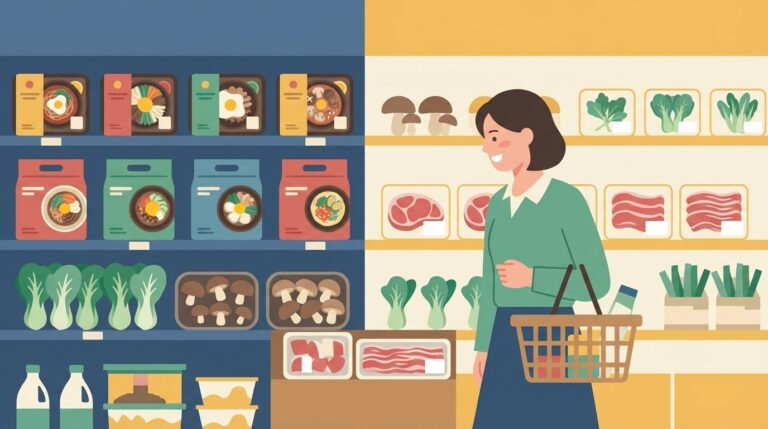
If you live in Korea or plan to stay for a while, you’ll quickly realize that grocery shopping for one used to be a nightmare. Korean food culture is deeply communal—think massive heads of cabbage for Kimchi, family-sized stews, and buying onions in bulk. But with over 30% of households now being single occupants, the market has dramatically shifted. Enter 소포장 (small packaging) and 밀키트 (meal kits).
If you don’t know the expressions in this unit, you might end up eating the same bulk-bought onions for three weeks straight. Let’s learn how to navigate the modern Korean mart like a true local!
Phase 2: Core Expressions Deep Dive
1. 이거 1인분도 되나요?
- Pronunciation: igeo il-inbundo doenayo? [ee-geo il-in-boon-do dwe-na-yo?]
- Meaning: (Literal) Is 1-person portion also possible? / (Real nuance) Can I just buy/order a portion for one person?
- K-Culture Moment: You are at a local butcher or a traditional market, and the pre-packaged meat looks too big. You ask the owner this with a polite smile, and they’ll gladly cut a smaller portion for you.
- Editor’s Insight: The word ‘분 (bun)’ refers to portions. ‘1인분 (il-inbun)’ is the magic word for solo-livers. The particle ‘도 (do)’ adds a soft, polite nuance, implying “I know you usually sell in bulk, but would one portion also be okay?”
- Situation Spectrum:
- Casual (to a clerk): ✅
- Semi-formal: ✅
- Formal: ✅
- 🤔 Think About It: Why is it sometimes awkward to ask for ‘1인분’ at traditional Korean BBQ restaurants? How does the concept of communal eating shape the way food is priced and served in Korea?
2. 소포장된 거 없나요?
- Pronunciation: sopojangdoen geo eomnayo? [so-po-jang-dwen geo eom-na-yo?]
- Meaning: (Literal) Is there nothing that is small-packaged? / (Real nuance) Do you have this in smaller packages?
- K-Culture Moment: You’re at an Emart or Homeplus. You see a huge bag of garlic, but you only need a few cloves for your weekend pasta. You grab a staff member and ask this question.
- Editor’s Insight: ‘소 (So)’ means small, ‘포장 (pojang)’ means packaging. It sounds much more natural and specific than saying “작은 거 (small thing)”. Using this word proves you have a B2-level grasp of everyday adult vocabulary!
- Situation Spectrum:
- Casual: ✅
- Semi-formal: ✅
- Formal: 🚫 (Not a phrase used for superiors, just for customer service situations)
- 🤔 Think About It: Packaging waste is a growing issue globally. How do you balance the convenience of ‘소포장’ with environmental consciousness in your home country?
3. 밀키트 코너는 어디예요?
- Pronunciation: milkiteu koneoneun eodiyeyo? [mil-ki-teu ko-neo-neun eo-di-ye-yo?]
- Meaning: Where is the meal kit section?
- K-Culture Moment: You are throwing a mini housewarming party (집들이) for two friends, but you can’t cook. You run to the mart to buy a ‘Budae Jjigae’ (Army Stew) meal kit. It looks like you cooked it from scratch!
- Editor’s Insight: Koreans have embraced Konglish (Korean-English) for modern food trends. They use the word ‘밀키트’ exactly as it sounds.
- Situation Spectrum:
- Casual: ✅
- Semi-formal: ✅
- Formal: ⚠️
Phase 3: Textbook vs Real Korean
[Situation 1: Looking for food for one]
* 📖 Textbook Korean: 저는 혼자 삽니다. 1인용 식재료를 사고 싶습니다. (I live alone. I want to buy ingredients for one person.)
* 🗣️ Real Korean: 이거 혼자 먹을 건데, 양이 얼마나 돼요? (I’m going to eat this alone, how much is the portion?)
* 💡 Why the difference?: Real spoken Korean focuses on the action and context rather than stating your demographic status. Asking “how much is the portion?” is the natural way to gauge if it’s too much.
[Situation 2: Asking for smaller vegetables]
* 📖 Textbook Korean: 작게 포장된 채소 있습니까? (Are there vegetables packaged small?)
* 🗣️ Real Korean: 소포장 채소 어딨어요? / 반 모만 살 수 있어요? (Where are the small-packaged veggies? / Can I just buy half a block?)
* 💡 Why the difference?: For items like tofu (두부), Koreans use specific counters like ‘모’. Asking for ‘반 모’ (half a block) is the ultimate insider way to buy small portions.
Phase 4: Cultural Context — K-Culture Deep Dive
4-1. The Non-Verbal ‘Nunchi’ of Solo Shopping
When asking a busy market vendor to split a package for you, it requires a bit of Nunchi (눈치). Don’t demand it while they are handling a line of 10 people. Approach them with a slightly apologetic smile, use the magic word “사장님~ (Boss/Owner),” and gently point to the item.
4-2. K-Food Connection: The Rise of ‘Honbap’ (혼밥)
Until about a decade ago, eating alone in Korea was seen with pity. Korean food is inherently designed for sharing—large pots of stew bubbling in the center of the table, shared side dishes (반찬). But as single households surged, a new culture emerged: 혼밥 (Honbap – eating alone).
Nowadays, convenience stores (편의점) are the ultimate playground for the single diner, offering high-quality Bento boxes (도시락) and 1+1/2+1 promotions perfectly tailored for solo dwellers. Furthermore, premium meal kits (밀키트) have allowed single Koreans to enjoy complicated, traditional dishes like Tteok-galbi or Kalguksu without buying $50 worth of raw ingredients.
Phase 5: Interactive Roleplay Scenario
Setting: It’s 7 PM on a Thursday. You are at your local neighborhood mart (동네 마트). You want to make a simple fried rice, but the only green onions (대파) available are bundled up like a bridal bouquet—way too much for you.
Characters:
– YOU: An expat living alone in a small studio (원룸) in Seoul.
– Mart Staff (아주머니): A friendly but fast-moving middle-aged lady restocking vegetables.
Dialogue:
YOU: 저기요, 사장님! 이거 대파…
(jeogiyo, sajangnim! igeo daepa…)
[Excuse me, boss! This green onion…]
(🎭 Stage Direction: You hold up the massive bundle of green onions with two hands, looking overwhelmed.)
아주머니: 네, 그거 오늘 아침에 들어와서 아주 싱싱해요! 한 단에 삼천 원!
(ne, geugeo oneul achime deureowaseo aju singsinghaeyo! han dane samcheon won!)
[Yes, that came in this morning, very fresh! 3,000 won for one bundle!]
YOU: 아… 제가 혼자 살아서요. 양이 너무 많은데…
(a… jega honja saraseoyo. yang-i neomu maneunde…)
[Ah… I live alone, so. The portion is too big…]
🔀 Your Turn! How should you ask for a smaller amount?
– A) “조금만 주세요.” (Give me a little.)
– B) “혹시 소포장된 건 없나요? 반 단만 살 수 있어요?” (By any chance, do you have smaller packaging? Can I just buy half a bundle?)
– C) “대파 너무 커요. 안 사요.” (Green onion too big. I won’t buy.)✅ Best Choice: B — It shows excellent B2-level vocabulary (소포장) and specifically asks for a practical solution (반 단 – half bundle).
⚠️ Choice A Analysis: “조금만 주세요” sounds like you are begging for a free sample rather than trying to purchase a smaller retail unit.
아주머니: 아유, 혼자 살아? 그럼 저기 안쪽 냉장고 봐봐. 거기 썰어놓은 파 1인분씩 팩으로 팔아!
(ayu, honja sara? geureom jeogi anjjok naengjanggo bwabwa. geogi sseoreonoeun pa irinbunssik paegeuro para!)
[Oh, you live alone? Then check the fridge inside over there. We sell chopped onions in 1-person packs there!]
YOU: 아! 밀키트 옆에 있는 거요? 감사합니다!
(a! milkiteu yeope inneun geoyo? gamsahamnida!)
[Ah! The ones next to the meal kits? Thank you!]
Phase 6: 10-Second Shadowing Drill
Practice your rhythm and intonation! Follow the slash marks for pauses.
🥺 사장님, / 혹시 이거 / 소포장된 건 / 없나요?
(sajangnim, / hoksi igeo / sopojangdoen geon / eomnayo?)
Say this slightly apologetically, dragging the ‘yo’ at the end just a bit to sound softer.
😊 우와! / 요즘은 밀키트가 / 정말 잘 나오네요!
(uwa! / yojeumeun milkiteuga / jeongmal jal naoneyo!)
Bright and impressed! Emphasize ‘정말’ (really).
Phase 7: K-Culture Mini Dictionary
| 한국어 | Romanization | English | Context |
|---|---|---|---|
| 혼밥 | honbap | Solo dining | Short for ‘혼자 먹는 밥’. Once a taboo, now a massive lifestyle trend in Korea. |
| 1인 가구 | irin gagu | Single household | A demographic category that is driving modern Korean economic and housing trends. |
| 소포장 | sopojang | Small packaging | Groceries packed specifically for 1-2 people. |
| 가성비 | gaseongbi | Cost-effectiveness | Crucial slang. Meal kits are often praised for having great ‘가성비’ compared to eating out. |
| 밀키트 | milkiteu | Meal kit | Pre-portioned ingredients with a recipe, booming in popularity in Korea. |
Phase 8: Traveler & Expat Survival Kit
Even if you’re just visiting Korea and staying in an Airbnb, you might want to cook.
🆘 Survival Phrases for Grocery Shopping
– 🇰🇷 “이거 2플러스1 (투플러스원) 맞나요?” (igeo tu-peulleoseu-won mannayo?)
– 🗣️ Meaning: Is this really Buy 2 Get 1 Free?
– 📍 Where to use: Convenience stores (CU, GS25, 7-Eleven).
– 💡 Pro Tip: In Korean convenience stores, “1+1” (one plus one) and “2+1” are everywhere. But if you only want ONE item, you can sometimes ask them to “save” the extra one in the store’s app (like the ‘나만의 냉장고’ app for GS25) to pick up later!
📌 Editor’s Travel Note:
For single households, delivery apps are a lifesaver. Baemin B-Mart (배민 B마트) or Kurly (컬리) deliver single-portioned groceries and meal kits directly to your door within hours or by early morning.
Phase 9: Critical Thinking — “One Step Deeper”
🧠 Think Deeper: Food & Identity (음식과 정체성)
Historically, Korean dining was deeply rooted in the concept of Jeong (정 – deep emotional connection/affection), visually represented by a family sharing a single bubbling stew and passing side dishes to one another. “Have you eaten?” (밥 먹었어?) is literally used as a greeting.
However, the rise of the single household and meal kits presents an interesting cultural shift. Is the Korean identity of communal sharing fading? Or is it simply evolving? Interestingly, many Koreans now buy premium meal kits and host small “home parties” with friends, using modern convenience to maintain that traditional sense of Jeong.
💬 Your Turn: How is the rise of single households changing the food culture in your country? Do you still see communal dining, or is everything shifting to single portions? Share your thoughts in the comments!
Phase 10: FAQ & Mistake Prevention
Q: Can I ask for ‘1인분’ (1 portion) at a Korean BBQ restaurant?
A: Usually, NO. Most traditional K-BBQ places have a strict “Minimum 2 portions (2인분 이상)” rule for the first order, even if you are eating alone. This is because of the cost of setting up the charcoal and the vast array of side dishes. However, times are changing, and specific “Honbap BBQ” places are popping up!
Q: Can I use “소포장” in a restaurant?
A: No. “소포장” (small packaging) is strictly for retail/groceries. In a restaurant, if you want less food, you say “조금만 주세요” (Please give me a little) or “양 적게 주세요” (Please give me a smaller portion).
❌ Common Mistake #1: Confusing 1개 (one item) and 1인분 (one portion).
✅ How to fix it: If you are buying an apple, it’s 1개 (il-gae). If you are buying a meal or meat meant to feed a human, it’s 1인분 (il-inbun).
Phase 11: Summary & Action Items
One-Liner Summary: Surviving as a solo diner in Korea is all about mastering the magical words: ‘1인분’ (1 portion), ‘소포장’ (small packaging), and embracing ‘밀키트’ (meal kits).
Action Mission 3 Steps:
– 🥉 Bronze (Solo): Say “밀키트 코너는 어디예요?” out loud 3 times with confidence.
– 🥈 Silver (Online): Look up “배달의민족 B마트” or “마켓컬리” online and browse their ‘1인가구’ or ‘밀키트’ categories.
– 🥇 Gold (Real World): Go to an Emart, Homeplus, or a large convenience store in Korea, find the meal kit section, and try cooking one for dinner tonight!
🎬 K-Culture Mission:
Watch a recent Korean vlog on YouTube by searching “자취생 밀키트 브이로그” (Someone living alone Meal kit vlog). Notice how they prepare their meals and see if you can spot any small-packaged ingredients!
Did you ever struggle with buying too much food in Korea? Let me know your funny grocery stories in the comments below!
Phase 12: Quiz — Interactive Challenge
1. Situational Judgment:
You are at a Korean convenience store. You see a sticker that says “2+1” on your favorite drink. You bring 2 drinks to the counter. What will the cashier most likely say to you?
– A) “소포장 하실 건가요?”
– B) “하나 더 가져오세요.”
– C) “밀키트 어딨어요?”
(Answer: B – “Bring one more.” Since it’s Buy 2 Get 1 Free, if you bring 2, they will remind you to grab your free 3rd item!)
2. Fill in the Blank:
“제가 혼자 살아서 파가 너무 많은데, 혹시 _______ 된 건 없나요?”
(I live alone so this is too much green onion, by any chance do you have anything _______?)
(Answer: 소포장)
3. True or False – K-Culture Edition:
“You can easily order 1인분 (1 portion) of Samgyeopsal (pork belly) at any traditional Korean BBQ restaurant.”
(Answer: FALSE. Most require a minimum of 2 portions for the initial order!)
Frequently Asked Questions (FAQ)
Q: What does "이거 1인분도 되나요?" mean in Korean and how do you pronounce it?
A: In Korean, "이거 1인분도 되나요?" is pronounced [igeo il-inbundo doenayo? [ee-geo il-in-boon-do dwe-na-yo?] and means: (Literal) Is 1-person portion also possible? / (Real nuance) Can I just buy/order a portion for one person?
Q: What does "소포장된 거 없나요?" mean in Korean and how do you pronounce it?
A: In Korean, "소포장된 거 없나요?" is pronounced [sopojangdoen geo eomnayo? [so-po-jang-dwen geo eom-na-yo?] and means: (Literal) Is there nothing that is small-packaged? / (Real nuance) Do you have this in smaller packages?
Q: What does "밀키트 코너는 어디예요?" mean in Korean and how do you pronounce it?
A: In Korean, "밀키트 코너는 어디예요?" is pronounced [milkiteu koneoneun eodiyeyo? [mil-ki-teu ko-neo-neun eo-di-ye-yo?] and means: Where is the meal kit section?







