

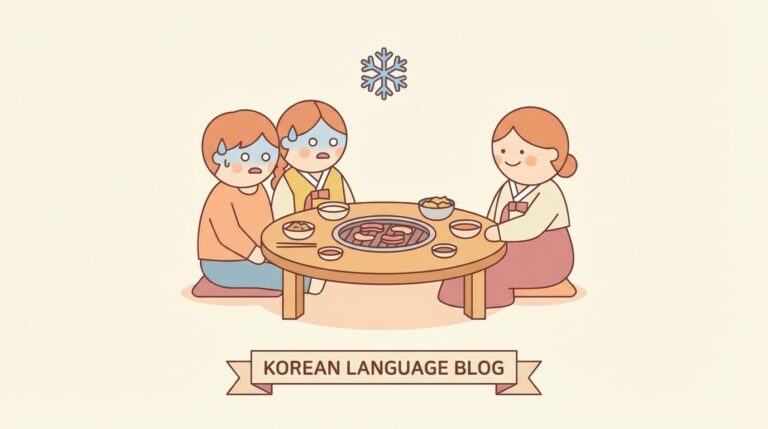
Phase 1: Empathy & K-Culture Cold Open
Hello! I’m your Daily Hangul Editor, your local Korean bestie.
Picture this: You are watching a popular Korean variety show like Running Man or Knowing Bros. The cast is laughing, the background music is upbeat, and the energy is high. Suddenly, someone tells a terrible ‘dad joke’ (아재개그).
Record scratch.
The background music abruptly stops. A CG graphic of a cold autumn wind or icicles appears on the screen, accompanied by the sound of a crow (caw caw).
Has this ever happened to you in real life? You’re at a fun gathering, and someone says something that completely kills the vibe. In your native language, you might think, “Well, this is awkward,” or “Way to kill the mood.” But how do Koreans express this highly specific, yet universally relatable moment?
If you learn this one magic word today, I promise your Korean friends will look at you with wide eyes and say, “Whoa, how do you know that?!” You’ll officially go from a beginner to an ‘Insider’ (인싸).
(Note: This post is based on actual moments my A1 students experienced when they tried to understand Korean variety shows and everyday hangouts!)
Phase 2: Core Expression Deep Dive
Let’s break down the ultimate slang for “mood-killer.”
1. 갑분싸 (Gap-bun-ssa)
- Pronunciation: [gap-bun-ssa]
- gap: sounds like ‘gap’ in English.
- bun: sounds like ‘boon’.
- ssa: make a sharp hissing sound like a snake!
- Meaning:
- Literal: 갑(갑자기/Suddenly) + 분(분위기/Mood) + 싸(싸해짐/Turns cold) = Suddenly, the mood turns cold.
- Real Nuance: “Awkward silence,” “Mood killed,” or “That got weird fast.”
- K-Culture Moment: Imagine sitting at a company dinner (회식 – hoesik). Everyone is cheering with their Soju glasses. Suddenly, the boss says, “By the way, who wants to work this weekend?” Immediate gapbunssa. People suddenly start looking at their phones or intensely grilling the meat.
- Editor’s Insight: This word is basically a noun, but we use it as an exclamation. You can just quietly mutter, “Ah… gapbunssa” when the vibe drops.
- Situation Spectrum:
- Casual (Close friends): ✅ Perfect!
- Semi-formal (Co-workers of the same age): ⚠️ Use only if you are close.
- Formal (Boss/Elders): 🚫 Never. (It sounds too informal and slightly rude to point out an elder ruined the mood!)
- 🤔 Think About It: Why do Koreans have a specific slang word for the “mood” dropping? It reflects a deeply rooted cultural concept. How important is “reading the room” in your culture?
Phase 3: Textbook vs. Real Korean
Let’s see how this slang transforms a boring textbook sentence into native-level coolness!
[Situation 1: A friend tells a terrible joke]
* 📖 Textbook Korean: 분위기가 어색해졌어요. (The atmosphere has become awkward.) – Too robotic!
* 🗣️ Real Korean: 아… 갑분싸. (Ah… gapbunssa.)
* 💡 Why the difference?: Koreans love efficiency! We take the first syllables of long phrases (갑자기 분위기 싸해짐) and shorten them. It’s an internet-born trend that became everyday language.
[Situation 2: Someone asks a too-personal question at a party]
* 📖 Textbook Korean: 무슨 말을 해야 할지 모르겠어요. (I don’t know what to say.)
* 🗣️ Real Korean: 헐, 갑분싸… (Heol, gapbunssa… / Heol = OMG/Wow)
* 💡 Why the difference?: Using slang softens the blow. Instead of getting angry, calling out the “gapbunssa” turns the awkwardness into a funny, shared moment.
(Bottom Note: Since you are at an A1 level, you don’t need to memorize the long original phrase. Just remembering the three blocks “Gap-Bun-Ssa” is enough to impress natives!)
Phase 4: Cultural Context — K-Culture Deep Dive
4-1. Non-Verbal Elements (How to act the part)
When you say gapbunssa, your body language matters!
– Do NOT make intense eye contact.
– DO look slightly down, take an awkward sip of your drink, or let out a nervous little laugh (haha…).
– This heavily ties into the Korean concept of Nunchi (눈치)—the ability to read the room. If someone causes a gapbunssa, they lack nunchi!
4-2. K-Variety Shows & K-Pop V-Live Connections
If you watch K-Pop idols on live streams (like Weverse or YouTube Live), you’ll see this all the time.
– An idol might accidentally drop a spoiler for their next album, and the other members just freeze.
– The comment section will instantly flood with: “ㅋㅋㅋㅋㅋ 갑분싸” (Lololol gapbunssa).
– Critical View: Idols use this slang to act like “the boy/girl next door” and connect with fans. While idols use it freely on camera, remember that in real-life professional settings (like a business meeting in Seoul), saying this to your manager would be a massive gapbunssa in itself!
Phase 5: Real-Life Roleplay Scenario
Setting: Friday night, 7 PM. A busy Korean BBQ restaurant in Hongdae. The smell of grilled pork belly (Samgyeopsal) fills the air. You are sitting with your new Korean friends.
Characters:
– YOU: A beginner in Korean, excited to try your new slang.
– Minsu (25): The funny guy of the group.
– Jihoon (25): Loves making terrible “dad jokes.”
Dialogue:
Jihoon: 여러분! 제가 재미있는 농담 하나 할까요?
(yeoreobun! jaega jaemi-inneun nongdam hana halkkayo?)
[Guys! Should I tell a funny joke?]
(🎭 Stage Direction: Jihoon smiles proudly, expecting applause.)
Minsu: 아… 불안한데.
(a… buranhande.)
[Ah… I have a bad feeling about this.]
Jihoon: 딸기가 도망가면 뭔지 알아? 딸기 시럽 (딸기쓰-럽)!
(ttalgiga domanggamyeon mwonji ara? ttalgi sireop!)
[Do you know what you call a runaway strawberry? Strawberry syrup! (pun on ‘syrup’ and ‘slip’)]
(🎭 Stage Direction: Absolute silence. Even the sizzling of the meat seems to stop. Minsu stares at the ceiling.)
🔀 YOUR TURN! How do you react to save the mood?
– A) “재미없어요.” (jaemieopseoyo. – It’s not funny.)
– B) “아… 갑분싸.” (a… gapbunssa. – Ah… mood killed.)
– C) “선생님, 감사합니다.” (seonsaengnim, gamsahamnida. – Thank you, teacher.)
✅ Best Choice: B!
By saying gapbunssa, you perfectly capture the awkwardness. Minsu will burst out laughing because a beginner just used a native slang perfectly!
⚠️ Choice A Analysis: It’s a bit too direct and might actually hurt Jihoon’s feelings.
⚠️ Choice C Analysis: Too formal and out of context for a friend setting!
Phase 6: 10-Second Shadowing Drill
Let’s practice the intonation! Follow the slash (/) for pauses.
- 😑 Awkwardly: 아… / 갑분싸.
(a… / gap-bun-ssa) -
😆 Laughing at a friend: 야! / 완전 / 갑분싸잖아!
(ya! / wanjeon / gap-bun-ssa-jana!)
(Hey! That’s a total mood-killer!)
Phase 7: K-Culture Mini Dictionary
| 한국어 (Korean) | Romanization | English | Context |
|---|---|---|---|
| 갑분싸 | gapbunssa | Awkward silence | When the mood drops instantly. |
| 눈치 | nunchi | Social sense / Tact | The art of reading the room in Korea. |
| 아재개그 | ajae-gag | Dad joke | Lame jokes that often cause a gapbunssa. |
| 회식 | hoesik | Company dinner | The ultimate test of your nunchi. |
Phase 8: Traveler Survival Kit
How does gapbunssa relate to your Korean trip? If you don’t read the room on public transport, you might cause a gapbunssa yourself!
📌 Editor’s Travel Note: Subway Nunchi
Korean subways are surprisingly quiet. If you talk loudly on the phone or play music without headphones, you will feel the icy stares of everyone around you. That is a real-time gapbunssa!🆘 Survival Phrases When You Mess Up!
If you accidentally cause an awkward moment in Korea, use these safe A1 phrases:
– 🇰🇷 “아, 죄송합니다!” (a, joesonghamnida!)
– 🗣️ Pronunciation: Ah, jway-song-ham-ni-da!
– 📍 Meaning: Oh, I’m sorry!
– 🇰🇷 “제가 한국말을 잘 못해요.” (jega hangungmareul jal mothaeyo.)
– 🗣️ Pronunciation: Je-ga han-gung-ma-reul jal mo-tae-yo.
– 📍 Meaning: I can’t speak Korean well.
– 💡 Pro Tip: A quick slight bow of the head along with these phrases will instantly melt away any awkwardness!
Phase 9: Critical Thinking — “One Step Deeper”
Language & Power: The Culture of “Nunchi”
Why does gapbunssa exist? In Korean culture, harmony within a group (the “mood” or 분위기) is often valued more than individual expression. If one person disrupts the group’s harmony by saying something inappropriate or selfish, it affects everyone’s emotional state. Gapbunssa isn’t just about a bad joke; it’s a social checkpoint. It playfully reminds people, “Hey, you need to use your nunchi (social radar) and protect our group’s vibe!”
💬 Your Turn: Does your culture value group harmony over individual expression? What happens when someone ruins the mood at a party in your country? Let me know in the comments!
Phase 10: FAQ & Avoiding Misunderstandings
- Q: Can I use gapbunssa to my boss or teacher?
- A: NO. It’s strictly for friends, people your age, or younger. Using it to an elder implies they lack social awareness, which is a big no-no in Korea.
- Q: Can I write this in a fan letter to my favorite K-Pop idol?
- A: YES! Fans use this playfully all the time when commenting on live streams, especially if an idol does something clumsy or tells a dad joke.
❌ Common Mistake: Using it when someone is actually angry or sad.
✅ Do This Instead: Only use gapbunssa for playfully awkward, cringe-worthy, or light-hearted mood drops. If there is a serious argument, using this slang will make the situation 100 times worse!
Phase 11: Summary & Action Items
- One-Liner Summary: Use “갑분싸 (Gap-bun-ssa)” when a friend tells a terrible joke and suddenly ruins the mood!
🎯 Action Missions:
– 🥉 Bronze (Solo): Look in the mirror, make an awkward, unimpressed face, and say “Ah… gapbunssa” 3 times.
– 🥈 Silver (Online): Find a funny K-Pop YouTube compilation video (like ‘Idol awkward moments’) and comment “갑분싸 ㅋㅋㅋ”!
– 🥇 Gold (Real Life): The next time your language exchange partner tells a bad joke, drop a “gapbunssa” and watch their jaw drop.
📺 K-Culture Mission:
Watch one episode of Running Man this weekend. Keep an eye out for the “cold wind” or “icicle” special effects. Whenever you see it, shout “갑분싸!” at the TV!
Phase 12: Quiz — Interactive Challenge
1. Situational Judgment:
You are at a cozy cafe with your Korean friend, Sora. You both are laughing. Sora tells a joke that makes absolutely no sense. The table goes quiet. What is your best response?
– A) 안녕하십니까? (Annyeong-hasimnikka? / Hello?)
– B) 갑분싸… (Gapbunssa… / Awkward…)
– C) 수고하셨습니다. (Sugo-hasyeotseumnida. / Good job.)
2. True or False – K-Culture Edition:
In Korea, it is polite to point out a gapbunssa moment when your boss makes a bad joke at a company dinner. (T/F)
(Answers: 1. B – Perfect use of the slang! A and C are completely unrelated greetings. / 2. False! You must fake-laugh at your boss’s jokes to survive the company dinner! 🤫)
Frequently Asked Questions (FAQ)
Q: What does "갑분싸 (Gap-bun-ssa)" mean in Korean and how do you pronounce it?
A: In Korean, "갑분싸 (Gap-bun-ssa)" is pronounced [gap-bun-ssa] and means: a key conversational Korean expression covered in this lesson.







