

Phase 1: Empathy & K-Culture Cold Open
Hello! I’m the Chief Editor at Daily Hangul, your personal local culture navigator and veteran Korean tutor.
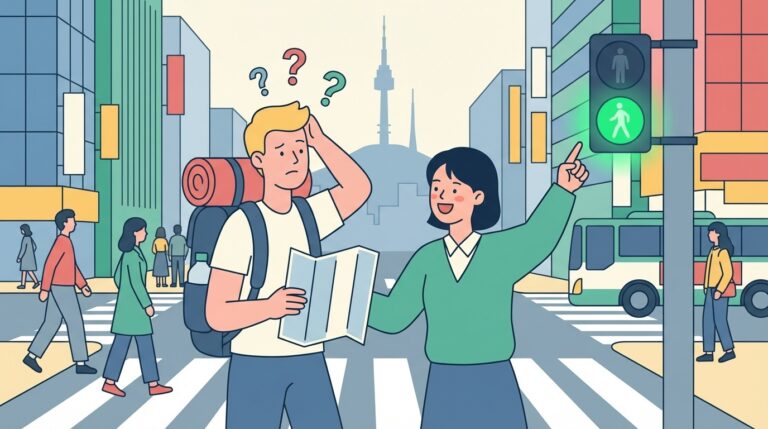
Picture this: You are standing at a massive crosswalk in the heart of Gangnam, Seoul. The traffic is buzzing, and you’re waiting with your Korean friend. Suddenly, the pedestrian signal changes to green. Your friend grabs your arm and says, “Go! It’s blue!”
You freeze. Blue? You frantically look around for a blue light, maybe a police car or an ambulance? But no, they are pointing straight at the bright green walking man on the traffic light.
Welcome to one of the most fascinating, mind-bending quirks of the Korean language! If you don’t know this, you might miss your chance to cross the street safely. But if you do, you’ll instantly earn your ‘insider’ badge in Korea.
(Transparency Note: This guide is crafted from the real panic moments of my beginner students who stood completely frozen at Seoul’s crosswalks!)
Phase 2: Core Expressions Deep Dive
Let’s break down the color blue and why it sometimes magically becomes green in Korea.
1. 파란색 (The Color Blue)
- Pronunciation: [pa-ran-saek]
- Sound-alike guide: ‘pa’ like papa + ‘ran’ like run + ‘saek’ like sack.
- Meaning: Blue color (Literal & Real meaning)
- K-Culture Moment: You are in a K-Pop merchandise pop-up store in Hongdae. You want to buy a T-shirt in your favorite idol’s official fandom color (if it happens to be blue!). You can point and say, “파란색 주세요” (Please give me the blue one).
- Editor’s Insight: This is the absolute standard word for the color blue. You use it for clothes, the sky, the ocean, and objects.
- Situation Spectrum:
- Casual with friends: ✅
- Semi-formal (co-workers): ✅
- Formal (bosses/elders): ✅
- 🤔 Think About It: Notice the word ends in ‘색’ (saek)? ‘색’ literally means ‘color’. In Korean, we almost always attach ‘color’ to the end of the color’s name. Does your language do this?
2. 파란불 (Green Traffic Light)
- Pronunciation: [pa-ran-bul]
- Sound-alike guide: ‘pa-ran’ + ‘bul’ (sounds like bull, the animal).
- Meaning: Literally “Blue light/fire”, but actually means Green traffic light.
- K-Culture Moment: This is pure K-Drama survival. When the hero is running late to stop the heroine from leaving at the airport, the taxi driver will mutter, “Ah, why won’t it turn to paran-bul?” while staring at a red light.
- Editor’s Insight: This is the expression that shocks foreigners the most. ‘불’ (bul) means fire or light. Even though the light is objectively green, Koreans intuitively call it a “blue light.”
- Situation Spectrum:
- Casual with friends: ✅
- Semi-formal (co-workers): ✅
- Formal (bosses/elders): ✅
- 🤔 Think About It: Why do Koreans call green “blue”? Is there a word in your native language that describes a color differently depending on the object?
Phase 3: Textbook vs. Real Korean
Let’s see how the color blue plays out in real life versus your Korean textbook.
[Situation 1: Waiting at a Crosswalk]
* 📖 Textbook Korean: 녹색불입니다. (nok-saek-bul-im-ni-da / It is a green light.)
* 🗣️ Real Korean: 파란불이야! 건너! (pa-ran-bul-i-ya! geon-neo! / It’s a blue light! Cross!)
* 💡 Why the difference?: While ‘녹색’ (nok-saek) strictly means green, Koreans traditionally grouped green and blue under one umbrella term. In daily life, saying “파란불” is the natural, culturally ingrained habit.
[Situation 2: Shopping for Clothes]
* 📖 Textbook Korean: 파란색 옷을 보여주세요. (pa-ran-saek os-eul bo-yeo-ju-se-yo / Please show me blue clothes.)
* 🗣️ Real Korean: 이거 파란색 있어요? (i-geo pa-ran-saek is-seo-yo? / Do you have this in blue?)
* 💡 Why the difference?: Real conversation is all about efficiency. Dropping the word for “clothes” and just pointing (“이거” – this) sounds much more like a local!
Bottom Note: As an A1 learner, don’t worry about memorizing fancy synonyms. Just mastering “파란색” (blue) and knowing “파란불” means “go” will make your trip to Korea 100% easier!
Phase 4: Cultural Context — K-Culture Deep Dive
4-1. Non-verbal Cue: The Crosswalk “Nunchi” (눈치)
When the light turns 파란불 (blue/green), you’ll notice Koreans start walking almost a millisecond before the light changes. This is part of the famous “빨리빨리” (Ppal-li-ppal-li / Hurry, hurry) culture. Your Nunchi (ability to read the room) is crucial here: don’t block the front of the crosswalk if you’re going to walk slowly!
4-2. K-Travel Connection: The Survival Color
When you travel in Korea, you will hear colors constantly.
– Taking a taxi? The driver will sigh, “아, 계속 빨간불이네… 파란불 언제 켜져?” (Ah, it’s constantly red… when will the blue turn on?).
– Walking through a traditional market? You might hear merchants selling fresh, green vegetables but describing them as “파랗다” (Blue!). Yes, fresh green veggies are also sometimes called “blue!”
Phase 5: Interactive Roleplay Scenario
Setting: It’s a sunny Saturday afternoon. You are standing at the bustling 8-lane crosswalk near Gwanghwamun Square.
Characters:
– YOU: A beginner Korean learner, excited but slightly overwhelmed by the Seoul traffic.
– Minji (28): Your Korean language exchange partner, energetic and walks very fast.
Dialogue:
Minji: 날씨 진짜 좋다! 하늘이 파란색이에요. ☀️
(nal-ssi jin-jja jo-ta! ha-neul-i pa-ran-saek-i-e-yo.)
[The weather is really good! The sky is blue.]
YOU: 네! 파란색 예뻐요.
(ne! pa-ran-saek ye-ppeo-yo.)
[Yes! The blue is pretty.]
Minji: 아, 신호등 바뀌었다!
(a, sin-ho-deung ba-kkwi-eot-da!)
[Ah, the traffic light changed!]
(🎭 Stage Direction: Minji grabs her bag, ready to sprint across the street)
Minji: 파란불이에요! 빨리 가요!
(pa-ran-bul-i-e-yo! ppal-li ga-yo!)
[It’s a blue light! Let’s go quickly!]
🔀 Your Turn! How should you respond?
– A) “파란색? 안 보여요…” (Blue? I don’t see it…)
– B) “네, 초록색불이네요!” (Yes, it’s a green light!)
– C) “네! 빨리 건너요!” (Yes! Let’s cross quickly!)✅ Best Choice: C — You understood the cultural context! No need to argue about the color theory. Just run with Minji!
⚠️ Choice A & B Analysis: If you stop to look for blue or correct her to “green” (초록색), you might miss the crossing time. Embrace the “blue=green” matrix!
Phase 6: 10-Second Shadowing Drill
Practice speaking like a local! Pay attention to the pauses (/) and the emotion.
😲 헉! / 파란불이에요! / 건너요!
(heok! / pa-ran-bul-i-e-yo! / geon-neo-yo!)
[Gasp! / It’s a blue (green) light! / Cross!]
Voice tip: Raise your pitch slightly on “건너요” to show a sense of urgency!
Phase 7: K-Culture Mini Dictionary
| Korean | Romanization | English | Context |
|---|---|---|---|
| 파란색 | pa-ran-saek | Blue (Color) | Used for objects, sky, ocean, clothes. |
| 파란불 | pa-ran-bul | Green Light | Literally “blue light,” used for traffic signals. |
| 초록색 | cho-rok-saek | Green (Color) | The actual word for the color green (like trees or matcha). |
| 신호등 | sin-ho-deung | Traffic Light | What you look at before crossing the street. |
| 빨리빨리 | ppal-li-ppal-li | Hurry, hurry | The unspoken rhythm of Korean life. |
Phase 8: Traveler Survival Kit
Colors are incredibly useful when shopping or asking for directions in Korea.
🆘 Survival Phrases #1: Shopping with Colors
– 🇰🇷 “이거 파란색 있어요?” (i-geo pa-ran-saek is-seo-yo?)
– 🗣️ English: Do you have this in blue?
– 📍 Where to use: Clothing stores in Myeongdong, K-Pop shops, Olive Young.
– 💡 Pro Tip: If you don’t know the name of an item, just point and use the color! “저 파란색 주세요” (Give me that blue one).📌 Editor’s Travel Note
– Navigating Crosswalks: Sometimes Korean pedestrian lights have timers (countdown bars or numbers). Once it drops below 5 seconds, do not start crossing. Koreans drive fast!
– Taxis & Lights: If you’re in a taxi and want to practice listening, tune in when approaching an intersection. You’ll definitely hear the driver mumble about 빨간불 (red light) or 파란불 (blue/green light).
Phase 9: Critical Thinking — “One Step Deeper”
Language & Nature (The ‘Grue’ Phenomenon)
Why do Koreans call a green light “blue”? Historically, the Korean language didn’t strictly separate blue and green. The traditional word 푸르다 (pu-reu-da) encompassed the color of both the vast blue sky and the lush green mountains. It represented “freshness” and “nature” rather than a specific optical wavelength. When modern traffic lights were introduced, the “green” light felt perfectly natural to be described with the blue/green nature term. So, when a Korean says a traffic light is “파란불” (blue), they aren’t colorblind; they are using a deeply poetic linguistic heritage!
💬 Your Turn: Does your native language have a word that covers multiple colors, or a funny translation that doesn’t quite match reality? Share it in the comments!
Phase 10: FAQ & Avoiding Mistakes
- “Can I just say 초록불 (cho-rok-bul / green light) instead of 파란불?”
Yes, you absolutely can! Younger generations use “초록불” more often nowadays. However, older generations, taxi drivers, and the news still predominantly say “파란불.” Understanding it is key to not getting confused!
❌ Common Mistake #1: Arguing with a Korean friend that the light is green, not blue.
✅ Do this instead: Nod wisely, cross the street, and flex your knowledge of the “푸르다” (nature color) history!❌ Common Mistake #2: Asking for “파란불 옷” (Blue light clothes) when you want a blue shirt.
✅ Do this instead: Always use “파란색” (pa-ran-saek) for objects. “불” (bul) is only for lights/fire.
Phase 11: Summary & Action Items
- One-Liner Summary: “파란색” (pa-ran-saek) is blue for things, but “파란불” (pa-ran-bul) means GO at a green traffic light!
-
Action Mission:
- 🥉 Bronze (Solo): Look at the sky today and say out loud: “파란색 예뻐요!” (Blue is pretty!).
- 🥈 Silver (Online): Find an emoji of a blue object and post it below with “파란색” in the comments!
- 🥇 Gold (Real World): Next time you watch a K-Drama and a street scene appears, try to shout “파란불!” before the characters cross the street.
- K-Culture Mission: Open Google Street View in Gangnam, Seoul. Find a traffic light and practice saying “파란불!” (Green light) and “빨간불!” (Red light).
Phase 12: Quiz — Interactive Challenge
1. You are in a K-Beauty shop and want a blue hair dye. What should you say?
A) 파란불 주세요.
B) 파란색 주세요.
2. True or False — K-Culture Edition:
If a Korean taxi driver tells you “파란불이 켜졌어요” (The pa-ran-bul turned on), you should expect to see a literal blue sapphire-colored light on the traffic pole.
(Answers: 1. B – because ‘불’ is only for lights! 2. False – You will see a green light!)
Frequently Asked Questions (FAQ)
Q: What does "파란색 (The Color Blue)" mean in Korean and how do you pronounce it?
A: In Korean, "파란색 (The Color Blue)" is pronounced [pa-ran-saek] and means: a key conversational Korean expression covered in this lesson.
Q: What does "파란불 (Green Traffic Light)" mean in Korean and how do you pronounce it?
A: In Korean, "파란불 (Green Traffic Light)" is pronounced [pa-ran-bul] and means: a key conversational Korean expression covered in this lesson.







