

Surviving the Korean Jjimjilbang: How to Sweat Like a Local in the Bulgama!
Phase 1: Empathy (The K-Culture Cold Open)
Hello there! This is your Lead Editor at Daily Hangul.
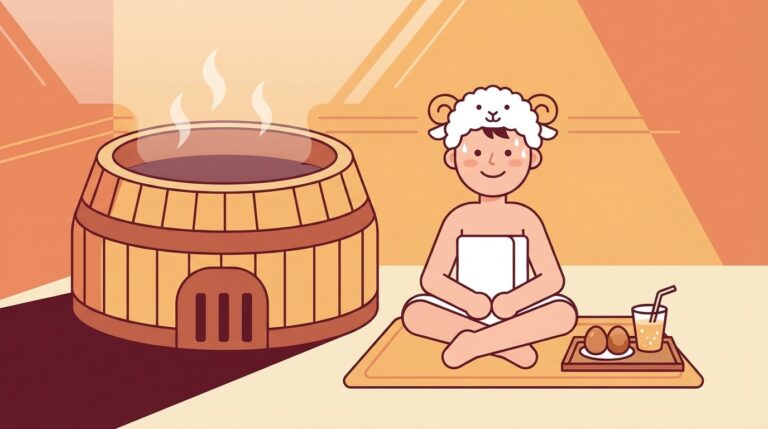
Imagine this: You are watching a K-Drama. The main characters have just had a huge argument, or maybe they’re hiding from the bad guys. Where do they go? A massive room filled with people wearing matching T-shirts and shorts, with cute towels rolled into ‘sheep heads’ (양머리) on their heads.
Curiosity takes over, and during your trip to Seoul, you finally step into a Jjimjilbang (찜질방, Korean sauna). You bravely open the heavy door to the Bulgama (불가마, Fire Kiln)—a room that literally looks like a pizza oven and reads 90°C (194°F). As you gasp for air in the blazing heat, an older Korean man next to you lets out a deep sigh and says, “Ah~ Siwonhada! (It’s so cool!)”
Wait, what? Cool?! Is his thermometer broken?
If you don’t understand the cultural context behind Korean saunas, you might think you’ve stepped into a parallel universe. But don’t worry! I’ve been there, sweating it out and sipping icy rice punch. Today, I’ll guide you through the exact expressions and cultural nuances you need to enjoy the hot Bulgama like a true local.
Phase 2: Core Expressions Deep Dive
Let’s break down the essential phrases you’ll hear and use inside the sweltering heat of the Bulgama.
1. 땀(을) 빼다
- Pronunciation: ttam(eul) ppaeda [ddam-eul ppay-da]
- Sound-alike guide: ‘ttam’ sounds like ‘Tom’ but with a sharp, tense ‘T’. ‘ppaeda’ sounds like ‘pay-da’.
- Meaning: Literal = To subtract sweat / Real = To sweat it out, to detox.
- K-Culture Moment: You’ll hear this when friends are stressed after a long week of work. “Let’s go to the Jjimjilbang and sweat it out!”
- Editor’s Insight: Koreans view sweating not just as getting dirty, but as a cleansing ritual. Sweating in a Bulgama is seen as releasing stress, toxins, and fatigue.
- Situation Spectrum:
- Casual (Friends): ✅
- Semi-formal (Coworkers): ✅
- Formal (Boss/Elders): ⚠️ (Better to say “찜질하러 가시죠” – Let’s go do Jjimjil)
- 🤔 Think About It: In many cultures, sweating is something to avoid. Why do you think Korean culture actively seeks out “sweating together” as a bonding and healing activity?
2. 시원하다
- Pronunciation: siwonhada [shee-won-ha-da]
- Sound-alike guide: ‘shee’ + ‘won’ (like winning a prize) + ‘ha-da’.
- Meaning: Literal = It is cool/cold / Real = It is relieving, refreshing, or hits the spot.
- K-Culture Moment: This is the ultimate Korean paradox. You step into a boiling hot bath or a fiery Bulgama, and you say this. You drink boiling hot soup, and you say this.
- Editor’s Insight: Siwonhada goes beyond temperature. It describes the physical and mental release of tension. When the intense heat relaxes your stiff muscles, that feeling of relief is siwonhada.
- Situation Spectrum:
- Casual: ✅
- Semi-formal: ✅
- Formal: ✅
- 🤔 Think About It: Is there a word in your language that describes the paradoxical feeling of “pain turning into pleasure/relief”?
3. 지지다
- Pronunciation: jijida [jee-jee-da]
- Sound-alike guide: ‘jee’ as in Jeep, repeated twice, plus ‘da’.
- Meaning: Literal = To pan-fry or sear / Real = To apply heat to a sore body part to relieve pain.
- K-Culture Moment: Older Koreans love saying “몸 좀 지져야겠다” (I need to sear my body). It means lying flat on the boiling hot ondol (heated floor) or in the Bulgama to soothe aching muscles.
- Editor’s Insight: It sounds almost like cooking yourself, right? It’s a slightly older, folksy expression, but if a foreigner uses it, Koreans will be deeply impressed by your “local vibe.”
- Situation Spectrum:
- Casual: ✅
- Semi-formal: ⚠️
- Formal: 🚫 (Too colloquial for formal settings)
- 🤔 Think About It: The Korean floor heating system (Ondol) has existed for centuries. How might this history of sleeping on hot floors have created words like ‘jijida’?
Phase 3: Textbook vs. Real Korean
Let’s see how these words change from textbook theory to Bulgama reality!
[Situation 1: Expressing how hot the room is]
* 📖 Textbook Korean: 온도가 매우 높습니다. (The temperature is very high.)
* 🗣️ Real Korean: 으아, 땀 쫙 빠진다! (Whoa, the sweat is pouring out!) or 아유~ 시원하다! (Ah~ so refreshing!)
* 💡 Why the difference?: Koreans focus on the effect the heat has on the body (relief, detox) rather than stating the obvious scientific fact of the temperature.
[Situation 2: Asking a friend to go to the hottest sauna room]
* 📖 Textbook Korean: 우리 뜨거운 불가마에 들어갈까요? (Shall we enter the hot fire kiln?)
* 🗣️ Real Korean: 야, 몸 좀 지지러 가자. (Hey, let’s go ‘sear’ our bodies.)
* 💡 Why the difference?: Real conversations use vivid, action-oriented slang (‘지지다’) that immediately conveys the intention of muscle relaxation.
Bottom Note: For B1 (Intermediate) learners, using “땀 빼다” and “시원하다” perfectly will make you sound incredibly natural without risking being overly slangy.
Phase 4: Cultural Context — K-Culture Deep Dive
4-1. Non-Verbal Cues (The Art of the Bulgama)
When inside the Bulgama, language isn’t just spoken; it’s physical.
– The Towel Protocol: You must protect your hair from the extreme heat. Many Koreans wrap their towels into a Yangmori (양머리, sheep head). It’s cute, but it’s actually functional!
– Silence and Endurance: In the highest temperature rooms, people don’t chat much. They close their eyes, breathe steadily, and focus. Nunchi (눈치) dictates that you keep your voice down to a whisper. It’s a shared meditative suffering.
4-2. The K-Food Connection inside the Jjimjilbang
If you’ve watched any K-Variety show like Running Man, you know what happens after sweating in the Bulgama. You MUST refuel.
– Sikhye (식혜 – Sweet Rice Punch): Icy cold and sweet. It brings your core temperature down instantly.
– Maekbanseok Gyeran (맥반석 계란 – Roasted Eggs): Cooked slowly in the saunas.
– K-Drama Trope Warning: You’ve probably seen characters crack the egg by smashing it against their friend’s head. Real Life Tip: Do this gently! Those eggs are hard, and you might actually start a fight if you do it too hard!
Phase 5: Interactive Roleplay Scenario
Scenario A: The Bulgama Challenge
- Setting: A famous massive Jjimjilbang in Yongsan, Seoul. It’s 10 PM. You and your Korean friend are wearing matching orange sauna uniforms. You are standing in front of a heavy wooden door that reads “Han-jeung-mak (Traditional Pine Fire Kiln) – 85°C”.
- Characters:
- YOU: An intermediate Korean learner, slightly intimidated by the heat.
- Minji (28): Your energetic Korean friend who firmly believes sweating cures all ailments.
Minji: 우와, 여기 온도 장난 아니다! 우리 여기 들어가서 땀 좀 뺄까?
(Uwa, yeogi ondo jangnan anida! uri yeogi deureogaseo ttam jom ppaelkka?)
[Wow, the temperature here is no joke! Should we go in here and sweat it out?]
(Minji fixes her sheep-head towel and looks at you excitedly.)
YOU: 85도? 미친 거 아니야? 사람이 어떻게 들어가?
(85-do? michin geo aniya? sarami eotteoke deureoga?)
[85 degrees? Isn’t that crazy? How can a human go in there?]
Minji: 에이, 한 번 들어가면 엄청 시원해! 몸 좀 지져야 피로가 풀리지. 딱 5분만 버텨보자!
(Ei, han beon deureogamyeon eomcheong siwonhae! mom jom jijyeoya piroga pulliji. ttak 5-bunman beotyeoboja!)
[Hey, once you go in, it’s super refreshing! We need to ‘sear’ our bodies to relieve fatigue. Let’s just endure it for 5 minutes!]
🔀 Your Turn! How will you respond?
– A) “아… 나는 못 해. 밖에서 기다릴게.” (Ah… I can’t. I’ll wait outside.)
– B) “좋아! 대신 땀 빼고 식혜 쏘기!” (Alright! But in exchange, you treat me to Sikhye after we sweat!)
– C) “저기요, 불 꺼주세요.” (Excuse me, turn off the fire.)✅ Best Choice: B — Reason: You accept the cultural challenge while perfectly negotiating for the ultimate sauna reward (Sikhye). It shows you really understand Jjimjilbang culture!
⚠️ Choice C Analysis: Hilarious, but impossible. The Bulgama is a massive clay oven heated by actual logs for hours. You can’t just flip a switch!
Scenario B: The Snack Bar (Bonus)
(You survived the Bulgama. You are now at the snack bar (매점) dripping with sweat.)
YOU: 이모님! 여기 얼음 식혜 두 잔이랑 맥반석 계란 세 개 주세요.
(Imonim! yeogi eoreum sikhye du janirang maekbanseok gyeran se gae juseyo.)
[Auntie! Two glasses of iced Sikhye and three roasted eggs, please.]
Auntie: 네~ 키 대세요. 띡.
(Ne~ ki daeseyo. ttik.)
[Okay~ Put your key here. Beep.]
(You tap your electronic locker bracelet to pay—no wallet needed!)
Phase 6: 10-Second Shadowing Drill
Let’s practice exactly how a local sounds when they step out of the hot Bulgama. Pay attention to the deep breath and the pauses!
😫 (Deep sigh) 아유~ / 🥵 불가마에서 / 땀을 쫙 뺐더니 / 😌 너무 시원해요!
(Ayu~ / bulgama-eseo / ttam-eul jjwak ppaetdeoni / neomu siwonhaeyo!)
[Ah~ / After sweating it all out / in the Bulgama / it’s so refreshing!]
Phase 7: K-Culture Mini Dictionary
| 한국어 (Korean) | Romanization | English | Context |
|---|---|---|---|
| 찜질방 | jjimjilbang | Korean public bath/sauna | Literally “heated room.” A 24-hour complex for bathing, sweating, and sleeping. |
| 불가마 | bulgama | Fire kiln sauna | The hottest room in a Jjimjilbang, usually shaped like a dome and heated with pine wood. |
| 양머리 | yangmeori | Sheep head (towel) | Folding a towel into two buns on the side to protect the head from heat. |
| 식혜 | sikhye | Sweet rice punch | A traditional sweet drink made of malt and rice. The holy grail after a sauna session. |
| 맥반석 계란 | maekbanseok gyeran | Elvan stone roasted eggs | Eggs slowly roasted in the sauna heat, turning them brown, chewy, and nutty. |
Phase 8: Traveler Survival Kit
Planning to visit a Jjimjilbang in Korea? Here are the top survival expressions you absolutely need.
🆘 Survival Expression #1: How to pay
– 🇰🇷 “이걸로 결제할게요.” (igeollo gyeoljehalgeyo.)
– 🗣️ [ee-geol-lo gyul-jeh-hal-geh-yo]
– 📍 Where to use: At the snack bar or massage chair.
– 💡 Pro Tip: Hold up your electronic wristband (key) while saying this. You don’t carry cash inside!🆘 Survival Expression #2: Asking about gender areas
– 🇰🇷 “여탕/남탕 어디예요?” (yeotang/namtang eodiyeyo?)
– 🗣️ [yeo-tang/nam-tang eo-di-yeh-yo]
– 📍 Where to use: Right after getting your uniform.
– 💡 Pro Tip: “여탕” is Women’s bath, “남탕” is Men’s bath. Don’t mix them up!📌 Editor’s Travel Note: Jjimjilbang Etiquette
– Naked Truth: The shower/bath area is strictly separated by gender, and yes, you must be 100% naked. No swimsuits allowed! But the Bulgama and snack areas are mixed-gender, and you wear the provided uniform.
– Keep Electronics Safe: Do NOT take your smartphone into the 80°C+ Bulgama. It will overheat and break!
Phase 9: Critical Thinking — “One Step Deeper”
Mind and Body Connection: The Philosophy of Iyeol-chiyeol (이열치열)
Why do Koreans call boiling heat “refreshing”? It roots back to traditional Korean medicine and the philosophy of Iyeol-chiyeol (fighting heat with heat). Koreans believe that when you are tired or the weather is oppressive, exposing your body to intense heat opens up your pores, releases stagnant energy (toxins), and ultimately restores balance to your core. So, when a Korean says “시원하다” in a 90°C Bulgama, they aren’t talking about the room’s temperature. They are talking about the internal, spiritual release of bodily stress.
💬 Your Turn: Does your culture have a tradition where enduring physical discomfort (like extreme heat, cold plunges, or spicy food) is seen as a way to cleanse or heal the body? Share your thoughts below!
Phase 10: FAQ & Avoiding Mistakes
Q: Do I have to be completely silent in the Jjimjilbang?
In the common lounge areas (where people sleep on the floor and watch TV), you can talk quietly. However, inside the actual Bulgama or sleeping caves, silence is golden.
Q: Can I wear my glasses inside the hot sauna?
Absolutely not! The metal frames can burn your skin, and plastic frames can warp. Leave your glasses in the cubbies outside the sauna doors.
❌ Common Mistake #1: Going straight into the Jjimjilbang (sauna area) without showering first.
✅ Do This Instead: You must wash your body thoroughly in the gender-segregated bathhouse (목욕탕) BEFORE putting on the uniform and entering the communal sauna zones. It’s basic etiquette!
Phase 11: Summary & Action Items
- One-Liner Summary: Surviving the Bulgama is all about saying “시원하다” (It’s refreshing) while you “땀 빼다” (sweat it out) and earn your icy Sikhye!
-
Action Mission:
- 🥉 Bronze: Watch a YouTube video of a Korean Jjimjilbang and practice saying “아유, 시원하다~” when they step into the sauna.
- 🥈 Silver: Try folding a towel into a ‘Yangmori’ (Sheep Head) at home and take a selfie!
- 🥇 Gold: Find a Korean spa/sauna in your country (or when you visit Korea), brave the hot room, and order Sikhye using Korean!
- K-Culture Mission: Next time you watch a K-Drama, look closely at the Jjimjilbang scenes. Can you spot who is wearing the Yangmori and who is aggressively cracking eggs?
Phase 12: Quiz — Interactive Challenge
1. You step into a 90°C Bulgama. It is incredibly hot, but you feel your muscles relaxing. What is the most natural “local” thing to say?
A) 아, 너무 추워요. (Ah, it’s too cold.)
B) 으아, 시원하다! (Whoa, it’s so refreshing!)
C) 불가마를 꺼주세요. (Please turn off the kiln.)
(Answer: B – Because the heat relieves your physical tension!)
2. True or False: You should pay for your Jjimjilbang snacks using paper cash.
(Answer: False! You tap your locker wristband to pay, and settle the bill when you leave the building!)
3. Fill in the blank: To describe the act of sitting in the sauna to detox, Koreans say “___ 빼다” (to subtract ___).
A) 피 (Blood)
B) 살 (Fat)
C) 땀 (Sweat)
(Answer: C – 땀 빼다!)
Did you enjoy today’s guide to the Korean Jjimjilbang? Leave a comment below if you’d be brave enough to try the 90°C Bulgama!
Frequently Asked Questions (FAQ)
Q: What does "땀(을) 빼다" mean in Korean and how do you pronounce it?
A: In Korean, "땀(을) 빼다" is pronounced [ttam(eul] and means: Literal = To subtract sweat / Real = To sweat it out, to detox.
Q: What does "시원하다" mean in Korean and how do you pronounce it?
A: In Korean, "시원하다" is pronounced [siwonhada [shee-won-ha-da] and means: Literal = It is cool/cold / Real = It is relieving, refreshing, or hits the spot.
Q: What does "지지다" mean in Korean and how do you pronounce it?
A: In Korean, "지지다" is pronounced [jijida [jee-jee-da] and means: Literal = To pan-fry or sear / Real = To apply heat to a sore body part to relieve pain.







