

Phase 1: Empathy
Greeting: “안녕하세요! Hello! I’m your Daily Hangul Editor.”
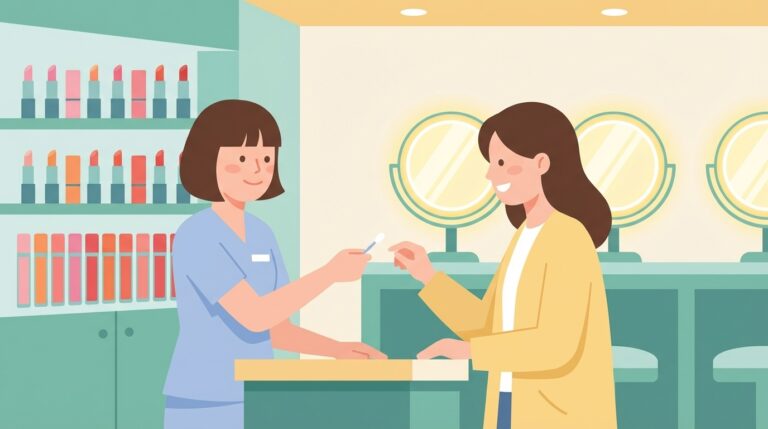
Imagine this: You are standing in the middle of a brightly lit cosmetics shop in Myeongdong, like Olive Young or Etude. The K-Pop music is pumping, and the walls are lined with hundreds of lipsticks and tints. You want to achieve that perfect K-Drama “glowy lip” look. You pick up a gorgeous shade of red, take the cap off, and right as you’re about to apply it to your lips… you freeze.
Wait, am I allowed to just put this on? Do I ask first? Where are the mirrors?
If you’ve ever felt the panic of wanting to try makeup in a foreign country but not knowing the rules (or the words!), you’re not alone. In Korea, K-Beauty isn’t just about shopping; it’s a culture of “testing before you buy,” but there are strict unwritten rules about hygiene.
Today, we’re going to learn exactly how to ask to try on that lipstick, find your perfect shade, and check out smoothly. This guide is based on real SOS messages from my beginner students who ended up buying the wrong color because they were too shy to ask for a tester!
Phase 2: Core Expressions Deep Dive
Let’s master the 3 golden phrases you need at any K-Beauty store.
1. 이거 발라봐도 돼요?
- Pronunciation: igeo ballabwado dwaeyo? [ee-guh bahl-lah-bwa-do dwae-yo?]
(Think of “bahl-lah” like you are singing a ‘ballad’, and “dwae-yo” sounds like ‘d-way-yo’.)- Meaning: Can I try applying this? (Literal: Is it okay if I try putting this on?)
- K-Culture Moment: You see Wonyoung’s glossy tint on a poster. You want it. But the tester looks used. You ask the staff this question while pointing at the display.
- Editor’s Insight: The verb 바르다 (to apply/spread) is crucial here. In English, we “put on” clothes and makeup. In Korean, we “wear” (입다) clothes, but “spread/apply” (바르다) makeup or lotion.
- Situation Spectrum:
- 친구 사이 (Casual): 이거 발라봐도 돼? ✅
- 가게 직원 (Semi-formal/Polite): 이거 발라봐도 돼요? ✅
- 격식 있는 자리 (Highly Formal): 이것을 발라보아도 됩니까? 🚫 (Too robotic for shopping!)
- 🤔 Think About It: Notice the grammar ~아/어 보다 (to try doing something). Why do Koreans use “try to” so often when asking permission? It softens the request, showing humility and respect for the other person’s space or property.
2. 면봉 있어요?
- Pronunciation: myeonbong isseoyo? [myun-bong ees-suh-yo?]
- Meaning: Do you have cotton swabs?
- K-Culture Moment: In a K-Drama, the wealthy CEO female lead never uses a used tester. In reality, neither do average Koreans! For hygiene, you almost never put a store tester directly on your lips.
- Editor’s Insight: ‘면봉’ means cotton swab (Q-tip). If you ask this, the staff will instantly think, “Ah, this foreigner knows Korean store etiquette!”
- Situation Spectrum:
- 친구 사이 (Casual): 면봉 있어? ✅
- 가게 직원 (Semi-formal): 면봉 있어요? / 면봉 어디 있어요? (Where are they?) ✅
- 🤔 Think About It: Hygiene is a collective effort in Korea. Leaving testers clean for the next person reflects ‘배려’ (consideration for others), a core Korean social value.
3. 새 상품으로 주세요.
- Pronunciation: sae sangpumeuro juseyo. [sae sang-poom-uh-ro joo-seh-yo]
- Meaning: Please give me a new one.
- K-Culture Moment: You tested the lipstick on your hand, fell in love with it, and want to buy it. You don’t take the tester to the cashier!
- Editor’s Insight: You take the boxed, sealed item from the shelf. If the shelf is empty but the tester is there, you say this phrase to ask if they have unopened stock in the drawers.
- Situation Spectrum:
- 가게 직원 (Semi-formal/Polite): 새 상품으로 주세요. ✅ / 새 거 있어요? (Do you have a new one?) ✅
- 🤔 Think About It: Why is asking for “새 상품” (new product) so common? K-beauty consumers are very particular about packaging, expiration dates, and pristine conditions.
Phase 3: Textbook vs Real Korean
[Asking to try a product]
* 📖 Textbook Korean: 이것을 입술에 발라 보아도 됩니까? (May I apply this to my lips?)
* 🗣️ Real Korean: 이거 테스터 써봐도 돼요? (Can I use the tester for this?)
* 💡 Why the difference?: Koreans love using “Konglish” words like 테스터 (tester) in shopping settings because it’s fast and universally understood.
[Asking for color recommendations]
* 📖 Textbook Korean: 나의 피부색에 맞는 립스틱을 추천해 주십시오. (Please recommend a lipstick that matches my skin color.)
* 🗣️ Real Korean: 저 웜톤(or 쿨톤)인데 잘 어울릴까요? (I’m a warm-tone/cool-tone, do you think this will look good?)
* 💡 Why the difference?: The “Personal Color” (퍼스널 컬러) trend is deeply ingrained in modern Korea. People rarely just say “my skin color”; they use “warm tone” or “cool tone.”
Phase 4: Cultural Context — K-Culture Deep Dive
4-1. Non-verbal Nunchi (눈치) in the Shop
When you ask “이거 발라봐도 돼요?”, watch the staff’s eyes. If they slightly widen or gesture toward a little container on the table, it means “Yes, but please use the disposable applicators.” Good nunchi means grabbing a cotton swab (면봉) or a makeup sponge (퍼프) before they even have to tell you!
4-2. The “Personal Color” Obsession (K-Beauty)
If you watch any K-beauty YouTuber, you’ll hear terms like 봄 웜톤 (Spring Warm Tone) or 여름 쿨톤 (Summer Cool Tone). Finding the “perfect fit” is crucial in Korean beauty culture. When you buy lipstick, staff might naturally comment, “고객님 피부가 하얘서 쿨톤 핑크가 잘 어울려요” (Since your skin is pale, cool-tone pink suits you well). Knowing your tone is like knowing your MBTI in Korea—it’s an instant conversation starter!
Phase 5: Real-Life Roleplay Scenario
Setting: Saturday afternoon at a mega Olive Young store in Gangnam. It’s crowded, bright, and slightly overwhelming. You are standing in front of the lip tint section.
Characters:
– YOU: A K-beauty enthusiast who wants to try a “Tanghulu” (glossy) lip tint.
– 지민 (Jimin): 24-year-old shop staff. Wearing an olive green apron, very polite, speaking fast.
Dialogue:
지민: (Smiling) 어서 오세요, 올리브영입니다! 찾으시는 제품 있으세요?
(eoseo oseyo, ollibeuyeong-imnida! chajeusineun jepum isseuseyo?)
[Welcome to Olive Young! Are you looking for any product?]
YOU: 아, 네. 립스틱 좀 보려고요.
(a, ne. ripseutik jom boryeogoyo.)
[Ah, yes. I’m just looking at some lipsticks.]
지민: 편하게 둘러보세요~
(pyeonhage dulleoboseyo~)
[Please look around comfortably~]
(🎭 Stage Direction: You find a beautiful glossy tint but aren’t sure if it suits you.)
YOU: 저기요, 이거 발라봐도 돼요?
(jeogiyo, igeo ballabwado dwaeyo?)
[Excuse me, can I try this on?]
지민: 네, 고객님! 그런데 입술에 직접 바르시면 안 되고요…
(ne, gogaengnim! geureonde ipsure jikjeop bareusimyeon an doegoyo…)
[Yes, customer! But you shouldn’t apply it directly to your lips…]
🔀 Your Turn! How do you respond?
– A) “아, 그럼 제 손등에 바를게요!” (Ah, then I’ll swatch it on the back of my hand!)
– B) “왜요? 제 입술인데요?” (Why? It’s my lips?)
– C) “아… 네. (Put it down and run away out of embarrassment)”✅ Best Choice: A — 이유 (Reason): Swatching on the back of your hand (손등) is the most natural thing to do! You can also ask for a cotton swab.
⚠️ Choice B Analysis: This sounds very rude and confrontational. The staff is protecting everyone from bacteria, not attacking you!
(Let’s continue assuming you picked A)
YOU: 아, 그럼 제 손등에 바를게요. 면봉 있어요?
(a, geureom je sondeunge bareulgeyo. myeonbong isseoyo?)
[Ah, then I’ll apply it on the back of my hand. Do you have cotton swabs?]
지민: 네! 여기 테스터용 면봉 있습니다.
(ne! yeogi teseuteoyong myeonbong itseumnida.)
[Yes! Here are the cotton swabs for testers.]
YOU: (Swatches it) 오, 색깔 예쁘네요. 이걸로 할게요. 새 상품 있어요?
(o, saekkal yeppeuneyo. igeollo halgeyo. sae sangpum isseoyo?)
[Oh, the color is pretty. I’ll take this. Do you have a new one?]
지민: 네, 바로 밑에 서랍에서 꺼내드릴게요. 카운터로 모시겠습니다!
(ne, baro mite seorabeseo kkeonaedeurilgeyo. kaunteoro mosigetseumnida!)
[Yes, I’ll take one out from the drawer right below. I’ll guide you to the counter!]
Phase 6: 10-Second Shadowing Drill
Let’s practice the rhythm! Pay attention to the pauses (/) and the mood tags.
- 🥺 Politely asking: 저기요, / 이거 / 발라봐도 / 돼요?
(jeogiyo, / igeo / ballabwado / dwaeyo?) - 😤 Confident shopper: 저한테는 / 쿨톤이 / 어울려요!
(jeohanteneun / kultoni / eoullyeoyo!) - 😊 Ready to buy: 이거 / 새 상품으로 / 주세요!
(igeo / sae sangpumeuro / juseyo!)
Phase 7: K-Culture Mini Dictionary
| 한국어 | Romanization | English | 맥락 설명 (Context) |
|---|---|---|---|
| 테스터 | teseuteo | Tester | The opened products meant for trying. Never put them directly on your face! |
| 면봉 / 화장솜 | myeonbong / hwajangsom | Q-tip / Cotton pad | Essential tools provided at cosmetic counters for hygienic testing. |
| 웜톤 / 쿨톤 | womton / kulton | Warm tone / Cool tone | The K-Beauty classification of skin undertones. |
| 매트하다 | maeteuhada | To be matte | Used to describe lipsticks with no shine. |
| 촉촉하다 | chokchokhada | To be dewy/moisturizing | Used to describe glossy “Tanghulu” lips or hydrating skincare. |
| 품절 | pumjeol | Sold out | The word that breaks every K-Beauty shopper’s heart. |
Phase 8: Traveler Survival Kit
Since trying on lipstick means you are definitely shopping, here are the top phrases you need when moving from the display to the cashier!
🆘 Survival Phrases for K-Beauty Shopping
– 🇰🇷 “이거 얼마예요?” (igeo eolmayeyo?) – How much is this?
– 🇰🇷 “할인(세일) 해요?” (halin/seil haeyo?) – Is it on sale?
– 🇰🇷 “텍스프리(면세) 되나요?” (tekseupeuri doenayo?) – Can I get tax-free?📌 Editor’s Travel Note
– Tax Refund: Most big olive youngs and cosmetic shops in Myeongdong offer immediate tax refunds at the counter. Just hand them your physical passport!
– Sales Period: Look out for “올영세일” (Olive Young Sale). It happens four times a year (usually March, June, September, December), and things get crazy cheap!
Phase 9: Critical Thinking Corner — “A Step Deeper”
🧠 Think Deeper: Language & Power in the Shop
Have you noticed that the store staff (지민 in our roleplay) uses extremely formal and honorific language (~시~, 고객님) while you, the customer, use polite but standard language (~요)? In Korean society, the customer-service dynamic is highly reflected in grammar. The staff uses “Service Honorifics” to elevate you. However, this doesn’t mean you have the power to be rude! Using a polite “~요” form and saying “감사합니다” (Thank you) when handed a tester shows your class and respect as a global citizen.💬 Your Turn: In your home country, do shop assistants speak to you formally, or do they talk to you like a friend? Share in the comments!
Phase 10: FAQ & Avoiding Misunderstandings
Q: “Can I ask the staff to do my makeup to test the lipstick?”
Maybe. In high-end department stores (백화점) like Chanel or Hera, yes! But in drugstore chains like Olive Young, it’s mostly self-service. You swatch it yourself.
Q: “If I don’t buy anything after swatching 10 lipsticks, is it rude?”
Not at all! You can swatch half the store, wipe it off with a tissue, and walk out. No one will pressure you.
❌ Common Mistake #1: Calling everything “Lipstick” (립스틱).
✅ Do this instead: In Korea, traditional solid lipsticks are called 립스틱, but liquid formulas are overwhelmingly called 틴트 (Tint). If you want that K-pop idol gradient lip, ask for a “틴트”!
Phase 11: Summary & Action Items
- One-Liner Summary: To test makeup in Korea, always ask “발라봐도 돼요?” and use a cotton swab (면봉) instead of applying directly to your face!
-
Action Mission:
- 🥉 Bronze (Solo): Look in the mirror, hold an imaginary lipstick, and say “이거 발라봐도 돼요?” 3 times.
- 🥈 Silver (Online): Go to YouTube, search “웜톤 립스틱 추천” (Warm tone lipstick recommendations) and try to catch the word “매트” or “촉촉”.
- 🥇 Gold (Real World): Visit a Korean cosmetic store in your country (or when you travel to Korea) and ask the staff “새 상품으로 주세요!”
- K-Culture Mission: Find a picture of your favorite K-Pop idol or actor. Look closely at their lips. Are they wearing a 매트 (matte) lipstick or a 촉촉한 (dewy) 틴트?
Phase 12: Quiz — Interactive Challenge
Q1. You want to test a lipstick at a Myeongdong shop. What is the most appropriate action?
A) Apply it directly to your lips so you can see the true color.
B) Swatch it on the back of your hand or use a provided cotton swab.
C) Ask the staff to buy it, try it, and return it if you don’t like it.
(Toggle for Answer)
Answer: B. Hygiene is strictly observed. Never put testers directly on your lips, and cosmetic returns are rarely accepted if opened!
Q2. Fill in the blank: You decided to buy the tester color. You ask the staff: “____ 상품(으로) 주세요.” (Please give me a new one.)
(Toggle for Answer)
Answer: 새 (Sae = New).
Q3. True or False: In Korean cosmetic shops, liquid lip colors are usually called “틴트” (Tint) rather than “립스틱” (Lipstick).
(Toggle for Answer)
Answer: True! Tints are incredibly popular in K-Beauty for their long-lasting staining effect and gradient possibilities.
Frequently Asked Questions (FAQ)
Q: What does "이거 발라봐도 돼요?" mean in Korean and how do you pronounce it?
A: In Korean, "이거 발라봐도 돼요?" is pronounced [igeo ballabwado dwaeyo? [ee-guh bahl-lah-bwa-do dwae-yo?] and means: Can I try applying this? (Literal: Is it okay if I try putting this on?)
Q: What does "면봉 있어요?" mean in Korean and how do you pronounce it?
A: In Korean, "면봉 있어요?" is pronounced [myeonbong isseoyo? [myun-bong ees-suh-yo?] and means: Do you have cotton swabs?
Q: What does "새 상품으로 주세요." mean in Korean and how do you pronounce it?
A: In Korean, "새 상품으로 주세요." is pronounced [sae sangpumeuro juseyo. [sae sang-poom-uh-ro joo-seh-yo] and means: Please give me a new one.







