

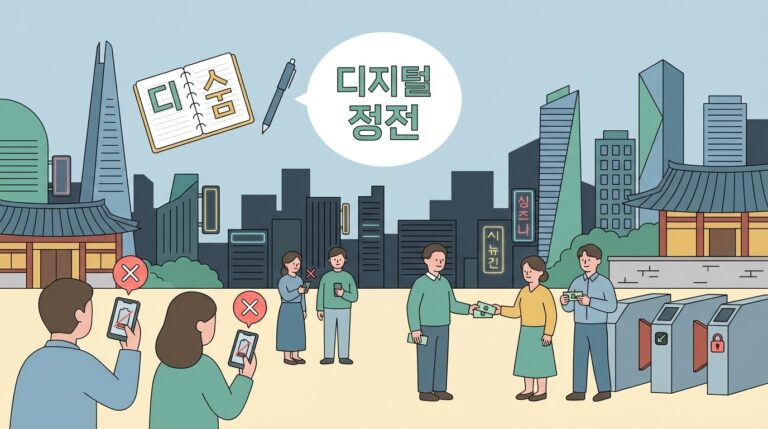
When Seoul Goes Offline: Surviving a Cyber Blackout in Korea like a Local
Phase 1: Empathy & The K-Culture Cold Open
Hello! I’m the Lead Editor at Daily Hangul. Welcome back to another deep dive into the Korean language.
Imagine this: You are standing in the middle of a bustling cafe in Gangnam. You’ve just ordered your iced Americano, and you confidently tap your smartphone on the terminal to pay. Silence. The machine doesn’t beep. You try again. Nothing. Suddenly, you notice the digital menu boards are flickering, people around you are staring blankly at their KakaoTalk screens, and the subway station outside is flashing a red warning sign.
In a K-Drama, this is the exact moment the brooding hacker protagonist types furiously on a multi-monitor setup while the government declares a state of emergency. A cyber-attack has just paralyzed the national IT infrastructure.
South Korea is arguably the most hyper-connected society on earth. We don’t carry wallets; we rely on Kakao for everything from messaging to hailing taxis, and our internet speed is a point of national pride. So, what happens when it all goes dark? If you don’t know the right expressions for this specific disaster, you might be left standing with an unpaid coffee and a lot of confusion. Let’s master the C2-level vocabulary you need to navigate a digital crisis like a true local.
Phase 2: Core Expressions Deep Dive
Here are the top three expressions you need when the digital world crashes around you.
1. 시스템이 먹통이 되다
- Pronunciation: siseutem-i meoktong-i doeda [sounds like: sys-tem-ee muk-tong-ee dway-da]
- Meaning: (Literal) The system became a wooden inkbox. / (Real Nuance) The system is completely dead/unresponsive.
- K-Culture Moment: You’re at a PC Bang (internet cafe) with friends, and mid-game, the screen freezes. Someone takes off their headset and yells, “아, 또 먹통이네!” (Ah, it’s dead again!).
- Editor’s Insight: The word ‘먹통’ (meoktong) originally referred to the wooden inkboxes carpenters used. Because they were sealed and black inside, the term evolved to mean someone who is deaf/blind to a situation, and eventually, a piece of technology that refuses to respond. It carries a heavy sigh of frustration.
- Situation Spectrum:
- Casual with friends: ✅
- Semi-formal with coworkers: ✅
- Formal/Official announcements: 🚫 (Use ‘장애가 발생하다’ instead)
- 🤔 Think About It: Why do Koreans use such an analog, traditional word (an inkbox) to describe the failure of cutting-edge technology? Does your native language also recycle ancient concepts for modern tech glitches?
2. 국가 전산망이 마비되다
- Pronunciation: gukga jeonsanmang-i mabidoeda [sounds like: gook-gah jun-san-mang-ee mah-bee-dway-dah]
- Meaning: (Literal) The national computer network is paralyzed. / (Real Nuance) Nationwide infrastructure is down due to a cyber-attack or systemic failure.
- K-Culture Moment: This is the phrase the solemn news anchor uses when a cyber-terrorist group hacks the national grid, plunging Seoul into darkness in a thriller movie.
- Editor’s Insight: ‘마비’ (mabi) means paralysis. We use it for the human body, but in Korea, the network is the central nervous system of society. When the network is down, the country is literally paralyzed.
- Situation Spectrum:
- Casual with friends: ⚠️ (A bit too dramatic for a simple Wi-Fi drop)
- Semi-formal with coworkers: ✅
- Formal/Official announcements: ✅
- 🤔 Think About It: Treating a network failure as a “bodily paralysis” shows how deeply integrated tech is in Korean society. How is a national tech failure described in your country?
3. 서버가 뻗다
- Pronunciation: seobeo-ga ppeotda [sounds like: suh-buh-gah pput-dah]
- Meaning: (Literal) The server stretched out its legs. / (Real Nuance) The server crashed/died from overload.
- K-Culture Moment: Ticketing day for a massive K-Pop concert. Millions of fans hit refresh at 8:00 PM exact. The screen goes white. The fandom group chat explodes: “서버 또 뻗었어!” (The server crashed again!).
- Editor’s Insight: ‘뻗다’ (ppeotda) means to stretch out. Think of someone who is so exhausted they just collapse on the floor with their limbs splayed out. That’s exactly how we visualize a server crashing from a DDoS attack or too much traffic.
- Situation Spectrum:
- Casual with friends: ✅
- Semi-formal with coworkers: ✅ (Very common in IT companies)
- Formal/Official announcements: 🚫
- 🤔 Think About It: Personifying technology as an exhausted worker collapsing on the floor—what does this tell you about Korean work culture and server loads?
Phase 3: Textbook vs. Real Korean
Let’s compare what you learned in the classroom with what you’ll actually hear when the cyber grid goes down.
[Situation 1: The payment terminal isn’t working]
* 📖 Textbook Korean: 단말기에 오류가 발생했습니다. (An error has occurred in the terminal.)
* 🗣️ Real Korean: 아, 기계가 완전 먹통이네요. (Ah, the machine is completely dead.)
* 💡 Why the difference?: Koreans prefer visceral, physical descriptors (‘먹통’) over clinical terms (‘오류’) to express the shared frustration of an inconvenience.
[Situation 2: Warning someone about a system crash]
* 📖 Textbook Korean: 현재 인터넷 연결이 불가능합니다. (Internet connection is currently unavailable.)
* 🗣️ Real Korean: 지금 통신망 다 뻗었대요. 아날로그로 가야 돼요. (They say the whole telecom network crashed. We gotta go analog.)
* 💡 Why the difference?: Using “뻗다” creates an immediate sense of urgency and camaraderie among victims of the outage.
Bottom Note: At the C2 level, your goal isn’t just to be understood; it’s to match the emotional frequency of the room. Using ‘뻗다’ in a tech crisis shows you truly understand the Korean corporate/digital vibe.
Phase 4: Cultural Context — K-Culture Deep Dive
4-1. Non-Verbal Elements: The Nunchi of a Blackout
When a system fails in Korea, do not immediately yell at the cashier. The non-verbal protocol is Nunchi (눈치). You must read the room. If the cashier is frantically tapping the screen and sweating, step back slightly, give a sympathetic nod, and patiently wait. Pushing your card forward again is considered rude. We share the trauma of the delay together.
4-2. K-Culture Connection: The Irony of “빨리빨리” (Ppalli-Ppalli)
In South Korea, everything is delivered fast, paid for instantly, and updated in real-time. This is the ‘빨리빨리’ (Hurry, hurry) culture. But when a cyber-attack hits and infrastructure paralyzes, this high-speed society hits a brick wall.
If you watch K-Dramas like Phantom (유령) or movies about cyber terrorism, the ultimate horror isn’t monsters; it’s the banking app failing and the navigation system shutting down in the middle of Seoul. During the real-life 2022 data center fire that brought down KakaoTalk, the nation experienced a collective panic attack. People couldn’t unlock their rented scooters, pay for meals, or find their way home. It proved that without our digital crutches, the mighty IT powerhouse suddenly has to remember how to use paper maps and physical cash.
Phase 5: Real-Life Roleplay Scenario
Setting: It’s 12:30 PM on a Tuesday. You and your Korean coworkers are at a busy, slightly chaotic K-BBQ restaurant for lunch. Suddenly, a breaking news alert pops up on everyone’s phones: “Massive Cyber Attack on National Banking Grid.” The restaurant owner is looking at the POS machine in a panic.
Characters:
– YOU: An expat executive who has lived in Seoul for a few years. You always keep a 50,000 KRW bill in your phone case “just in case.”
– Min-su (32): Your tech-savvy coworker who never carries physical cash and relies entirely on Samsung Pay.
Dialogue:
Min-su: 어? 삼성페이가 안 열리는데요? 로딩만 계속 돌아요. 📱
(eo? samseongpeiga an yeollindehyo? rodingman gyesok dorayo.)
[Huh? Samsung Pay isn’t opening. It’s just spinning on the loading screen.]
YOU: 뉴스 보니까 방금 국가 전산망에 사이버 테러 의심 공격이 있었대요.
(nyuseu bonikka banggeum gukga jeonsanmange saibeo tereo uisim gonggeogi isseotdaeyo.)
[Looking at the news, they say there was a suspected cyber terror attack on the national network just now.]
Min-su: 헐, 진짜요? 어쩐지 가게 포스기도 완전히 먹통이 된 것 같더라고요.
(heol, jinjjayo? eojjeonji gage poseugido wanjeonhi meoktongi doen geot gatdeoragoyo.)
[Whoa, really? No wonder the store’s POS machine seems completely dead too.]
(🎭 Stage Direction: Min-su anxiously taps his phone against his palm.)
Min-su: 아… 저 지갑 안 들고 다니는데 어떡하죠? 계좌 이체도 안 되려나?
(a… jeo jigap an deulgo danineunde eotteokhajo? gyejwa ichedo an doeryeona?)
[Ah… I don’t carry a wallet, what do I do? I guess bank transfers won’t work either?]
YOU: 은행 서버도 다 뻗었다고 하니까 당분간은 현금만 될 거예요.
(eunhaeng seobeodo da ppeodeotdago hanikka dangbungan-eun hyeongeumman doel geo-yeyo.)
[They say all the bank servers crashed too, so it’ll probably be cash only for a while.]
🔀 Your Turn! How do you handle this crisis like a boss?
– A) “제가 현금 있어요. 이거 쓰세요!” (Simple, textbook response.)
– B) “걱정 마세요. 제가 비상금 뽑아둔 게 있어서 오늘은 제가 쏘겠습니다!” (Smooth, situational awareness, and generous.)
– C) “대박! 한국 IT 다 죽었네요. 우리 그냥 도망갈까요?” (Too joking, inappropriate for a disaster context.)✅ Best Choice: B — Reason: You acknowledge his panic, reveal your preparedness (“비상금” – emergency stash), and casually offer to treat him (“제가 쏘겠습니다”), turning a tense disaster moment into a bonding opportunity.
⚠️ Choice C Analysis: While ‘대박’ (daebak) is fun, joking about “running away” without paying (먹튀) in front of an already stressed restaurant owner is a huge faux pas.
Phase 6: 10-Second Shadowing Drill
Let’s practice the cadence of a stressed, yet composed local assessing the IT failure.
😤 아, / 기계가 / 완전히 먹통이네요. / 서버가 뻗었나 봐요.
(a, / gigyega / wanjeonhi meoktong-ineyo. / seobeo-ga ppeodeonna bwayo.)
Meaning: Ah, the machine is completely dead. Looks like the server crashed.
Tip: Drop your pitch on ‘먹통’ to emphasize the heaviness of the failure, and sigh slightly on ‘아’.
Phase 7: K-Culture Mini Dictionary
| 한국어 | Romanization | English | Context |
|---|---|---|---|
| 먹통 | meoktong | Unresponsive / Brick | Used when tech freezes completely. |
| 전산망 | jeonsanmang | Computer Network | The grid. Usually used in news/formal contexts. |
| 뻗다 | ppeotda | Crash / Die | Used for servers or people passing out from exhaustion. |
| 비상금 | bisanggeum | Emergency Cash | Crucial in a cashless society when cyber attacks hit. |
| 우회 | uhoe | Bypass | Finding an analog or alternative route when systems fail. |
| 현금 없는 사회 | hyeongeum eomneun sahoe | Cashless Society | Korea’s current state, making it highly vulnerable to network outages. |
Phase 8: Traveler Survival Kit
Even if you’re just visiting, a cyber-attack or telecom fire will immediately affect you. No Naver Maps, no Subway app, no card payments.
🆘 Survival Expressions for the Analog Shift
– 🇰🇷 “혹시 현금 결제만 되나요?” (hoksi hyeongeum gyeoljeman doenayo?)
– 🗣️ Meaning: Is it cash only by any chance?
– 📍 Where to use: Cafes, taxis, restaurants during a network outage.
- 🇰🇷 “지금 와이파이 아예 안 터지죠?” (jigeum waipa-i aye an teojijyo?)
- 🗣️ Meaning: The Wi-Fi isn’t working at all right now, right?
- 📍 Where to use: Confirming with others that the outage is systemic, not just your phone.
📌 Editor’s Travel Note
– Cash is King in a Crisis: Korea is 95% cashless, but always keep a 50,000 KRW bill in your passport case. If the grid goes down, ATMs won’t work either.
– Offline Maps: Download an offline map of Seoul before arriving. KakaoMap and Naver Map require live data connections for most features.
Phase 9: Critical Thinking Corner — “A Step Deeper”
🧠 Think Deeper: Global Era & Vulnerability of the IT Powerhouse
South Korea’s rapid transformation into a hyper-connected, cashless society is a global success story. However, this extreme efficiency creates a paradoxical vulnerability. When a cyber-attack paralyzes the national infrastructure, the panic is profound because the society has lost its “analog muscle memory.”
The language reflects this: we use biological terms like “paralysis” (마비) for networks and “collapsing” (뻗다) for servers because technology has essentially become an extension of the Korean human body. Losing the network isn’t just an inconvenience; it’s an amputation of our social mobility and safety.
💬 Your Turn: How resilient is your home country to a sudden digital blackout? Do people still carry cash, or would society halt completely? Share your thoughts in the comments!
Phase 10: FAQ & Avoiding Misunderstandings
Q: Can I use “서버가 뻗었어요” (The server crashed) in an official business report?
A: No. While perfectly fine to say to your immediate team members in an emergency, written reports to executives or clients must use formal terminology: “서버 장애가 발생했습니다” (A server failure has occurred) or “시스템이 다운되었습니다” (The system is down).
Q: If a taxi’s card reader is broken due to a network outage, what do I do?
A: Communicate immediately. Say, “기사님, 지금 전산망 마비라서 카드 안 되죠? 현금 드릴게요.” (Driver, the network is down so cards don’t work, right? I’ll give you cash.) They will be incredibly relieved.
❌ Common Mistake: Translating “My phone died” literally as “내 전화기가 죽었어요.” (Nae jeonhwagiga jugeosseoyo.)
✅ Do this instead: To sound native, say “배터리가 나갔어요” (My battery went out) or if there’s no signal, “데이터가 안 터져요” (Data isn’t popping/connecting).
Phase 11: Summary & Action Items
One-Liner Summary: When a cyber disaster strikes Korea, don’t panic—grab your emergency cash and confidently declare that the system is “먹통” (meoktong) and the servers have “뻗었다” (ppeotda).
Action Mission 3 Steps:
– 🥉 Bronze (Solo): Stand in front of a mirror, look deeply frustrated, and sigh: “아, 시스템 또 먹통이야.”
– 🥈 Silver (Online): Comment on a tech-related YouTube video in Korean using the word ‘마비되다’.
– 🥇 Gold (Real-world): Next time an app crashes or a website takes too long to load while you’re with a Korean friend, casually drop: “서버 뻗었나 보네.”
K-Culture Mission: The Analog Challenge
Try navigating from your home/hotel to a cafe in Seoul without using a digital map or a card. Pay with physical cash and memorize the subway stops. Experience how Koreans felt during the 2022 blackout!
Phase 12: Interactive Quiz
1. Situational Judgment: You are at a company meeting, and the main server goes down due to a suspected hack. You need to inform the CEO. Which is the MOST appropriate phrase?
– A) 대표님, 우리 서버 먹통이에요.
– B) 대표님, 국가 전산망이 마비된 것 같습니다. 서버에 장애가 발생했습니다.
– C) 대표님, 서버가 뻗었어요. 퇴근할까요?
2. Fill in the Blank:
“아, 기계가 완전히 ( ________ )이네요. 카드가 안 읽혀요.”
3. True or False – K-Culture Edition:
In South Korea, because it’s a cashless society, you can legally demand a store to accept a bank transfer even if their IT system is completely hacked and down. (T/F)
🚨 Click here for the Answers!
1. B (You must use formal, professional language ‘장애가 발생하다/마비되다’ with the CEO. A and C are too casual and C will probably get you fired.)
2. 먹통 (meoktong)
3. False. While bank transfers (계좌이체) are common when card readers break under normal circumstances, during a national cyber paralysis, the banking apps themselves will be down, rendering transfers impossible. This is why having emergency physical cash is crucial!
Frequently Asked Questions (FAQ)
Q: What does "시스템이 먹통이 되다" mean in Korean and how do you pronounce it?
A: In Korean, "시스템이 먹통이 되다" is pronounced [siseutem-i meoktong-i doeda [sounds like: sys-tem-ee muk-tong-ee dway-da] and means: (Literal) The system became a wooden inkbox. / (Real Nuance) The system is completely dead/unresponsive.
Q: What does "국가 전산망이 마비되다" mean in Korean and how do you pronounce it?
A: In Korean, "국가 전산망이 마비되다" is pronounced [gukga jeonsanmang-i mabidoeda [sounds like: gook-gah jun-san-mang-ee mah-bee-dway-dah] and means: (Literal) The national computer network is paralyzed. / (Real Nuance) Nationwide infrastructure is down due to a cyber-attack or systemic failure.
Q: What does "서버가 뻗다" mean in Korean and how do you pronounce it?
A: In Korean, "서버가 뻗다" is pronounced [seobeo-ga ppeotda [sounds like: suh-buh-gah pput-dah] and means: (Literal) The server stretched out its legs. / (Real Nuance) The server crashed/died from overload.






