

Phase 1: Empathy (The K-Culture Cold Open)
Hello! I’m the Lead Editor at Daily Hangul.
Imagine this: You’ve finally arrived in Seoul! You drop your bags at the hotel and rush out to Myeongdong. The neon lights are glowing, and the smell of spicy Tteokbokki and sweet Hotteok fills the air. You point to a delicious skewer, pull out your credit card, and the vendor politely crosses their arms into an ‘X’ shape. Cash only!
Or maybe you’re at a K-Pop concert venue, and you spot fans selling unofficial merch (photocards, cute keyrings). You need Korean Won, and you need it now.
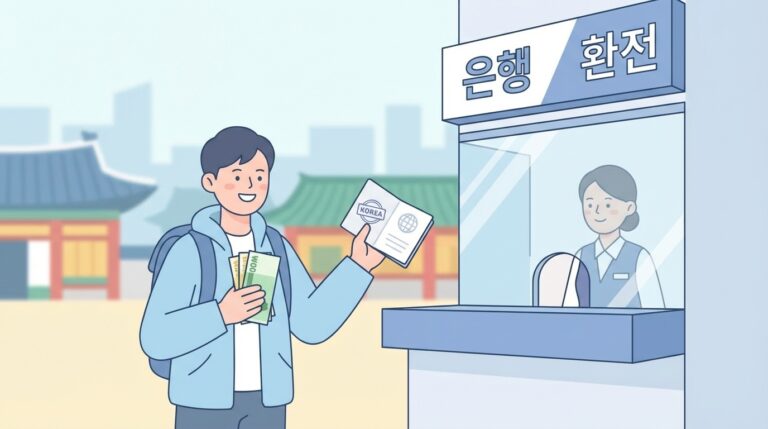
Walking into a Korean bank or a currency exchange booth (환전소) can feel intimidating. The guards, the ticketing machines, the fast-speaking tellers… But don’t worry! This guide is based on real experiences from my A1 students. Today, we’re going to learn exactly how to say “I’m here to exchange currency” and get you that cash so you can eat, shop, and explore like a true insider.
Phase 2: Core Expressions Deep Dive
Here are the top survival phrases you need at the bank.
1. 환전해 주세요 (Please exchange money)
- Pronunciation: hwanjeonhae juseyo [Hwan-jun-hae joo-se-yo]
- Sound-alike guide: ‘Hwan’ rhymes with ‘swan’. ‘Jeon’ sounds like ‘John’, but shorter. ‘Juseyo’ is your magic word for ‘please give me / please do’.
- Meaning: Literal: Please do the currency exchange. / Real: I’d like to exchange money.
- K-Culture Moment: In K-Dramas, when a character is about to flee the country, they slam a bag of gold bars on the counter and say this. For you, it’ll just be a normal Tuesday at the airport bank!
- Editor’s Insight: This is the most direct, polite, and perfect phrase for beginners. You don’t need complex grammar. Just say the noun (환전) + please do it (해 주세요).
- Situation Spectrum:
- Casual (Friends): 🚫 (Friends don’t exchange currency for you!)
- Semi-formal (Bank teller, Exchange booth): ✅
- Formal (Bank manager): ✅
- 🤔 Think About It: Why do Koreans use ‘주세요’ (please give/do for me) for almost every request? It reflects a culture of asking for a favor respectfully rather than giving a command. Do you have a universal “magic word” in your language?
2. 여권 여기 있어요 (Here is my passport)
- Pronunciation: yeogwon yeogi isseoyo [Yuh-gwon yuh-gee ee-suh-yo]
- Meaning: Literal: Passport here exists. / Real: Here is my passport.
- K-Culture Moment: You will hear “여기 있어요” (Here it is) everywhere in Korea—when a waiter brings your food, or when you hand your T-money card to the bus driver.
- Editor’s Insight: In Korea, you absolutely need your physical passport to exchange money at a bank. When they ask for ID, simply hand it over and say this phrase. It sounds incredibly natural!
- Situation Spectrum:
- Casual: ✅ (If a friend asks for something)
- Semi-formal: ✅
- Formal: ✅
- 🤔 Think About It: Notice how the word “my” (제) is missing? Korean frequently drops pronouns like “my” or “I” when the context is obvious. It makes the language fast and efficient!
Phase 3: Textbook vs. Real Korean
Let’s see how real people talk at the bank compared to textbooks.
[At the Bank Counter]
* 📖 Textbook Korean: 저는 달러를 한국 돈으로 환전하고 싶습니다. (I would like to exchange dollars into Korean money.)
* 🗣️ Real Korean: 환전해 주세요. (Please exchange money.) OR simply “환전이요.” (Exchange, please.)
* 💡 Why the difference?: Korean is a high-context language. If you are a foreigner standing at a bank counter with foreign cash in your hand, they already know what you want! Keep it short and polite.
[Handing Over the Money]
* 📖 Textbook Korean: 여기 백 달러가 있습니다. (Here is one hundred dollars.)
* 🗣️ Real Korean: (Just handing the money over with two hands) 여기요. (Here you go.)
* 💡 Why the difference?: Actions speak louder than words in Korea. The physical gesture of respect (using two hands) is often more important than a full grammatical sentence.
Phase 4: Cultural Context — K-Culture Deep Dive
4-1. Non-Verbal Elements: The “Two-Hand” Rule
In Korea, hands are just as vocal as words. When you hand your money and passport to the bank teller, do not slide it across the counter with one hand like a poker dealer.
Instead, hold the items with both hands, or use your right hand to pass the items while lightly supporting your right elbow or forearm with your left hand. This is the ultimate sign of respect. You will instantly look like someone who deeply understands Korean etiquette!
4-2. The “Number Ticket” (번호표) Culture
If you walk into a Korean bank, do not walk straight to the teller. Look for a machine near the door. This is the 번호표 (number ticket) machine.
Korean society runs on the “Bali Bali” (빨리빨리 – hurry, hurry) culture, but it is also highly organized. You must pull a ticket and wait for your number to chime on the screen.
Pro Tip: Sometimes the machine has different buttons for different services. Look for the button that says 환전 (Currency Exchange) or 외환 (Foreign Exchange)!
Phase 5: Real-Life Roleplay Scenario
Setting: It’s 10:00 AM in Myeongdong. You found a commercial bank. You pulled your number ticket and waited. Finally, “Ding-dong! Customer 104!” You walk up to the glass window.
Characters:
– YOU: An excited traveler who wants to buy K-Beauty products today.
– Teller (지민 – Jimin): A friendly, efficient bank employee wearing a neat uniform.
Dialogue:
지민: 어서 오세요. 어떻게 오셨어요? 😊
(eoseo oseyo. eotteoke osyeosseoyo?)
[Welcome. How can I help you?]
YOU: 안녕하세요! 환전해 주세요. 💵
(annyeonghaseyo! hwanjeonhae juseyo.)
[Hello! Please exchange money.]
지민: 네, 여권 주시겠어요?
(ne, yeogwon jusigesseoyo?)
[Yes, could you give me your passport?]
(🎭 Stage Direction: You reach into your bag to grab your passport.)
🔀 YOUR TURN! How should you respond and hand over your passport?
– A) (Toss it on the counter with one hand) “여권!” (Passport!)
– B) (Hand it with both hands) “여기 있어요.” (Here it is.)
– C) (Wave it in the air) “빨리빨리!” (Hurry, hurry!)✅ Best Choice: B — “여기 있어요” paired with the two-handed gesture is the gold standard of polite, natural Korean.
⚠️ Choice A & C Analysis: Throwing items or saying “빨리빨리” to a service worker is considered extremely rude. Never rush a Korean bank teller—they are already working as fast as humanly possible!
지민: 감사합니다. 백 달러 환전해 드리겠습니다. 서명해 주세요. ✍️
(gamsahamnida. baek dalleo hwanjeonhae deurigetseumnida. seomyeonghae juseyo.)
[Thank you. I will exchange 100 dollars. Please sign here.]
YOU: 네, 여기요.
(ne, yeogiyo.)
[Yes, here you go.]
지민: 여기 한국 돈 십삼만 원입니다. 즐거운 여행 되세요! 💸
(yeogi hanguk don sipsamman wonimnida. jeulgeoun yeohaeng doeseyo!)
[Here is 130,000 Korean won. Have a nice trip!]
YOU: 감사합니다!
(gamsahamnida!)
[Thank you!]
Phase 6: 10-Second Shadowing Drill
Practice out loud! Pay attention to the pauses (/) and the emotion tags.
- 😌 (Polite & Clear) 환전해 / 주세요. (hwanjeonhae / juseyo.)
- 🤝 (Handing it over) 여권 / 여기 있어요. (yeogwon / yeogi isseoyo.)
- ❓ (Asking casually) 어디서 / 환전해요? (eodiseo / hwanjeonhaeyo?) -> Where do I exchange money?
Phase 7: K-Culture Mini Dictionary
| Korean | Romanization | English | Context |
|---|---|---|---|
| 환전소 | hwanjeonso | Exchange Booth | Private booths often found in Myeongdong or Itaewon. Often offer better rates than banks! |
| 원 | won | Won | The Korean currency. (e.g., 만 원 – 10,000 won) |
| 여권 | yeogwon | Passport | Your absolute necessity for any banking in Korea. |
| 번호표 | beonhopyo | Number Ticket | The little paper ticket you pull at banks or hospitals to wait your turn. |
| 현금 | hyeongeum | Cash | What you need for street food! |
Phase 8: Traveler’s Survival Kit
🆘 Survival Phrases for Banking & Money
– 🇰🇷 “이거 얼마예요?” (igeo eolmayeyo?)
– 🗣️ Sound: Ee-guh ul-ma-ye-yo?
– 📍 Where to use: Markets, underground shopping malls, food stalls.
– 🇰🇷 “카드로 할게요.” (kadeuro halgeyo.)
– 🗣️ Sound: Ka-deu-ro hal-ge-yo.
– 📍 Where to use: Convenience stores, cafes, restaurants (when you prefer paying by card).📌 Editor’s Travel Note
– Card Heaven: South Korea is a nearly cashless society. You can buy a 1,000 won pack of gum with a credit card! However, traditional markets (like Gwangjang Market) and street food vendors still heavily rely on cash or local bank transfers.
– Exchange Rates: Airport banks have the highest fees. Exchange just enough for your bus/train to the city, then visit a “환전소” (Exchange Booth) in Myeongdong for the best rates.
– WOWPASS / Namane Card: Look into these foreigner-exclusive prepaid cards! You can load foreign cash into machines, and it converts to a Korean debit card + transit card.
Phase 9: Critical Thinking — “One Step Deeper”
Media vs Reality: The Cashless Society vs. The Reality of Street Markets
If you watch K-Dramas, you rarely see characters carrying cash. They pay for fancy dinners with sleek Samsung Pay or shiny black credit cards. It’s true—Korea has one of the highest cashless transaction rates in the world.
However, this creates a unique “dual reality” for tourists. While locals tap their phones to pay for almost everything, tourists discovering the raw, cultural side of Korea—like bustling night markets, tiny grandmother-owned eateries, or buying K-Pop socks in underground subway malls—suddenly find themselves in a cash-only bubble. This highlights a fascinating gap: the ultra-modern corporate Korea vs. the traditional, working-class Korea.
💬 Your Turn: Is your country moving towards a completely cashless society? Do you miss the feeling of physical money? Share your thoughts in the comments!
Phase 10: FAQ & Avoiding Misunderstandings
- Q: Can I exchange coins at a Korean bank?
- A: Usually, NO. Banks and exchange booths generally only accept foreign paper bills. Make sure your bills are clean and untorn!
- Q: Do I really need my physical passport? Can I use a photo on my phone?
- A: You MUST have the physical passport. Korean banking laws are very strict about identity verification.
- Q: Can I say “환전해” without “주세요”?
- A: No! That makes it an informal command (반말). You would sound like you are demanding money from the teller like a bank robber. Always add “주세요”.
❌ Common Mistake #1: Forgetting to pull a number ticket (번호표) and standing in line like at a grocery store.
✅ Do This Instead: Walk in, find the machine, press the button, take your ticket, and sit down until your number is called.
Phase 11: Summary & Action Items
One-Liner Summary: To get your Won safely and politely, hand over your passport with two hands and say, “환전해 주세요!”
Action Mission 3 Steps:
– 🥉 Bronze (Solo): Stand in front of a mirror, hold a book with two hands like it’s your passport, and say “여권 여기 있어요” three times.
– 🥈 Silver (Online): Find a Korean travel video on YouTube about Myeongdong street food and comment: “환전해 주세요! I’m ready for the food!”
– 🥇 Gold (Real Life): Next time you travel, use the two-hand rule when handing your payment to a cashier, even in your own country. Notice if it changes your posture!
K-Culture Mission:
Go to Google Maps (or Naver Maps), search for “Myeongdong Station,” and drop the Street View peg. Look around for signs that say “환전” or “Currency Exchange.” Imagine walking in and saying your new phrases!
Phase 12: Interactive Challenge Quiz
1. Situational Judgment: You walk into a Korean bank to exchange money. What is the FIRST thing you should do?
– A) Yell “환전해 주세요!”
– B) Look for the 번호표 (number ticket) machine.
– C) Wait in a single-file line behind the person currently at the counter.
2. Fill in the Blank:
You want to hand your passport to the teller.
“여권 ________ 있어요.” (Here is my passport.)
– A) 저기 (over there)
– B) 여기 (here)
– C) 빨리 (hurry)
3. True or False – K-Culture Edition:
In Korea, it is considered polite to hand money to the bank teller using only your left hand. (T/F)
4. Roleplay Outcome:
In Phase 5, if you chose to throw your passport on the counter and say “빨리빨리!” (Hurry up!), what would be the likely reaction of the teller?
– A) They will smile and work faster because they appreciate efficiency.
– B) They will internally panic, feel deeply disrespected, and the mood will become very cold.
Click to see the answers!
- B – You must pull a number ticket first!
- B – 여기 (yeogi) means ‘here’.
- False – You should use both hands, or your right hand supported by your left. Never just the left hand!
- B – Politeness is key. Rushing a worker is considered very rude in Korean service culture.
Frequently Asked Questions (FAQ)
Q: What does "환전해 주세요 (Please exchange money)" mean in Korean and how do you pronounce it?
A: In Korean, "환전해 주세요 (Please exchange money)" is pronounced [hwanjeonhae juseyo [Hwan-jun-hae joo-se-yo] and means: a key conversational Korean expression covered in this lesson.
Q: What does "여권 여기 있어요 (Here is my passport)" mean in Korean and how do you pronounce it?
A: In Korean, "여권 여기 있어요 (Here is my passport)" is pronounced [yeogwon yeogi isseoyo [Yuh-gwon yuh-gee ee-suh-yo] and means: Literal: Passport here exists. / Real: Here is my passport.







