

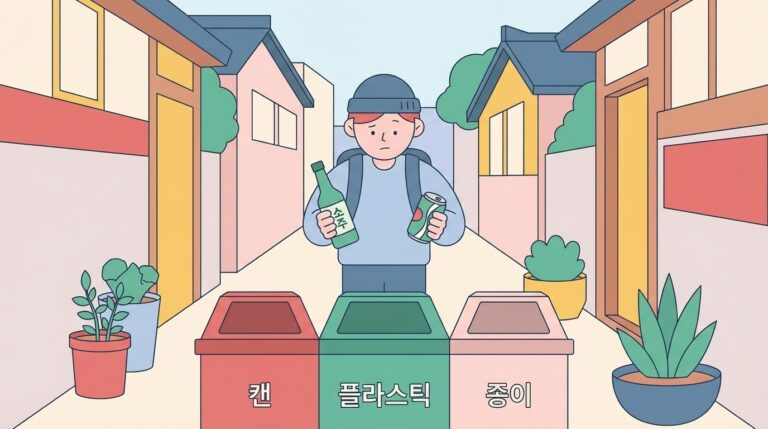
How to Survive Korea’s Strict Recycling: Disposing Cans & Bottles Like a Local
Phase 1: Empathy & The “Why”
Hello! I’m the Daily Hangul Editor, your personal K-Culture navigator and Korean tutor.
Picture this K-Drama moment: You’re sitting outside a Korean convenience store (편의점) under a glowing umbrella on a warm summer night. You and your friends just finished some spicy instant ramyeon and a refreshing can of local beer. The vibe is perfect. But then, it’s time to clean up. You grab your empty beer can and a green Soju glass bottle, walk up to the trash area, and freeze. There are five different bins staring back at you. A strict-looking ahjumma (middle-aged lady) is eyeing your every move. You start sweating.
If you just toss that can into the general waste bin, you might get a serious scolding! Korea has one of the best—and strictest—recycling systems in the world, known as 분리수거 (bunlisugeo). Knowing how to throw away your cans and glass bottles won’t just save you from an embarrassing encounter; it shows you respect the local culture, earning you instant “insider” points.
Don’t worry! This guide is based on real panic moments from my A1 students. By the end of this post, you’ll be recycling like a true Seoulite.
Phase 2: Core Expressions Deep Dive
Here are the three absolute survival phrases you need when holding an empty can or bottle.
1. 이거 어디에 버려요? (Where do I throw this away?)
- Pronunciation: [i-geo eo-di-e beo-ryeo-yo?]
- i-geo = ‘E’ (like elephant) + ‘go’
- eo-di-e = Sounds like asking “Oh, D.A.?”
- beo-ryeo-yo = beo (like ‘bun’ without ‘n’) + ryeo (like ‘Reo’ in Oreo) + yo.
- Meaning: Literal = This, where do (I) throw? / Real nuance = I want to do this right, please point me to the correct bin!
- K-Culture Moment: You’ll use this at an Airbnb, an office pantry, or a convenience store when you’re totally lost. It instantly triggers the “helpful Korean” instinct in locals.
- Editor’s Insight: This phrase is magic. It shows you want to follow the rules but just need help. It’s polite but very practical.
- Situation Spectrum:
- Casual with friends: ✅ (Say: 이거 어디에 버려? Drop the ‘yo’)
- Semi-formal (Convenience store worker): ✅
- Formal (Boss/Elders): ⚠️ (Better to say: “이것은 어디에 버려야 합니까?”)
- 🤔 Think About It: Why don’t Koreans just have one big trash can like in some other countries? How does the lack of land in Korea influence this culture?
2. 캔이랑 병은 따로 버리세요. (Throw cans and bottles separately.)
- Pronunciation: [kaen-i-rang byeong-eun tta-ro beo-ri-se-yo.]
- tta-ro = Double ‘t’ (strong T) + ro.
- Meaning: Literal = Cans and bottles, separately throw away. / Real nuance = Don’t mix them up, put them in their own bins!
- K-Culture Moment: When an Airbnb host explains the house rules, or when you read a sign at a K-Pop concert cleanup zone.
- Editor’s Insight: The key word here is 따로 (ttaro), meaning “separately.” If you hear this word, DO NOT mix your trash!
- Situation Spectrum:
- Casual with friends: ✅ (캔이랑 병 따로 버려)
- Semi-formal: ✅
- Formal: 🚫 (You wouldn’t usually command an elder to throw out trash!)
- 🤔 Think About It: In Korean restaurants, side dishes come on separate little plates. Trash is also separated strictly. Do you notice a pattern of categorization in daily Korean life?
3. 씻어서 버려주세요. (Please wash it and throw it away.)
- Pronunciation: [ssi-seo-seo beo-ryeo-ju-se-yo.]
- ssi-seo-seo = Make a strong, hissing ‘S’ sound for the first syllable.
- Meaning: Literal = Wash and throw please. / Real nuance = Rinse out the remaining beer/soda before recycling it.
- K-Culture Moment: When ordering K-Food delivery (like Tteokbokki in plastic containers or canned drinks), you must rinse out the red sauce and sticky liquids before recycling!
- Editor’s Insight: Yes, Koreans wash their garbage! If a bottle has sweet juice left in it, it attracts bugs and ruins the recycling process.
- Situation Spectrum:
- Casual with friends: ✅
- Semi-formal: ✅
- Formal: 🚫
- 🤔 Think About It: Washing trash before throwing it away requires extra effort for the sake of the community. How does this reflect the Korean concept of “Jeong” (정 – collective care) or “Nunchi”?
Phase 3: Textbook vs. Real Korean
Let’s see how language changes from the textbook to the buzzing streets of Seoul.
[Situation 1: Reading signs at the trash area]
* 📖 Textbook Korean: 캔과 유리병은 분리수거함에 배출하십시오. (Please discharge cans and glass bottles into the recycling bin.)
* 🗣️ Real Korean: 캔/병은 저쪽에 놔두세요. (Just leave the cans/bottles over there.)
* 💡 Why the difference?: Textbooks use formal written Korean (공지어) for public signs, but in real life, Koreans prefer quick, direct, and slightly softer spoken directions.
[Situation 2: Telling your friend you’ll throw it away]
* 📖 Textbook Korean: 제가 분리수거를 하겠습니다. (I will do the recycling.)
* 🗣️ Real Korean: 쓰레기 내가 버릴게. (I’ll throw away the trash.)
* 💡 Why the difference?: Among friends, nobody uses the formal term “bunlisugeo” (recycling process). They just say “throw away the trash” using casual speech (반말).
Bottom Note: As an A1 learner, stick to “이거 어디에 버려요?” It’s perfectly polite and works 99% of the time!
Phase 4: Cultural Context — K-Culture Deep Dive
4-1. Non-Verbal Elements & Nunchi
When throwing away trash, Nunchi (눈치) is everything! Nunchi is the subtle art of reading the room. If you are at a friend’s house and they are separating the bottle caps from the glass bottles… don’t just stand there! Hand them the bottles. Also, when asking someone where the trash is, hold the trash slightly away from them so it doesn’t get in their personal space.
4-2. K-Drama & K-Travel Connection: Han River Hangouts
You’ve seen it in dozens of K-Dramas: the iconic Han River (한강) picnic. Characters spread out a mat, order delivery, and drink canned beer. But what the drama usually skips is the intense cleanup process at the end!
At the Han River parks, there are massive recycling stations. You cannot just leave your cans on the grass. You must walk to the station, pour out any leftover liquid in a specific bucket, throw the can in the “Can (캔)” bin, and the glass in the “Bottle (병)” bin. If you look lost at these stations, an older Korean citizen might literally take the can from your hand and put it in the right bin for you. That’s the rough but warm Korean affection!
Phase 5: Practical Roleplay Scenario
Scenario A: The Convenience Store Patio
- Setting: 11 PM on a Friday. The outdoor patio of a GS25 convenience store in Hongdae. The plastic table is covered with empty ramen cups and canned sodas.
- Characters:
- YOU: A foreign traveler on your 3rd day in Korea. You want to be a good tourist.
- Ji-hoon (25): A friendly Korean college student sitting at the next table, noticing you look confused.
YOU: (Staring at an empty soda can and a glass Soju bottle, looking around nervously)
(English) Oh man, where does this go…
(🎭 Stage Direction: You hold up the can and look at the bins)
지훈: 도와드릴까요?
(Do-wa-deu-ril-kka-yo?)
(English) Can I help you?
YOU: 아, 네! 이거 어디에 버려요? 🥫
(A, ne! i-geo eo-di-e beo-ryeo-yo?)
(English) Ah, yes! Where do I throw this away?
지훈: 아, 캔은 저기 파란색 통이요.
(A, kaen-eun jeo-gi pa-ran-saek tong-i-yo.)
(English) Ah, cans go in that blue bin over there.
YOU: 유리병은요?
(Yu-ri-byeong-eun-yo?)
(English) What about the glass bottle?
지훈: 병은 노란색 통에 버리세요.
(Byeong-eun no-ran-saek tong-e beo-ri-se-yo.)
(English) Throw bottles in the yellow bin.
🔀 Your Turn! The bottle still has a little bit of soda inside. What should you do?
– A) Just throw it in the yellow bin quickly before he notices.
– B) Ask: “이거 물로 씻어야 돼요?” (Do I have to wash this with water?)
– C) Drink the rest of the flat soda.✅ Best Choice: B — This shows peak cultural awareness! Ji-hoon will be incredibly impressed. (Though pouring the liquid into the liquid-waste bucket is usually enough at a convenience store!).
⚠️ Choice A Analysis: The liquid will attract bugs and ruin the recycling. You might get scolded by the store clerk!
YOU: 감사합니다!
(Gam-sa-ham-ni-da!)
(English) Thank you!
지훈: 네, 남은 물은 저기 버리고 캔이랑 병은 따로 버리세요!
(Ne, na-meun mu-reun jeo-gi beo-ri-go kaen-i-rang byeong-eun tta-ro beo-ri-se-yo!)
(English) Yes, throw away the leftover liquid there, and throw the cans and bottles separately!
YOU: 네, 알겠습니다!
(Ne, al-get-seum-ni-da!)
(English) Yes, understood!
(🎭 Stage Direction: You triumphantly separate the trash. You feel like a local.)
Scenario B: K-Culture Bonus (The BBQ Restaurant)
- Setting: A loud Korean BBQ restaurant. You’ve finished your meal and want to help clean up the empty Soju bottles.
YOU: 사장님, 빈 병 어디에 놔둬요? (Boss, where do I leave the empty bottles?)
사장님 (Boss): 그냥 상 위에 두세요! 치워드릴게요~ (Just leave them on the table! I’ll clean it up~)
💡 Pro-tip: In Korean restaurants, you don’t need to throw away the glass bottles yourself. The staff collects them because they get small refunds for returning them!
Phase 6: 10-Second Shadowing Drill
Let’s train your muscle memory. Repeat this out loud!
🥺 저기요... / 이거 / 어디에 / 버려요?
(jeo-gi-yo... / i-geo / eo-di-e / beo-ryeo-yo?)
Emotion Tag: Look slightly helpless and polite. Use this to get someone’s attention before asking!
😤 캔이랑 / 병은 / 따로 / 버리세요!
(kaen-i-rang / byeong-eun / tta-ro / beo-ri-se-yo!)
Emotion Tag: Firm and instructive. (Imagine you are the strict neighbor teaching a newbie).
Phase 7: K-Culture Mini Dictionary
| Korean | Romanization | English | Cultural Context |
|---|---|---|---|
| 분리수거 | bunlisugeo | Recycling | The holy grail of Korean waste management. It means “separate collection.” |
| 쓰레기통 | sseuregitong | Trash can | Sometimes hard to find on Korean streets! |
| 일반 쓰레기 | ilban sseuregi | General waste | Things that cannot be recycled. Requires a special paid plastic bag (종량제 봉투). |
| 캔 | kaen | Can | Soda, beer, and canned coffee containers. |
| 유리병 | yuribyeong | Glass bottle | Soju and beer bottles. |
| 재활용 | jaehwalyong | Recycling | You will see this word on many bins. It literally means “re-use.” |
Phase 8: Traveler’s Survival Kit
If you are traveling in Korea, this is your holy grail for trash!
🆘 Survival Phrases for the Streets
– 🇰🇷 “일반 쓰레기봉투 주세요.” (ilban sseuregi bongtu juseyo.)
– 🗣️ Guide: il-ban sseu-re-gi bong-tu ju-se-yo.
– 📍 Where to use: Convenience stores. (You MUST buy government-mandated trash bags to throw away general waste at your Airbnb!)📌 Editor’s Travel Note
– No Public Trash Cans? You might notice there are almost NO public trash cans on the streets of Seoul. Why? Because people used to dump their household trash in them to avoid buying the paid trash bags!
– What to do: Carry your empty coffee cup or can with you until you find a subway station or a restroom—they always have recycling bins.
Phase 9: Critical Thinking Corner — “One Step Deeper”
🧠 Think Deeper: Global Era & The Environment
When you visit Korea, the strict recycling culture (분리수거) might feel overwhelming. You have to separate labels from plastic bottles, wash out cans, and separate clear glass from green glass. Why is Korea like this?
Korea is a country with a very high population density and very little landmass. Decades ago, they realized they simply didn’t have enough space for massive landfills. The strict recycling system was born out of survival. It also reflects a deep cultural mindset of communal responsibility. If one person doesn’t separate their cans, the entire apartment building might get fined. It’s the ultimate test of living in harmony with your neighbors.
💬 Your Turn: How does recycling work in your country? Do you wash your cans before throwing them away? Let us know in the comments!
Phase 10: FAQ & Avoiding Common Mistakes
Q: Can I just put my empty cans in a plastic bag and leave it outside my hotel room?
A: In a hotel, yes, the cleaning staff handles it. But in an Airbnb or Guesthouse, NO! You must use the designated bins downstairs.
Q: I broke a glass bottle. Do I put it in the glass recycling bin (유리병)?
A: NO! This is a massive safety hazard. Broken glass cannot be recycled normally. Wrap it thickly in newspaper, put it in a general waste bag, and label it “Broken Glass (깨진 유리).”
❌ Common Mistake #1: Throwing food-stained paper or unwashed cans into the recycling.
✅ How to fix it: If a can has dried, sticky syrup in it that won’t wash out, it is actually GENERAL WASTE (일반 쓰레기). Only clean items get recycled!
Phase 11: Summary & Action Items
One-Liner Summary: When in doubt about your empty can or bottle, politely ask, “이거 어디에 버려요?” (Where do I throw this away?) and remember to wash it first!
Your Action Missions:
– 🥉 Bronze (Solo): Look at an empty can or bottle in your room right now and say “이거 어디에 버려요?” out loud 3 times.
– 🥈 Silver (Online): Comment below with the Korean word for “Recycling” without scrolling up!
– 🥇 Gold (Real Life): Next time you are at a Korean restaurant or convenience store, try separating your trash and identifying the 캔 and 병 signs.
K-Culture Mission: Watch any modern K-Drama today. I guarantee you will spot a character taking out the recycling (usually in a designated clear bag) in at least one episode. Pay attention to how the bins are organized!
Phase 12: Quiz — Interactive Challenge
1. Situational Judgment: You are at a Han River park. You finish a can of beer. What is the most Korean thing to do?
– A) Hide it under a bench.
– B) Throw it in the nearest bin, regardless of the color.
– C) Walk to the recycling station, empty any leftover drops, and put it in the bin marked ‘캔’.
(Answer: C! Leaving trash is a big no-no, and mixing trash is frowned upon.)
2. Fill in the Blank:
Friend: “Can you help me clean up?”
You: “Yeah! 캔이랑 병은 ______ 버리세요!” (Throw cans and bottles separately!)
(Answer: 따로 – ttaro)
3. True or False – K-Culture Edition:
“In Korean BBQ restaurants, you must carry your empty Soju bottles to the recycling bin outside.”
(Answer: FALSE. The restaurant staff will clear the table. Just leave the bottles on the table!)
Awesome job today! You are now fully equipped to keep Korea clean and impress the locals. See you in the next Daily Hangul lesson! 👋
Frequently Asked Questions (FAQ)
Q: What does "이거 어디에 버려요? (Where do I throw this away?)" mean in Korean and how do you pronounce it?
A: In Korean, "이거 어디에 버려요? (Where do I throw this away?)" is pronounced [i-geo eo-di-e beo-ryeo-yo?] and means: a key conversational Korean expression covered in this lesson.
Q: What does "캔이랑 병은 따로 버리세요. (Throw cans and bottles separately.)" mean in Korean and how do you pronounce it?
A: In Korean, "캔이랑 병은 따로 버리세요. (Throw cans and bottles separately.)" is pronounced [kaen-i-rang byeong-eun tta-ro beo-ri-se-yo.] and means: a key conversational Korean expression covered in this lesson.
Q: What does "씻어서 버려주세요. (Please wash it and throw it away.)" mean in Korean and how do you pronounce it?
A: In Korean, "씻어서 버려주세요. (Please wash it and throw it away.)" is pronounced [ssi-seo-seo beo-ryeo-ju-se-yo.] and means: a key conversational Korean expression covered in this lesson.







