

Phase 1: Empathy (Immersive Opening)
Hello! I’m your Daily Hangul Editor.
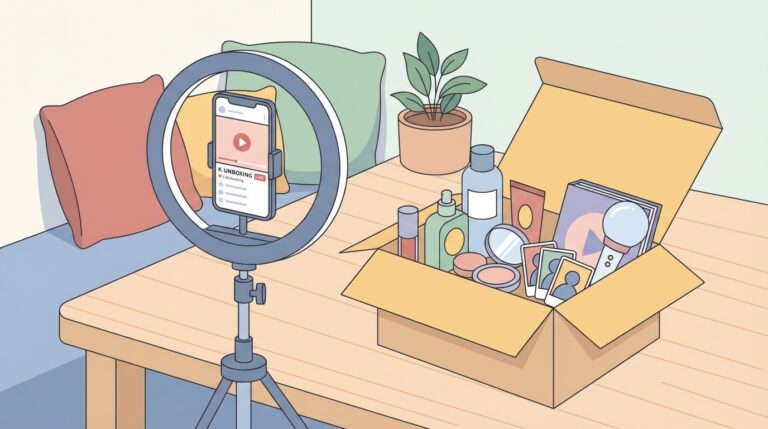
Imagine this: You’re sitting in front of your ring light, holding that brand new K-Pop album or the trending K-Beauty serum you waited three weeks to be delivered. You hit record. You want to enthusiastically say, “This looks amazing in person!” or “This is totally worth the money!” but… you pause. If you use the textbook Korean you learned, your exciting unboxing video might suddenly sound like a 9 PM news report!
Or perhaps you’re scrolling through Korean online shopping apps like Coupang or Zigzag, trying to figure out if a product is actually good or just heavily sponsored. You see comments full of slang you can’t find in the dictionary.
Knowing real-life review and unboxing vocabulary isn’t just about making your TikToks or Reels pop. It’s an essential B2-level survival skill that helps you decipher genuine Korean reviews, avoid getting scammed, and instantly sound like an ‘Insider’ (인싸). Let’s dive into the authentic expressions real Korean influencers and shoppers use!
Phase 2: Deep Dive into Key Expressions
1. 내돈내산 (naedonnaesan)
- Pronunciation: [nae-don-nae-san]
- Meaning: (Literal) My money, my buy. / (Real nuance) I bought this with my own money (100% honest, non-sponsored review).
- K-Culture Moment: You’ll see this as a hashtag on almost every genuine YouTube review or Instagram post. When a beauty YouTuber holds up an empty bottle of toner and says “이거 진짜 내돈내산이에요,” trust levels skyrocket.
- Editor’s Insight: This is a catchy abbreviation of “내 돈 주고 내가 산 (I paid my money and I bought it).” It implies, “I have no reason to lie because nobody paid me to say this.”
- Situation Spectrum:
- Friends (Casual): ✅
- Co-workers (Semi-formal): ✅ (Great for casual office chats about shopping)
- Boss/Elders (Formal): ⚠️ (A bit too internet-slangy, though widely understood)
- 🤔 Think About It: Why is a specific word for “non-sponsored” so popular in Korea? How does this reflect the modern consumer’s desire for transparency in the influencer era?
2. 실물 깡패 (silmul kkangpae)
- Pronunciation: [sil-mul kkang-pae]
- Meaning: (Literal) Real-life gangster. / (Real nuance) Looks insanely better in person than in photos or videos.
- K-Culture Moment: A K-Pop fan carefully opens an album, pulls out the random photocard, gasps, and covers her mouth. “와… 이번 지민 포카 완전 실물 깡패야!” (Wow… this Jimin photocard looks incredibly good in person!)
- Editor’s Insight: In Korean slang, adding “깡패” (gangster) to a word means it heavily dominates that category. It “beats up” everything else with how good it is in reality!
- Situation Spectrum:
- Friends (Casual): ✅
- Co-workers (Semi-formal): ⚠️
- Boss/Elders (Formal): 🚫 (Do not call your boss’s new watch a gangster!)
- 🤔 Think About It: Can you think of English slang where a typically negative word (like ‘sick’ or ‘badass’) is used as a supreme compliment?
3. 갓성비 (gasseongbi)
- Pronunciation: [gat-seong-bi]
- Meaning: (Literal) God + Cost-effectiveness. / (Real nuance) God-tier value for money; an absolute steal.
- K-Culture Moment: You order a massive set of spicy tteokbokki, fries, and drinks for just 10,000 won. Your Korean friend snaps a photo for their IG story with the caption: “갓성비 대박 떡볶이집 발견!”
- Editor’s Insight: The textbook word for cost-effectiveness is 가성비 (gaseongbi). By replacing ‘가’ with the English word ‘God’, you emphasize that the value is miraculously good.
- Situation Spectrum:
- Friends (Casual): ✅
- Co-workers (Semi-formal): ✅
- Boss/Elders (Formal): 🚫
- 🤔 Think About It: Koreans love combining English words with Korean concepts (like God + seongbi). Does your native language create new slang by mixing in foreign words?
Phase 3: Textbook vs. Real Korean
[Describing how something looks in person]
* 📖 Textbook Korean: 사진보다 직접 보는 것이 더 예쁩니다. (Looking at it directly is prettier than the picture.)
* 🗣️ Real Korean: 와, 이거 완전 실물 깡패예요! 영롱하다 진짜! (Wow, this is a real-life gangster! It’s so radiant!)
* 💡 Why it’s different: Online culture favors strong, punchy, and slightly exaggerated expressions (like ‘gangster’ or ‘radiant’) over dry, descriptive sentences to capture immediate emotional reactions.
[Confirming you bought it yourself]
* 📖 Textbook Korean: 저는 협찬을 받지 않고 제 돈으로 샀습니다. (I did not receive sponsorship and bought it with my money.)
* 🗣️ Real Korean: 이거 100% 내돈내산 찐 후기입니다. (This is a 100% my-money-my-buy real review.)
* 💡 Why it’s different: “찐” (jjin – real/authentic) and abbreviations like “내돈내산” save time typing and immediately signal that you belong to the modern digital generation.
[Talking about the price]
* 📖 Textbook Korean: 가격에 비해 품질이 아주 좋습니다. (The quality is very good compared to the price.)
* 🗣️ Real Korean: 이거 완전 갓성비 템이에요. 무조건 사세요. (This is a total god-tier value item. Buy it unconditionally.)
* 💡 Why it’s different: Fast-paced consumer culture creates a need for quick, impactful recommendations. “템” (tem) is short for “아이템” (item).
Bottom Note: For B2 level learners, using “갓성비” and “내돈내산” shows high cultural fluency without crossing the line into overly aggressive or inappropriate internet slang.
Phase 4: Cultural Context — K-Culture Deep Dive
4-1. Non-verbal Nuances in Unboxing
When filming an unboxing video, Korean influencers often utilize ASMR elements. Before opening a box, they will lightly tap their fingernails against the cardboard. When holding up a small item (like a lipstick), they will put their hand flat behind the item so the camera lens can auto-focus. This “influencer hand gesture” (뷰티 유튜버 손짓) is a universal non-verbal cue in K-Beauty!
Also, Nunchi (눈치) applies heavily to online reviews. Even when Koreans leave a negative review, they often soften the blow. Instead of saying “This tastes terrible,” they might say “제 입맛에는 안 맞네요” (It doesn’t suit my personal taste). It’s a way of being considerate to the business owner.
4-2. The K-Pop Connection: Album Kkang (앨범 깡)
In the K-Pop fandom, an unboxing video isn’t just an unboxing—it’s a ritual called 앨범 깡 (Album Kkang). The suffix ‘-깡’ originally meant to forcefully rip something open. Now, it’s the standard term for mass-opening albums or blind boxes.
When fans open the album, they hide the random photocard (포카 – poka) and reveal it slowly to build suspense. If they pull their “bias” (최애 – choeae), you will hear the ultimate joyful scream. Learning this vocabulary is essential if you want to participate in the global K-Pop community’s most exciting moments!
Phase 5: Real-Life Roleplay Scenario
Let’s put you in the director’s chair!
Setting: A sunny Saturday afternoon in your cozy bedroom. You have your smartphone set up on a tripod. You are about to film a haul video of the K-Beauty products you bought from Olive Young.
Characters:
– YOU: A B2 Korean learner who loves K-Culture and wants to start a TikTok channel.
– Minji (26): Your energetic Korean friend who is acting as your camera operator and hype woman.
Dialogue:
Minji: 자, 카메라 돌아요! 3, 2, 1, 액션! 🎬
(Ja, kamera dorayo! 3, 2, 1, aeksyeon!)
[Translation] Okay, camera is rolling! 3, 2, 1, action!
YOU: 안녕하세요 여러분! 오늘은 올리브영 하울 영상을 찍어볼게요.
(Annyeonghaseyo yeoreobun! Oneureun ollibeuyeong haul yeongsangeul jjigeobolgeyo.)
[Translation] Hi guys! Today I’m going to film an Olive Young haul video.
Minji: 오~ 기대되는데요? 첫 번째 아이템 보여주세요!
(O~ gidaedoeneundeyo? Cheot beontjae aitem boyeojuseyo!)
[Translation] Oh~ I’m excited! Show us the first item!
YOU: 짜잔! 요즘 핫하다는 틴트예요.
(Jjajan! Yojeum hathadaneun tinteuyeyo.)
[Translation] Ta-da! It’s the tint that’s super hot these days.
Minji: (🎭 Zooming in) 패키지 진짜 예쁘다. 협찬받으신 건가요? 장난장난~
(Paekiji jinjja yeppeuda. Hyeopchanbadeusin geongayo? Jangnan-jangnan~)
[Translation] The packaging is so pretty. Did you get sponsored? Just kidding~
🔀 Your Turn! How should you respond to prove it’s your own money?
– A) “아닙니다. 제가 번 돈으로 지불했습니다.” (Too robotic and formal!)
– B) “에이, 당연히 내돈내산이죠! 영수증도 있어요.”
– C) “저 돈 많아요.”✅ Best Choice: B — It perfectly uses the native slang to assure the audience it’s an honest review.
⚠️ Choice A & C Analysis: A sounds like a police interrogation. C sounds arrogant and misses the cultural context of why she asked!
(Continuing with Choice B)
YOU: 에이, 당연히 내돈내산이죠! 영수증도 있어요.
(Ei, dangyeonhi naedonnaesanijyo! Yeongsujeungdo isseoyo.)
[Translation] Hey, of course it’s my-money-my-buy! I even have the receipt.
Minji: 역시! 그럼 한 번 발라보세요.
(Yeoksi! Geureom han beon ballaboseyo.)
[Translation] As expected! Then try putting it on.
YOU: (🎭 Applies it to the back of your hand) 와… 색감 미쳤어요.
(Wa… saekgam micheosseoyo.)
[Translation] Wow… the colors are crazy.
Minji: 대박! 화면보다 훨씬 예쁜데요?
(Daebak! Hwamyeonboda hwolssin yeppeundeyo?)
[Translation] Daebak! It’s way prettier than on screen?
YOU: 맞아요, 이거 완전 실물 깡패예요. 갓성비 템으로 인정합니다!
(Majayo, igeo wanjeon silmul kkangpaeyeyo. Gasseongbi temeuro injeonghamnida!)
[Translation] Right, this is a total real-life gangster. I approve this as a god-tier value item!
Phase 6: 10-Second Shadowing Drill
Practice your intonation like a true influencer!
- 😤 단호하게 (Firmly, showing trust):
이거는 / 100% / 내돈내산 / 찐 후기입니다!
(igeoneun / baek-peosenteu / nae-don-nae-san / jjin hugi-imnida!) - 🥺 감격하며 (Overwhelmed with awe):
와... / 사진보다 / 완전 / 실물 깡패예요.
(wa… / sajinboda / wanjeon / silmul kkangpaeyeyo.) - 😊 밝게 (Brightly, recommending):
이 가격에 / 이 퀄리티면 / 완전 / 갓성비죠!
(i gagyeoge / i kwollitimyeon / wanjeon / gasseongbijyo!)
Phase 7: K-Culture Mini Dictionary
| 한국어 | Romanization | English | Cultural Context |
|---|---|---|---|
| 하울 | haul | Haul | Borrowed from English, referring to showcasing a large amount of purchased goods (e.g., 하울 영상). |
| 득템 | deuk-tem | Great find | “득(얻다, gain)” + “템(item)”. Getting a great item, usually at a good price or rare to find. |
| 영롱하다 | yeong-rong-ha-da | Radiant/Sparkling | A poetic word heavily used by Gen Z to describe shiny cosmetics, jewelry, or K-Pop merch. |
| 언박싱 / 깡 | eonbangsing / kkang | Unboxing | ‘언박싱’ is used generally, while ‘깡’ is heavily used in fandoms (e.g., 앨범 깡). |
| 별점 테러 | byeol-jeom te-reo | Review bombing | Leaving 1-star reviews maliciously on delivery apps or shopping sites. |
Phase 8: Traveler Survival Kit
Even if you aren’t filming a YouTube video, you’ll need these shopping skills when visiting Korea! Whether you are at a K-Pop pop-up store in Seongsu-dong or Olive Young in Myeongdong, knowing what’s popular is key.
🆘 Survival Phrases for Offline Shopping
– 🇰🇷 “이거 요새 제일 잘 나가는 거 맞죠?” (igeo yosae jeil jal naganeun geo matjyo?)
– 🗣️ Meaning: This is the best-selling one these days, right?
– 📍 Where to use: Stores, boutiques, cosmetic shops.
- 🇰🇷 “혹시 새 상품으로 주실 수 있나요?” (hoksi sae sangpumeuro jusil su innayo?)
- 🗣️ Meaning: Could you possibly give me a new/unopened one?
- 📍 Where to use: When purchasing a display item but wanting a boxed one for unboxing!
📌 Editor’s Travel Note
– Review Events (리뷰 이벤트): In Korea, whether ordering food on Baemin or visiting a restaurant, you’ll see “Review Events.” If you promise to write a review with a photo, they will give you free service (like an extra drink or cheese topping). It’s a massive part of Korean consumer culture!
Phase 9: Critical Thinking — “One Step Deeper”
🧠 Think Deeper: Media vs Reality (The Demand for Transparency)
Why did the word “내돈내산” (My money, my buy) become so culturally significant in Korea? A few years ago, the Korean internet was rocked by the “뒷광고 (Back-door advertising)” scandal. Many top influencers were caught promoting products while pretending they bought them with their own money. The public felt deeply betrayed because Korean society highly values authenticity and trust (정/Jeong) between creators and their communities. As a result, explicitly stating “내돈내산” became a mandatory badge of honor. It highlights how Korean language adapts instantly to social controversies, creating new vocabulary to rebuild social trust.
💬 Your Turn: Have influencers in your country ever faced a similar advertising scandal? How do creators in your culture prove their reviews are genuine? Share your thoughts in the comments!
Phase 10: FAQ & Avoiding Misunderstandings
- Q: Can I write “실물 깡패” in a formal review on a company website?
- No! While it’s great for Instagram, YouTube, or casual blog posts, avoid using slang words containing “깡패(gangster)” in official customer service complaints or formal company reviews.
- Q: Is it okay to use English words like “sponsor” or “unboxing” in Korean?
- Yes and No. Koreans use “언박싱” (unboxing) frequently. However, for sponsorships, saying “스폰서 (sponsor)” can sometimes carry a negative or inappropriate nuance in certain contexts in Korea. It’s much safer and more natural to use the Korean term “협찬” (hyeop-chan) for product sponsorships.
❌ Common Mistake #1: Saying “이거 제 돈이에요” (This is my money) to mean you bought it yourself.
✅ Do This Instead: Say “이거 내돈내산이에요” (slang) or “제 돈으로 직접 샀어요” (polite/standard).
Phase 11: Summary & Action Items
One-Liner Summary: Boost your Korean review skills by dropping textbook formalities and using native gems like Naedonnaesan (bought with my own money) and Silmul Kkangpae (looks amazing in person)!
Action Mission:
– 🥉 Bronze (Solo): Say “이거 완전 갓성비예요!” out loud 3 times in front of your mirror.
– 🥈 Silver (Online): Find a Korean product you recently bought and post a picture of it on social media with the hashtag #내돈내산.
– 🥇 Gold (Real-world): Go to a Korean cafe or store, buy something worth the price, and tell your Korean friend “이거 가성비 진짜 좋네요!”
K-Culture Mission:
Go to YouTube and search “올리브영 하울” (Olive Young Haul) or “앨범 깡” (Album Kkang). Watch 3 minutes of a video and try to catch the moment they mention the price, the packaging, or use the word “대박”!
Phase 12: Interactive Quiz
1. Situational Judgment: You want to tell your audience that the lipstick color looks much more beautiful in real life than on the camera monitor. What is the most natural B2-level phrase?
A) 이 색깔은 사진에 없습니다.
B) 와, 색감 완전 실물 깡패예요!
C) 이것은 매우 예쁜 물건입니다.
2. Fill in the Blank:
“협찬 아니에요! 이거 제 영수증도 있어요. 완전 100% ( _____ ) 후기입니다!”
3. True or False – K-Culture Edition:
In Korea, adding the prefix “갓” (God) to a word (like 갓성비) is considered highly offensive and should never be used.
(Answers: 1: B, 2: 내돈내산, 3: False – It is a very common internet slang to praise something as “God-tier”.)
Frequently Asked Questions (FAQ)
Q: What does "내돈내산 (naedonnaesan)" mean in Korean and how do you pronounce it?
A: In Korean, "내돈내산 (naedonnaesan)" is pronounced [nae-don-nae-san] and means: (Literal) My money, my buy. / (Real nuance) I bought this with my own money (100% honest, non-sponsored review).
Q: What does "실물 깡패 (silmul kkangpae)" mean in Korean and how do you pronounce it?
A: In Korean, "실물 깡패 (silmul kkangpae)" is pronounced [sil-mul kkang-pae] and means: (Literal) Real-life gangster. / (Real nuance) Looks insanely better in person than in photos or videos.
Q: What does "갓성비 (gasseongbi)" mean in Korean and how do you pronounce it?
A: In Korean, "갓성비 (gasseongbi)" is pronounced [gat-seong-bi] and means: (Literal) God + Cost-effectiveness. / (Real nuance) God-tier value for money; an absolute steal.







