

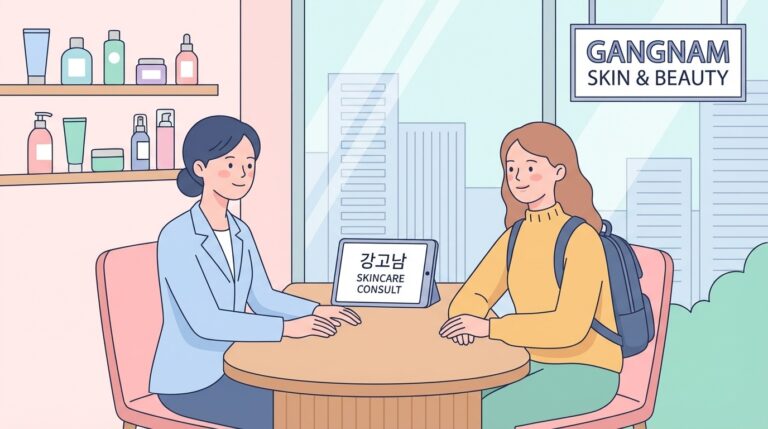
Phase 1: Empathy (Welcome to the K-Beauty Capital!)
Hello! I’m your Daily Hangul Editor.
Picture this: You step out of Gangnam Station Exit 10. The streets are bustling, and everywhere you look, you see people walking confidently with small bandages on their faces, wearing oversized sunglasses, and sipping from little silver pouches of pumpkin juice.
You’re here for a consultation—maybe it’s for that viral glass-skin dermatology treatment you saw on TikTok, or maybe something a bit more transformative. But as you sit in the luxurious, marble-floored waiting room of a Gangnam clinic, sipping complimentary Americano, panic sets in. The subtitles from your favorite K-Dramas didn’t prepare you for this. How do I explain that I want to look like ‘me, but better’? What if they upsell me? How do I ask about tax refunds?
If you don’t know the right expressions, you might end up with a result that’s a bit too dramatic or miss out on medical tourist perks. Don’t worry! This guide is built from the real experiences of my students who traveled to Seoul for K-Beauty treatments. Let’s make sure you get exactly what you want, sounding like a savvy local!
Phase 2: Core Expressions Deep Dive
Here are the top three expressions you absolutely need before stepping into a consultation room.
1. 너무 티 나지 않게, 자연스럽게 해 주세요.
- Pronunciation: Neomu ti naji anke, jayeonseureopge hae juseyo. [Neo-mu tee na-jee an-keh, ja-yeon-suh-ruhp-geh heh joo-seh-yo]
- Meaning: (Literal) Please do it naturally so it doesn’t show too much. / (Real Nuance) I want a subtle, natural result; I don’t want it to look obvious that I got work done.
- K-Culture Moment: The biggest trend in Korean beauty right now is 꾸안꾸 (kku-an-kku), meaning “effortlessly chic” or “decorated but not decorated.” Whether it’s makeup, fashion, or medical procedures, the ultimate compliment in Korea is, “Wow, you look great! Did you lose weight or change your skincare?” rather than “Who is your surgeon?”
- Editor’s Insight: The phrase “티 나다” (to be obvious/noticeable) is incredibly useful. Add “너무” (too much) and “않게” (not to), and you have the perfect boundary-setting phrase.
- Situation Spectrum:
- Friendly Consultant (Casual/Semi-formal): ✅
- Doctor (Formal): ✅
- 🤔 Think About It: Why do you think the “natural look” is so highly prized in modern K-Beauty, compared to the more dramatic “Gangnam Beauty” stereotypes of the early 2010s?
2. 일상생활은 언제부터 가능해요?
- Pronunciation: Ilsangsaenghwareun eonjebuteo ganeunghaeyo? [Il-sang-saeng-hwar-eun uhn-jeh-boo-tuh ga-neung-heh-yo?]
- Meaning: (Literal) From when is daily life possible? / (Real Nuance) How long is the downtime? When can I go back to work/shopping/eating normally?
- K-Culture Moment: Korean society runs on 빨리빨리 (Ppal-li ppal-li – hurry hurry). Nobody has time to hide at home for weeks! Clinics pride themselves on procedures with minimal “downtime.” Instead of asking “How long does it take to heal?”, Koreans specifically ask when they can return to “일상생활” (daily life)—meaning washing their face, wearing makeup, and going to work.
- Editor’s Insight: This phrase instantly makes you sound like a local. It shows you are practical and value your schedule.
- Situation Spectrum:
- Consultant/Nurse: ✅
- Doctor: ✅
- 🤔 Think About It: How does the “fast-paced” culture of a country affect its medical technologies and recovery methods?
3. 부가세 환급(택스 리펀) 서류 챙겨 주세요.
- Pronunciation: Bugase hwangeup (Taekseu ripeon) seoryu chaenggyeo juseyo. [Boo-ga-seh hwan-geup suh-ryoo chaeng-gyuh joo-seh-yo]
- Meaning: (Literal) Please pack the value-added tax refund documents. / (Real Nuance) Please prepare my Tax Free forms.
- K-Culture Moment: Medical tourism is a massive industry in Korea. The government allows foreign tourists to get tax refunds on cosmetic procedures (plastic surgery, dermatology, etc.).
- Editor’s Insight: The verb “챙기다” (to pack, to take care of, to prepare) is a very native way of asking someone to gather necessary items for you. It sounds much more natural than simply asking “주세요” (give me).
- Situation Spectrum:
- Payment Desk (Semi-formal): ✅
Phase 3: Textbook vs. Real Korean
[Situation 1: Asking about Pain]
* 📖 Textbook Korean: 수술이 많이 아픕니까? (Is the surgery very painful?)
* 🗣️ Real Korean: 마취는 어떻게 해요? 많이 아파요? (How is the anesthesia done? Does it hurt a lot?)
* 💡 Why the difference?: Koreans are practical. Rather than just asking if it hurts, they immediately ask about the anesthesia (마취)—whether it’s local, sleep, or topical cream—to gauge the pain level.
[Situation 2: Dealing with Costs]
* 📖 Textbook Korean: 총 비용이 얼마입니까? (What is the total cost?)
* 🗣️ Real Korean: 외국인 텍스 리펀 되죠? (Tax refund for foreigners is available, right?)
* 💡 Why the difference?: You already know it’s going to cost money. The real Korean way to handle the desk is confirming your benefits and discounts immediately.
Phase 4: Cultural Context — K-Culture Deep Dive
4-1. The Art of the “Consultant” (상담실장)
In Korean clinics, you rarely discuss prices with the doctor. First, you meet with a 상담실장 (Sangdam-siljang)—the Head Consultant. They are usually incredibly beautiful, sharply dressed, and very friendly. They will assess your face, recommend treatments, and negotiate the price.
Non-verbal tip: Do not be offended if they point out “flaws” on your face you didn’t even notice. In Korean medical beauty culture, they are simply offering a “menu” of improvements. Keep your Nunchi (눈치): listen politely, but stay firm on what you actually want.
4-2. The “Reference Photo” Culture
Have you ever seen a K-Drama where a character brings a magazine to a salon? In Gangnam clinics, it is 100% normal—and actually preferred—for you to bring photos of K-Pop idols or actors to show the exact nose shape, eye crease, or skin texture you want. Doctors love visual references. Don’t be shy; pull up your Instagram saves!
Phase 5: Real-World Roleplay Scenario
Setting: Tuesday afternoon. A high-end dermatology clinic in Cheongdam-dong. You are sitting on a velvet couch, holding a warm cup of herbal tea. The consultant, Min-ji, walks in with an iPad.
Characters:
* YOU: A foreigner in Seoul for a week, wanting a subtle skin-lifting treatment (like Shurink or Inmode) without breaking the bank.
* Min-ji (30s, Head Consultant): Extremely polite, persuasive, with flawless glass skin.
Dialogue:
Min-ji: 안녕하세요! 오늘 리프팅 상담 오셨죠? 피부가 너무 좋으신데요?
(Annyeonghaseyo! Oneul ripeuting sangdam osyeotjyo? Pibuga neomu joeusindeyo?)
[Hello! You’re here for a lifting consultation today, right? Your skin is already so good!]
(🎭 Stage Direction: Min-ji smiles warmly and zooms in on your chart on her iPad)
YOU: 아, 감사합니다. 그런데 턱선이 조금 고민이라서요.
(A, gamsahamnida. Geureonde teokseoni jogeum gominiraseoyo.)
[Ah, thank you. But I’m a bit concerned about my jawline.]
Min-ji: 아~ 그러시구나. 그럼 인모드(Inmode) 추천해 드려요. 그런데 눈가 보톡스도 같이 하시면 훨씬 예쁠 것 같아요!
(A~ geureosiguna. Geureom Inmode chucheonhae deuryeoyo. Geureonde nunga botokseudo gachi hasimyeon hwolssin yeppeul geot gatayo!)
[Ah~ I see. Then I recommend Inmode. But if you do eye botox together, it will look much prettier!]
🔀 Your Turn! How do you politely decline the upsell?
* A) “아니요, 보톡스는 절대 안 해요!” (No, I will never do botox!)
* B) “아~ 추천은 감사하지만, 오늘은 리프팅만 먼저 해볼게요.”
* C) “비싸요. 깎아주세요.”✅ Best Choice: B — “Ah~ thanks for the recommendation, but I’ll just try the lifting first today.” (A- chucheoneun gamsahajiman, oneureun ripeutingman meonjeo haebolgeyo.) This is the perfect Korean Nunchi play. You acknowledge her advice but firmly state your boundary.
⚠️ Choice A & C Analysis: A is too aggressive and kills the mood. C is a bit rude for a high-end clinic setting. You can negotiate, but “깎아주세요” is for street markets, not luxury dermatology.
Min-ji: 네, 알겠습니다! 그럼 리프팅만 자연스럽게 해 드릴게요.
(Ne, algetseumnida! Geureom ripeutingman jayeonseureopge hae deurilgeyo.)
[Yes, understood! Then we’ll just do the lifting naturally.]
YOU: 네, 너무 티 나지 않게 해 주세요. 아, 그리고 일상생활은 언제부터 가능해요?
(Ne, neomu ti naji anke hae juseyo. A, geurigo ilsangsaenghwareun eonjebuteo ganeunghaeyo?)
[Yes, please make it not too obvious. Ah, and when can I return to daily life?]
Min-ji: 시술 끝나고 바로 화장하셔도 돼요!
(Siseul kkeunnago baro hwajanghasyeodo dwaeyo!)
[You can put on makeup right after the procedure!]
Phase 6: 10-Second Shadowing Drill
Let’s practice your clinic survival boundary-setting phrase. Pay attention to the pauses!
😊 원장님, / 저는 / 너~~무 티 나는 건 / 싫어요. / 자연스럽게 / 해 주세요.
(Wonjangnim, / jeoneun / neo~~mu ti naneun geon / sileoyo. / jayeonseureopge / hae juseyo.)
Emotion: Polite but firm, with a slight smile.
Phase 7: K-Culture Mini Dictionary
| 한국어 (Korean) | Romanization | English | Context |
|---|---|---|---|
| 상담실장 | sangdam-siljang | Head Consultant | The person who discusses procedures and prices before you meet the doctor. |
| 원장님 | wonjang-nim | Doctor / Clinic Director | The polite title for the head doctor at a clinic. |
| 붓기 | butgi | Swelling | A major concern post-treatment. Clinics often provide laser treatments to reduce it. |
| 호박즙 | hobak-jeup | Pumpkin Juice | A traditional Korean remedy widely consumed post-surgery to reduce swelling quickly. |
| 꾸안꾸 | kku-an-kku | Effortlessly Chic | Slang for “Decorated but not decorated.” The ultimate goal of modern K-Beauty. |
Phase 8: Traveler’s Survival Kit
Navigating pharmacies and tax refunds after your treatment!
🆘 Survival Phrases for Medical Tourists
* 🇰🇷 “처방전 여기 있습니다.” (Cheobangjeon yeogi itseumnida.)
* 🗣️ English Guide: [Chuh-bang-jeon yuh-gee it-seum-nee-da]
* 📍 Where to use: At the pharmacy (약국) after your clinic visit to hand over your prescription.
- 🇰🇷 “붓기 빼는 약도 같이 주세요.” (Butgi ppaeneun yakdo gachi juseyo.)
- 🗣️ English Guide: [Boot-gee ppeh-neun yak-doh ga-chee joo-seh-yo]
- 📍 Where to use: At the pharmacy. Asking for over-the-counter swelling reduction medicine or pumpkin extract pills.
🇰🇷 “외국인 텍스 리펀 되나요?” (Oegugin taekseu ripeon doenayo?)
- 🗣️ English Guide: [Weh-goo-gin tex-eu ree-pun dweh-na-yo?]
- 📍 Where to use: At the clinic’s payment desk.
📌 Editor’s Travel Note:
* Passport: ALWAYS bring your physical passport to the clinic if you want the Tax Refund. A photo on your phone usually won’t work.
* Pharmacies (약국): Look for the word “약” (Yak) in big red or green letters. Korean pharmacists are highly trained; if you have minor skin irritation after a treatment, you can just show them and they will recommend a cream.
Phase 9: Critical Thinking Corner — “A Step Deeper”
🧠 Think Deeper: Media vs. Reality – The “Beauty as Maintenance” Culture
In Western media, Korean plastic surgery is often portrayed as extreme makeovers—jaw shaving and major structural changes. While that exists, the reality of everyday Korean medical beauty is much closer to routine maintenance. Visiting a dermatologist (피부과) for lasers, botox, or acne treatments is considered normal self-care, much like going to the dentist for a cleaning. It’s not a secret to be hidden; it’s a casual topic among friends and coworkers. This shift in perspective explains why modern Korean phrases emphasize “natural” (자연스럽게) and “quick return to daily life” (일상생활). It’s not about changing who you are; it’s about optimizing what you have.
💬 Your Turn: In your culture, is visiting a dermatologist or getting minor cosmetic procedures openly discussed, or is it kept a secret? Share in the comments!
Phase 10: FAQ & Avoiding Mistakes
- “Can I show a picture of a K-Pop idol to the doctor?”
- YES! Absolutely. Doctors love visual references because it eliminates miscommunication. Just say, “이 사진처럼 자연스럽게 해 주세요” (Please do it naturally like this photo).
- “Is it rude to say no to the consultant?”
- NO. They expect negotiation. You can firmly say “오늘은 이것만 할게요” (I will only do this today).
- “Do I tip the doctor or consultant?”
- NO! There is absolutely no tipping culture in Korea, especially not in medical facilities. It will cause extreme confusion.
❌ Common Mistake #1: Saying “아파요?” (Does it hurt?) for everything.
✅ Do this instead: Pain is subjective. Instead of just asking if it hurts, ask about the anesthesia: “마취 크림 발라요?” (Do you apply numbing cream?)
Phase 11: Summary & Action Items
One-Liner Summary: To navigate Korean clinics like a pro, use “자연스럽게” to get the subtle look you want, and confidently ask about “일상생활” (downtime) and “텍스 리펀” (tax refunds)!
Action Mission:
* 🥉 Bronze: Say “자연스럽게 해 주세요” out loud 3 times in front of your mirror.
* 🥈 Silver: Write down your ideal K-Beauty treatment in Korean in your notes app.
* 🥇 Gold: Next time you visit a clinic or salon in Korea, use one of today’s phrases with the consultant!
K-Culture Mission: Go to YouTube and search “Korea Dermatology Vlog” (한국 피부과 브이로그). Listen closely to the consultation scene—can you hear the patient or consultant say “자연스럽게” or “일상생활”?
Phase 12: Interactive Quiz
1. Situational Judgment: The consultant suggests adding a lip filler to your skin treatment, but you only want the skin treatment. What is the most polite, native-sounding response?
* A) 싫어요. 비싸요.
* B) 추천은 감사하지만, 오늘은 피부 관리만 할게요.
* C) 너 미쳤어?
2. Fill in the Blank:
“수술 후에 ________은 언제부터 가능해요?” (When can I return to daily life after the procedure?)
3. True or False – K-Culture Edition:
In Korea, you should secretly slip a tip to your dermatologist if they do a good job. (T/F)
Answers & Explanations (Click to reveal)
1. B – It acknowledges the recommendation politely but sets a firm boundary. (A is too blunt, C is highly offensive).
2. 일상생활 (ilsangsaenghwal – daily life/routine).
3. False. Korea has a strict no-tipping culture, and tipping medical professionals is considered highly inappropriate.
Frequently Asked Questions (FAQ)
Q: What does "너무 티 나지 않게, 자연스럽게 해 주세요." mean in Korean and how do you pronounce it?
A: In Korean, "너무 티 나지 않게, 자연스럽게 해 주세요." is pronounced [Neomu ti naji anke, jayeonseureopge hae juseyo. [Neo-mu tee na-jee an-keh, ja-yeon-suh-ruhp-geh heh joo-seh-yo] and means: (Literal) Please do it naturally so it doesn't show too much. / (Real Nuance) I want a subtle, natural result; I don't want it to look obvious that I got work done.
Q: What does "일상생활은 언제부터 가능해요?" mean in Korean and how do you pronounce it?
A: In Korean, "일상생활은 언제부터 가능해요?" is pronounced [Ilsangsaenghwareun eonjebuteo ganeunghaeyo? [Il-sang-saeng-hwar-eun uhn-jeh-boo-tuh ga-neung-heh-yo?] and means: (Literal) From when is daily life possible? / (Real Nuance) How long is the downtime? When can I go back to work/shopping/eating normally?
Q: What does "부가세 환급(택스 리펀) 서류 챙겨 주세요." mean in Korean and how do you pronounce it?
A: In Korean, "부가세 환급(택스 리펀) 서류 챙겨 주세요." is pronounced [Bugase hwangeup (Taekseu ripeon] and means: (Literal) Please pack the value-added tax refund documents. / (Real Nuance) Please prepare my Tax Free forms.







