

Phase 1: Empathy (The K-Culture Cold Open)
Greeting: 안녕하세요! 매일한글 에디터입니다.
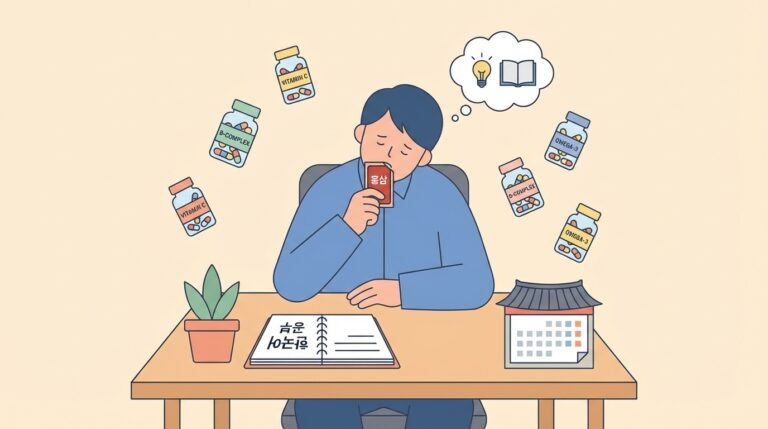
Picture this: You are watching your favorite K-Drama. The main character has been working all night on a presentation. They look utterly exhausted. Suddenly, a supportive colleague (or perhaps a secret crush) slides up to their desk, smoothly pulls a small, shiny foil stick from their pocket, and hands it over. The protagonist tears it open with their teeth, takes a quick sip of the dark liquid, and sighs in relief.
If you’ve watched more than three Korean dramas, you know exactly what I’m talking about—the iconic Red Ginseng Stick (홍삼 스틱)!
In Korea, talking about health and well-being (건강과 웰빙) isn’t just small talk; it’s a profound way of showing you care. Giving someone a vitamin pill or asking if they’ve taken their supplements is the modern-day equivalent of asking, “Have you eaten?” If you only know how to say “I am tired” (피곤해요) or “medicine” (약), you are missing out on a massive cultural bonding tool.
This guide is based on real questions from our B2-level learners who were confused when their Korean coworkers kept offering them random pills and pouches. Let’s decode the secret language of Korean nutritional supplements (영양제)!
Phase 2: Core Expressions Deep Dive
1. 영양제를 챙겨 먹다
- Pronunciation: yeongyangjereul chaeng-gyeo meokda [young-yang-je-reul cheng-gyeo meok-da]
- Meaning: (Literal) To pack and eat nutritional supplements / (Real Nuance) To proactively make sure you take your supplements
- K-Culture Moment: You’ll hear this constantly in K-Pop V-Live streams. Fans will comment, “Oppa, you look tired!” and the idol will reply, “Don’t worry, I’ve been making sure to take my supplements.” (저 영양제 잘 챙겨 먹고 있어요!)
- Editor’s Insight: The verb 챙기다 is the soul of this phrase. It doesn’t just mean “to eat”; it means “to not forget,” “to take care of,” or “to gather.” Using “먹다” alone sounds like you’re just consuming food. “챙겨 먹다” shows you are taking responsibility for your health.
- Situation Spectrum:
- 친구 사이 (Casual): ✅
- 직장 동료 (Semi-formal): ✅
- 직장 상사·어른 (Formal): ✅ (Use 챙겨 드세요 for elders)
- 🤔 Think About It: Why do Koreans use a special verb (챙기다) instead of just “eat” or “take”? It reflects the cultural value placed on effort. Health isn’t just something that happens; it’s something you must actively manage and “take care of” for the sake of the community.
2. 요즘 기가 빨려서 홍삼 좀 먹어야겠어요
- Pronunciation: yojeum giga ppallyeoseo hongsam jom meogeoyagesseoyo [yo-jeum gi-ga ppal-lyeo-seo hong-sam jom meo-geo-ya-get-seo-yo]
- Meaning: (Literal) Lately my energy is sucked out, so I must eat some red ginseng / (Real Nuance) I’m completely emotionally and physically drained lately, I really need a health boost.
- K-Culture Moment: This is the ultimate office worker’s anthem. When the boss finally leaves after a 2-hour meeting, you’ll hear someone mutter this while aggressively opening a supplement packet.
- Editor’s Insight: 기(가) 빨리다 is a fantastic B2-level slang phrase. “기” (Gi/Qi) is your life force. “빨리다” means to be sucked. It perfectly captures that feeling of being drained by introverted exhaustion, a difficult person, or overwork.
- Situation Spectrum:
- 친구 사이 (Casual): ✅
- 직장 동료 (Semi-formal): ✅ (Great for bonding over shared struggles)
- 직장 상사·어른 (Formal): 🚫 (Too casual to say to a boss)
- 🤔 Think About It: Does your language have a phrase for being “energetically drained” as opposed to just physically tired?
3. 식후 삼십 분에 드세요
- Pronunciation: sikhu samsip bune deuseyo [sheek-hoo sam-ship boon-eh deu-se-yo]
- Meaning: (Literal) Eat it 30 minutes after meal / (Real Nuance) Take this 30 minutes after eating.
- K-Culture Moment: Whenever you visit a Korean 약국 (Pharmacy), the pharmacist will hand you your bag of supplements or medicine and repeat this phrase like a magical spell.
- Editor’s Insight: Notice the use of 드세요 (the honorific form of 먹다/마시다). Pharmacists will always use highly polite language with customers.
- Situation Spectrum:
- 친구 사이 (Casual): 🚫 (Too formal)
- 직장 동료 (Semi-formal): ⚠️
- 약사/직원 (Service Provider to Customer): ✅
Phase 3: Textbook vs. Real Korean
[Telling someone to take their vitamins]
* 📖 교과서 한국어: 비타민을 꼭 먹으세요. (Please eat your vitamins.)
* 🗣️ 진짜 한국어: 영양제 잘 챙겨 먹어. (Make sure you’re keeping up with your supplements.)
* 💡 왜 다를까?: Native speakers group vitamins, omega-3s, and probiotics under the umbrella term 영양제. Adding ‘챙기다’ adds a layer of affection and care.
[Expressing extreme fatigue]
* 📖 교과서 한국어: 저는 오늘 매우 피곤합니다. (I am very tired today.)
* 🗣️ 진짜 한국어: 아, 오늘 진짜 기 빨린다 / 완전 방전됐어. (Ah, my energy is totally sucked out today / I’m completely discharged like a battery.)
* 💡 왜 다를까?: Modern Korean society is fast-paced. Visual metaphors like a drained battery (방전되다) or sucked-out energy (기 빨리다) resonate much stronger than just saying “I’m tired.”
Bottom Note: At the
B2level, moving away from simple adjectives like “피곤하다” to descriptive, action-based feelings like “기 빨린다” will make your Korean sound incredibly natural.
Phase 4: Cultural Context — K-Culture Deep Dive
4-1. Non-Verbal Cues: The Art of the “Sneak Pass”
When giving a coworker a supplement at work, Koreans often do the “sneak pass.” They won’t make a big announcement. They’ll just quietly slide a Vitamin C packet or a red ginseng jelly onto your desk with a small nod. It requires 눈치 (Nunchi)—reading the room. It says, “I see you are struggling, I acknowledge your hard work, take this and survive.”
4-2. K-Drama & The PPL (Product Placement) Phenomenon
If you’ve noticed that literally everyone in K-Dramas seems to suck on the exact same brand of red ginseng sticks, you’ve discovered PPL (간접광고). Because Korean broadcast laws heavily regulate traditional commercial breaks, brands weave their products directly into the story.
비판적 관점 (Critical View): While it looks incredibly stylish in a drama when a wealthy CEO dramatically drinks a ginseng stick before a boardroom battle, the reality is much more relatable. Walk into any Korean office, and you’ll see desks looking like mini-pharmacies. It highlights a culture where long hours are common, and maintaining stamina through supplements is almost a professional requirement.
Phase 5: Real-Life Roleplay Scenario
Setting: Friday afternoon, 4:00 PM. A modern tech office in Pangyo. The air is heavy with the exhaustion of the work week. You are staring blankly at your monitor.
Characters:
– YOU: A foreign employee trying to finish up a tough project.
– Minsu (32): Your friendly, slightly extroverted Korean coworker who always has snacks and pills.
Dialogue:
Minsu: 00씨, 안색이 안 좋아요. 오늘 무리한 거 아니에요? 🥺
(00-ssi, ansaegi an joayo. oneul murihan geo anieyo?)
[00, you don’t look so good. Didn’t you overdo it today?]
(🎭 Stage Direction: Minsu rolls his chair over to your desk)
YOU: 아… 네. 이번 프로젝트 때문에 어제 야근을 해서요.
(A… ne. ibeon peurojekteu ttaemune eoje yageuneul haeseoyo.)
[Ah… yeah. I worked overtime yesterday because of this project.]
Minsu: 어쩐지! 완전 기 빨려 보이더라고요. 자, 이거 하나 드세요.
(Eojjeonji! wanjeon gi ppallyeo boideoragoyo. Ja, igeo hana deuseyo.)
[No wonder! You looked totally drained of energy. Here, have one of these.]
(🎭 Stage Direction: Minsu hands you a sleek red ginseng stick)
Minsu: 홍삼 스틱인데, 피로 회복에 최고예요.
(Hongsam seutiginde, piro hoeboge choegoyeyo.)
[It’s a red ginseng stick, it’s the best for fatigue recovery.]
🔀 당신의 차례! 어떻게 대답할까요? (Your Turn!)
– A) “약은 안 먹어요. 괜찮습니다.” (Too blunt, sounds like you are rejecting medicine.)
– B) “헐 대박! 완전 필요했어요. 당장 먹을게요!” (Fun, but maybe a bit too casual for the office unless you are very close.)
– C) “아, 감사합니다! 잘 챙겨 먹을게요!”✅ Best Choice: C. Saying “잘 챙겨 먹을게요” (I’ll make sure to take it well) is the ultimate native-like response. It acknowledges their care and uses the crucial vocabulary we learned!
Phase 6: 10-Second Shadowing Drill
Time to practice your acting skills! Emphasize the pauses (/) and stretch the highlighted sounds.
🥺 아휴, / 요즘 너무 기가 빨려서 / 영양제를 꼭 / 챙겨 먹어야겠어요.
(ahyu, / yojeum neomu giga ppallyeoseo / yeongyangjereul kkok / chaeng-gyeo meogeoyagesseoyo.)
Tip: When you say “기가 빨려서”, let out a deep sigh to really sell the B2-level emotional exhaustion!
Phase 7: K-Culture Mini Dictionary
| 한국어 | Romanization | 영어 | 맥락 설명 (Context) |
|---|---|---|---|
| 영양제 | yeongyangje | Nutritional supplements | Includes vitamins, omega-3, probiotics, etc. Koreans rarely specify “vitamin” unless it’s specifically Vitamin C. |
| 홍삼 | hongsam | Red Ginseng | The holy grail of Korean health supplements. Often gifted during major holidays like Chuseok. |
| 챙기다 | chaeng-gida | To take care of / make sure to | The most important verb for taking supplements regularly. |
| 기가 빨리다 | giga ppallida | Energy drained | Used when someone or something (like a tough meeting) completely exhausts your mental energy. |
| 눈치 | nunchi | Social awareness / reading the room | Slipping a coworker a supplement when they look tired without making a fuss requires good nunchi. |
Phase 8: Traveler’s Survival Kit
If you are traveling in Korea, you will likely visit Olive Young (올리브영) for light vitamins/collagen, or a 약국 (Pharmacy) for serious fatigue recovery. Here are the survival phrases you need!
🆘 Survival Phrases at the Pharmacy
– 🇰🇷 “피로 회복에 좋은 영양제 추천해 주세요.” (piro hoeboge joeun yeongyangje chucheonhae juseyo.)
– 🗣️ Meaning: Please recommend a supplement good for fatigue recovery.
– 🇰🇷 “이거 부작용 있나요?” (igeo bujagyong innayo?)
– 🗣️ Meaning: Are there any side effects to this?
– 🇰🇷 “어떤 게 제일 잘 나가요?” (eotteon ge jeil jal nagayo?)
– 🗣️ Meaning: Which one sells the best? (Great for Olive Young!)📌 Editor’s Travel Note
In Korea, if you tell a pharmacist you are extremely tired, they might mix a “potion” for you—a small glass bottle of energy drink mixed with a couple of pills or liquid packets. Drink it right there on the spot! It’s a lifesaver for jet lag.
Phase 9: Critical Thinking Corner — “한 발 더 깊이”
Media vs. Reality (미디어 vs 현실): The ‘Hustle’ Behind the Health
In media and K-Dramas, giving health supplements looks like a glamorous gesture of romance or a cool power move. But let’s think deeper. Why does Korean society have such a massive market for quick-fix energy boosters and supplements? It’s deeply tied to the intense, fast-paced work culture (빨리빨리 문화) and the expectation of long working hours. Taking supplements isn’t just a health choice; it’s often a survival mechanism to keep up with the societal pace. Giving someone a vitamin isn’t just saying “be healthy”; it’s a profound cultural acknowledgment of their hard work and a shared understanding of modern burnout.
💬 Your Turn: Does your culture rely heavily on supplements or caffeine to get through the work week? How do coworkers show they care when someone is tired? Let us know in the comments!
Phase 10: FAQ & Preventing Misunderstandings
- Q: Can I give vitamins or red ginseng as a gift to my boss or my Korean partner’s parents?
- A: YES! 100%. Premium health supplements (like beautifully packaged red ginseng extracts) are considered top-tier, respectful gifts in Korea, especially for holidays like Lunar New Year (설날) or Parents’ Day (어버이날).
❌ 흔한 실수 (Common Mistake): Calling supplements “약” (Medicine)
If you take a multivitamin at work and tell your colleagues, “저 요즘 약 먹어요” (I’m taking medicine lately), they will gasp and ask, “어디 아파요?!” (Are you sick?!).
✅ 이렇게 하세요: Make sure to differentiate. Say 영양제 for daily health supplements, and 약 only when you are actually sick and treating an illness!
Phase 11: Summary & Action Items
One-Liner Summary: To sound like a true local, don’t just eat your vitamins—챙겨 먹고 (make sure to take them) and share the health with coworkers when their 기 (energy) is drained!
Action Mission:
– 🥉 Bronze (혼자서): Stand in front of your mirror and practice the 10-second shadowing drill with a deep, dramatic sigh.
– 🥈 Silver (온라인): Next time you watch a K-Drama, count how many times a character hands someone a health supplement. Spot the PPL!
– 🥇 Gold (실전): Go to a Korean supermarket or Olive Young (if you are in Korea) and ask, “어떤 영양제가 제일 잘 나가요?” (Which supplement sells the best?)
Phase 12: Quiz — Interactive Challenge
1. Fill in the Blank (빈칸 채우기):
Your Korean friend is studying for exams and looks exhausted. You hand them a vitamin jelly and say:
“건강 생각해서 영양제 좀 ______ 먹어!”
(Hint: The verb that implies “taking care of” and “not forgetting”)
2. Situational Judgment (상황 판단):
You want to tell your coworker that the meeting completely drained your energy. Which phrase is best?
A) 저는 피곤합니다.
B) 오늘 완전 기가 빨렸어요.
C) 영양제 부작용이 있어요.
3. True or False — K-Culture Edition:
If you tell a Korean friend “저 요즘 매일 약 먹어요,” they will assume you are just taking daily vitamins to stay healthy. (T/F)
👉 정답 확인하기 (Click for Answers)
1. 정답: 챙겨. (영양제 좀 챙겨 먹어!)
2. 정답: B. ‘기(가) 빨리다’ is the perfect natural expression for emotional/mental exhaustion.
3. 정답: False. ‘약’ implies you are sick with an illness. For vitamins, you must say ‘영양제’.
Frequently Asked Questions (FAQ)
Q: What does "영양제를 챙겨 먹다" mean in Korean and how do you pronounce it?
A: In Korean, "영양제를 챙겨 먹다" is pronounced [yeongyangjereul chaeng-gyeo meokda [young-yang-je-reul cheng-gyeo meok-da] and means: (Literal) To pack and eat nutritional supplements / (Real Nuance) To proactively make sure you take your supplements
Q: What does "요즘 기가 빨려서 홍삼 좀 먹어야겠어요" mean in Korean and how do you pronounce it?
A: In Korean, "요즘 기가 빨려서 홍삼 좀 먹어야겠어요" is pronounced [yojeum giga ppallyeoseo hongsam jom meogeoyagesseoyo [yo-jeum gi-ga ppal-lyeo-seo hong-sam jom meo-geo-ya-get-seo-yo] and means: (Literal) Lately my energy is sucked out, so I must eat some red ginseng / (Real Nuance) I'm completely emotionally and physically drained lately, I really need a health boost.
Q: What does "식후 삼십 분에 드세요" mean in Korean and how do you pronounce it?
A: In Korean, "식후 삼십 분에 드세요" is pronounced [sikhu samsip bune deuseyo [sheek-hoo sam-ship boon-eh deu-se-yo] and means: (Literal) Eat it 30 minutes after meal / (Real Nuance) Take this 30 minutes after eating.







