

Phase 1: Empathy & Immersion (Opening)
Hello! I’m your Daily Hangul Editor, your local guide to real-life Korean.
Picture this: You are watching a K-Drama. The main characters just finished a heartbreaking, tear-filled conversation over a hot bowl of Kimchi Jjigae (Kimchi stew). As they leave the small, cozy mom-and-pop restaurant, they wipe their tears, turn to the kitchen, and politely shout a phrase. The subtitles just say, “Thank you,” but if you listen closely, it doesn’t sound like the usual “Kamsahamnida.”
What did they actually say? They said, “잘 먹었습니다” (I ate well).
In Korea, food is more than just calories; it’s a language of care. Knowing how to pay the bill and show gratitude for the meal is your ultimate ticket to earning a warm smile from any Korean restaurant owner. If you only rely on textbooks, you might find yourself awkwardly waiting at your table for a bill that will never arrive!
Don’t worry. As someone who has helped hundreds of beginners navigate the bustling streets of Seoul, I’ve designed this guide to help you pay and say thanks like a true local.
Phase 2: Core Expressions Deep Dive
1. 잘 먹었습니다 (Jal meogeotseumnida)
- Pronunciation: [jal meo-geot-seum-ni-da] + Sound-alike: jahl muh-goht-soom-nee-dah
- Meaning: Literal: “I ate well.” / Real nuance: “Thank you for the delicious meal.”
- K-Culture Moment: This is the golden phrase! You’ll hear K-Pop idols saying this to the staff after a backstage meal, or colleagues saying it to their boss after a company dinner (Hoesik). It shows deep appreciation for the effort that went into the food.
- Editor’s Insight: You don’t need to overthink the grammar here. Think of it as a magical “Thank you” exclusively used for food. Say it loudly and cheerfully as you walk out the door!
- Situation Spectrum:
- Friends (Casual): ⚠️ (Friends usually say “잘 먹었어” – jal meogeosseo)
- Coworkers (Semi-formal): ✅
- Elders/Staff (Formal): ✅✅ (Highly recommended!)
- 🤔 Think About It: Why do Koreans specifically mention “eating well” instead of just saying “thank you”? Could it be tied to Korea’s history where sharing a full, hearty meal was the greatest sign of affection? Does your culture have a specific phrase for thanking someone after a meal?
2. 계산해 주세요 (Gyesanhae juseyo)
- Pronunciation: [gye-san-hae ju-se-yo] + Sound-alike: gyeh-san-heh joo-seh-yo
- Meaning: Literal: “Please calculate.” / Real nuance: “Bill, please” or “I’d like to pay.”
- K-Culture Moment: You are at a trendy cafe in Hongdae. You grabbed your pastries, and now you are at the register. You say this phrase as you hand over your credit card.
- Editor’s Insight: The word ‘계산’ (gyesan) means calculation or payment. Add ‘주세요’ (juseyo – please give/do), and you have the perfect, polite way to initiate payment.
- Situation Spectrum:
- Friends (Casual): 🚫
- Coworkers (Semi-formal): ✅
- Elders/Staff (Formal): ✅
- 🤔 Think About It: In many Western countries, you ask for the “check.” In Korea, you ask them to “calculate” (gyesan). How does the physical action of paying differ in your country compared to Korea?
3. 영수증 주세요 (Yeongsujeung juseyo)
- Pronunciation: [yeong-su-jeung ju-se-yo] + Sound-alike: young-soo-joong joo-seh-yo
- Meaning: Literal & Real nuance: “Receipt, please.”
- K-Culture Moment: Many Korean cashiers will ask, “영수증 드릴까요?” (Would you like a receipt?) before printing it to save paper. If you need it for your travel budget tracking, this is your go-to phrase!
- Editor’s Insight: ‘으’ (eu) in ‘jeung’ sounds like the disgusted sound “ugh” you make when stepping in gum, but keep your lips stretched wide into a fake smile. Try it: jeung!
- Situation Spectrum:
- Friends (Casual): 🚫
- Coworkers (Semi-formal): ⚠️
- Elders/Staff (Formal): ✅
- 🤔 Think About It: Korea is moving quickly towards a paperless society. Do you still collect paper receipts when you travel?
Phase 3: Textbook vs. Real Korean
[Situation 1: Asking for the bill]
* 📖 Textbook Korean: 계산서를 주시겠습니까? (Would you please give me the bill?)
* 🗣️ Real Korean: 여기 계산이요! (Over here, payment!)
* 💡 Why the difference?: Korean culture values Palli-palli (speed). “여기 계산이요” is fast, effective, and perfectly polite when paired with a friendly tone.
[Situation 2: When you don’t need a receipt]
* 📖 Textbook Korean: 영수증은 필요하지 않습니다. (I do not need a receipt.)
* 🗣️ Real Korean: (영수증) 버려주세요. (Please throw it away) OR 괜찮아요. (It’s okay/No thanks.)
* 💡 Why the difference?: Simply saying “Gwaenchanayo” (It’s okay) with a gentle hand wave is the universally understood, polite way to decline something in Korea.
Bottom Note: As an A1 beginner, you don’t need to memorize long textbook sentences. Master the “Real Korean” short phrases, and you’ll instantly sound more natural!
Phase 4: Cultural Context — K-Culture Deep Dive
4-1. Non-verbal Elements: The “Belly Button Bow”
When saying “잘 먹었습니다”, you don’t just stand completely stiff. Add a slight 15-degree head bow. You don’t need to do a full 90-degree bow like in historical dramas! A gentle nod while making brief eye contact with the cashier or chef shows the perfect amount of respect.
4-2. K-Travel Connection: The “Front Counter” Rule
If there is one thing you must know about Korean restaurants, it’s this: You usually pay at the front door, not at your table!
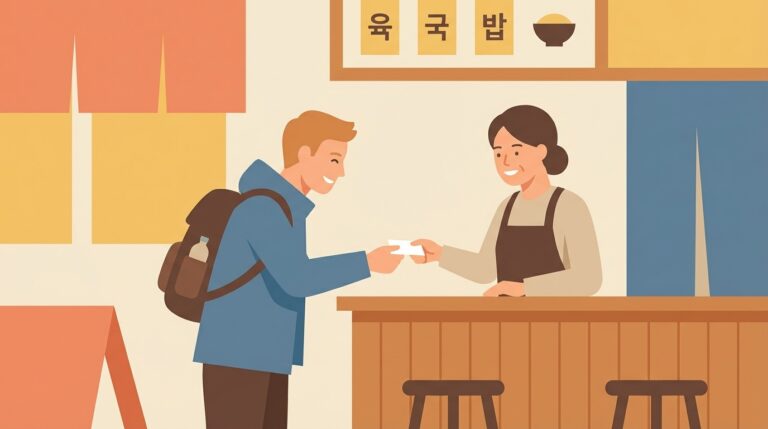
In Western movies, you see people raising their hands, asking for the check, and leaving cash on the table. In Korea, when you are done eating, you simply stand up, grab the small printed bill on your table (or remember your table number), and walk to the front counter (Gyesandae). Also, there is NO tipping culture in Korea! The price on the menu is exactly what you pay.
Phase 5: Real-Life Roleplay Scenario
Setting: Friday night, 8 PM. A bustling Korean BBQ (Samgyeopsal) restaurant in Gangnam. The smell of roasted pork is in the air. You just finished a fantastic meal with your Korean friends.
Characters:
– YOU: A traveler on day 3 of your Korea trip, excited to practice your Korean.
– Ajumma (Restaurant Owner): A warm, fast-moving lady wearing an apron.
Dialogue:
YOU: (Walking to the front counter with your credit card)
여기 계산해 주세요! 💳
(Yeogi gyesanhae juseyo!)
[I’d like to pay here!]
(🎭 Stage Direction: You hand over your credit card with both hands)
Ajumma: 네~ 맛있게 드셨어요?
(Ne~ masitge deusyeosseoyo?)
[Yes~ Did you enjoy the meal?]
YOU: 네, 너무 맛있었어요!
(Ne, neomu masisseosseoyo!)
[Yes, it was so delicious!]
Ajumma: 다행이네요. (Swipes card) 5만 원 결제되었습니다. 영수증 드릴까요?
(Dahaengineyo. Oman won gyeoljedeo-eot-seumnida. Yeongsujeung deurilkkayo?)
[Glad to hear. 50,000 won is paid. Shall I give you the receipt?]
🔀 Your Turn! How do you answer?
– A) “아니요, 괜찮아요.” (Aniyo, gwaenchanayo. / No, it’s okay.)
– B) “영수증 싫어요!” (Yeongsujeung sileoyo! / I hate receipts!)
– C) “킵 더 체인지!” (Keep the change!)✅ Best Choice: A — “괜찮아요” is the most polite and natural way to decline.
⚠️ Choice B & C Analysis: B sounds aggressive and slightly childish. C will confuse the cashier because there are no tips in Korea, and you paid with a card!
YOU: 아니요, 괜찮아요.
(Aniyo, gwaenchanayo.)
[No, it’s okay.]
Ajumma: 네, 카드 여기 있습니다. 안녕히 가세요!
(Ne, kadeu yeogi itseumnida. Annyeonghi gaseyo!)
[Yes, here is your card. Goodbye!]
YOU: 잘 먹었습니다! 또 올게요!
(Jal meogeotseumnida! Tto olgeyo!)
[I ate well! I will come again!]
Ajumma: (Smiling brightly) 네~ 또 오세요!
(Ne~ tto oseyo!)
[Yes~ Come again!]
🌟 Bonus K-Culture Scenario: Idol Fan Sign
Imagine you are at a fan signing event for your favorite K-Pop group.
Idol: “밥 먹었어요?” (Bap meogeosseoyo? / Did you eat?)
YOU: “네! 방금 불고기 먹고 왔어요.” (Ne! Banggeum bulgogi meokgo wasseoyo. / Yes! I just had Bulgogi.)
Idol: “우와, 맛있었겠다!” (Uwa, masisseotgetda! / Wow, that must have been delicious!)
YOU: “네, 완전 잘 먹었습니다!” (Ne, wanjeon jal meogeotseumnida! / Yes, I totally ate well!)
Phase 6: 10-Second Shadowing Drill
Let’s practice! Follow the slash (/) for pauses, and read with the emotion tags.
- 😊 Bright and cheerful (Walking out the door)
사장님! / 너무 / 잘 먹었습니다!
(sa-jang-nim! / neo-mu / jal meo-geot-seum-ni-da!) -
💳 Polite and clear (Handing over the card)
여기 / 계산해 / 주세요.
(yeo-gi / gye-san-hae / ju-se-yo.) -
✋ Gently declining (Shaking your hands slightly)
영수증은 / 괜찮아요.
(yeong-su-jeung-eun / gwaen-cha-na-yo.)
Phase 7: K-Culture Mini Dictionary
| Korean | Romanization | English | Context |
|---|---|---|---|
| 사장님 | sajangnim | Boss / Owner | The safest, most polite way to call a restaurant owner. |
| 이모님 | imonim | Auntie | Used in casual, older traditional restaurants (like BBQ or soup places) to call a friendly female server. |
| 계산대 | gyesandae | Counter / Register | The place near the front door where you pay. |
| 더치페이 | deochipei | Dutch Pay / Split the bill | Koreans often use this Konglish word when splitting the bill among friends! |
| 포장 | pojang | Takeout | Use this word if you want to pack leftover food. |
Phase 8: Traveler’s Survival Kit
Since you are learning how to pay, you absolutely need these survival phrases for your Korean adventure!
🆘 Survival Phrases TOP 3
1. 🇰🇷 “이거 얼마예요?” (igeo eolmayeyo?)
– 🗣️ Sound: ee-geo ull-mah-yeh-yo?
– 📍 Where to use: Markets, convenience stores, underground shopping malls.
2. 🇰🇷 “카카오페이 되나요?” (kakaopei doenayo?)
– 🗣️ Sound: ka-ka-o-pay dweh-nah-yo?
– 📍 Where to use: When asking if they accept digital payments (like Kakao Pay or Apple Pay).
3. 🇰🇷 “따로 계산해 주세요.” (ttaro gyesanhae juseyo.)
– 🗣️ Sound: dda-ro gyeh-san-heh joo-seh-yo.
– 📍 Where to use: When you and your friends want to pay separately at the counter.📌 Editor’s Travel Note
– Cards vs. Cash: South Korea is a “Card Kingdom.” You can pay for a $1 coffee with a credit card without any dirty looks. However, traditional markets (like Gwangjang Market) often prefer cash or bank transfers.
– Tipping: Do NOT leave tips on the table. The server will literally run out to the street to return your “forgotten” money!
Phase 9: Critical Thinking — “One Step Deeper”
Food & Identity: Why “I ate well” is a cultural cornerstone
In Korea, greetings are deeply rooted in food. Instead of “How are you?” Koreans often ask “밥 먹었어?” (Did you eat?). This stems from a period of poverty after the Korean War, where checking if someone had a meal was a genuine expression of care. Therefore, saying “잘 먹었습니다” (I ate well) is not just a polite transaction; it is an emotional acknowledgment of the chef’s hard work and the warm Jeong (정, affection/connection) shared through the food.
🧠 Think Deeper:
When you say “I ate well,” you are actively participating in a decades-old tradition of communal care. You aren’t just a customer; for that brief moment, you are a guest who was taken care of.💬 Your Turn: Does your culture have a unique way of showing appreciation to a chef or host? Let me know in the comments!
Phase 10: FAQ & Avoiding Mistakes
Q: Can I say “잘 먹었습니다” to my friend if they bought me a coffee?
Yes! But since they are your friend, you should drop the formal ending and say, “잘 먹을게!” (Before drinking: I will drink it well!) or “잘 먹었어!” (After drinking: I drank it well!).
Q: Can I ask the restaurant to pack my leftovers?
Absolutely! Just point to the food and say, “포장해 주세요” (Pojanghae juseyo – Please pack this for takeout).
❌ Common Mistake #1: Leaving cash on the table.
✅ Do this instead: Always take your bill and pay at the front counter before walking out.❌ Common Mistake #2: Saying “Keep the change” (잔돈은 가지세요).
✅ Do this instead: Accept all your change! Tipping can actually make the staff feel awkward or confused.
Phase 11: Summary & Action Items
- One-Liner Summary: Walk to the front counter, say “계산해 주세요” to pay, and shout “잘 먹었습니다!” as you leave to win the hearts of Koreans.
-
Action Mission:
- 🥉 Bronze: Stand in front of your mirror and practice saying “잘 먹었습니다” with a 15-degree bow and a warm smile.
- 🥈 Silver: Leave a comment below using the Romanization or Hangul of today’s expressions!
- 🥇 Gold: Next time you visit a Korean restaurant in your city, try using “잘 먹었습니다” to the staff when leaving.
- K-Culture Mission:
Watch an episode of any K-Drama featuring a restaurant scene (like Itaewon Class or Let’s Eat). Spot the exact moment characters pay at the counter and say “Jal meogeotseumnida!”
Phase 12: Quiz — Interactive Challenge
1. Situational Judgment: You are at a Korean cafe. The cashier hands you your iced Americano and your receipt. You don’t want the receipt. What should you say?
– A) “잘 먹었습니다!” (Jal meogeotseumnida)
– B) “영수증 괜찮아요.” (Yeongsujeung gwaenchanayo)
– C) “계산해 주세요.” (Gyesanhae juseyo)
2. True or False — K-Culture Edition:
“In Korea, if the service is amazing, you should leave a 15% tip on the table.”
– [True / False]
3. Fill in the Blank:
You had an amazing K-BBQ dinner. You want to tell the owner, “I ate well!”
“사장님! 너무 ( _______ )!”
(Answers: 1. B – ‘A’ is for after eating, ‘C’ is for paying. / 2. False – No tipping in Korea! / 3. 잘 먹었습니다 (Jal meogeotseumnida))
Frequently Asked Questions (FAQ)
Q: What does "잘 먹었습니다 (Jal meogeotseumnida)" mean in Korean and how do you pronounce it?
A: In Korean, "잘 먹었습니다 (Jal meogeotseumnida)" is pronounced [jal meo-geot-seum-ni-da] and means: Literal: "I ate well." / Real nuance: "Thank you for the delicious meal."
Q: What does "계산해 주세요 (Gyesanhae juseyo)" mean in Korean and how do you pronounce it?
A: In Korean, "계산해 주세요 (Gyesanhae juseyo)" is pronounced [gye-san-hae ju-se-yo] and means: Literal: "Please calculate." / Real nuance: "Bill, please" or "I'd like to pay."
Q: What does "영수증 주세요 (Yeongsujeung juseyo)" mean in Korean and how do you pronounce it?
A: In Korean, "영수증 주세요 (Yeongsujeung juseyo)" is pronounced [yeong-su-jeung ju-se-yo] and means: Literal & Real nuance: "Receipt, please."







