

Phase 1: Empathy & K-Culture Cold Open
Hello! It’s your lead editor from Daily Hangul.
Imagine this: You’re in a bustling, vibrant alley in Seoul. You’ve just taken your first bite of authentic, bright-red Tteokbokki (spicy rice cakes). It’s delicious, but suddenly, your mouth is on FIRE!
You frantically look around your table. Chopsticks? Check. Napkins? Check. Water? …Wait, where is the water?! You look at the restaurant owner, hoping for a rescue, but they are busy serving other tables.
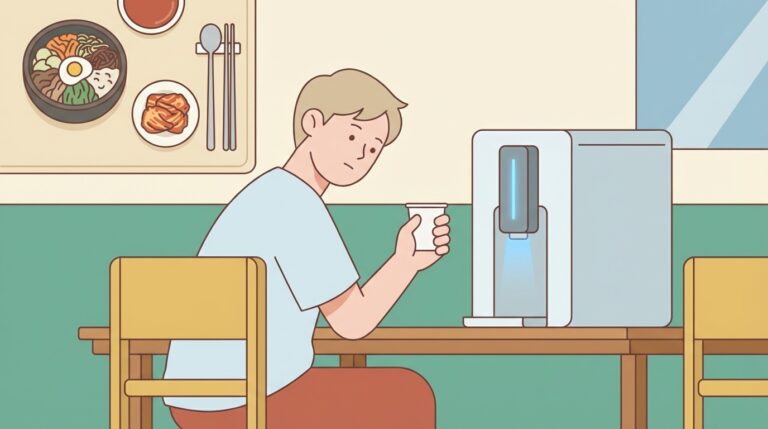
If you’ve watched Korean dramas, you might recall scenes where characters casually walk up to a sleek machine in the corner, grab a tiny paper cup, and drink water while gossiping. That machine is the 정수기 (Jeong-su-gi, Water Purifier), and it is the ultimate oasis in Korea.
In Korea, water is almost always free, but it’s often not brought to your table. You have to find it yourself! Knowing how to spot the water purifier and understanding the culture of “self-serve” will save you from the spicy Tteokbokki fire and make you look like a total local insider. Let’s dive in!
Phase 2: Core Expressions Deep Dive
Here are the absolute basic, life-saving phrases you need when you’re thirsty in Korea.
1. 정수기 어디에 있어요?
- Pronunciation: jeong-su-gi eo-di-e isseo-yo?
(Tip: ‘eo’ sounds like the ‘uh’ in ‘uh-oh’. ‘gi’ sounds like ‘key’ but softer, like ‘gee’ in ‘geese’.)- Meaning: Where is the water purifier?
- K-Culture Moment: You’ll use this in restaurants, banks, subway stations, and clinics. Yes, Korea has free water purifiers everywhere!
- Editor’s Insight: The phrase “어디에 있어요?” (Where is…?) is your golden ticket for A1 level. You can put ANY noun in front of it. Bathroom? Hwajangsil eodie isseoyo? Water purifier? Jeongsugi eodie isseoyo?
- Situation Spectrum:
- Casual with friends: ✅ (Just say: Jeongsugi eodi isseo?)
- Restaurant staff (Semi-formal): ✅
- Formal/Elders: ⚠️ (A bit too direct, but acceptable for foreigners)
- 🤔 Think About It: Why do you think Korea provides free water purifiers in almost every public space? How does this compare to finding drinking water in your home country?
2. 물은 셀프입니다
- Pronunciation: mul-eun sel-peu-im-ni-da.
- Meaning: Water is self-serve. (Literal: Water is self).
- K-Culture Moment: You will see this written on a sign on the wall of 90% of casual Korean restaurants.
- Editor’s Insight: Koreans took the English word “self” and turned it into a cultural rule. When you see “셀프” (sel-peu), it means you have to get up and do it yourself!
- Situation Spectrum:
- This is mostly a written sign or something a busy restaurant owner will shout to you across the room!
- 🤔 Think About It: Does the “self-serve” culture feel rude to you, or efficient? In Korea, it’s a sign of a casual, affordable, and fast-paced dining environment!
3. 찬물 / 뜨거운 물
- Pronunciation: chan-mul / tteu-geo-un mul.
(Tip: ‘eu’ (으) sounds like the disgusted sound you make when you step in chewing gum: “Eugh!”)- Meaning: Cold water / Hot water.
- K-Culture Moment: The water purifier usually has two buttons or levers. Blue for chan-mul, Red for tteu-geo-un mul. If you’re making instant cup noodles at a convenience store, you need the red button!
- Editor’s Insight: Don’t confuse the two! Pressing the wrong one can either ruin your instant noodles or burn your tongue.
- Situation Spectrum:
- Casual: ✅
- Semi-formal: ✅
- Formal: ✅
Phase 3: Textbook vs. Real Korean
[Situation 1: Asking for water at a restaurant]
* 📖 Textbook Korean: 물 좀 주시겠습니까? (mul jom jusigesseumnikka? – Could you please give me some water?)
* 🗣️ Real Korean: 사장님, 정수기 어딨어요? (Sajangnim, jeongsugi eodisseoyo? – Boss, where’s the water purifier?)
* 💡 Why different?: Textbook Korean assumes the waiter serves you. Real Korean recognizes the “Self-serve” culture. You don’t ask them to bring it; you ask where the machine is so you can get it quickly!
[Situation 2: Warning a friend about the hot water]
* 📖 Textbook Korean: 이것은 뜨거운 물입니다. (igeoseun tteugeoun murimnida. – This is hot water.)
* 🗣️ Real Korean: 앗 뜨거! 조심해! (at tteugeo! josimhae! – Ah, hot! Careful!)
* 💡 Why different?: In urgent, everyday situations, Koreans drop the formal grammar and use short, emotional exclamations like “앗” (Oops/Ah).
Bottom Note: As an A1 beginner, don’t worry about long, polite sentences yet. Just pointing and saying “정수기 어디에 있어요?” is perfectly polite and natural!
Phase 4: Cultural Context — K-Culture Deep Dive
4-1. Non-Verbal Elements: The Tiny Paper Cup
When you find the Jeongsugi, you will often see stacks of incredibly small paper cups (종이컵 – jong-i-keop) next to it. They look like they are for dolls!
* How to use: You take one tiny cup, press it against the lever of the machine, drink it in one gulp, and throw it away (or refill it).
* Nunchi (눈치) Alert: Don’t bring your massive 1-liter personal Hydro Flask and fill it up at a busy restaurant’s purifier. It’s considered slightly rude because you’re draining the cold water supply for other customers!
4-2. K-Drama & K-Food Connection
The Office Oasis (K-Drama): Have you noticed in K-Dramas, whenever characters need to gossip about the handsome CEO or complain about their manager, they gather around the office water purifier? The Jeongsugi is the Korean equivalent of the “water cooler.” It’s where social bonding happens!
The Spicy Food Survival (K-Food): Korean food is famous for its fiery red pepper paste (Gochujang). Dishes like Dakbal (spicy chicken feet) or Jjamppong (spicy seafood noodle soup) will test your limits. Knowing where the water purifier is BEFORE you start eating is a pro-level survival tactic.
Phase 5: Real-Life Roleplay Scenario
Setting: Friday evening, 7:00 PM. A noisy, crowded Galbi-jjim (braised short ribs) restaurant in Hongdae. The smell of spicy food fills the air.
Characters:
– YOU: A foreigner in Korea, eating spicy food for the first time.
– Min-su (32): Your friendly Korean coworker who loves spicy food.
Dialogue:
Min-su: 우리 매운 갈비찜 먹자! 🥩
(uri maeun galbijjim meokja!)
[Let’s eat spicy braised short ribs!]
YOU: 좋아요! 엄청 기대돼요.
(joayo! eomcheong gidaedwaeyo.)
[Sounds good! I’m really excited.]
(🎭 Stage Direction: The food arrives. You take a big bite.)
YOU: 헉… 너무 매워요! 불이야! 🔥
(heok… neomu maewoyo! buriya!)
[Gasp… It’s too spicy! Fire!]
Min-su: 하하하! 괜찮아? 물 마셔!
(hahaha! gwaenchana? mul masyeo!)
[Hahaha! Are you okay? Drink water!]
YOU: 물이 없어요. 테이블에 물이 없어요!
(muri eopseoyo. teibure muri eopseoyo!)
[There is no water. There’s no water on the table!]
Min-su: 아, 저기 벽에 뭐라고 써 있어?
(a, jeogi byeoge mworago sseo isseo?)
[Ah, what is written on the wall over there?]
YOU: 음… ‘물은 셀프’? 무슨 뜻이에요?
(eum… ‘mureun selpeu’? museun tteusieyo?)
[Umm… ‘Water is self’? What does it mean?]
Min-su: 네가 직접 가져와야 한다는 뜻이야!
(nega jikjeop gajyeowaya handaneun tteusiya!)
[It means you have to get it yourself!]
🔀 Your Turn! What do you say next to find the water?
– A) “물 좀 주시겠습니까?” (Saying this loudly to the owner)
– B) “정수기 어디에 있어요?” (Asking Minsu where the machine is)
– C) “물 안 마실래요.” (I won’t drink water.)✅ Best Choice: B — Since you know water is self-serve, asking where the purifier (Jeongsugi) is the most natural next step!
⚠️ Choice A Analysis: If the sign says “Self”, shouting for the owner to bring water will make them point at the sign and say, “Self!”
YOU: 정수기 어디에 있어요?
(jeongsugi eodie isseoyo?)
[Where is the water purifier?]
Min-su: 저기 입구 옆에 있어. 찬물 꼭 눌러!
(jeogi ipgu yeope isseo. chanmul kkok nulleo!)
[It’s over there next to the entrance. Make sure to press cold water!]
Phase 6: 10-Second Shadowing Drill
Practice speaking out loud! Follow the pauses (/) and the emotion tags.
- 🥺 Desperately (Mouth on fire):
사/장/님, / 정수기 / 어디에 / 있어요?!
(sa-jang-nim, / jeong-su-gi / eo-di-e / isseo-yo?!) -
😊 Friendly & Informative:
물은 / 셀프/입니다.
(mul-eun / sel-peu-im-ni-da.)
Phase 7: K-Culture Mini Dictionary
| Korean | Romanization | English | Cultural Context |
|---|---|---|---|
| 정수기 | jeong-su-gi | Water Purifier | Found everywhere in Korea. A symbol of free, accessible drinking water. |
| 셀프 | sel-peu | Self-serve | Adopted from English, meaning “do it yourself.” Very common in casual dining. |
| 매워요 | mae-wo-yo | It’s spicy | The magic word that triggers the immediate need for a Jeongsugi! |
| 종이컵 | jong-i-keop | Paper cup | Small cups usually stacked next to the water purifier. |
Phase 8: Traveler’s Survival Kit
Finding facilities is a crucial survival skill for any traveler in Korea!
🆘 Survival Phrases TOP 3
– 🇰🇷 “정수기 어디에 있어요?” (jeongsugi eodie isseoyo?) -> Where is the water purifier?
– 🇰🇷 “화장실 어디에 있어요?” (hwajangsil eodie isseoyo?) -> Where is the bathroom?
– 🇰🇷 “휴지통 어디에 있어요?” (hyujitong eodie isseoyo?) -> Where is the trash can?💡 Pro Tip: In Korea, public trash cans are notoriously hard to find on the streets. If you use a tiny paper cup at a Jeongsugi, ALWAYS throw it away in the small bin located directly under or next to the machine!
📌 Editor’s Travel Note
– Water at Restaurants: If you sit down and the waiter brings you a plastic bottle of water but no cups, check your table! The cups might be inside a drawer attached to the table, or stacked on a little shelf above it.
Phase 9: Critical Thinking — “One Step Deeper”
Food & Identity: The “Bbali-Bbali” and Self-Serve Culture
Why does Korea rely so heavily on “Self-serve” water and free Jeongsugi machines rather than waiters bringing glasses of water? It perfectly reflects Korea’s famous Bbali-bbali (hurry, hurry) culture. Casual restaurants prioritize speed and affordability. By making water self-serve, restaurant owners can focus on cooking and serving hot food instantly, keeping prices low. It also reflects a high-trust society where customers are trusted to freely use machines without making a mess or stealing the supplies.
💬 Your Turn: Does your home country charge for water at restaurants? Do you prefer a waiter bringing you water, or the freedom of getting it yourself from a machine? Share in the comments!
Phase 10: FAQ & Avoiding Misunderstandings
Q: “Can I fill up my personal water bottle at a restaurant’s Jeongsugi?”
A: Maybe, but usually No. If it’s a small restaurant and you are filling a huge bottle, it’s considered poor manners (lacking Nunchi). However, at a public park or a large rest area, it’s totally fine!
Q: “What if I want bottled water instead of purifier water?”
A: You can buy it! Ask: “생수 있어요?” (saengsu isseoyo? – Do you have bottled water?). Just note that while Jeongsugi water is free, you have to pay for bottled water.
❌ Common Mistake #1: Sitting at your table for 15 minutes, fuming with anger because the waiter “forgot” your water.
✅ Do This Instead: Look around the walls. If you see “물은 셀프” (Water is self), proudly stand up, find the Jeongsugi, and get your own water like a boss!
Phase 11: Summary & Action Items
One-Liner Summary: When your mouth is on fire in Korea, look for the sign “셀프” (Self) and ask “정수기 어디에 있어요?” (Where is the water purifier?).
Action Mission 3-Steps:
* 🥉 Bronze (Solo): Look in the mirror and practice asking, “Jeongsugi eodie isseoyo?” 3 times.
* 🥈 Silver (Online): Go to a K-Drama YouTube clip and see if you can spot a water purifier in an office or restaurant scene.
* 🥇 Gold (Real-world): Next time you visit a Korean restaurant (even in your home country), ask the staff “Jeongsugi eodie isseoyo?” instead of asking for water in English!
K-Culture Mission:
The next time you eat spicy ramen or Tteokbokki, drink your water out of the smallest cup you can find in your house to simulate the true Korean Jeongsugi experience!
Phase 12: Interactive Quiz
1. Situational Judgment: You walk into a busy Korean restaurant. You are very thirsty. You don’t see any water on the tables. What is the BEST thing to do?
– A) Shout “Water please!” in English.
– B) Look for a sign that says “물은 셀프” and find the machine.
– C) Wait patiently until the owner notices you are thirsty.
2. True or False — K-Culture Edition:
– At a Korean convenience store, you can use the Jeongsugi’s hot water (뜨거운 물) for free to make the cup noodles you just bought. (T/F)
3. Fill in the Blank:
– “Excuse me! ________ 어디에 있어요?” (Where is the water purifier?)
(Answers: 1. B – Waiting or shouting might not work if it’s a self-serve place! / 2. True – Convenience stores have hot water dispensers specifically for ramen buyers! / 3. 정수기 – Jeongsugi)
Frequently Asked Questions (FAQ)
Q: What does "정수기 어디에 있어요?" mean in Korean and how do you pronounce it?
A: In Korean, "정수기 어디에 있어요?" is pronounced [jeong-su-gi eo-di-e isseo-yo?] and means: Where is the water purifier?
Q: What does "물은 셀프입니다" mean in Korean and how do you pronounce it?
A: In Korean, "물은 셀프입니다" is pronounced [mul-eun sel-peu-im-ni-da.] and means: Water is self-serve. (Literal: Water is self).
Q: What does "찬물 / 뜨거운 물" mean in Korean and how do you pronounce it?
A: In Korean, "찬물 / 뜨거운 물" is pronounced [chan-mul / tteu-geo-un mul.] and means: Cold water / Hot water.






