

Phase 1: Empathy (Immersion Open)
Hello! It’s your Daily Hangul Editor.
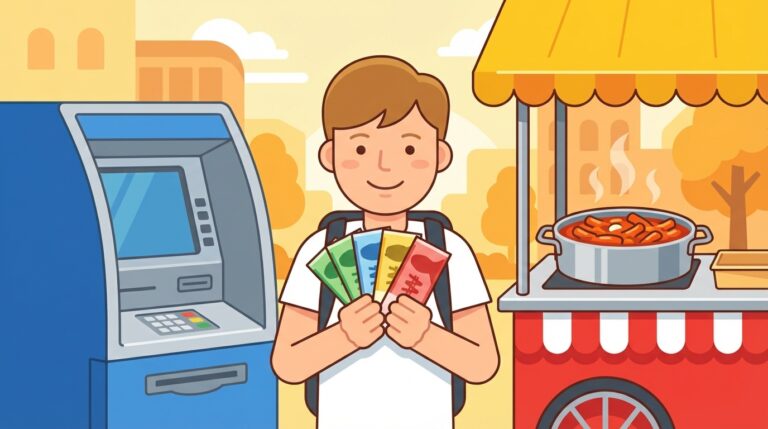
Imagine this: You are walking down the vibrant streets of Myeongdong or Hongdae. The smell of sweet Bungeoppang (fish-shaped pastry) and spicy Tteokbokki hits your nose. You step up to the cart, confident and ready to order, tapping your sleek credit card or Apple Pay against your phone. But then, the stall owner points to a small, handwritten cardboard sign: 현금만 가능 (Cash Only) or 계좌이체 (Bank Transfer).
Panic sets in. In a country famous for being a “cashless society,” you suddenly need physical Korean Won. Where do you go? How do you ask for an ATM?
Don’t worry! I’ve seen countless of my A2 students freeze in this exact moment. Today, I’m going to teach you exactly how to navigate the banking and cash-withdrawal waters in Korea like a true local. By the end of this guide, you won’t just survive; you’ll be grabbing that street food with absolute confidence!
Phase 2: Deep Dive into Core Expressions
Let’s break down the essential phrases you need when you’re on a mission to get some cash.
1. ATM 어디에 있어요?
- Pronunciation: ATM eodie isseoyo? [ei-ti-em eo-di-e is-seo-yo?]
- Meaning: Where is the ATM?
- K-Culture Moment: You’re lost in a subway station trying to reload your T-Money card (which requires cash!). You spot a convenience store clerk and ask this to save your commute.
- Editor’s Insight: The textbook word for ATM is ‘현금 인출기’ (hyeongeum inchulgi), but honestly? It’s too long. Just say “ATM”! Almost every Korean uses the English abbreviation. Just remember to pronounce it in the Korean style: “A-T-M” rather than blending the letters.
- Situation Spectrum:
- Casual with friends: ✅
- Semi-formal (Store clerk): ✅
- Formal (Boss): ✅ (Add ‘혹시’ at the beginning for extra politeness: 혹시 ATM 어디에 있어요?)
- 🤔 Think About It: Koreans love shortening words for efficiency (called 줄임말). Even official machines are often just called ATM. Does your language use abbreviations for banking terms too?
2. 돈 좀 뽑고 싶어요.
- Pronunciation: don jom ppopgo sipeoyo. [don jom ppop-go shi-po-yo]
- Meaning: I’d like to withdraw some money. (Literal: I want to pull out some money.)
- K-Culture Moment: You are heading to a Korean wedding. In Korea, you must give ‘Congratulatory Money’ (축의금) in a white envelope. You tell your Korean friend you need to stop by the bank first using this phrase.
- Editor’s Insight: The formal verb for withdrawing is ‘출금하다’ (to withdraw). But in everyday life, Koreans use the verb ‘뽑다’ (to pull out/extract). It sounds much more natural and native-like!
- Situation Spectrum:
- Casual with friends: ✅ (돈 좀 뽑을게!)
- Semi-formal: ✅ (돈 좀 뽑고 싶어요)
- Formal (At the bank counter): ⚠️ (Better to say: 출금하려고요)
- 🤔 Think About It: “Pulling out” money sounds very physical, right? It reflects the tactile sensation of taking bills out of a machine.
3. 수수료가 얼마예요?
- Pronunciation: susuryoga eolmayeyo? [soo-soo-ryo-ga ohl-ma-ye-yo?]
- Meaning: How much is the fee?
- K-Culture Moment: You find an ATM inside a convenience store at 11 PM. Your Korean friend might warn you, “Hey, check the fee first!” because late-night convenience store ATMs can have high transaction fees.
- Editor’s Insight: ‘수수료’ (susuryo) is a magic word. It applies to ATM fees, delivery fees (배달 수수료), and bank transfer fees. Memorize this noun!
- Situation Spectrum:
- Casual with friends: ✅ (수수료 얼마야?)
- Semi-formal: ✅
- Formal: ✅
Phase 3: Textbook vs. Real Korean
| Situation | 📖 Textbook Korean | 🗣️ Real Korean | 💡 Why is it different? |
|---|---|---|---|
| Saying “I’ll withdraw money” | 출금하겠습니다. (I will withdraw.) | 저 돈 좀 뽑을게요. (I’ll pull out some money.) | ‘뽑다’ is a visual, everyday verb preferred in spoken language over the formal Hanja-based ‘출금하다’. |
| Asking for the PIN | 비밀번호를 입력하십시오. (Please enter your password.) | 비번 쳐주세요. / 비번 누르세요. (Type/Press your PIN.) | ‘비밀번호’ (Password) is almost always shortened to ‘비번’ in casual or semi-formal speech! |
| Asking for an ATM | 현금 인출기 어디 있습니까? | 혹시 ATM 있어요? (By chance, is there an ATM?) | Koreans soften requests by adding ‘혹시’ (by any chance) to avoid sounding demanding. |
Bottom Note: As an A2 learner, using “돈 좀 뽑을게요” will instantly make you sound like someone who has actually lived in Korea, not just studied it from a book!
Phase 4: Cultural Context — K-Culture Deep Dive
4-1. Non-verbal Cues: The Art of Passing Money
When you finally get your cash and buy that street food, never hand the money with just one hand while looking away. In Korea, respect is physical.
– Use two hands to give the cash to the vendor, OR
– Hand it with your right hand while your left hand lightly supports your right wrist.
It shows respect and good Nunchi (social awareness).
4-2. K-Food Connection: The Cash-Only Havens
Korea is proudly a “plastic-first” nation. You can pay for a 1,000 won pack of gum with a credit card without getting any weird looks. However, the true essence of K-Food lies in places where cards go to die:
1. 포장마차 (Pojangmacha): The iconic red tents from K-Dramas where characters drink Soju and eat Udon.
2. 전통시장 (Traditional Markets): Places like Gwangjang Market where you eat Bindaetteok (mung bean pancakes).
3. Food Trucks/Carts: Winter snacks like Bungeoppang, Hotteok, and Odeng.
Always carry a crisp 10,000 won bill (Man-won) in your winter coat pocket. It’s practically a survival rule in Korea!
Phase 5: Real-Life Roleplay Scenario
Setting: It’s a chilly Friday evening. You and your Korean friend Min-su are at Gwangjang Market. The sizzling sound of mung bean pancakes fills the air. You both just finished eating a massive plate of food, and it’s time to pay.
Characters:
– YOU: An A2 Korean learner, determined to pay for the meal to thank Min-su for showing you around.
– Min-su: (28) Your energetic local friend who loves food.
Dialogue:
Min-su: 와, 진짜 배부르다! 내가 계산할게.
(Wa, jinjja baebureuda! Naega gyesanhalge.)
[Wow, I’m so full! I’ll pay.]
(🎭 Stage Direction: Min-su reaches for his wallet)
YOU: 아니에요, 오늘은 제가 살게요!
(Anieyo, oneureun jega salgeyo!)
[No, I’ll buy it today!]
Min-su: 에이, 괜찮아. 어? 근데 여기 카드 안 되네? 현금만 된대.
(Ei, gwaenchana. Eo? Geunde yeogi kadeu an dwene? Hyeongeumman dwendae.)
[Ah, it’s fine. Huh? But cards don’t work here? They say cash only.]
YOU: 헐, 진짜요? 저 현금 없는데…
(Heol, jinjjayo? Jeo hyeongeum eomneunde…)
[OMG, really? I don’t have cash…]
Min-su: 나도 지갑에 오천 원밖에 없어. 어떡하지?
(Nado jigabe ocheon wonbakke eopseo. Eotteokhaji?)
[I only have 5,000 won in my wallet too. What should we do?]
🔀 Your Turn! How should you respond?
– A) “사장님, 죄송해요. 돈이 없어요.” (Boss, sorry. We don’t have money.)
– B) “제가 잠깐 나가서 돈 좀 뽑아올게요. ATM 어디에 있어요?” (I’ll go out for a bit and withdraw some money. Where is the ATM?)
– C) “은행 어디예요? 출금하겠습니다.” (Where is the bank? I will withdraw.)✅ Best Choice: B — It perfectly uses real-life Korean (돈 좀 뽑아올게요) and asks for the solution (ATM 어디에 있어요?).
⚠️ Choice A Analysis: Sounds like you are trying to run away without paying!
⚠️ Choice C Analysis: Way too formal for a market setting, and banks are closed in the evening anyway. You need an ATM, not a whole bank branch!
Phase 6: 10-Second Shadowing Drill
Practice speaking like a local! Focus on the pauses (/) and the emotion tags.
- 🥺 “혹시 / 근처에 / ATM / 있어요?”
(hok-si / geun-cheo-e / ei-ti-em / it-seo-yo?)
[By any chance, is there an ATM nearby?] -
😤 “아, / 현금이 없네. / 돈 좀 / 뽑고 올게!”
(a, / hyeon-geum-i eom-ne. / don jom / ppop-go ol-ge!)
[Ah, I have no cash. I’ll go withdraw some money and come back!]
Phase 7: K-Culture Mini Dictionary
| Korean | Romanization | English | Context/Explanation |
|---|---|---|---|
| 현금 | hyeongeum | Cash | Physical paper money and coins. |
| 계좌이체 | gyejwaiche | Bank Transfer | Vendors often prefer this if you have no cash. They’ll show you a piece of paper with their bank account number. |
| 수수료 | susuryo | Fee / Commission | The extra money you pay to use another bank’s ATM. |
| 축의금 | chuguigeum | Congratulatory Money | Cash given at weddings. Must be crisp, clean bills placed in an envelope! |
| 붕어빵 | bungeoppang | Fish-shaped pastry | The ultimate reason why foreigners suddenly need ATMs in winter. |
Phase 8: Traveler’s Survival Kit
If you are traveling in Korea, you will definitely need this survival info.
🆘 Survival Phrases for the ATM/Bank
– 🇰🇷 “글로벌 ATM 어디에 있어요?” (geullobeol ei-ti-em eodie isseoyo?)
– 🗣️ Meaning: Where is the Global ATM?
– 📍 Where to use: In banks or subway stations.
– 💡 Pro Tip: Normal Korean ATMs might NOT accept foreign cards. You MUST look for the sign that says “Global ATM” or “Foreign Cards”.📌 Editor’s Travel Note
– Convenience Store ATMs: Easy to find (CU, GS25, 7-Eleven), but the withdrawal fee (수수료) can be high (1,000~1,500 KRW).
– Bank ATMs: Usually cheaper or free, but they often lock their doors at 11:30 PM! Don’t get trapped!
– T-Money: You can only recharge your public transit card (T-Money) with CASH at convenience stores and subway machines.
Phase 9: Critical Thinking Corner — “One Step Deeper”
Global Era vs. Tradition: The Paradox of Cash in Korea
🧠 Think Deeper:
South Korea has one of the highest credit card usage rates in the world. You can literally live for months in Seoul without touching a single paper bill. However, physical cash still holds immense traditional and emotional weight. Giving allowance to parents on Lunar New Year (설날), handing a white envelope at a wedding, or slipping pocket money to a niece—these moments must be done with crisp, brand-new physical cash. The “hassle” of going to the bank to withdraw money is actually a demonstration of sincerity and effort.💬 Your Turn: In your culture, does physical money still have a special meaning for gifts or holidays, or has everything gone digital? Let us know in the comments!
Phase 10: FAQ & Mistake Prevention
Q: “My PIN is 6 digits, but the Korean ATM only asks for 4. What do I do?”
Usually, try entering your 4-digit PIN. If it fails, sometimes adding ’00’ at the end of your 4-digit PIN works for foreign cards. But always check with your home bank before traveling!
Q: “Can I ask a convenience store clerk to break my 50,000 won bill into smaller bills?”
Yes! You can ask: “혹시 잔돈으로 바꿔주실 수 있어요?” (Could you change this into small change?). But buy a small item like a water bottle first out of politeness!
❌ Common Mistake #1: Assuming every ATM takes foreign cards.
✅ Do this instead: Always look for the “VISA/Mastercard” logo or the word “Global” on the machine before inserting your card. Otherwise, the machine might spit it out with an error sound that panics everyone around you!❌ Common Mistake #2: Tipping the street food vendor to “keep the change.”
✅ Do this instead: Tipping doesn’t exist in Korea! If you tell them to keep the change, they might chase you down the street thinking you forgot your money. Always take your exact change.
Phase 11: Summary & Action Items
One-Liner Summary: When you need cash for delicious street food, remember to find a Global ATM and say “돈 좀 뽑을게요!” (I’ll withdraw some money!).
Action Mission:
– 🥉 Bronze (Solo): Say “ATM 어디에 있어요?” out loud 3 times right now.
– 🥈 Silver (Online): Comment below with what Korean street food you want to buy with your withdrawn cash!
– 🥇 Gold (Real Life): The next time you are at a Korean convenience store, see if you can spot the ATM machine in the corner.
K-Culture Mission:
Next time you watch a K-Drama (especially a wedding or funeral scene), look closely at how the characters hand over the white envelopes of cash. Notice they always use two hands!
Phase 12: Quiz — Interactive Challenge
1. Situational Judgment:
You are at a cozy café and the card machine is broken. You need to tell the barista you are going to get cash. What is the most natural phrase?
– A) 출금하겠습니다.
– B) 돈 좀 뽑아올게요.
– C) 수수료가 얼마예요?
2. True or False – K-Culture Edition:
“You can recharge your Korean subway card (T-Money) with a credit card at the convenience store.” (True / False)
3. Fill in the Blank:
You want to ask your friend where the ATM is.
“혹시 근처에 _____ 있어요?”
Answers: 1. B (Natural and casual but polite enough for a barista if you add ‘요’), 2. False (T-Money recharges almost always require CASH!), 3. ATM
Frequently Asked Questions (FAQ)
Q: What does "ATM 어디에 있어요?" mean in Korean and how do you pronounce it?
A: In Korean, "ATM 어디에 있어요?" is pronounced [ATM eodie isseoyo? [ei-ti-em eo-di-e is-seo-yo?] and means: Where is the ATM?
Q: What does "돈 좀 뽑고 싶어요." mean in Korean and how do you pronounce it?
A: In Korean, "돈 좀 뽑고 싶어요." is pronounced [don jom ppopgo sipeoyo. [don jom ppop-go shi-po-yo] and means: I'd like to withdraw some money. (Literal: I want to pull out some money.)
Q: What does "수수료가 얼마예요?" mean in Korean and how do you pronounce it?
A: In Korean, "수수료가 얼마예요?" is pronounced [susuryoga eolmayeyo? [soo-soo-ryo-ga ohl-ma-ye-yo?] and means: How much is the fee?







