

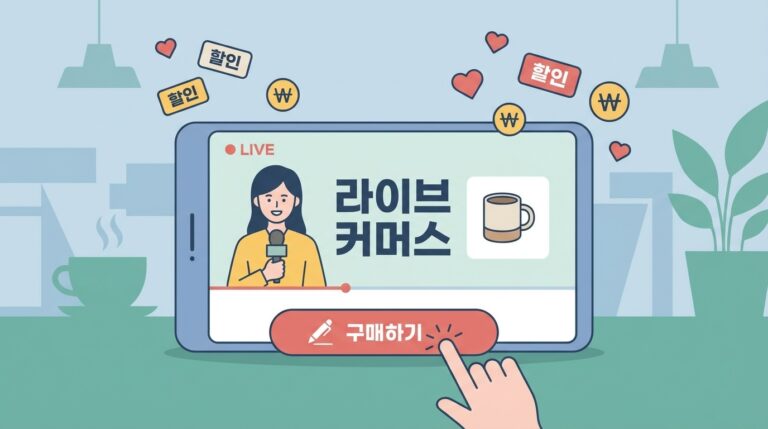
Phase 1: Empathy — Welcome to the Digital Battlefield
Hello! I’m your Daily Hangul Editor.
Picture this: It’s 8:00 PM on a Tuesday. You’re watching your favorite K-Beauty influencer or K-Pop idol on a live stream. They casually hold up an exclusive, limited-edition item—maybe an autographed album or a skincare bundle with a massive discount. The chat suddenly accelerates to warp speed, becoming a blur of Korean text. You eagerly click ‘Add to Cart,’ but before the page even loads, a giant ‘SOLD OUT’ banner slaps across your screen. You sit there, completely stunned.
Welcome to the intense, hyper-competitive world of Korean ‘라방’ (Rabang – Live Broadcasts).
As a C2-level Korean learner, you already know words like ‘사다’ (to buy) or ‘할인’ (discount). But in the ruthless arena of Rabang, standard textbook Korean won’t save you. If you don’t understand the hyper-specific slang used by the hosts and the viewers, you’ll miss out on the best deals and the cultural camaraderie of the chatroom.
This guide isn’t just about shopping; it’s about mastering the high-speed digital culture of modern Korea. Let’s upgrade your vocabulary so you can snag those deals like a true local!
Phase 2: Core Expressions Deep Dive
Here are the top-tier expressions you need to survive and thrive in a Korean Live Commerce broadcast.
1. 광클 (Gwang-keul)
- Pronunciation: [gwang-keul] — ‘Gwang’ sounds like the start of ‘guacamole’ but with an ‘ah’ sound, and ‘keul’ sounds like ‘cool’ but with that tight, disgusted ‘eu’ sound you make when stepping on gum.
- Meaning: (Literal) Crazy clicking. / (Real nuance) Clicking frantically to secure a highly competitive item.
- K-Culture Moment: This word originated from hardcore gamers and K-Pop fans trying to secure concert tickets (피켓팅 – blood ticketing). When a Rabang host says, “여러분, 지금부터 광클 준비하세요!” (Everyone, get ready to click like crazy!), it’s your cue to flex your index finger.
- Editor’s Insight: It carries a sense of physical desperation and adrenaline. You don’t just ‘click’ to buy something in Korea; you go to war for it.
- Situation Spectrum:
- Casual with friends: ✅
- Semi-formal (in a livestream chat): ✅
- Formal/Business: 🚫
- 🤔 Think About It: Why does Korean have so many words related to ‘speed’ (빨리빨리) and ‘competition’ in everyday shopping? How does your culture express the urgency of a limited-time sale?
2. 혜자스럽다 (Hyeja-seureopda) / 혜자 구성 (Hyeja guseong)
- Pronunciation: [hyeja-seureopda] — ‘Hye’ sounds like ‘hey’ with a ‘y’, and ‘ja’ is like the start of ‘jar’.
- Meaning: (Literal) To be like Hye-ja. / (Real nuance) An incredibly generous, cost-effective, and abundant deal.
- K-Culture Moment: Named after veteran actress Kim Hye-ja, whose licensed convenience store bento boxes were famous for being cheap but packed with high-quality food. In Rabang, a host will constantly yell, “오늘 구성 진짜 혜자예요!” (Today’s bundle is seriously a steal/so generous!).
- Editor’s Insight: It’s the ultimate compliment for a product. It implies that the seller is practically giving it away out of motherly love.
- Situation Spectrum:
- Casual with friends: ✅
- Semi-formal (Livestream chat/Online): ✅
- Formal/Business (To your boss): 🚫
- 🤔 Think About It: Taking a real person’s name to describe ‘value for money’ shows how deeply pop culture impacts the Korean language. Are there brand names or celebrities in your language that became adjectives?
3. 드릉드릉 (Deureung-deureung)
- Pronunciation: [deureung-deureung] — Roll your ‘R’s slightly. The ‘eu’ sounds like you’re politely clearing your throat.
- Meaning: (Literal) Vroom-vroom (engine revving sound). / (Real nuance) Itching/dying to do something, especially spending money.
- K-Culture Moment: You’re watching an unboxing Rabang. The host shows the sparkling new merch. You type in the chat: “아, 지갑 열려고 드릉드릉하는 중” (Ah, my wallet is revving up / I’m itching to open my wallet).
- Editor’s Insight: This is a fantastic C2-level mimetic word (의태어). It paints a vivid picture of someone barely holding back their impulses.
- Situation Spectrum:
- Casual with friends: ✅
- Semi-formal (Colleagues of similar age): ⚠️ (Use playfully)
- Formal/Business: 🚫
- 🤔 Think About It: Korean is incredibly rich in onomatopoeia and mimetic words. Why do you think Korean relies so heavily on ‘sound/shape’ words to express psychological states?
Phase 3: Textbook vs. Real Korean
| Situation | 📖 Textbook Korean | 🗣️ Real Korean (Rabang Slang) | 💡 Why the difference? |
|---|---|---|---|
| Item is sold out instantly | 모든 상품이 매진되었습니다. | 순삭됐어요 (순식간에 삭제) / 품절각 | ‘순삭’ (instantly deleted) reflects digital UI, treating physical goods like digital data disappearing. |
| Getting a good deal | 저렴하게 잘 샀습니다. | 완전 득템했어요! (득템) | Borrowed from gaming (‘acquiring an item’), turning shopping into a triumphant quest. |
| Trying to buy but failing | 구매에 실패했습니다. | 광탈했어요 (광속 탈락) | ‘광탈’ (eliminated at the speed of light) highlights the sheer speed of Korean internet culture. |
| Asking the host a question | 질문이 있습니다. | 소통해요! / 질문 받아주세요 | ‘소통’ (communication) is the lifeblood of Rabang. Viewers demand a two-way parasocial relationship. |
Bottom Note for C2 Learners: Avoid using these highly colloquial terms in academic or strict business emails. However, dropping a perfectly timed “완전 혜자네요!” in an informal office lunch will instantly elevate you to “Insider” (인싸) status among your Korean colleagues.
Phase 4: Cultural Context — K-Culture Deep Dive
4-1. Non-verbal Cues: The Art of ‘눈치’ (Nunchi) in the Chat
In a Rabang, Nunchi (the subtle art of reading the room) translates to reading the chat speed. If the chat is moving slowly, the item is probably too expensive. If the chat explodes with “헐” (OMG) and “미쳤다” (Crazy), your Nunchi should tell you: Buy it now, ask questions later. Additionally, using excessive emojis in a fast-paced sale can actually mark you as a newbie—veterans type short, punchy consonants like “ㄷㄷ” (shivering/amazing) or “ㄱㄱ” (go go) to save time.
4-2. The K-Pop Connection: ‘Ticketing’ Trauma meets Shopping
If you’ve ever tried to buy BTS or Blackpink concert tickets, you know the trauma of the ‘waiting room’ screen. This K-Pop “피켓팅” (Blood Ticketing) culture has seamlessly merged with Korean online shopping. Rabang hosts often build hype by treating a skincare launch like a K-Pop comeback. They use idol terminology like “스포” (Spoiler – revealing a deal early) and “오픈런” (Open Run – rushing the moment it starts). Understanding this intersection reveals how deeply fandom mechanics influence mainstream Korean consumer behavior.
Phase 5: Real-life Roleplay Scenario
Setting: It’s 9 PM. You’re chilling at a cozy cafe in Yeonnam-dong with your Korean friend, Min-ji. Both of your smartphones are propped up against your coffee cups. A famous beauty brand is hosting a Rabang with a crazy 70% discount on a viral serum.
Characters:
– YOU: A savvy expat living in Seoul, determined to secure this deal.
– Min-ji (28): Your Korean friend, a Rabang veteran with lightning-fast thumbs.
Dialogue:
Min-ji: 야, 5분 남았다. 손가락 풀었어?
(Ya, obun namatda. Songarak pureosseo?)
[Hey, 5 minutes left. Did you warm up your fingers?]
(🎭 Stage Direction: Min-ji cracks her knuckles dramatically)
YOU: 당연하지. 결제수단도 미리 다 등록해 놨어.
(Dangyeonhaji. Gyeoljesudando miri da deungnokhae nwasseo.)
[Of course. I even registered my payment method in advance.]
Min-ji: 오~ 역시! 근데 이거 수량 100개 한정이라 1분 컷일 듯.
(O~ yeoksi! Geunde igeo suryang baekgae hanjeongira ilbun keosil deut.)
[Oh~ as expected! But there are only 100 in stock, so it’ll probably sell out in a minute (1-minute cut).]
YOU: 진짜? 나 지금 사려고 엄청 드릉드릉하고 있는데.
(Jinjja? Na jigeum saryeogo eomcheong deureungdeureunghago inneunde.)
[Really? I’m itching so bad to buy this right now.]
Min-ji: 헐, 시작했다! 호스트가 지금 쿠폰 번호 불렀어!
(Heol, sijakaetda! Hoseuteuga jigeum kupon beonho bulleosseo!)
[OMG, it started! The host just called out the coupon code!]
🔀 Your Turn! The host asks the chat, “여러분, 이 구성 어때요?” (Everyone, how is this bundle?) What do you type to get noticed?
- A) “너무 저렴하고 좋은 상품입니다.” (Too robotic. The host will scroll right past it.)
- B) “완전 혜자 구성 미쳤다!! ㅠㅠ 무조건 광클 ㄱㄱ”
- C) “비싸요 깎아주세요.”
✅ Best Choice: B — “This generous bundle is crazy!! ㅠㅠ Absolute mad clicking, go go.” This matches the high energy of the stream, uses the exact C2 slang (혜자, 광클), and perfectly captures the native vibe.
(🎭 Stage Direction: You furiously tap the screen… but the loading wheel spins…)
Min-ji: 아… 나 결제창에서 튕겼어. 광탈이야.
(Ah… na gyeoljechang-eseo twinggyeosseo. Gwangtariya.)
[Ah… I got bounced from the payment screen. Eliminated at the speed of light.]
YOU: 나도… 완전 순삭이네. 다음 라방을 노리자.
(Nado… wanjeon sunsagine. Da-eum rabang-eul norija.)
[Me too… It was deleted instantly. Let’s aim for the next live stream.]
Phase 6: 10-Second Shadowing Drill
Practice expressing absolute disbelief when an item sells out while you’re putting in your credit card info. Focus on the intonation and pauses!
🥺 헐... / 방금 / 결제창 터진 거 / 실화예요?
(heol… / banggeum / gyeoljechang teojin geo / silhwayeyo?)
(OMG… / just now / the payment page crashing / is this real life?)
Tip: Stretch the “헐” slightly with a sigh, and emphasize “실화예요?” (Is this a true story/real life?) with an upward, incredulous tone.
Phase 7: K-Culture Mini Dictionary
| 한국어 (Korean) | Romanization | English Meaning | Cultural Context |
|---|---|---|---|
| 라방 | rabang | Live Stream | Short for ‘라이브 방송’. The heart of modern Korean e-commerce. |
| 광탈 | gwang-tal | Instant Failure | Short for ‘광속 탈락’. Failing to secure a ticket/item instantly. |
| 득템 | deuk-tem | Great Catch/Steal | ‘Deuk’ (to obtain) + ‘Item’. Getting a rare or cheap item. |
| 순삭 | sun-sak | Gone in a flash | Short for ‘순식간에 삭제’ (deleted in an instant). |
| 실화냐 | sil-hwa-nya | Is this real? | Slang used to express shock when a deal is either too good, or sells out too fast. |
Phase 8: Traveler Survival Kit
You might think Rabang is just for online shoppers, but travelers face this exact culture when trying to score limited goods at Seoul’s famous Pop-Up Stores (Seongsu-dong, The Hyundai Seoul).
🆘 Survival Phrases for Pop-up Store ‘Ticketing’
– 🇰🇷 “이거 혹시 품절인가요?” (igeo hoksi pumjeoringayo?)
– 🗣️ Meaning: Is this by any chance sold out?
– 📍 Where to use: Olive Young, Pop-up stores, Department store limited events.
– 💡 Pro Tip: If they say yes, follow up with “재입고 언제 되나요?” (When will it be restocked?)📌 Editor’s Travel Note: The Digital Queue
In Korea, you rarely stand in a physical line anymore. You need apps like CatchTable (캐치테이블) or a KakaoTalk account to register your phone number on a tablet at the entrance (웨이팅 등록). If you don’t have a Korean number, immediately find a staff member and say, “외국인인데 웨이팅 어떻게 하나요?” (I’m a foreigner, how do I wait in line?). They will usually give you a physical ticket or write your name down!
Phase 9: Critical Thinking Corner — “한 발 더 깊이”
🧠 Think Deeper: Hyper-Consumerism and Digital Solidarity
Korean Live Commerce language is fascinating because it blends aggressive consumerism with a profound sense of digital solidarity. Words like “광탈” (instant elimination) or “피켓팅” (blood ticketing) use extreme, almost violent imagery to describe shopping. This reflects Korea’s hyper-competitive “빨리빨리” (hurry hurry) society, where resources (jobs, real estate, concert tickets, discount serums) are fiercely contested. Yet, when the stream crashes or the item sells out, viewers immediately flood the chat with “ㅠㅠ” and bond over their shared failure. The competition is fierce, but the communal experience of participating in the ‘event’ is just as important as buying the item itself.
💬 Your Turn:
Does your culture have a similar phenomenon? Think about Black Friday or massive holiday sales. Do people bond over the chaos, or is it purely individualistic? Share your thoughts in the comments!
Phase 10: FAQ & Avoiding Misunderstandings
Q: Can I use “혜자스럽다” in a formal business meeting about budgeting?
No. While it means ‘cost-effective,’ it is fundamentally slang based on a celebrity’s name. In a formal meeting, use “가성비가 좋습니다” (It’s highly cost-effective) or “수익성이 높습니다” (It’s highly profitable).
Q: If I’m chatting in a Rabang, should I use formal language (존댓말) or informal (반말)?
Usually 존댓말 (Polite/Formal). Even though the chat is wild and fast, viewers usually use the standard ‘-요’ form to the host. However, exclamations directed at nobody in particular (like “대박”, “미쳤다”) are written in their base forms.
❌ Common Mistake #1: Translating “My wallet is ready” directly to “내 지갑이 준비됐어요.” It sounds unnatural and translated.
✅ Do this instead: Use the C2 expression “지갑 열 준비 완료” (Preparation to open wallet complete) or “드릉드릉하는 중” (Revving up).
Phase 11: Summary & Action Items
✨ One-Liner Summary:
Surviving Korean Live Commerce requires mastering high-speed slang like Gwang-keul (광클) and Hyeja (혜자) to outpace the fierce competition.
🎯 Action Mission (Pick Your Level):
– 🥉 Bronze (Solo): Read the 10-second shadowing drill out loud 3 times, focusing on acting shocked.
– 🥈 Silver (Online): Go to Naver Shopping Live, open any active Rabang, and spot at least two slang words in the chat.
– 🥇 Gold (Real-world): Next time you find a great deal online or in a Korean store, confidently say to yourself or your friend, “와, 이거 완전 혜자다!”
🛍️ K-Culture Mission:
Download the ‘Olive Young’ app or go to their Global site during a ‘Big Bang Sale’ period. Look at how they market their bundles. Can you feel the Gwang-keul energy?
Phase 12: Quiz — Interactive Challenge
Test your advanced C2 intuition!
1. Situational Judgment: You are watching a BTS merch Rabang. The host reveals a signed poster, but only 5 are available. What is the most natural thing to type in the chat?
– A) 아주 사고 싶습니다. (I want to buy it very much.)
– B) 서버 터질 각 ㄷㄷ 광클 간다! (Looks like the server will crash shiver Going for the mad click!)
– C) 이것은 너무 비쌀 것 같아요. (I think this will be too expensive.)
2. Fill in the Blank:
“아 진짜 짜증나! 결제 버튼 누르자마자 ________ 했어.”
(Ah, so annoying! As soon as I pressed pay, I was ________.)
– Hint: Eliminated at the speed of light.
3. T/F – K-Culture Edition:
In Korean pop-up stores, you always stand in a physical line for hours without using your phone.
(True / False)
🚨 Click to reveal answers!
- B — A is too robotic, C kills the hype. B is perfect C2-level native chat lingo.
- 광탈 (Gwang-tal) — The perfect term for failing a digital queue.
- False — Most popular pop-ups use a digital waiting system (웨이팅 기계) where you input your phone number and leave until you get a text.
Did you ever experience a ‘광탈’ moment? Let me know in the comments below! Don’t forget to bookmark this guide for your next Korean shopping spree.
Frequently Asked Questions (FAQ)
Q: What does "광클 (Gwang-keul)" mean in Korean and how do you pronounce it?
A: In Korean, "광클 (Gwang-keul)" is pronounced [gwang-keul] and means: (Literal) Crazy clicking. / (Real nuance) Clicking frantically to secure a highly competitive item.
Q: What does "혜자스럽다 (Hyeja-seureopda) / 혜자 구성 (Hyeja guseong)" mean in Korean and how do you pronounce it?
A: In Korean, "혜자스럽다 (Hyeja-seureopda) / 혜자 구성 (Hyeja guseong)" is pronounced [hyeja-seureopda] and means: (Literal) To be like Hye-ja. / (Real nuance) An incredibly generous, cost-effective, and abundant deal.
Q: What does "드릉드릉 (Deureung-deureung)" mean in Korean and how do you pronounce it?
A: In Korean, "드릉드릉 (Deureung-deureung)" is pronounced [deureung-deureung] and means: (Literal) Vroom-vroom (engine revving sound). / (Real nuance) Itching/dying to do something, especially spending money.







