

Navigating Korea’s Modernized Traditional Markets: From QR Codes to Youth Malls
Phase 1: The Empathy Connection (Cold Open)
Hello! This is the Lead Editor of Daily Hangul.
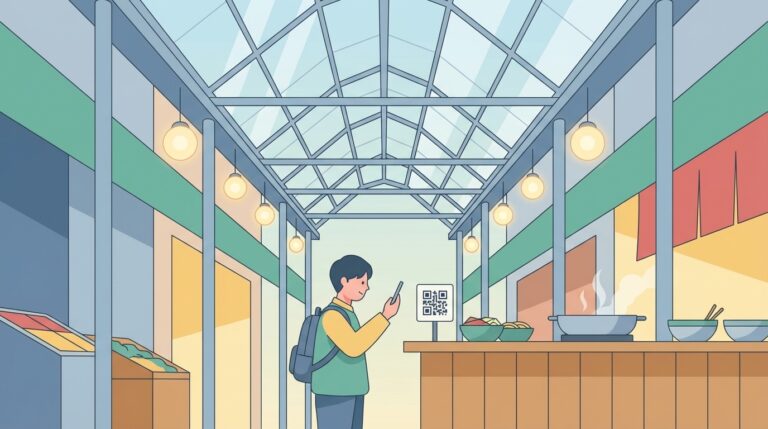
Picture this: You’ve watched countless K-Dramas and documentaries like Netflix’s Street Food. You head to Mangwon Market in Seoul, fully expecting muddy floors, shouting merchants, and handing over crumpled cash for a skewer of hot tteokbokki. But when you arrive? The alleys are covered with sleek glass arcades, a “Youth Mall” (청년몰) is selling vegan fusion dishes, and when you pull out a 10,000 won bill, the 70-year-old halmeoni (grandmother) points to a sleek little sign and says, “Just scan the QR code, student!”
Wait, what? A QR code at a traditional market?
Welcome to the modernized Korean traditional market. As a C1-level learner, you already know basic transactional phrases like “얼마예요?” (How much is it?). But navigating Korea’s rapidly digitizing society requires a vocabulary upgrade. If you don’t know the right words, you might find yourself awkwardly holding cash while a long line of impatient locals forms behind you.
This guide is built from the real-life experiences of my advanced students who realized that sounding like a local means knowing how to blend centuries-old market Jeong (정, warmth/connection) with 5G internet speeds. Let’s dive in!
Phase 2: Core Expressions Deep Dive
1. 계좌이체 해드릴게요. (I’ll transfer the money to your account.)
- Pronunciation: gye-jwa-i-che hae-deu-ril-gge-yo. (Think of ‘gye’ like the start of ‘get’, and ‘jwa’ like ‘Mwah!’ but with a J).
- Meaning: I will do a bank transfer for you.
- K-Culture Moment: You’re at a bustling Jeon (pancake) stall. The card machine is slow, or the purchase is too small for a card (like 3,000 won). You say this, whip out your banking app, and type in the account number taped to the stall. It’s the ultimate “I live here” flex.
- Editor’s Insight: Notice the verb “해드릴게요” (I will do it for you) instead of just “할게요” (I will do it). It adds a layer of respect and consideration, softening the cold nature of a digital transaction and preserving the traditional market vibe.
- Situation Spectrum:
- Casual (to a young merchant): ✅
- Semi-formal (to an older stall owner): ✅
- Formal/Corporate: ⚠️ (A bit too direct for corporate settings)
- 🤔 Think About It: Why do Koreans prefer instant bank transfers over cash, even for tiny amounts? How does this reflect Korea’s “Pali-pali” (hurry hurry) culture combined with its advanced IT infrastructure?
2. 사장님, 여기 온누리(상품권) 큐알 결제 되죠?
- Pronunciation: sa-jang-nim, yeo-gi on-nu-ri (sang-pum-gwon) kyu-al gyeol-je doe-jyo?
- Meaning: Boss, you accept Onnuri (Gift Certificate) QR payment here, right?
- K-Culture Moment: ‘Onnuri’ is a government-subsidized currency exclusively for traditional markets to help them compete with mega-marts. It used to be paper, but now it’s an app. Asking this shows you are a savvy consumer who knows about local tax benefits!
- Editor’s Insight: We use “되죠?” (It works, right?) instead of “되나요?” (Does it work?) because in modernized markets, it’s almost expected that they accept it. It sounds confident and natural.
- Situation Spectrum:
- Friend to Friend: 🚫 (Not used between friends)
- Customer to Merchant: ✅
- 🤔 Think About It: Using the word “사장님” (Boss/CEO) for a small stall owner is standard in Korea. How does elevating the title of the person you are buying from change the dynamic of the transaction compared to your home country?
3. 청년몰은 어느 쪽으로 가야 돼요?
- Pronunciation: cheong-nyeon-mo-reun eo-neu jjo-geu-ro ga-ya dwae-yo?
- Meaning: Which way should I go to get to the Youth Mall?
- K-Culture Moment: To save dying markets, the government created “Youth Malls” inside them—giving young entrepreneurs cheap rent to open trendy dessert cafes, photo studios, or fusion restaurants. You’ll often see K-Pop idols visiting these spots on variety shows!
- Editor’s Insight: “어느 쪽으로” (in which direction) is much more natural and advanced than the basic “어디예요?” (Where is it?). It implies you know it’s within the market complex but just need the specific route.
- Situation Spectrum:
- Asking a passerby: ✅
- Asking a merchant: ✅
- 🤔 Think About It: Blending “Youth” (청년) with an English loanword “Mall” (몰) inside a traditional setting. What does this linguistic mix tell you about modern Korea’s approach to preserving tradition?
Phase 3: Textbook vs. Real Korean
| Situation | 📖 Textbook Korean | 🗣️ Real Korean | 💡 Why the Difference? |
|---|---|---|---|
| Paying without a card | 현금으로 계산하겠습니다. (I will pay with cash.) | 계좌이체 해드렸어요~ 보여드릴까요? (I transferred it~ Shall I show you?) | Cash is disappearing! Showing your phone screen builds instant trust (Nunchi culture). |
| Asking for a discount | 좀 깎아주세요. (Please give me a discount.) | 사장님, 서비스 좀 많이 주세요~ (Boss, please give me a lot of ‘service’/extras~) | Prices are often digitized now. Instead of haggling the price down, modern Koreans ask for extra items (service). |
| Commenting on the market | 시장이 참 좋네요. (The market is very nice.) | 아케이드 생겨서 진짜 깔끔해졌네요. (It’s gotten so clean since the arcade was built.) | Acknowledging the specific modernization efforts (arcades/roofs) makes for great small talk. |
Bottom Note for C1 Learners: Haggling (흥정) used to be the core of market culture, but with price-tag mandates and digital payments, aggressively asking to lower the price can now be seen as rude. Stick to asking for “서비스” (extras) with a smile!
Phase 4: Cultural Context — K-Culture Deep Dive
4-1. Non-Verbal Nunchi: The “Screen Tap”
When you pay via “계좌이체” (bank transfer), never just transfer the money and walk away. Traditional Nunchi dictates that you must assure the merchant they’ve been paid without making them demand proof.
Pro Move: Transfer the money, step forward slightly, tilt your phone screen toward the merchant, point at the “Transfer Complete” screen, and say cheerfully, “사장님, 이체했어요!” (Boss, I transferred it!). They might just nod without looking closely, but this gesture establishes massive trust.
4-2. K-Food Connection: The “New-Retro” (뉴트로) Vibe
If you’ve watched K-Dramas recently, you’ll notice scenes where young couples go on dates to traditional markets like Gwangjang or Mangwon. This isn’t just a TV trope; it’s a massive trend called “New-Retro” (뉴트로). Young Koreans flock to modernized markets to eat traditional Bindaetteok (mung bean pancakes), but they take photos of it with their iPhones, post it on Instagram, and pay with KakaoPay. When you visit, don’t be surprised to see vendors vacuum-sealing (진공 포장) your side dishes so they don’t leak in your stylish tote bag or on the subway!
Phase 5: Real-Life Roleplay Scenario
Setting: Friday evening at Mangwon Market. The alleys are brightly lit under the modern glass arcade roof. You are standing in front of a famous Dakgangjeong (sweet crispy fried chicken) stall. A line of young locals is behind you.
Characters:
– YOU: An expat living in Seoul, craving some Friday night chicken.
– Sajangnim (사장님): A lively stall owner in her 50s, wearing a modern hygienic mask and gloves, efficiently packing chicken into sleek branded boxes.
Dialogue:
Sajangnim: 다음 손님! 닭강정 중짜리 맞으시죠? 매운맛으로 드릴까?
(da-eum son-nim! dak-gang-jeong jung-jja-ri ma-jeu-si-jyo? mae-un-ma-seu-ro deu-ril-kka?)
[Next customer! A medium sweet crispy chicken, right? Shall I give you the spicy flavor?]
YOU: 네! 혹시 반반도 되나요?
(ne! hok-si ban-ban-do doe-na-yo?)
[Yes! By any chance, can I do half-and-half?]
Sajangnim: 그럼요~ (포장하며) 자, 만 이천 원입니다.
(geu-reom-yo~ [po-jang-ha-myeo] ja, man i-cheon-won-im-ni-da.)
[Of course~ (While packing) Here you go, it’s 12,000 won.]
YOU: 아, 제가 실물 카드가 없어서요.
(a, je-ga sil-mul ka-deu-ga eop-seo-seo-yo.)
[Ah, I don’t have a physical card on me.]
🔀 Your Turn! The line is long. How should you handle the payment?
– A) “어떡하죠? 현금도 없는데…” (What should I do? I don’t have cash either…)
– B) “여기 계좌이체 해드릴게요. 번호가… 아, 저기 있네요!” (I’ll transfer the money. The number is… ah, it’s over there!)
– C) “그냥 안 살게요. 죄송합니다.” (I just won’t buy it. Sorry.)✅ Best Choice: B.
You take charge. You spot the account number on the wall, initiate the transfer, and keep the line moving.
⚠️ Choice A Analysis: Playing helpless will frustrate the busy merchant and the people behind you. In modern markets, there is always a digital backup.
(Continuing with Option B)
YOU: (Tapping your phone) 사장님, 국민은행으로 이체해 드렸어요! 여기 영수증 화면이요.
(sa-jang-nim, guk-min-eun-haeng-eu-ro i-che-hae deu-ryeot-seo-yo! yeo-gi yeong-su-jeung hwa-myeon-i-yo.)
[Boss, I transferred it to your Kookmin Bank account! Here is the receipt screen.]
Sajangnim: (Glances at your phone) 네, 확인했어요. 맛있게 먹어요!
(ne, hwa-gin-haet-seo-yo. ma-sit-ge meo-geo-yo!)
[Yes, confirmed. Enjoy the food!]
🌟 Bonus K-Culture Scenario: Finding the Restroom
Modernized markets pride themselves on new facilities. If you need a restroom, don’t look for a dingy outhouse.
– YOU: 저기요, 혹시 공중화장실이 어디예요?
– Passerby: 아, 저기 청년몰 건물 2층으로 가시면 엄청 깨끗해요. 엘리베이터 타시면 돼요.
(Ah, if you go to the 2nd floor of the Youth Mall building over there, it’s very clean. You can take the elevator.)
Phase 6: 10-Second Shadowing Drill
Let’s practice the flow and rhythm. Pay attention to the pauses (/) and the emotion!
😊 밝고 친절하게 (Bright and polite):
사장님! / 국민은행으로 / 이체~ / 해드렸어요!
(sa-jang-nim! / guk-min-eun-haeng-eu-ro / i-che~ / hae-deu-ryeot-seo-yo!)
(Tip: Stretch the ‘체~’ slightly to sound extremely friendly and local!)
Phase 7: K-Culture Mini Dictionary
| Korean | Romanization | English | Contextual Meaning |
|---|---|---|---|
| 계좌이체 | gye-jwa-i-che | Bank Transfer | The lifeblood of modern market transactions. Usually done via banking apps or KakaoPay. |
| 청년몰 | cheong-nyeon-mol | Youth Mall | A designated area in traditional markets where young entrepreneurs open trendy, modern shops to attract the MZ generation. |
| 아케이드 | a-ke-i-deu | Arcade (Roof) | The modern glass/plastic roofs built over market alleys to protect shoppers from weather. A key sign of a modernized market. |
| 온누리상품권 | on-nu-ri-sang-pum-gwon | Onnuri Gift Cert. | Government-issued currency for traditional markets. Now available as a mobile app with QR payment features. |
| 시장 인심 | si-jang in-sim | Market Generosity | The warm, generous spirit of market vendors (like giving you extra food). Modernization hasn’t killed this! |
Phase 8: Traveler’s Survival Kit
🆘 Survival Phrases for the Modern Market
– 🇰🇷 “카카오페이 되나요?” (ka-ka-o-pe-i doe-na-yo?)
– 🗣️ Meaning: Do you take KakaoPay?
– 📍 Where to use: Literally any stall. If they don’t have a card machine, they have KakaoPay.
- 🇰🇷 “포장 안 새게 진공으로 해주세요.” (po-jang an sae-ge jin-gong-eu-ro hae-ju-se-yo.)
- 🗣️ Meaning: Please vacuum-seal the packaging so it doesn’t leak.
- 📍 Where to use: Buying kimchi, side dishes (banchan), or liquids to take back to your hotel.
📌 Editor’s Travel Note
– Cash vs. Card: While cards are widely accepted in modernized markets, stalls selling items under 5,000 won still prefer bank transfers or cash.
– Trash Cans: Modernized markets often have designated dining zones or cafes. Do not throw your street food skewers on the ground; take them back to the vendor or look for a public recycling bin.
Phase 9: Critical Thinking Corner — “A Step Deeper”
Global Era vs. Traditional Identity: The Gentrification of Markets
🧠 Think Deeper:
As traditional markets like Gwangjang and Mangwon modernize, they are experiencing rapid gentrification. On one hand, government funding for arcades, QR payments, and “Youth Malls” has saved these spaces from dying out. On the other hand, the influx of trendy cafes and tourists is driving up rent, pushing out the original elderly vendors who made the market authentic. When we use words like “계좌이체” instead of exchanging physical cash, the transaction becomes seamless, but does it lose the brief moment of human touch that defined “시장 인심” (market generosity)? Korea is constantly balancing hyper-modern efficiency with the desire to preserve its cultural soul.💬 Your Turn: Have traditional markets or old neighborhoods in your home country undergone similar modernization or gentrification? How has it changed the way people communicate there? Share your thoughts in the comments!
Phase 10: FAQ & Avoiding Misunderstandings
Q: Can I still haggle (깎아주세요) in a modernized traditional market?
A: Generally, NO. With the modernization push, most traditional markets now enforce a “Price Tag System” (가격표시제). Prices are fixed and visible. Trying to haggle for a 5,000 won item will just make things awkward. Instead, rely on the vendor’s Jeong to give you a little extra (서비스) automatically.
Q: I don’t have a Korean bank account. What do I do when they ask for a transfer?
A: Simply say, “외국인이라 계좌이체가 안 돼요. 현금 드릴게요.” (I’m a foreigner so I can’t do bank transfers. I’ll give you cash.) They will completely understand!
❌ Common Mistake #1: Calling young vendors in the Youth Mall “아줌마” (Ahjumma) or “아저씨” (Ajeossi).
✅ Do This Instead: Always use “사장님” (Sajangnim – Boss). It’s polite, professional, and universally appreciated, regardless of age or gender.
Phase 11: Summary & Action Items
One-Liner Summary: Navigating Korea’s modernized traditional markets requires blending old-school warmth (Jeong) with modern digital vocabulary like 계좌이체 (bank transfer) and 청년몰 (Youth Mall).
Action Mission:
– 🥉 Bronze (Solo): Stand in front of a mirror and practice saying “사장님, 여기 계좌이체 해드릴게요!” while pretending to show your phone screen.
– 🥈 Silver (Online): Go to a Korean language forum or comment below: Tell us what street food you would buy using a QR code!
– 🥇 Gold (Real Life): Visit a traditional market in Korea (or a Korean grocery store abroad) and ask, “혹시 카카오페이나 계좌이체 되나요?”
🇰🇷 Special K-Culture Mission:
Open YouTube and search for “망원시장 브이로그” (Mangwon Market Vlog) or “전통시장 청년몰” (Traditional Market Youth Mall). Spot the QR codes on the stalls and listen for how the vloggers pay!
Phase 12: Interactive Quiz
1. Situational Judgment: You bought some strawberries for 8,000 won at a modernized stall. You want to pay via bank transfer. What is the most culturally appropriate sequence of actions?
– A) Silently transfer the money and walk away.
– B) Say “계좌이체 할게요,” transfer the money, show the merchant your phone screen, and say “확인해 주세요!”
– C) Give them your phone to do the transfer themselves.
2. Fill in the Blank:
“The market got so much cleaner after they built the roof!”
“여기 ___________ 생겨서 진짜 깔끔해졌네요!”
3. True or False (K-Culture Edition):
Because markets are modernized now, you are expected to leave a 10% tip when paying via QR code. (T / F)
👀 Click here for answers!
1. B – Showing the screen builds trust and confirms the transaction politely.
2. 아케이드 (Arcade) – The glass/plastic roofs are a hallmark of modernized markets.
3. False – Korea is strictly a no-tip culture, even in modernized traditional markets! Asking for a tip is practically unheard of.
Frequently Asked Questions (FAQ)
Q: What does "계좌이체 해드릴게요. (I'll transfer the money to your account.)" mean in Korean and how do you pronounce it?
A: In Korean, "계좌이체 해드릴게요. (I'll transfer the money to your account.)" is pronounced [gye-jwa-i-che hae-deu-ril-gge-yo. (Think of 'gye' like the start of 'get', and 'jwa' like 'Mwah!' but with a J] and means: I will do a bank transfer for you.
Q: What does "사장님, 여기 온누리(상품권) 큐알 결제 되죠?" mean in Korean and how do you pronounce it?
A: In Korean, "사장님, 여기 온누리(상품권) 큐알 결제 되죠?" is pronounced [sa-jang-nim, yeo-gi on-nu-ri (sang-pum-gwon] and means: Boss, you accept Onnuri (Gift Certificate) QR payment here, right?
Q: What does "청년몰은 어느 쪽으로 가야 돼요?" mean in Korean and how do you pronounce it?
A: In Korean, "청년몰은 어느 쪽으로 가야 돼요?" is pronounced [cheong-nyeon-mo-reun eo-neu jjo-geu-ro ga-ya dwae-yo?] and means: Which way should I go to get to the Youth Mall?







