

Phase 1: Empathy (Welcome to Your K-Drama Moment!)
Hello there! I’m your Daily Hangul editor, your personal guide to the heart of Korean culture.
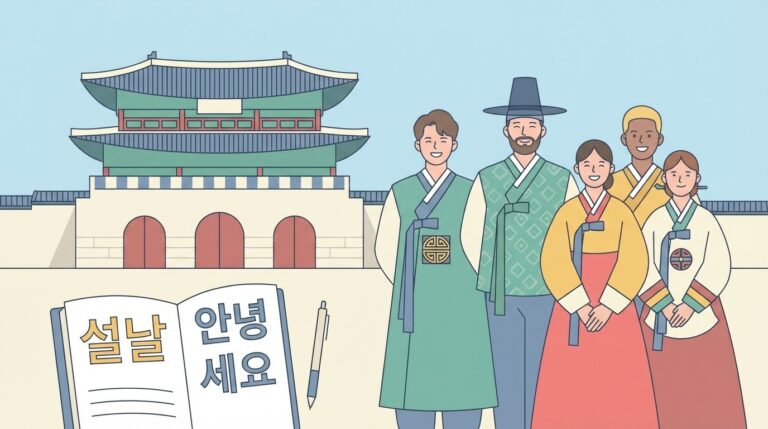
Imagine this: It’s a crisp, sunny morning during Seollal (Korean Lunar New Year). You are walking near Gyeongbokgung Palace, and suddenly, you feel like you’ve time-traveled. Everywhere you look, people are swishing around in vibrant, pastel-colored traditional clothes. You want to join in! You walk into a rental shop, surrounded by oceans of silk and gold foil. But… the shop owner (a very energetic Ajumma) fires off rapid Korean. You just stand there, smiling awkwardly, pointing at a random skirt.
We’ve all been there! Renting a Hanbok (한복) is the ultimate K-Culture bucket-list item. Whether you want to recreate that romantic scene from your favorite historical K-Drama (Sageuk) or just take the perfect Instagram shot, knowing just a few key phrases will transform you from a confused tourist into a confident cultural explorer.
Don’t worry, this guide is built from the real-life ‘panic moments’ of my A1 beginner students. Let’s get you ready for your royal debut!
Phase 2: Core Expressions for Hanbok Renting
Here are the top 3 magical phrases you need to survive and thrive at a Hanbok shop.
1. 이거 입어봐도 돼요? (Can I try this on?)
- Pronunciation: i-geo / i-beo-bwa-do / dwae-yo? (Sound analogy: ‘i-geo’ sounds like ‘ego’, ‘dwae’ sounds like ‘dway’.)
- Meaning: Literal: Is it okay even if I try wearing this? / Real Nuance: Can I try this on?
- K-Culture Moment: You are standing in front of a stunning pink Chima (skirt). Instead of just grabbing it and walking to the fitting room (which might surprise the owner), you hold it up, make eye contact, and use this phrase. The owner will immediately smile and usher you in!
- Editor’s Insight: This is the ultimate “polite permission” phrase. Koreans value asking for permission in shops, rather than just taking things.
- Situation Spectrum:
- Casual (Friends): ✅ (Drop the ‘yo’ -> 이거 입어봐도 돼?)
- Semi-formal (Shop owners): ✅ (Perfect!)
- Formal (Elders/Bosses): 🚫
- 🤔 Think About It: Koreans ask for permission frequently in public spaces (Can I sit here? Can I try this?). How does this reflect the Korean concept of respecting shared spaces and social harmony? Does your culture do the same?
2. 너무 예뻐요! (It is so pretty!)
- Pronunciation: neo-mu / ye-ppeo-yo! (‘neo-mu’ = too/very, ‘ye-ppeo-yo’ = sounds like ‘yeah-ppo-yo’. Make the ‘pp’ strong and tense!)
- Meaning: Literal: Too pretty! / Real Nuance: It’s gorgeous! / You look gorgeous!
- K-Culture Moment: Your friend walks out of the fitting room wearing a king’s robe. Or the shop owner finishes braiding your hair with a traditional ribbon. You clasp your hands and gasp, “너무 예뻐요!” It’s the ultimate mood-booster.
- Editor’s Insight: In Korean, we often drop the subject (I, you, it). So “예뻐요” can mean “The Hanbok is pretty” OR “You are pretty.” The context decides!
- Situation Spectrum:
- Casual: ✅
- Semi-formal: ✅
- Formal: ⚠️ (To an elder’s clothes, yes. To the elder’s face? A bit too casual. Use “아름다우십니다” instead, though that’s advanced!)
- 🤔 Think About It: Why do Koreans drop the subject so often? Because in a high-context culture like Korea, if we are looking right at the Hanbok, stating “This Hanbok is pretty” feels redundant!
3. 새해 복 많이 받으세요 (Happy New Year)
- Pronunciation: sae-hae / bok / ma-ni / ba-deu-se-yo
- Meaning: Literal: Please receive a lot of New Year’s luck. / Real Nuance: Happy New Year!
- K-Culture Moment: The classic Seollal K-Drama scene: Children wearing Hanbok, doing a deep bow (Sebae) on the floor to their grandparents, and chanting this exact phrase to receive cash (Sebaetdon).
- Editor’s Insight: Say this to the Hanbok shop owner during the Seollal holiday season, and watch their face light up. They might even give you a free accessory!
- Situation Spectrum:
- Casual: ✅
- Semi-formal: ✅
- Formal: ✅ (Very respectful!)
- 🤔 Think About It: While Westerners say “Happy” New Year (a feeling), Koreans wish for you to “receive luck/blessings” (an action and a gift). What does this tell us about traditional Korean values?
Phase 3: Textbook vs. Real Korean
Let’s see how real people talk in a busy Hanbok shop!
| Situation | 📖 Textbook Korean | 🗣️ Real Spoken Korean | 💡 Why the difference? |
|---|---|---|---|
| Asking for a bigger size | 더 큰 치수 있습니까? (Do you have a larger size?) | 이거 더 큰 거 있어요? (Do you have a bigger one of this?) | Spoken Korean prefers simple pointing words (“this”, “bigger one”) over formal vocabulary like “size” (치수). |
| Saying “I’ll take this one” | 저는 이것으로 결정하겠습니다. (I will decide on this one.) | 이걸로 할게요. (I’ll do it with this.) | Efficiency! “~로 할게요” is the universal, natural way to make a choice in Korea (shopping, cafes, etc.). |
| Getting a compliment | 감사합니다. (Thank you.) | 아니에요~ (No, no~) + awkward laugh | Humility is key! Denying a compliment playfully is much more natural than just accepting it directly. |
Phase 4: Cultural Context — K-Culture Deep Dive
4-1. Non-verbal Cue: The “Gongsu” (공수) Pose
When you wear a Hanbok, you shouldn’t just stand with your hands in your pockets! There is a traditional way to hold your hands called Gongsu (공수).
– For women: Right hand lightly placed over the left hand, resting gently below the belly button.
– For men: Left hand placed over the right hand.
Try standing like this when taking photos at the palace. The locals will be amazed by your cultural Nunchi (tact/awareness)!
4-2. The K-Drama Connection: “Sageuk” Fantasy vs. Reality
Have you seen Love in the Moonlight or The Red Sleeve? In historical dramas (Sageuk), characters wear Hanbok gracefully while running, fighting, and cooking.
But here is a fun critical view: The Hanbok you rent today near the palaces is often quite different from strict traditional ones! Modern rental Hanboks use wire hoops underneath to make the skirt poofy (like a Western princess dress) and feature shiny gold foils. While some historians debate this “modernization,” it is undeniably what made Hanbok globally popular. Remember: Dramas show a stylized fantasy, but wearing a modernized Hanbok is still a beautiful way to engage with the culture!
Phase 5: Real-Life Roleplay Scenario
Setting: It’s 10:00 AM on the day before Seollal. You are inside a bustling Hanbok rental shop near Bukchon Hanok Village. Colorful skirts are flying everywhere. You finally find the perfect pastel blue skirt.
Characters:
– YOU: A K-Drama fan, excited but a bit nervous.
– Sajang-nim (Shop Owner): A friendly Korean lady in her 50s, holding a tape measure.
Dialogue:
YOU: 사장님! 이거 입어봐도 돼요? 👗
(sa-jang-nim! i-geo i-beo-bwa-do dwae-yo?)
(Boss! Can I try this on?)
Sajang-nim: 네! 이쪽으로 오세요.
(ne! i-jjo-geu-ro o-se-yo.)
(Yes! Please come this way.)
(🎭 Stage Direction: She helps you put it on in the fitting room and ties the ribbon perfectly.)
Sajang-nim: 어머, 너무 예뻐요! 진짜 잘 어울려요!
(eo-meo, neo-mu ye-ppeo-yo! jin-jja jal eo-ul-lyeo-yo!)
(Oh my, it’s so pretty! It really suits you!)
🔀 YOUR TURN! How do you reply to her compliment?
– A) 네, 저는 예뻐요. (Yes, I am pretty.)
– B) 아니에요~ 감사합니다! (No, no~ Thank you!)
– C) 대박! (Awesome!)✅ Best Choice: B. In Korean culture, showing a little humility (“아니에요” – it’s not) before saying thank you is extremely charming and natural!
⚠️ Why not A? Saying “Yes, I am pretty” sounds a bit arrogant in Korean culture. Modesty is the best policy!
YOU: 아니에요~ 감사합니다! 이걸로 할게요.
(a-ni-e-yo~ gam-sa-ham-ni-da! i-geol-lo hal-ge-yo.)
(No, no~ Thank you! I’ll take this one.)
Sajang-nim: 네, 새해 복 많이 받으세요!
(ne, sae-hae bok ma-ni ba-deu-se-yo!)
(Okay, Happy New Year!)
YOU: 사장님도 새해 복 많이 받으세요!
(sa-jang-nim-do sae-hae bok ma-ni ba-deu-se-yo!)
(Happy New Year to you too, boss!)
Phase 6: 10-Second Shadowing Drill
Let’s practice! Follow the pacing (/ means a tiny pause) and the emotion tag.
- 🥺 (Politely asking) 이거 / 입어봐도 / 돼요?
(i-geo / i-beo-bwa-do / dwae-yo?) - 🥰 (Genuinely amazed) 우와, / 진짜 / 예뻐요!
(u-wa, / jin-jja / ye-ppeo-yo!) - 🙇♂️ (Warm and respectful) 새해 복 / 많이 / 받으세요!
(sae-hae bok / ma-ni / ba-deu-se-yo!)
Phase 7: K-Culture Mini Dictionary
Before you hit the streets, arm yourself with these essential Hanbok terms:
| 한국어 (Korean) | Romanization | English | Cultural Context |
|---|---|---|---|
| 한복 | Hanbok | Traditional clothes | Worn during holidays (Seollal, Chuseok) and weddings. |
| 치마 | Chima | Skirt | The voluminous, beautiful skirt worn by women. |
| 저고리 | Jeogori | Top/Jacket | The short upper garment worn by both men and women. |
| 사극 | Sageuk | Historical Drama | K-Dramas set in the Joseon or Goryeo dynasties. |
| 세배 | Sebae | New Year’s Bow | The deep, traditional bow on the floor performed on Seollal. |
Phase 8: Traveler Survival Kit
Since you’re going out to rent a Hanbok, keep these absolute lifesavers in your back pocket!
🆘 Survival Phrases for the Palace & Shops
1. 🇰🇷 “얼마예요?” (eol-ma-ye-yo?)
– 🗣️ Meaning: How much is it?
– 📍 Where to use: At the rental shop before you commit!
2. 🇰🇷 “사진 찍어 주시겠어요?” (sa-jin jji-geo ju-si-ge-sseo-yo?)
– 🗣️ Meaning: Could you take a picture for me?
– 📍 Where to use: Asking a passing local at Gyeongbokgung.
3. 🇰🇷 “짐 보관할 수 있어요?” (jim bo-gwan-hal su i-sseo-yo?)
– 🗣️ Meaning: Can I store my bags here?
– 📍 Where to use: Hanbok shops (they usually have lockers for your normal clothes!).📌 Editor’s Travel Note
– The Magic Hack: Did you know? If you are wearing a Hanbok, entry to Gyeongbokgung and Changdeokgung Palaces is 100% FREE!
– Shoes: You do NOT need to rent traditional shoes. The skirts are so long that no one sees your feet. Wear your most comfortable sneakers!
Phase 9: Think Deeper — K-Culture Corner
Let’s take a step back and think analytically about what we just learned.
Media vs Reality: The Hanbok Evolution
Through K-Dramas, the world fell in love with Hanbok. But if you visit Korea, you might be surprised to see that nobody wears it in daily life anymore—only on special occasions like Seollal, Chuseok, or weddings. Furthermore, the “rental Hanboks” popular with tourists today are quite different from historical ones; they feature crinolines (hoop skirts) and bright glitter. Some traditionalists argue this ruins the authenticity. However, others argue that cultures must evolve to survive. By making Hanbok fun, accessible, and Instagram-friendly, the younger generation and global tourists are actually keeping the tradition vibrantly alive.
💬 Your Turn: In your home country, do people still wear traditional clothing for fun, or is it strictly for formal events? Do you prefer strict tradition or modern fusion? Let us know in the comments!
Phase 10: FAQ & Avoiding Common Mistakes
Q: “I’m not Korean. Is it cultural appropriation for me to wear a Hanbok?”
A: ABSOLUTELY NOT! Koreans are incredibly proud of their culture and absolutely love seeing foreigners wearing Hanbok. You will likely get grandmothers stopping you on the street to tell you how pretty you look!
Q: “Can I wear my backpack over my Hanbok?”
A: Maybe… but it ruins the look! Most rental shops provide small, cute traditional purses. Leave your heavy backpack in their lockers.
❌ Common Mistake Alert: Tying the Otgoreum (chest ribbon) like a shoelace bow!
✅ How to fix it: The traditional ribbon has a specific one-sided loop. Don’t worry if you don’t know how—just ask the shop owner to do it for you. They are the experts!
Phase 11: Summary & Action Items
One-Liner Summary: With “이거 입어봐도 돼요?” and a little bit of cultural Nunchi, you are ready to rock your Hanbok and claim your free palace ticket!
Your Action Missions:
– 🥉 Bronze (Solo): Look in the mirror and say “우와, 진짜 예뻐요!” to yourself. You deserve it!
– 🥈 Silver (Online): Find a picture of your favorite K-Pop idol in a Hanbok and comment “한복이 너무 예뻐요!” (The Hanbok is so pretty!).
– 🥇 Gold (Real Life): Go to a Hanbok rental shop in Seoul, pick your favorite color, and use “이거 입어봐도 돼요?” with the owner!
🌟 Special K-Culture Mission:
Watch one episode of a historical K-Drama (like The Red Sleeve or Under the Queen’s Umbrella) this week. Look closely at how they position their hands (Gongsu) when talking to the King!
Phase 12: Interactive Quiz
Let’s test your new knowledge!
1. You find a beautiful Hanbok, but it looks a bit small. You want to see if they have a bigger one. What do you say?
A) 더 큰 치수 있습니까?
B) 이거 입어봐도 돼요?
C) 이거 더 큰 거 있어요?
2. True or False – K-Culture Edition:
“If you wear a Hanbok, you have to pay double to enter Gyeongbokgung Palace because they take professional photos.”
– True / False
3. Fill in the Blank:
It’s Seollal morning. You bow to your Korean friend’s parents. You should say: “새해 (____) 많이 받으세요!”
A) 돈 (Money)
B) 복 (Luck/Blessing)
C) 밥 (Rice)
Answers (Click to reveal!)
1. C (A is grammatically correct but sounds like a textbook robot! C is what locals actually say.)
2. False (You get in for FREE! It’s the best travel hack in Seoul.)
3. B (We wish for them to receive “Bok” – blessings/luck!)
Frequently Asked Questions (FAQ)
Q: What does "이거 입어봐도 돼요? (Can I try this on?)" mean in Korean and how do you pronounce it?
A: In Korean, "이거 입어봐도 돼요? (Can I try this on?)" is pronounced [i-geo / i-beo-bwa-do / dwae-yo? (Sound analogy: 'i-geo' sounds like 'ego', 'dwae' sounds like 'dway'.] and means: Literal: Is it okay even if I try wearing this? / Real Nuance: Can I try this on?
Q: What does "너무 예뻐요! (It is so pretty!)" mean in Korean and how do you pronounce it?
A: In Korean, "너무 예뻐요! (It is so pretty!)" is pronounced [neo-mu / ye-ppeo-yo! ('neo-mu' = too/very, 'ye-ppeo-yo' = sounds like 'yeah-ppo-yo'. Make the 'pp' strong and tense!] and means: Literal: Too pretty! / Real Nuance: It's gorgeous! / You look gorgeous!
Q: What does "새해 복 많이 받으세요 (Happy New Year)" mean in Korean and how do you pronounce it?
A: In Korean, "새해 복 많이 받으세요 (Happy New Year)" is pronounced [sae-hae / bok / ma-ni / ba-deu-se-yo] and means: Literal: Please receive a lot of New Year's luck. / Real Nuance: Happy New Year!







