

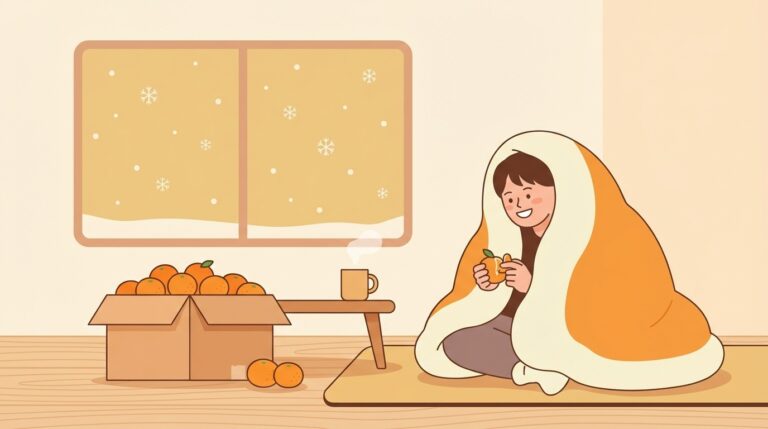
Phase 1: The Cozy Confession
Hello! I’m your Daily Hangul lead editor.
Let’s set the scene: You’re watching a classic K-Drama set in the winter, maybe something nostalgic like Reply 1988. The characters are sitting on the living room floor, legs tucked under a thick blanket. Right in the middle of them is a massive, slightly beaten-up cardboard box. What are they doing? They are peeling and eating gyul (Jeju tangerines) at the speed of light.
If you live in Korea during the winter, you’ll quickly realize that buying a few apples or a bunch of bananas is normal, but tangerines? You buy them by the 5kg or 10kg box. It’s an unspoken winter rule.
As a tutor who has spent over a decade in Seoul, I’ve seen so many expats get confused when their Korean friends randomly hand them three tangerines out of nowhere, or when their fingertips start turning slightly yellow in January. Today, we aren’t just learning vocabulary; we are mastering the cozy, lazy, and utterly delicious art of Korean winter survival.
Phase 2: Core Expressions for the Winter Hibernation
Let’s dive into the essential expressions you need when you’re trapped under a blanket with a box of citrus.
1. 이불 밖은 위험해
- Pronunciation: ibul bakkeun wiheomhae [ee-bool bah-kkun wee-hum-heh]
- Meaning: (Literal) It’s dangerous outside the blanket. / (Real nuance) It’s too cold to go out; staying in bed is the only safe option.
- K-Culture Moment: This is the ultimate Korean winter meme. When your friends text you on a freezing Friday night asking to meet in Hongdae, you send them a picture of you under a blanket with a tangerine, accompanied by this exact phrase.
- Editor’s Insight: It’s dramatic, it’s cute, and it’s highly relatable. It perfectly captures the desire to stay glued to the ondol (heated floor).
- Situation Spectrum:
- Casual (Friends): ✅ Perfect
- Semi-formal (Co-workers): ⚠️ Okay if you’re close and joking.
- Formal (Boss/Elders): 🚫 Too meme-like.
- 🤔 Think About It: Why does Korean culture have such specific phrases for avoiding the cold? Think about the traditional ondol heating system where the floor itself is the heat source. Once you sit down, you physically don’t want to get up!
2. 귤 한 박스 순삭했어요
- Pronunciation: gyul han bakseu sunsakhaesseoyo [gyool hahn bahk-su soon-sahk-hess-uh-yo]
- Meaning: (Literal) I instantly deleted a box of tangerines. / (Real nuance) I polished off/devoured a whole box of tangerines in a flash.
- K-Culture Moment: You’re back at the office after the weekend. Your coworker asks what you did. You sigh, look at your slightly yellow fingers, and deliver this line.
- Editor’s Insight: Sunsak (순삭) is a B2-level slang term combining 순식간 (instant) and 삭제 (delete). It’s widely used for food, time, or even your paycheck!
- Situation Spectrum:
- Casual (Friends): ✅
- Semi-formal (Co-workers): ✅ (Very commonly used among younger professionals)
- Formal (Boss/Elders): 🚫 Stick to “다 먹었어요” (I ate it all).
- 🤔 Think About It: “Deleting” food is an interesting concept born from internet gaming culture. How does your native language express eating something incredibly fast?
3. 손이 노랗게 될 때까지 까먹다
- Pronunciation: soni norake doel ttaekkaji kkameokda [so-nee no-rah-keh dwel tteh-kka-jee kka-muk-da]
- Meaning: (Literal) To peel and eat until your hands turn yellow.
- K-Culture Moment: This is the universal badge of honor for Korean winter. Because Jeju tangerines are so addictive, Koreans joke that the beta-carotene actually tints your fingertips yellow by January.
- Editor’s Insight: Note the verb kkameokda (까먹다) – it means “to peel and eat.” (It also means “to forget,” so context is key!)
- Situation Spectrum:
- Casual (Friends): ✅
- Semi-formal (Co-workers): ✅
- Formal (Boss/Elders): ✅ (It’s a harmless, relatable cultural observation).
Phase 3: Textbook vs. Real Korean
| Situation | 📖 Textbook Korean | 🗣️ Real Korean | 💡 Why the difference? |
|---|---|---|---|
| Explaining you ate them fast | 귤을 아주 빨리 다 먹었어요. (I ate the tangerines very fast.) | 귤 한 박스 순삭했어요. (I instantly deleted a box.) | Gamification of language; young Koreans love shortening words for efficiency. |
| Refusing to go out in winter | 날씨가 너무 추워서 집에 있을 거예요. (I will stay home because it’s cold.) | 겨울엔 이불 밖은 위험해요. (It’s dangerous outside the blanket.) | Memes and internet culture heavily influence everyday spoken Korean. |
| Handing someone a tangerine | 귤 하나 드시겠어요? (Would you like to eat a tangerine?) | 자, 비타민 충전! (Here, vitamin recharge!) | Koreans love connecting food to health/wellness casually. |
Phase 4: Cultural Context — K-Culture Deep Dive
4-1. Non-verbal Nunchi & The Art of Sharing
In Korea, you rarely eat a tangerine alone if someone is sitting next to you. If you peel one, you automatically offer half to your friend, or at least offer them an unpeeled one. If you are eating from a shared box and there is only one tangerine left, Nunchi (눈치) kicks in. You never just take the last piece without offering it around first. “누구 이거 먹을 사람?” (Anyone want this?) is the polite protocol.
4-2. The K-Drama Trope: The Ondol Trap
Have you ever noticed in K-Dramas that even if a house has a fancy sofa, the characters are sitting on the floor leaning against the sofa? This is the power of Ondol (온돌), Korea’s traditional underfloor heating.
During winter, the floor is the warmest place in the house. Families will drag their thick blankets (이불 – ibul) to the living room floor, turn on the TV, and place a box of tangerines in the center. Once you are in this “Ondol trap,” getting up to get a glass of water feels like an impossible mission. The person sitting closest to the kitchen becomes the designated servant for the night!
Phase 5: Real-life Roleplay Scenario
Setting: It’s a freezing Saturday night in Seoul (minus 10 degrees!). You are at your shared apartment with your Korean roommate, Minji. The living room floor is boiling hot. You both are under a thick blanket, and a 5kg box of Jeju tangerines sits between you.
Characters:
– YOU: An expat who was supposed to go out to Itaewon tonight.
– Minji (28): Your roommate, currently wearing fuzzy sleepwear and aggressively peeling her 5th tangerine.
Dialogue:
Minji: 밖은 영하 10도래. 오늘 이태원 간다고 하지 않았어? 🥶
(bakkeun yeongha sipdorae. oneul itaewon gandago haji anasseo?)
[They say it’s minus 10 degrees outside. Didn’t you say you were going to Itaewon today?]
YOU: 취소했어. 도저히 못 나가겠어.
(chwisohaesseo. dojeohi mot nagagesseo.)
[I canceled. I absolutely can’t go out.]
Minji: 잘했어. 역시 겨울엔 이불 밖은 위험해. 자, 귤이나 먹어. 🍊
(jalhaesseo. yeoksi gyeouren ibul bakkeun wiheomhae. ja, gyurina meogeo.)
[Good job. As expected, in winter, it’s dangerous outside the blanket. Here, have a tangerine.]
(🎭 Stage Direction: Minji tosses you a perfectly ripe tangerine)
YOU: 고마워. 근데 우리 이 박스 어제 사지 않았어?
(gomawo. geunde uri i bakseu eoje saji anasseo?)
[Thanks. But didn’t we buy this box yesterday?]
Minji: 응. 벌써 반이나 먹었네. 완전 순삭이다.
(eung. beolsseo banina meogeonne. wanjeon sunsagida.)
[Yeah. We already ate half of it. It’s totally disappearing in a flash.]
YOU: 이러다가 내일이면 다 먹겠는데?
(ireodaga naerimyeon da meoggenneunde?)
[At this rate, we’ll finish it all by tomorrow?]
Minji: 내 손 봐봐. 벌써 노랗게 변하는 것 같아. (Laughs)
(nae son bwabwa. beolsseo norake byeonhaneun geot gata.)
[Look at my hands. I think they are already turning yellow.]
YOU: (Looking into the box) 앗, 맛있는 귤은 다 먹고 이제 하나 남았네.
(at, masinneun gyureun da meokgo ije hana namanne.)
[Ah, we ate all the good ones and now there’s only one left.]
🔀 Your Turn! How do you handle the last tangerine?
– A) (Grab it quickly) “이건 내 거야! 잘 먹을게!” (This is mine! Thanks!)
– B) “민지야, 너 먹어. 내가 까줄까?” (Minji, you eat it. Shall I peel it for you?)
– C) “마지막 귤이네. 반씩 나눠 먹을까?” (It’s the last one. Shall we split it in half?)✅ Best Choice: C — Splitting the last piece is the ultimate display of Korean Jeong (affection) and good Nunchi.
⚠️ Choice A Analysis: While funny among very close friends, taking the last piece of food without offering is generally considered a minor social foul in Korea.
🎭 Bonus K-Culture Roleplay: The Market Vendor
Setting: You go to a local traditional market (like Mangwon Market) to buy your winter stash.
Vendor: 아가씨(총각), 제주 감귤 엄청 달아요! 맛보고 가요! (Miss/Young man, Jeju tangerines are so sweet! Have a taste!)
YOU: 한 박스에 얼마예요? (How much for one box?)
Vendor: 만 오천 원인데, 내가 덤으로 몇 개 더 넣어줄게! (15,000 won, but I’ll throw in a few extra for free – Deom!)
Phase 6: 10-Second Shadowing Drill
Read this aloud to practice your natural rhythm and intonation!
😊 겨울에는 / 이불 속에서 / 귤 까먹는 게 / 최~~~고예요!
(gyeoureneun / ibul sogeseo / gyul kkameongneun ge / choe~~~goyeyo!)
[In winter, eating tangerines under the blanket is the absoooooolute best!]
Pro Tip: Stretch out the ‘최 (choe)’ slightly to emphasize how amazing it is!
Phase 7: K-Culture Mini Dictionary
| Korean | Romanization | English | Contextual Meaning |
|---|---|---|---|
| 귤 | gyul | Tangerine/Mandarin | The undisputed king of Korean winter fruits, mostly from Jeju Island. |
| 뀰 | kkyul | Honey-tangerine | Slang combining 꿀 (honey) and 귤 (tangerine) to describe an incredibly sweet tangerine. |
| 덤 | deom | Extra / Freebie | A beautiful market culture where vendors give you a little extra for free out of good-heartedness. |
| 까먹다 | kka-meok-da | To peel and eat | Used for fruits with skins (tangerines, bananas) or nuts. Also slang for “to forget.” |
| 온돌 | ondol | Heated floor | Korea’s traditional underfloor heating system that makes floors irresistible in winter. |
Phase 8: Traveler Survival Kit
If you are visiting Korea in the winter, you must visit a local mart or traditional market to buy fruit.
🆘 Survival Phrase #1: Buying in Bulk
– 🇰🇷 “이거 한 박스에 얼마예요?” (igeo han bakseue eolmayeyo?)
– 🗣️ English Sound: [ee-guh hahn bahk-su-eh ul-mah-yeh-yo?]
– 📍 Where to use: Traditional markets, street fruit trucks.
– 💡 Pro Tip: Don’t buy tangerines at convenience stores; they are too expensive! Go to a neighborhood supermarket (마트 – mateu) or a street vendor truck.📌 Editor’s Travel Note
– The ‘Deom’ Culture: If you buy fruit at a traditional market, don’t be surprised if the vendor tosses two or three extra tangerines into your bag after you pay. That’s Deom (덤), a gesture of Korean warmth and appreciation!
– Trash Disposal: Tangerine peels are considered Food Waste (음식물 쓰레기) in Korea, NOT general trash! Make sure you throw them in the correct designated food waste bags.
Phase 9: Critical Thinking Corner — “A Step Deeper”
Food & Identity: The Concept of ‘Jeong’ (정)
Why do Koreans buy tangerines in massive 5kg boxes instead of just a small bag for themselves? It ties deeply into the concept of Jeong (정)—the Korean cultural fabric of collective social affection. Food in Korea is rarely meant to be consumed in isolation. Buying a large box means you intend to share it: you’ll bring a handful to your coworkers, offer some to your roommate, or pass them to guests. The act of peeling a tangerine and handing half to the person next to you is a quiet, non-verbal way of saying, “I care about you.”
💬 Your Turn:
Does your culture have a specific winter food that is meant to be shared in large quantities? Tell me about it in the comments!
Phase 10: FAQ & Avoiding Common Mistakes
Q: Can I take my tangerines into a cafe to eat?
No! While it’s tempting, Korean cafes have a strict “No Outside Food” (외부 음식 반입 금지) policy. Save them for the ondol floor!
Q: Is it polite to hand a tangerine to my boss with one hand?
If you are offering fruit to someone older or higher in status, always use two hands (or support your right arm with your left hand) when passing it to them.
❌ Common Mistake:
Saying “귤을 순삭했어요” to your Korean boss or professor.
✅ Do This Instead:
Sunsak is slang. With elders, stick to the standard: “귤이 너무 맛있어서 금방 다 먹었어요” (The tangerines were so delicious, I ate them all quickly).
Phase 11: Summary & Action Items
One-Liner Summary: Winter in Korea means surviving the cold by staying under a blanket on a heated floor, instantly deleting (sunsak) boxes of Jeju tangerines until your hands turn yellow.
Action Mission:
– 🥉 Bronze (Solo): Say “이불 밖은 위험해” out loud the next time you refuse to get out of bed on a cold morning.
– 🥈 Silver (Online): Post a photo of your favorite winter snack on your social media and caption it using the word “순삭” (e.g., “Hot chocolate 순삭 ☕️”).
– 🥇 Gold (Real Life): If you are in Korea, go to a local market, point to a box of tangerines, and ask “한 박스에 얼마예요?”
K-Culture Mission: Next time you watch a winter K-Drama, look closely at the living room scenes. I guarantee you will spot a box or basket of tangerines within the first three episodes!
Phase 12: Interactive Quiz
1. You are staying in on a snowy day. Your friend texts you to come out for drinks. What is the most culturally witty Korean reply?
A) 미안, 나 귤 까먹고 있어. (Sorry, I’m eating tangerines.)
B) 이불 밖은 위험해. (It’s dangerous outside the blanket.)
C) 날씨가 너무 추워요. (The weather is too cold.)
(Answer: B! It perfectly conveys your cozy, lazy winter mood in a humorous way.)
2. Fill in the Blank:
“The movie was so good, the 2 hours felt like they disappeared instantly! 2시간이 완전 [ ]이었어!”
(Answer: 순삭 – sunsak)
3. True or False – K-Culture Edition:
In Korea, you should throw tangerine peels into the general trash bin.
(Answer: False! Tangerine peels are organic and must go into the food waste bag – 음식물 쓰레기 봉투).
Frequently Asked Questions (FAQ)
Q: What does "이불 밖은 위험해" mean in Korean and how do you pronounce it?
A: In Korean, "이불 밖은 위험해" is pronounced [ibul bakkeun wiheomhae [ee-bool bah-kkun wee-hum-heh] and means: (Literal) It's dangerous outside the blanket. / (Real nuance) It's too cold to go out; staying in bed is the only safe option.
Q: What does "귤 한 박스 순삭했어요" mean in Korean and how do you pronounce it?
A: In Korean, "귤 한 박스 순삭했어요" is pronounced [gyul han bakseu sunsakhaesseoyo [gyool hahn bahk-su soon-sahk-hess-uh-yo] and means: (Literal) I instantly deleted a box of tangerines. / (Real nuance) I polished off/devoured a whole box of tangerines in a flash.
Q: What does "손이 노랗게 될 때까지 까먹다" mean in Korean and how do you pronounce it?
A: In Korean, "손이 노랗게 될 때까지 까먹다" is pronounced [soni norake doel ttaekkaji kkameokda [so-nee no-rah-keh dwel tteh-kka-jee kka-muk-da] and means: (Literal) To peel and eat until your hands turn yellow.







